Category Archives: Blog


Merely noticed this quote on another blog, and reproducing it:

“I gotta tell you, I just think to look across the room and automatically assume that somebody else is less aware than me, or that somehow their interior life is less rich, and complicated, and acutely perceived than mine, makes me not as good a writer. Because that means I’m going to be performing for a faceless audience, instead of trying to have a conversation with a person.”

I still consider BAFFLING that the name of Charles Manson still today evokes the idea of the most terrible and dangerous serial killer in US history. A figure not even remotely comparable to the recent true horror in Aurora, Colorado.

Yet the name Charles Watson, the one who was actually responsible of the murders attributed to Manson, is essentially unknown. He is still in jail, like Manson, but operates through friends a disconcertingly named site: aboundinglove.org

Yet, no matter what theory you can decide to embrace, Charles Manson never killed ANYONE. This is the only uncontested truth in the whole thing, but almost no one knows it because the image of the serial killer was superimposed on him. I wonder how a country can live and prosper upon such a skeleton, but then I also think that every country does. Every country has its own dismaying skeletons, terrible crimes and abuse of power in the name of some greater good that is wielded like a weapon.

The most dreadful aspect in this thing, a real assault on truth and freedom of speech, is that Manson was found guilty of “conspiracy” (so not serial-killing). But he’s known as serial killer for the media and general public because in America’s law system there’s a rule that basically says that planning a crime is equivalent to performing it. So if you tell someone to go kill someone else, and he goes and does it, both of you are guilty of murder. Hence Manson “inherited” crimes performed by others who claimed of having done them by following Manson’s instructions.

This gets real dangerous the more you get closer to the blurry edges: say you are a writer or a musician. You write a text that is highly symbolic and ambiguous. Some maniac reads it and interprets it in his own foolish way and then proceeds to commit crimes in YOUR name. Because he claims he simply follows those messages that were hidden in your work. So next you find yourself in jail, with a death sentence.

You may consider my example extreme and totally unplausible, but this is a big theme. I was discussing it when trying to defend R. Scott Bakker from the assault of the followers of RequiresHate internet cult. This was my message on abstract, describing another of those fanciful scenarios that look completely impossible, but that become more possible with every passing day (as long the blurry edges aren’t cleared):

Let’s try an experiment and COMPLETELY switch the context so that it is cleared of all pre-existing judgements:

Let’s say I’m a movie director who decides to make a documentary on the horrors of Hiroshima. I want to show the deaths and the consequences of the bomb, the radiations, the mutations that the people had to cope with along many years. In order to achieve this, I want to make it shocking. I want to show the real images of that horror, without any censorship and without employing a consolatory narrative filled with feel-good rhetoric. I want it to be a punch in the gut so that who sees it won’t easily forget it. Like a memory scar, because some things shouldn’t be allowed to be forgotten, especially if painful.

So the movie is indeed very crude. It comes out and one day a random guy goes to see it. When he comes out he makes the following statement: “This documentary shows the obsession that the director must have had with Hiroshima for a very long time. You can even find implicit traces of it in all his previous works. It is evidently an endorsement for war and slaughter as everything is shown in a so inhuman way that no one sane could have sustained. By showing only Japanese victims it reveals an hidden racist vein, imparting systematically that violence on a specific race, without any mention of similar tragedies that happened in history. The images of the mutations are so crude that they could be described as pornographic and I can imagine the director having edited this while masturbating to them. The whole thing is like an ode to that slaughter, filled with nostalgia as if it was some great event that he’d like to reenact in some way. He is a very sick, deranged person that should seek medical attention, and a real danger to us all.”

Now obviously, being the director, I can’t feel offended by this, nor I should defend my work and its actual purpose I tried to achieve with it.

Instead I should say: “I’m dismayed to hear that guy’s declarations. I can now see clearly what I’ve done. Evidently that spectator was able to reach a so deep insight that he opened a window into my subconscious and reveal what I truly wanted all along, but that I’m too scared to accept. Yes, I am a sick man and now detest myself. Help me, I need medical attention, or I may hurt someone for real if that part of my subconscious takes over me.”

–
Now simply answer me: do you find anything wrong with that?

This theme even returns in the last interview with Erikson I linked in the previous post, but he only circles around it by saying that the possibility of misunderstanding and misinterpretation can lead to self-censorship and that he kinda tries to address this by having a moral positive subtext. But the theme of responsibility is a big open wound, and one that isn’t easily treated at all. I have no answers myself because I recognize both the responsibility AND the right to express yourself without restraints. Because I believe that any form of censorship only exacerbates the problem and is never a solution.

In the case of Manson the man was used for a social function. Made into a symbol that he didn’t seek himself, but that was needed by the American culture to put a brake to the dissolution it was falling in. Manson was made into an example. Communities of hippies, that were becoming a REAL risk to the integrity of America’s social structure, with their free drugs and licentiousness, became criminalized.

This was the story that was needed to steer the masses back into control. The most absurd conspiracy theories were fabricated and attributed to Manson, who could only “play” the demon that was painted on him. He was indeed a shaman. He accepted the role, becoming a victim so that he could exorcize America of the crimes it was responsible of. He was made, simply, into a scapegoat. A sacrifice.

I have no idea if there was value in Manson, the man. Because what arrived to us is only Manson the demon. He’s not a myth of mine, but I do find a certain depth in the things he said to the jury when he was allowed to speak for more than an hour, freely.

Manson surely wasn’t a kind, lovable man. But he also wasn’t a murderer (even less a serial-killer). This is a fact. You can then guess whether or not he was a conspirator who sent his men to commit the murders. No one can say for sure because these things are always ambiguous, but if you were to read the details you’d be aware of how absurd, illogical and implausible was the accuse, and how linear and significant was the alternative theory that never had a chance to be brought up in the trial. This doesn’t make anything CERTAIN, but it should be enough to rise legitimate doubts.

The alternative theory is that this story was a cover-up to something big that was happening and that caused the murders. A cover-up made with the complicity of the police. It was related to the Mafia, the drug distribution and rival clans that competed for the “high places”. It is likely that the Mafia at the time had a VERY strong grasp on the whole Hollywood ambient, and the drug rings that circled around it. Manson, the artist, poet, musician, was the weirdo hippie that was often celebrated and invited into these parties of celebrities.

But the state wasn’t interested in the shadow of the Mafia and its pervasiveness in all things, it was interested in Manson, the symbol of a counter-culture threating the status-quo. It took three months before Manson’s name was brought up and linked to these murders. Three months to fabricate the story exactly as it was needed. Obviously, the role of the mafia in these murders was completely hidden, and Manson considered the only responsible, organizing a conspiracy entirely based on hidden messages heard by playing The Beatles’ records backwards. True story. The official story. The story that could fire the imagination of the media and general public, a perfect cliche of satanism mixed with rock bands and sensationalism. The story that many people wanted to be true, and made it so. Sometimes I wonder, regardless of which country you live in, if the “law” is only a thin coat of paint laid upon a huge rotten core. I know that in Italy where I live we had and maybe still have similar problems, with the Mafia deeply rooted into the economy and the politics, possibly replacing what is usually called a “state”.

To add color to folklore there’s also this little true trivia: the judge in Manson’s trial liked to go in the court room with a gun holstered under his dress.

But the most baffling thing I noticed and that gave me the motivation to bring this up again, is that I found out that the fancily named (and famous, since he wrote a book that made a lot of money, something I don’t think is exactly morally acceptable on such a theme and direct involvement) Vincent Bugliosi, the Manson’s prosecutor, and the one who came up with the most absurd conspiracy theory even conceived (and fabricated), wrote in 2008 a book of 1612 pages (!!!) on Kennedy’s assassination. Claims this is his “magnum opus”, like something he should be proud off.

He puts a bombastic title on this ultimate work of his: “Reclaiming History: The Assassination of President John F. Kennedy”

Reclaiming history.

In his career at the L.A. County District Attorney’s office, he successfully prosecuted 105 out of 106 felony jury trials, including 21 murder convictions without a single loss. His most famous trial, the Charles Manson case, became the basis of his classic, Helter Skelter , the biggest selling true-crime book in publishing history.

Notice that the book on Manson was titled “The True Story”. Just to make sure his readers don’t incur into doubts.

Reclaiming History: The Assassination of President John F. Kennedy was a New York Times bestseller and has been heralded as “epic” and “a book for the ages.” HBO, in association with Tom Hanks’ PlayTone Productions, will be producing this as an eight-hour miniseries in 2013, the 50th anniversary of the Kennedy assassination.

Quoting:

“Unless this fraud is finally exposed, the word believe will be forgotten by future generations and John F. Kennedy will have unquestionably become the victim of a conspiracy. Belief will have become unchallenged fact, and the faith of the American people in their institutions further eroded. If that is allowed to happen, Lee Harvey Oswald, a man who hated his country and everything for which it stands, will have triumphed even beyond his intent on that fateful day in November.”

John F. Kennedy, the victim of a conspiracy.

I really can’t understand how the man who fabricated the most insane, absurd and convoluted conspiracy theory ever (to pin on Manson and give the media the colorful story they needed), can so candidly affirm that nothing happened with Kennedy’s assassination. A fool just shot the president. It happens.

That’s your story. That’s your country. That’s the bones you crunch underfoot. Live and prosper, swimming in truth. And sleep well.

P.S.
Interesting idea: Charles Manson as a mhybe (sorry Erikson, for perverting your idea). An empty vessel. Something you slice away from you and project/inject in it the worst of you. To then banish it and feel purified.

And a bit of Malazan and Prince of Nothing too (men are ever deceived).

Anyone noticed a number of plot points shared? I’ll go through some spoilers assuming you’ve seen both Fringe and Final Fantasy 13 (and a bit of 13-2). Some of these things I have commented already.

Despite the 13 being the worst Final Fantasy gameplay-wise, it has a wonderful setting, with a great story and the best mythology in the series. Some themes even in common with Malazan, like the relationship between gods and human beings, and the number of times a revelation completely overturns what you believed up to that point.

The setting is essentially split between two worlds, Pulse is the huge earth-like world that is wild, filled with weird creatures and other colossal monsters roaming around. And Cocoon, that is a smaller planet hovering in the sky within Pulse’s atmosphere. Human beings live here nourished and protected by their gods, who also keep Cocoon afloat.

Cyclically Pulse sends up an attack to Cocoon, and Cocoon’s gods “mark” some human beings of choice to defend them from the attack. If they fail they get turned into mindless, misshapen monsters, if they succeed, they get turned into crystals for eternity (such a great reward for being your god’s bitch). FF13 begins during one of these attacks, with a chunk of the population of Cocoon being “deported”, since they suspect someone may be “contaminated” (by Pulse gods, marking some other human beings on Cocoon).

In the beginning of the game the party is split between characters marked by Cocoon gods, and two (Vanille, Fang) by Pulse gods. Only they get together because of a chain of events and some complicate misdirection and manipulation going on. With a wicked touch of genius: the trope of the naive, airhead girl is subverted by this girl doing most of the manipulation, “steering” around the other characters by relying on the fact that no one takes her seriously (including the player, who’s caught in this subversion). By playing the naive, totally clueless girl that she appears, she candidly drives the party.

Much later in the game not only it is revealed that the girl herself knew very little and was also being manipulated and used as a pawn in a larger plan, but that the party had been constantly followed by an “invisible hand” that nudged them onward, kept them on their course and even helped them at crucial moments, literally saving their life. All the while, though, the characters were ALWAYS convinced of following their own will, their morals, fighting for freedom and other noble ideals with lots and lots of self proclaimed rhetoric that was used to establish the characters as REAL HEROES. That amusingly never knew what they were doing for all the 60 hours the game lasted, wrongly “appropriating” the responsibility and merit of their actions, up to the final scenes, until the control is almost symbolically wrestled out from the player and the last CG sequence starts.
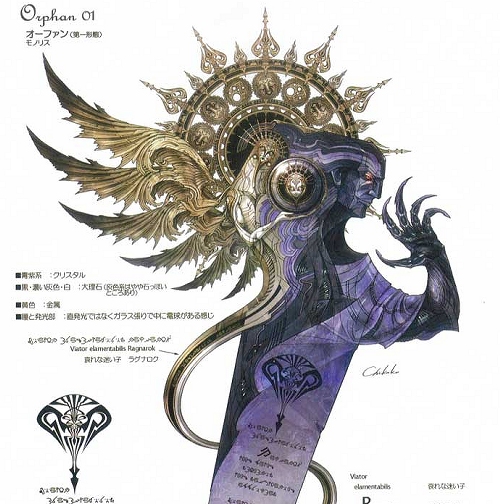
In truth, it was a god called Barthandelus who drove the plot like a supreme Deus ex Machina, making the characters believe they were responsible of their own actions when they were just being manipulated and ended up acting in predictable ways (doing every time exactly what Barthandelus wanted, while believing instead they were going AGAINST him, the goons).

The first revelation was: the gods weren’t keeping human beings in Eden-like Cocoon because they were benevolent, but because Cocoon was something like a FARM. They were only getting human beings prepared and fattened, so that they could then mercilessly MASS SLAUGHTER them at once. Such lovingly gods. Their goal was about opening a sort of portal, that the mass sacrifice would have triggered, and so forcefully pull back in the physical world the primal god that was responsible for creating the world and the gods themselves (the MAKER), but that ended up abandoning them all to their own sad destiny (one of the gods is appropriately named “Orphan”).

The second revelation was: Barthandelus was manipulating everything, and subverting even the plan itself. It was not anymore about opening a portal to pull the MAKER this side, but about the world being destroyed so that Barthandelus could himself abandon it and travel over, through the portal, to the side where the MAKER is. First FRINGE analogy: this reminds me when William Bell actually decides to destroy two worlds so that he himself could cross over and make his own. Same as Barthandelus, destroying two worlds so that he could gain access to something new (after having manipulated all characters for a whole season/game behind the scenes to align perfectly to his will).

At the end of the game Barthandelus is (predictably) defeated, but the characters continue being stuck to his plan. In fact they end up fighting Orphan, the god that sustains Cocoon. When Orphan is defeated, the game ends with a CG sequence. Cocoon starts to plunge toward the earth/Pulse. It’s the end of the world as Barthandelus planned it (even if he’s not there to rejoice). But in the end Fang and Vanille sacrifice themselves, transform into a pillar of crystal and prevent Cocoon to crash on Pulse. Eventually the survivors move down on Pulse and settle there, everyone living happily ever after.

Something like the end of Fringe season 3. The two worlds originally separated and fighting each other finally linked by a bridge/crystal pillar. Only that Lightning/Peter gets ERASED from the timeline by all seeing being(s) called Etro/Observers. But it’s not over, because while everyone else has forgotten about Lightning/Peter, her sister still does remember her thanks to the power of love™.

So begins Final Fantasy XIII-2. Due to the big fuckup of Etro/Walter trying to save Lightning/Peter and messing the timeline, all the timelines/worlds now are in collision and merging. There are anomalies all over, and the game will be about fixing this stuff. Being helped by Lightning that in this case is out of the timeline and can see past and future, sending her agents around.

Deja-vu.

P.S.
The ending of Final Fantasy 13 is a wonderful ANTI-Final Fantasy going right against all forms of conventional storytelling, only doing it so subtly that no one ever notices. The game does to you, the player, what Barthandelus did to the characters through the whole game. The ending, lavished with typical Final Fantasy rhetoric, makes the player believe that the characters of the game succeeded and survived because of their own strength as human beings, their uncompromising values, heroic efforts and so on. But the truth is that a god was watching this whole thing and found it so melodramatic and pathetic that she took pity of them (actually it’s shame, since this god was originally responsible for creating humanity) and decided to save them (another literal Deus ex Machina). The most amusing part is that she was so pitiful that she kept herself completely hidden and let the characters believe that they saved the day on their own without receiving any help.

Must keep them happy, and ever deceived.

P.P.S.
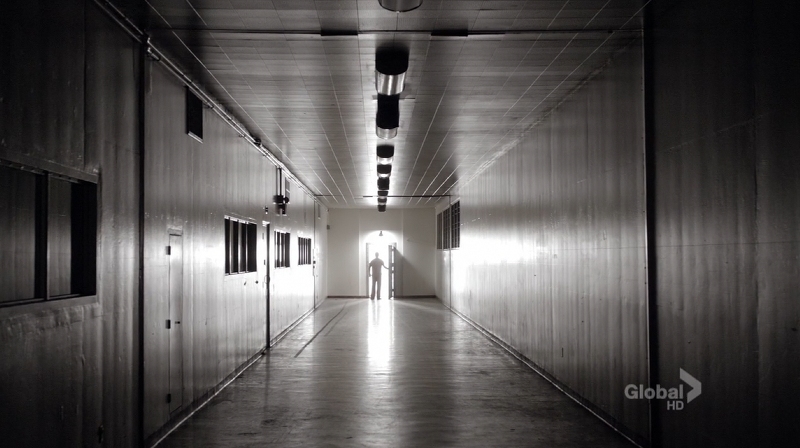
You can actually push this to another level. The game mirrors its own message. Final Fantasy 13 is the game in the series where the player has the least control. It’s completely (and horribly) linear and on rails. You go through the whole of it as if going down a narrow corridor. See the irony? As if: the player has no control, mimicked by the characters having no control of their own actions within the frame of the story.

The post-modern game of framing can go on: in Scott Bakker’s work the message is precisely that you don’t have the control you think you have and that you’re only hopelessly and deeply deluded. Your life is strictly not different than watching a cutscene in a game, you’ve literally as much control even if you keep taking credit of your actions and showering yourself with praise. Now I don’t know if Motomu Toriyama wanted the game to send this message, but it certainly allows to be read that way. Or more likely: Toriyama mirrored as much real life as to have unwillingly carried some of its bleak truths.

This is a retro-dated post so it’s kind of invisible for the main site, and that I’ll use a placeholder for cesspit.net comments on roguelike development. This because comments are disabled on that site, and I can manage them better over here.

I don’t actually expect there will be comments, but this will be the place in case the need arises.

Heat is defeating all my attempts at making my brain work and write about something interesting. So I watch lightweight TV series (Bunheads is fantastic) and play roguelikes (ADOM, Cataclysm, though the best reputation goes to Crawl), and the Goldbox Megacampaign.

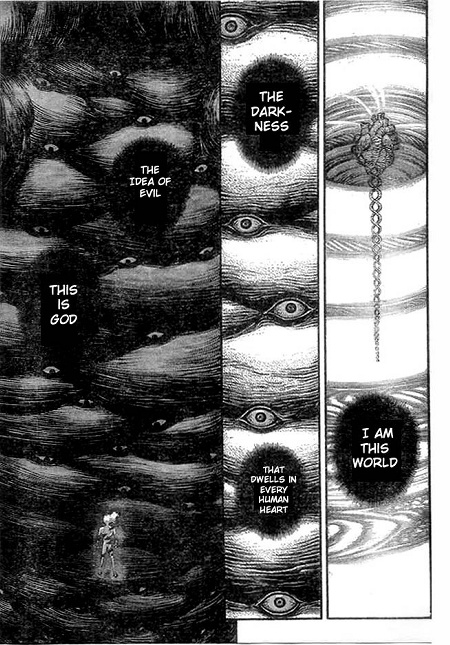
Since I was reading some review of the anime movie of Berserk, I looked up the wikipedia to see if the manga made some progress (it really didn’t) and noticed an old chapter that was removed from the main series titled “God of the Abyss (2)”. It was described as a mythological/cosmological chapter, so quite interesting.

I was able to find it here. The cues should be obvious. It seems everyone loves Jung’s Collective Consciousness. And extremely connected with both the interpretation of the Malazan mythology, as well as ours (as in: “The Wayward Mind” the book I’ve mentioned so many times). This one is obviously a rather simplistic take, but interesting nonetheless. I thought the idea of the heart in the whirlpool of consciousness is a fitting image. Follow the link for the rest.

There are also some interesting interpretations (give it a look even if you never heard of the manga):

“Conscious consent means little to me when you’re dealing with cosmic affairs on a mass scale since the conscious mind is only a tiny fraction of the total being. If the majority of the self (the sub- and un-conscious) gave consent, that’s consent to me.”

“It doesn’t matter to me if the world humans wished into existence is nice, or happy, or dangerous. The only thing that matters to me is that they got what they wanted, and can use the same mechanism to change it as they did to create it. … it’s a marvelous self-adjusting system.”

When you pick up a TV series you never know where it’s going to end up and if it will pay off. When you watch shows that play with mythologies and mysteries these stakes are even higher, because they rely far more on the worth of the overall arcs, than the single episode. Recently, Alcatraz revealed itself as awful with the closing of its first (and last) series. It was far, far shallower and more inconsistent (in the sense it lacked substance) than how LOST was. The writers must have been crazy thinking the public would bother going through the same patterns with even more empty baits and unexplained movers. And there’s Fringe, that grew in significance and inventiveness for the first three seasons, steadily improving, but then had a fourth season that became formulaic and proceeded by rehashing the previous three, ending in so much sloppiness and predictable cliches as to not only suck by itself, but also sucking value OUT of what preceded it.

Awake is instead the kind of show that goes as close as possible to a flawless execution. I don’t know what you could have possibly have done better with it. And if I have to explain why the public abandoned it, leading to a cancellation, then I can only find motivations for its complexity and high stakes, not making for a show that can be popular. It is true that Awake also droops into formulaic episodes through its first and middle section, and so feeling like it exhausted what it had to say (Touch also relies on the protagonist following faithfully some magical hand-waving, but that one was renewed, probably because it is a lot more hypocritical and consolatory). It can definitely feel heavy and boring depending how you approach with. Yet it didn’t ignore the hooks that are needed to reach that public, and used them in the best way possible without making them artificial and not pertinent. It wasn’t made as a “esoteric” show for a small group that could appreciate its theme, but made with the actual potential to reach out for a big public. And the execution was up to this task. SO WHY? I think because the general public prefers something (a show) that is not as much ambiguous as this one. If you’re dealing with fantasy, Sci-fi and mythology, then to be successful your show needs to be neck deep into it. Recognizable at a glance for what it is. It needs to use a “language” in the way people expect, and it needs to “surprise” while never daring to come out of the set of expectation and “communicative pact”. Awake, instead, was a show based on a tension itself based on substance you can’t pinpoint. It plays with psychology, perception and reality. It necessarily brings in the metaphysics (or meta-linguistic) aspects of the medium (who’s watching? who’s reliable?). And it is made to continuously challenge your expectations about it, making it hard to frame. Is it Sci-fi? Is it just a procedural? Is he dreaming? Is he dead? What are the stakes? And so obligatory requiring a kind of public that enjoys being put constantly off balance and challenged for real. Requiring an effort to readjust, and even accept the plausibility of its premise (since an openly Sci-fi show can dare doing a lot more without its public freaking out).

So my conclusion is that Awake “failed” (to secure at least a second season) to reach its intended public solely because it deliberately decided to stay outside of a given genre, and to dance on the edges. These days brands and genres aren’t out there in the world, they are hardwired in people’s brains. If you look at commercial successes across mediums you can see that they are always of a tribal nature. Tribes require clearly marked boundaries. Commercial success doesn’t come through authentic challenge, but through identity and beliefs reinforcement. Awake targets a public that is more heterogeneous, so potentially even bigger, but fails to trigger those mechanics that start the identity-making and tribal support. It’s more self-reflexive, personal, and fails building community. Awake was made of three parts: family drama, procedural, sci-fi/metaphysical gimmick. But it wasn’t embraced by any of these three typical audiences (way too convoluted for family drama, too magical for procedural, and didn’t flirt enough with genre to fully reach sci-fi/geek audiences).

That’s what I think about “context”, now I’ll try to say something about what happened in the show specifically. So, SPOILERS, and I assume you’ve seen it all. Structurally, and before starting with subjective guesses, the plot seems to have “folded” on itself in the last episode. First Britten abandons “red” reality (falls asleep, has a number of hallucinated transitions, ends up “merging”), then he abandons the “green” one (time freezes, he exits by walking right out of the fabric after asserting control, or doubt), to enter a third one with his family now whole. So one could say the finale not only gave closure to the story, but sequentially closed thematically and factually all the doors. The real question to tackle before speculating about an explanation, is speculating about how a second season could have worked.

I’d say we can exclude that the second season would have just this third reality. The show is still founded on a “gimmick” and so we can assume it is going to continue being present. Usually these shows restart by reestablishing an idea of normalcy. It’s plausible that the “happy end” we saw was going to be a temporary thing, and not a new status quo. While it is likely the show would reestablish the twin worlds as we currently known them (one with Britten in prison, the other with him still with his job and with a somewhat better resolution). Another assumption one can make, and evidently implicit (enjoy the apparent contradiction) in what I wrote above is that this show was going to continue staying outside genre. It wants to be a psychological drama, so you weren’t going to find strange Fringe-like machinery that somehow enabled Britten to walk between worlds. Whatever explanation needs to be sought through psychological terms.

Fortunately we don’t even have to do much guesswork since Kyle Killen (showrunner) generously answered all answerable questions. The second season was going to keep the red/green split, and the new reality that is “created” in the last minutes of the finale would have ended up like a psychological “jolly” with its workings being more symbolic than factual. They planned to have Britten in prison in “red”, with Vega trying to solve the case. Eventually (before the new season end) Britten would have been released, but in the meantime while he was in “red”, separated from his wife, he would have found a romantic interest in Rex’s tennis coach on the “green” side, where he’s not in jail and free to go on with his life. This leading to the two realities diverging more and more, and so caught in that progressive break-up and psychological fragmentation foreshadowed by Dr. Lee. How it could have proceeded from that point can’t be said, since the creators wanted to keep it open-ended and fluid.

We also know that the “mechanics” of the gimmick would have stayed ambivalent/ambiguous. Neither reality is authoritative on the other, and they are planned to “sustain” both narratives. You are supposed to find good reasons why “red” is a dream while “green” the real one, as the inverse. In fact above I said that the plot folded, red into green and green into a new one. But you can as well, and even more powerfully, plausibly, invert the order and find it being solid and convincing. Britten jailed (and these scenes gave me a sense of strong claustrophobia), destroyed and without justice, not only now separated from his son, but from his wife as well. With only a possibility for a way out: his mind.

One could even try to speculate on the “first mover”, but in this case the title of the finale is particularly explicit in its declaration of intent: “Turtles all the way down”. We know that the series creators didn’t consider this mystery as the focus of their work, and that it was simply an emotional “enabler” to tell this type of story. A what-if scenario to explore. In a post-modern world the answer is that Kyle Killen is guilty of charge (of being the first mover), but I guess this explanation wouldn’t satisfy anyone. But from there you can deduce a few thing. The reality split has been dominated by an origin: the accident. We also know that the apparent resolution of the first season wasn’t going to close it, so solving the case of the accident wouldn’t have “fixed” the split itself. Nor there was going to be a different accident causing a new split through the second season.

If I had to pick a favorite I wouldn’t say that Britten ended up in a coma and dreaming everything from that point. I’d rather ideally extend the idea of the first mover. He is imagining everything, but he isn’t passing his time unconscious in a hospital room while real reality goes on unsampled. I’d rather say he’s there, in the moment of the accident, trapped in the wreck of his car. He does not know if his wife is hurt, if his son is hurt. He has fears that he projects as speculative dreams. Like Killen himself, he begins imagining what could happen. This means that the closing scene of the finale may as well be real. Maybe no one died in the accident, or one of the three, or all three. We don’t know because the “real story” stopped before that moment. We just got a time freeze, we got to explore possibilities about what could have happened, the product of imagination. The first mover is Killen as the writer of the show, and the first mover, within the frame of the story, is Britten who fears the consequences of his accident and becomes the narrator of the story. The story itself can’t be resolved, because the show “ends” before it is written (and so truly open ended, since it’s who’s watching who gets to decide how it goes). (if you watch the movie Another Earth you’ll notice how they are built with the exact same intent, and even share the car incident as the trigger for parallel worlds)

That’s one possibility, but there aren’t that many to pick from considering the restraints the show works with (as I said: no sci-fi, no fantasy). The other possibilities is that one of the true realities is eventually revealed as “true”. This can happen at any moment and be plausible. Or maybe he is in a flux of consciousness. Less about what it is that makes his perception “weird” and more about creating doubts about our own reality. How can YOU say you’re not dreaming right now? How can YOU be sure you are not hallucinating? How can you say where is “up” and where is “down” if all your references have been removed? What if you are going through those transitions between realities constantly, but your brain self-adjust without making you perceive the “jump”?

I’ve finished reading a few days ago the first book of Thomas Covenant, and I’ll write again about this, since it deals even more directly with this specific theme.

Overall I think this was an excellent show that kept all its promises and delivered aplenty. It doesn’t even suffer much from the fact it wasn’t renewed, since the arc has a more than good closure. The mythology never became as prominent as I’d have liked, but the character drama and development through the whole arc was so convincing and well done that I didn’t mind if it played a bit conservatively. It sagged some after the first couple of episodes, and they could have done a better work describing how the subconscious was working instead of making it appear as a jedi mind-trick. But the tension in the last three episodes rose exponentially. The finale is a masterpiece from beginning to end, creative and truly inspired to the very end. That’s a perfectly crafted mind-bender, pulled off with amazing competence and so much better than more discussed mystery-based shows like Fringe, Lost, Alcatraz and so on.

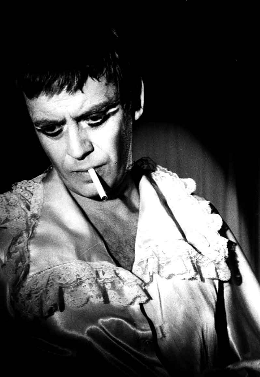
I guess most of everyone who may read this would have no idea of who Carmelo Bene is. And this is fine since he was an Italian avant-garde playwright and actor who died about 10 years ago and was probably the most important figure in Theater that we had.

I mention him here, this blog, because he was inspired by a similar sets of ideas, or beliefs. At some point he worked closely with Gilles Deleuze and was interested in the complete annihilation of the “self”, intended as a conscious entity. From my point of view he essentially represented in “art” Scott Bakker’s Blind Brain Theory. He refused to “exist” and became a rather popular figure in Italy because he was controversial and every time he appeared on TV he aroused all kinds of outrage and scandal. In particular he was accused of speaking in riddles, of nothing and being just a clever trickster who kept fooling the audience with his nonsensical, artificially shocking performances, just to draw the attention. Most of everyone was against him, he was deliberately an antagonist, and had a very troubled and animated relationships with his critics, who were continuously trying to frame him, diminish him or celebrate him, depending on their credo.

But he had a point. This is what happens when you are “misunderstood”. You keep talking of THIS, but people think it’s about THAT. Your stream of (post)consciousness goes in a direction, but everyone else is on another frequency. But when you instead understand the symbols he uses, the hooks, then the ephemeral nonsense of his words transforms into absolute clarity. He then used those ideas to speak about everything: theater, literature, philosophy, politics, his work, his private life.

His purpose, if there was a purpose, was to perform a checkmate on theater and literature. Destroy and deny everything there is, going beyond the post-modern, to some non-entity lying beyond. In order to be “there”, he had to deconstruct, not as conscious analysis, but to remove himself from the scene, to transform the voice and language in a form of non-language. In order to be there he had to “turn off the lights”. To quote Erikson again, two posts down, “look away to see”.

This is not a theory, he only works on the art, and so he only tries to represent it, give it some shape. He described himself as an “actorial machine”, he himself becoming a performance. Only by channeling some demon inside he could say something true. Get closer to the whole, the misshapen lack of identity and voluntary act.

“He considered his work to be about a “constant becoming” in a perpetual state of incompletion. Bene believed that to merely repeat the written lines of famous playwrights was to murder theater. His art, therefore, is an art of repetition through extreme variation. By experimenting with classical dramatic texts, Bene became known as a notorious destroyer of texts.”

I’ll try to translate some of his ideas to better understand what feeds the process. If you’re curious you can also see here one of his performances (it seems the whole thing can be seen here, but obviously in Italian. It’s, huh, quite NSFW). Instead I extracted some of the quotes from a TV show where he spoke directly with the public about himself and his work. The public was, obviously, badly attuned, but it made the show lively.

If someone has defined the “phonè” as a dialectic of thought, then I deny being part of it. I’m looking for the emptiness, which is the end of every art, of every story, of every world. The language of the Great Theater, incomprehensible by definition, becomes completely comprehensible on a different level of understanding, being all about the signifier, and not the signified, or sense.

Language creates failures, it is only made of black holes and failures: (quoting Montale/Nietzsche) “Only this we can now say: what we are not, what we do not want.” Who says “I say I exist, I say this” is two times a stupid. First because he believes in his self, secondly because he’s convinced of saying, and even a third time because he’s convinced of saying what he’s thinking. Because he believes that what he thinks is not signifier, but signified, a sense. That happens under his authority. It’s all noise. I think conscious intelligence is misery. I refuse to consider the ontology.

I do not speak, I am being spoken.

“The gods, plural is the noun, played yourself. The gods returned you to the mythical dawn of times. They carved you empty of simulation. Freed you of codes.”

“We are but ghost lights, representation and model. You and I, in the illusion of being. Sincerity in the lie, truth in contradiction. As truth does not exist, given only in the delirium of language.”

“Voice and language, delirium of omnipotence. Delirium because it’s not there. It does not exist.”

(talking of amplification through a microphone, in theater) The actorial machine is the consequence of the Great Actor, stripped of expressive corporeal human capabilities (vocal, facial expression, gestures, etc..) to wear an amplified attire, both visual and voiced. The voice of the actorial machine is not just a simple amplification, but an extension of the tonal range, becoming a whole. The autorial machine is a fusion between actor and machine; amplification is not a prosthesis, but a further organic extension where the voice is defined by the process. In the same way one doesn’t “have a body” but one “IS a body”, so one is or becomes amplification, equalization, etc…

This amplification is not a mere enlargement of the sound. As an example, it’s as if I’m reading this page at this distance. So I see and understand. But if I bring this page very close, the outlines begin to blur. Closer and closer till they vanish, and I see nothing. At this point, “everyone has his own visions”. What is infinitely large, as discovered in physics, corresponds to what is infinitely small. A step beyond the threshold. That’s why I make myself smaller, “so that he can augment, I have to wane”. It’s the conscious “self” that needs to get smaller. The emptying of the “I”, the abrogation of subject, and so of history. I refuse to be in history. I stepped out of thought.

Art has always been bourgeois, consolatory, idiotic, stupid, it has been especially blathering, whorish and pandering. Art has to be incommunicable. Art has only to overcome itself. That’s why it’s up to us, once we get outside ourselves, to become masterworks. Exit modality to reach the place where modality ceases to be. I can only try to explain my discomfort. I can’t engage with what’s real, what’s obvious, what’s rational. The darkness. Turning off the lights. I even hate symbolism as an artistic language. Poetry is shit. We’re still within words, trying to find a way and unable to come out. I have found in myself a desert, and I speak to the desert who’s the other, and not to someone else’s desert. I possess absence. That’s all. I am being honest because I am not myself.

Universe is one, one only. The pluriverse… is. One can’t say the pluriverse is “what’s left”. The universe is just a tiny, tiny sliver of pluriverse.

(question) What can I do to not exist?

Depose your will. Cut the strings. Will and consciousness are never good. Consciousness does not exist. Look for surrender if you can. But you can’t. You can’t find it. Because when we are not in surrender, we do not realize it. Because once we are in surrender we aren’t “us” anymore. You can’t even exploit it, because you aren’t there anymore when you are there. It doesn’t belong anymore to the dialectic, it comes before and after words.