Category Archives: Blog


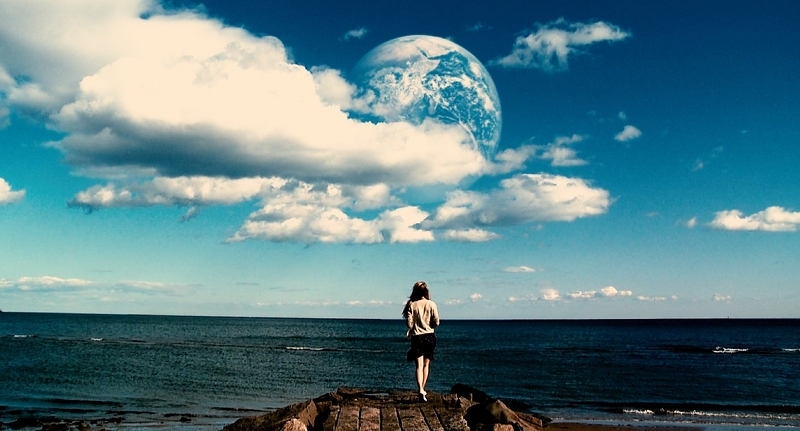
When early explorers first set out west across the Atlantic, most people thought the world was flat.
Most people thought if you sailed far enough west you would drop off a plane into nothing.
These vessels sailing out into the unknown…

We’re not real.

We’re a projection of the imagination of Earth Two.

It would be very hard to think “I am over there”…
And “Can I go meet me?”…
And “Is that me better than this me?”
“Can I learn from the other me?”
“Has the other me made the same mistakes I’ve made?”
Or “Can I sit down and have a conversation with me?”
Wouldn’t that be an interesting thing?

The truth is, we do that all day long every day.
People don’t admit it and they don’t think about it too much, but they do.
Everyday, they’re talking in their own head.
”What’s he doing?”
”Why’d he do that?”
“What did she think?”
“Did I say the right thing?”

In this case, there is another you out there.

In Plato’s allegory of the cave, the people living in the cave all they knew what was in the cave, and one day one of them gets out… and goes out and sees the real world, comes back and tells the others.
You know what happened to him?
They beat him up. They didn’t believe it.
“That can’t be,” they said.
I don’t think we’re ready to know what’s out there. It’s a bad idea.

So you’d rather stay in the cave?
I mean, if Galileo had felt that, we’d still think we’re the center of the universe, that the sun is orbiting us.
I mean- They tried to burn him at the stake for that.

Yeah, maybe they should have.
We still think we’re the center of the universe.
We call ourselves Earth One, and them Earth Two.

Within our lifetimes, we have marveled.
As biologists have managed to look at ever smaller and smaller things.
And astronomers have looked further and further… into the dark night sky, back in time and out in space.
But maybe the most mysterious of all…
Is neither the small nor the large.
It’s us, up close.

Could we even recognize ourselves?
And if we did, would we know ourselves?
What would we say to ourselves?
What would we learn from ourselves?
What would we really like to see if we could stand outside ourselves…
and look at us?

A visit to Christopher Priest’s site drew my attention to this movie (and made me bump up his book in my reading queue, so you should see “A Dream of Wessex” up there now). It’s a very good one and I recommend that you watch it.

The quotes above are extracted from the script but they may even give a wrong idea of what this movie is about. It carries its Sci-Fi “gimmick” (suddenly “another earth” appears in the sky, looking exactly as our own) well and convincingly, but the gimmick is not the point. This is a movie about characters and their stories, the focus never shifts away. It’s not like what they clumsily tried to do with Alcatraz (TV series), where they added to the standard procedural some mysterious elements as “flavor”. This isn’t a weird mix of parts that do not belong. The gimmick is instead just a point of view to observe something specific. A lens. You’re supposed to look through it, not at it.

“We structured it as a typical, straight drama, with all the reversals and character arcs, and then embedded it in this larger science fiction concept just for metaphor.”

I think it’s a movie that fulfills its goals perfectly and deals with its mystery well even if it’s not the focus. It illustrates well the distinction I make between “ambiguous” and “ambivalent”. It’s just a simplifying schema I use to define the ending of a mystery drama. Ambiguous is when you get no definite answers, what happened stays quite murky, you’re left confused and without an explanation about what went on. David Lynch, for example, usually falls in this category. And then there are ambivalent endings. These I consider much more satisfying because you’re given all the pieces to complete the puzzle. The movie is not deliberately obscure and ungenerous. The only problem is that you’re not given a definite, univocal solution. It’s open-ended. Meaning that you’re offered more than one solution to the puzzle. The movie doesn’t say which one is specifically the right one, it’s up to you to imagine the rest, you’re given this kind of power. But there aren’t parts that are missing or that you cannot properly reach, things that the director deliberately took away to prevent you to understand things as clearly as possible.

A very good quality of this movie compared to, say, Donnie Darko, is that it lacks pretentiousness and can be “held”. The end of the movie will spark a lot of questions, but you aren’t forced to watch it a second time with the hope to catch things you missed. What you need to know to understand it fully is all there. As a metaphor, its meaning is in the intent, not in the gimmick.

It’s curious because it’s part of the style of the movie too. It resembles some “found footage” movies or documentaries, where the “eye” of the camera is discreet. Giving the idea of observing objectively and passively. Yet in this movie I perceive a contradiction, since this eye is not discreet at all and is at times even invasive. See for example some conspicuous, sudden zooms. It almost seems creepy because it makes felt the presence of an observer, whose eye lingers and is precisely interested in details. It’s not a passive observer that disappears and is unnoticeable. It’s instead very deliberate. Usually I would criticize something like this, but in this context it matches the gimmick as a very deliberate and specific point of view. In this, it doesn’t pretend to be “true” or clinging to a pathetic idea of truth, but just tries to have an honest insight into this impossible situation. It’s fiction, it doesn’t pretend to be true, but it is honest.

In about a month a kind of companion work titled “Sound of My Voice” should come out in theaters in the US, I’d definitely watch it if I could.

Someone said that Sound of My Voice just keeps going deeper and deeper into more claustrophobic situations, while Another Earth just keeps going more open and open. They’re moving in different directions, and yet they’re working on something subconscious and magical.
Briefly on TV shows. The last episode of Fringe (4×14) was fine and made the plot move a bit, but it also shot itself in the foot by explaining Observers as a gimmick. I don’t think that mysteries to be effective have to stay unsolved, so it’s not that Observers were overexplained, but it just ended up a dead end not so unlike some explanations in LOST, that also sucked because they lead to nothing. Satisfying mystery “opens up” possibilities and interpretation, explains other stuff and gives it a new spin.

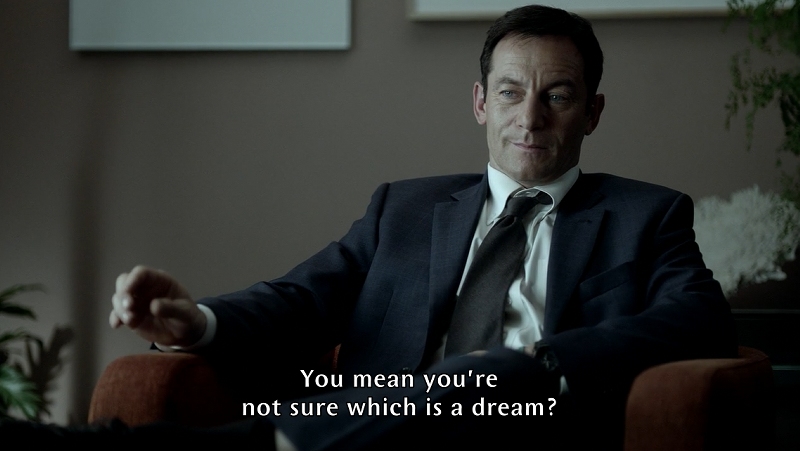
Now there’s a month break for Fringe, but I read about this new TV series, “Awake” (on NBC), that relies on a similar trick: the main protagonist is stuck between two realities and unable to figure out which one is the “dream”. I watched the first episode and it’s GLORIOUS. It plays wonderfully with its possibilities and it’s highly evocative. Way, way better than Fringe or Alcatraz. The latter feeling also like a very shallow gimmick, looking as a bad, plain procedural that moves the mystery plot in the last minute of every episode. It’s like it hits the formula for irritation.

“Awake” starts playing its cards perfectly. It doesn’t indulge in the drama of its premise as I expected, instead has it coming out of the rest. It puts the melodrama aside, and feels more authentic. It is playful with its possibilities, with the two shrinks in the two realities that try to outsmart each other. The show has a metalinguistic level that just tastes delicious, while not overshooting it into parody. The way this first episode struck a balance is already a statement of competency. I really hope the public sticks to it despite its “complexity”, because it deserves going on.

The stakes are put so it can also quickly become a disaster. Many ways that the show can take a wrong turn or lose that balance that make it feel right and plausible, but at least it got my trust solely with the pilot. Hopefully it continues to deliver.

And it’s fitting with the “groove”. I’m reading right now “The Wayward Mind”, that I ordered as soon as Scott Bakker wrote about it. I see in these pages many, many arguments that I dealt with in the past year, many fancy theories and lines of thoughts. Written so clearly so that one sees the “order” in the scheme instead of feeling lost in the myriad of sidetracks. That and Bakker’s own “The Blind Brain Theory of Consciousness” (he sent me the file he was working on) are eye-openers in ways that can’t be dismissed. Dramatic advancements for me. I almost feel like I’m understanding something. Or at least having a lot more tools to work with the problems, instead of staring at them without a clue.

So this show is like a way to relax while soaking in the same semantic level. The two realities becoming possible dreams constructed by the mind and dense with symbolic purposes. Conscious mind versus unconscious, the limits and tricks of perception. Watch this show, it plays well with its themes, manages to keep its consistency, and doesn’t seem to proceed conservatively to artificially continue as a serial with no end in sight (or so I hope).

I don’t read many mangas these days but I make exceptions for those masterpieces that set themselves apart. There are certain signature works in every medium and genre, Homunculus isn’t very much “signature” because it doesn’t seem to represent any canon, but it sets itself apart as one of those rare, significant works. It is a true masterpiece, of the kind you can count on your hands. I’m writing about it also because it’s finally complete. It’s 15 volumes, the last one came out in Japan in April 2011 and translated in English two days ago. Yes, it’s not officially licensed, but it also means that there’s the possibility to read it online, all 15 volumes for free, thanks to the work of fans who did the translation. It’s not the same experience of actually having the volumes in your hands (I read most of the volumes as they were published in Italy), but believe me that this is something you can’t miss.
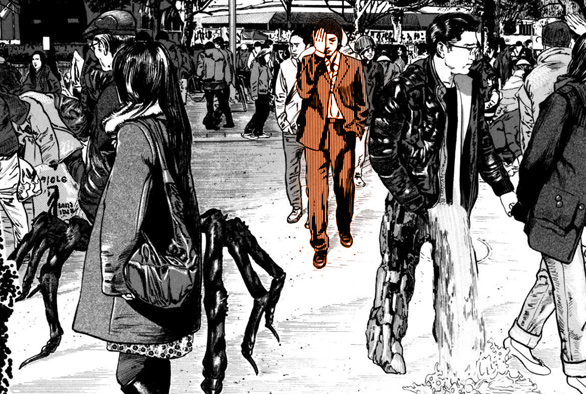
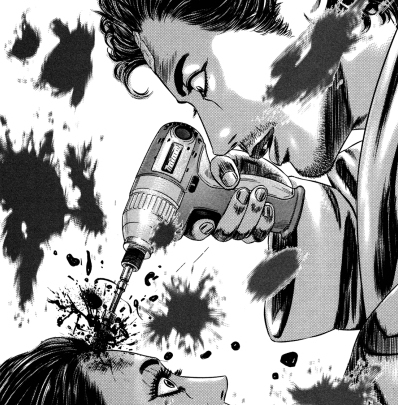
Considering the gruesome picture I decided to use one would expect some kind of brutal manga about violence or serial killers. While Yamamoto, the writer and artist, is the guy behind the more famous “Ichi the Killer”, that you may know for the movie adaptation by Takashi Miike, Homunculus is an entirely different thing. There’s not much violence, or action. It’s instead a deep psychological and metaphysical journey into consciousness. In that scene you see Nakoshi, the protagonist, trying to drill a hole into the girl’s skull. It’s gruesome, but he does not intend to kill her. It’s part of the metaphysical conceit the manga is based on, by drilling that hole you stimulate the brain to a different kind of activity, augmenting perception. In the specific case the hole allows the protagonist, by covering his right eye, to see the “truth”. To see demons, or “homunculus”, which are essentially symbolic constructs of the people he sees around himself.

They aren’t the demons “outside”, from the outer world, those typical in horror movies. They aren’t supernatural or magical. They are the demons inside, those who live truly within each of us, every day, and that we can’t exorcize since those demons are “us”. As real as everything you can touch and feel. Deep psychology and symbols, the stuff we live off. And it’s here that this manga reaches its apex. From the first to the last page, beside the single case of the premise of the trepanation, there’s nothing fantastic or that falls outside science. You’ll see all kinds of weird, freaky stuff, it flirts with the occult, but it will all be slowly explained in logical terms. Everything will be explained.

It is a masterpiece because of how it keeps the tension for 15 volumes straight, unrelenting. It’s an unbelievable crescendo that reaches the top right at the end. Truly ambitious works usually have problems finding a worthwhile ending that matches expectations and wraps up all mysteries and plots. This is an example of “flawless victory”. It does everything perfectly, with an ending I feel powerful. Recently I was discussing the difference between “ambiguous” and “ambivalent”. It’s a meaningful difference because I consider one satisfying and the other frustrating and infuriating. Ambiguous endings are infuriating, because you don’t get the answers you seek, the ending is open-ended, you’re left wondering what the authors wanted to say, you can’t come to grips with it. It’s not over and you can’t let it go, but you can’t do much with it either, because you feel like you can’t solve it, or that it was all a fraud, with no solution (hello LOST). Instead ambivalent endings are fine. They are still open-ended because you don’t get to know “exactly” a specific solution or truth, but at the same time you are given more than one specific solution. Each explaining plausibly what happened. You get your answers, mysteries are solved and explained, but there’s more than one single solution. You’re given more than one combination, but they all potentially open the lock. You don’t get to see the one that does it, but you know one of them will. The path is clear, the message delivered.

During the course of this manga, page after page, the protagonist will face the homunculus of other people that he needs to “solve”. Each is its own mystery, bound to the whole life of a real person. You’ll see stories surfacing and every single mystery about them slowly being explained. At the same time every chunk of these stories will go to build up the bigger picture, it will build up to the mystery of the homunculus. What these homunculi are, where they come from. The mystery will be revealed and the whole manga is built so that everything leads up to it. It’s a masterpiece because how every story exists on its own and yet builds up to that ultimate mystery. And it’s a masterpiece because how every single image, frame after frame, goes to acquire a symbolic meaning. Yamamoto is a genius, you’ll see the deep, meticulous research after every symbol, taking often hundreds of pages for the “descent into truth”.

“Truth” is what lurks deep down, in that pit that is the symbolic unconscious. You’ll get to see some of those truths, see their freaky shapes. All the while, remember, without any “magic”. This is the real thing.

It can be quite disturbing. But the truth rarely isn’t.

Just noticed this link on Bakker’s blog.

Quoting:

Abstract: Reasoning is generally seen as a means to improve knowledge and make better decisions. However, much evidence shows that reasoning often leads to epistemic distortions and poor decisions. This suggests that the function of reasoning should be rethought. Our hypothesis is that the function of reasoning is argumentative. It is to devise and evaluate arguments intended to persuade. Reasoning so conceived is adaptive given the exceptional dependence of humans on communication and their vulnerability to misinformation. A wide range of evidence in the psychology of reasoning and decision making can be reinterpreted and better explained in the light of this hypothesis. Poor performance in standard reasoning tasks is explained by the lack of argumentative context. When the same problems are placed in a proper argumentative setting, people turn out to be skilled arguers. Skilled arguers, however, are not after the truth but after arguments supporting their views. This explains the notorious confirmation bias. This bias is apparent not only when people are actually arguing, but also when they are reasoning proactively from the perspective of having to defend their opinions. Reasoning so motivated can distort evaluations and attitudes and allow erroneous beliefs to persist. Proactively used reasoning also favors decisions that are easy to justify but not necessarily better. In all these instances traditionally described as failures or flaws, reasoning does exactly what can be expected of an argumentative device: Look for arguments that support a given conclusion, and, ceteris paribus, favor conclusions for which arguments can be found.

I was thinking that these scenarios are consistent in the direction they all point to. Life without happiness. The more you are “aware” of the world and of yourself, the more happiness is precluded to you. Happiness can only be found in consolatory lies and story-telling. The more receptive and open you are, the more you’ll suffer. True self-knowledge only leads to despair and loss. Of everything.

You have the choice between being a lie, or nothing at all.

Fringe is one of those TV shows that I’d have never watched if it wasn’t for the fans affirming it was getting much better after the first season. The couple of episodes I watched were cliched and forgettable. It seemed like an homage to X-Files without anything worthwhile to say on its own. Homages are all good, but only as long you can also raise the stakes at some point.

Fringe did it. The second season started right at a beginning like an “all in” attempt. They pulled out all the stops and started daring. Many episodes were still weak and dull, but overall it was gaining steam and the characters strong enough that they could carry the show during the slow moments. Season 3 was even better, it felt like the writers were having fun. Still plenty of weak spots, but tolerable. The two parts ending to Season 3 was half made of suck and half made of win, in the end still keeping hopes up for a wonderful continuation.

Season 4 started… fine. Definitely a low key compared to the beginning of season 2 or 3. But at least they seemed to do something interesting with the mythological device of the Observers. But it was an HOAX. Instead of building momentum and grow, it sank into the mud. Sluggish and contrived.

From the third episode onward, and for what seems going to comprise the entire season, it became full of indulgent wankery. The whole arc is essentially an USELESS SEASON-LONG DETOUR. Meaningless because the whole time is wasted re-introducing clones of former characters in cloned universes that ultimately will disappear when this season is over and Peter returns to the former timeline. I wonder WHO among Fringe writers believed this was a good idea. Make a whole season of cloned characters in rewritten/rebooted universes while expecting the public will give a fuck. WORSE than comic books reboots. Nothing relevant is being added, episode after episode with recycled characters and stories in a “what if” flavor. Reheated food, formulaic writing and self-referential homages.

I’m pissed at J. J. Abrams because this is clearly the result of “too much love”. You know, when a guy breaks through in BOTH Hollywood and Television. All he does gets a huge attention, so the guy believes his ideas are made of gold and he is a Genius. Currently he has three shows going on TV at the same time, along with his “minor side projects” like blockbusters in the cinemas. Fringe is one of the things that go to shit because HE COULDN’T CARE LESS. Both Hollywood and television love him and he’d always have his other gigs to really care about anything specifically. Success leads to pampering, and suck. Nothing is at stake for him and I even doubt he is involved in production. He’s the Boss now, others can do the work for him and took the blame. He’ll surely be there to take the praises.

If the creator of a series shows no interest for it, why should the fans?

Fringe will be obviously cancelled. It deserves to be cancelled because the writers decided it was better to plan a whole season around a formulaic “what if” than to actually solve any mystery. They had PLENTY of time to bring the show to a wonderful conclusion, but decided to piss all over it because of OVERCONFIDENCE (the one thing that Abrams himself surely has provided on his own). The kind of overconfidence that makes you think it’s a good idea to revisit the same stuff over and over and over through a sly, clever, full-of-itself perspective.

So the show is going to be canceled because it lost most of its public and the writers decided that it was better to use what (plenty) time they had left to go on a full wankery detour than to actually give the show the conclusion it deserved. I hope they do not give it any second chances because they clearly do not deserve them. Abrams replied to the concerns by saying: “I would say without question that if Fringe comes back, I would do anything in my power to direct an episode.”

My reply is this:
WHO FUCKING CARES!

Not only he helped dig Fringe’s grave, but now he wants to come back in a time of need so that he’ll look like a SAVIOR. Go fuck yourself, and possibly regain some humility and sincere interest in what you do. Next time do one thing, and give it your best.

I’ll probably write more about this.

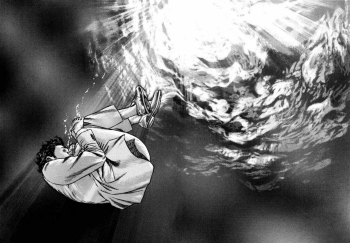
(that image goes with this song)

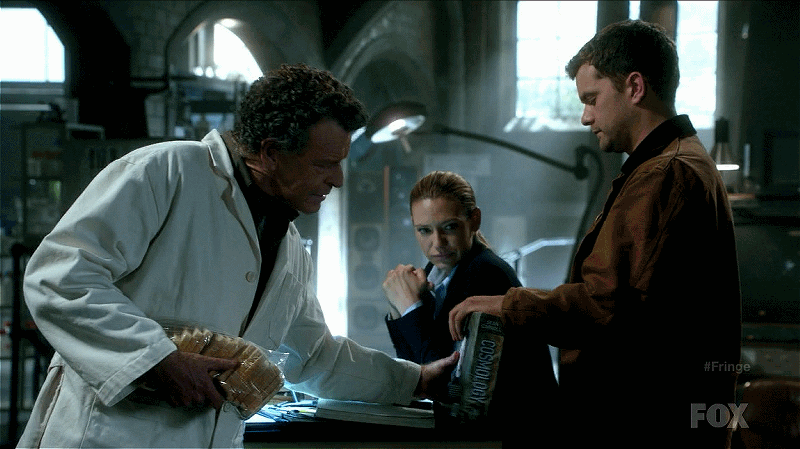
The last episode of Fringe (3X06) was a very good one. As usual I try to track some references, this time a book that Walter takes away from Peter. The book is a MASSIVE tome titled “Cosmology”, by Sean Carroll.

I found out there are two of them, a Sean B. Carroll and a Sean M. Carroll, both actually interesting in the greater discourse but it’s the latter who’s a cosmologist and published something. Though, no massive “Cosmology” seems to exist. The closest thing I found is this.

Looking at the wikipedia it seems his work is mostly about the idea of the arrow of time, which seems to tread dangerous ground (see previous discussions):

1- It is vividly recognized by consciousness.
2- It is equally insisted on by our reasoning faculty, which tells us that a reversal of the arrow would render the external world nonsensical.
3- It makes no appearance in physical science except in the study of organization of a number of individuals.

So consciousness and time, as if isolated from scientific objectivity. I can imagine this line of thoughts leading to places…

While looking for these things I also randomly found this curious book.