Category Archives: Blog


This is a retro-dated post so it’s kind of invisible for the main site, and that I’ll use a placeholder for cesspit.net comments on roguelike development. This because comments are disabled on that site, and I can manage them better over here.

I don’t actually expect there will be comments, but this will be the place in case the need arises.

Heat is defeating all my attempts at making my brain work and write about something interesting. So I watch lightweight TV series (Bunheads is fantastic) and play roguelikes (ADOM, Cataclysm, though the best reputation goes to Crawl), and the Goldbox Megacampaign.

Since I was reading some review of the anime movie of Berserk, I looked up the wikipedia to see if the manga made some progress (it really didn’t) and noticed an old chapter that was removed from the main series titled “God of the Abyss (2)”. It was described as a mythological/cosmological chapter, so quite interesting.

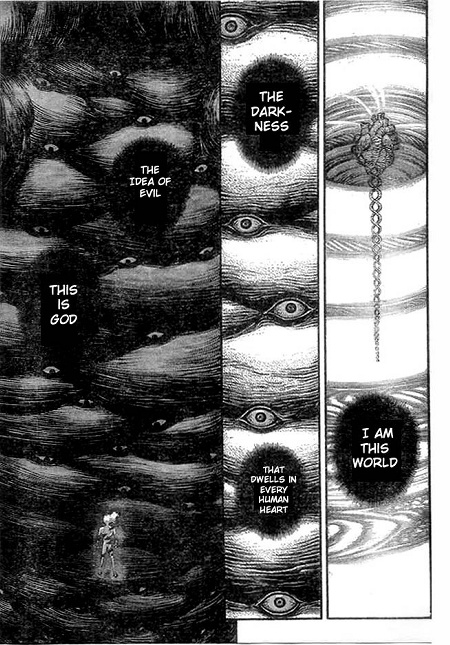
I was able to find it here. The cues should be obvious. It seems everyone loves Jung’s Collective Consciousness. And extremely connected with both the interpretation of the Malazan mythology, as well as ours (as in: “The Wayward Mind” the book I’ve mentioned so many times). This one is obviously a rather simplistic take, but interesting nonetheless. I thought the idea of the heart in the whirlpool of consciousness is a fitting image. Follow the link for the rest.

There are also some interesting interpretations (give it a look even if you never heard of the manga):

“Conscious consent means little to me when you’re dealing with cosmic affairs on a mass scale since the conscious mind is only a tiny fraction of the total being. If the majority of the self (the sub- and un-conscious) gave consent, that’s consent to me.”

“It doesn’t matter to me if the world humans wished into existence is nice, or happy, or dangerous. The only thing that matters to me is that they got what they wanted, and can use the same mechanism to change it as they did to create it. … it’s a marvelous self-adjusting system.”

When you pick up a TV series you never know where it’s going to end up and if it will pay off. When you watch shows that play with mythologies and mysteries these stakes are even higher, because they rely far more on the worth of the overall arcs, than the single episode. Recently, Alcatraz revealed itself as awful with the closing of its first (and last) series. It was far, far shallower and more inconsistent (in the sense it lacked substance) than how LOST was. The writers must have been crazy thinking the public would bother going through the same patterns with even more empty baits and unexplained movers. And there’s Fringe, that grew in significance and inventiveness for the first three seasons, steadily improving, but then had a fourth season that became formulaic and proceeded by rehashing the previous three, ending in so much sloppiness and predictable cliches as to not only suck by itself, but also sucking value OUT of what preceded it.

Awake is instead the kind of show that goes as close as possible to a flawless execution. I don’t know what you could have possibly have done better with it. And if I have to explain why the public abandoned it, leading to a cancellation, then I can only find motivations for its complexity and high stakes, not making for a show that can be popular. It is true that Awake also droops into formulaic episodes through its first and middle section, and so feeling like it exhausted what it had to say (Touch also relies on the protagonist following faithfully some magical hand-waving, but that one was renewed, probably because it is a lot more hypocritical and consolatory). It can definitely feel heavy and boring depending how you approach with. Yet it didn’t ignore the hooks that are needed to reach that public, and used them in the best way possible without making them artificial and not pertinent. It wasn’t made as a “esoteric” show for a small group that could appreciate its theme, but made with the actual potential to reach out for a big public. And the execution was up to this task. SO WHY? I think because the general public prefers something (a show) that is not as much ambiguous as this one. If you’re dealing with fantasy, Sci-fi and mythology, then to be successful your show needs to be neck deep into it. Recognizable at a glance for what it is. It needs to use a “language” in the way people expect, and it needs to “surprise” while never daring to come out of the set of expectation and “communicative pact”. Awake, instead, was a show based on a tension itself based on substance you can’t pinpoint. It plays with psychology, perception and reality. It necessarily brings in the metaphysics (or meta-linguistic) aspects of the medium (who’s watching? who’s reliable?). And it is made to continuously challenge your expectations about it, making it hard to frame. Is it Sci-fi? Is it just a procedural? Is he dreaming? Is he dead? What are the stakes? And so obligatory requiring a kind of public that enjoys being put constantly off balance and challenged for real. Requiring an effort to readjust, and even accept the plausibility of its premise (since an openly Sci-fi show can dare doing a lot more without its public freaking out).

So my conclusion is that Awake “failed” (to secure at least a second season) to reach its intended public solely because it deliberately decided to stay outside of a given genre, and to dance on the edges. These days brands and genres aren’t out there in the world, they are hardwired in people’s brains. If you look at commercial successes across mediums you can see that they are always of a tribal nature. Tribes require clearly marked boundaries. Commercial success doesn’t come through authentic challenge, but through identity and beliefs reinforcement. Awake targets a public that is more heterogeneous, so potentially even bigger, but fails to trigger those mechanics that start the identity-making and tribal support. It’s more self-reflexive, personal, and fails building community. Awake was made of three parts: family drama, procedural, sci-fi/metaphysical gimmick. But it wasn’t embraced by any of these three typical audiences (way too convoluted for family drama, too magical for procedural, and didn’t flirt enough with genre to fully reach sci-fi/geek audiences).

That’s what I think about “context”, now I’ll try to say something about what happened in the show specifically. So, SPOILERS, and I assume you’ve seen it all. Structurally, and before starting with subjective guesses, the plot seems to have “folded” on itself in the last episode. First Britten abandons “red” reality (falls asleep, has a number of hallucinated transitions, ends up “merging”), then he abandons the “green” one (time freezes, he exits by walking right out of the fabric after asserting control, or doubt), to enter a third one with his family now whole. So one could say the finale not only gave closure to the story, but sequentially closed thematically and factually all the doors. The real question to tackle before speculating about an explanation, is speculating about how a second season could have worked.

I’d say we can exclude that the second season would have just this third reality. The show is still founded on a “gimmick” and so we can assume it is going to continue being present. Usually these shows restart by reestablishing an idea of normalcy. It’s plausible that the “happy end” we saw was going to be a temporary thing, and not a new status quo. While it is likely the show would reestablish the twin worlds as we currently known them (one with Britten in prison, the other with him still with his job and with a somewhat better resolution). Another assumption one can make, and evidently implicit (enjoy the apparent contradiction) in what I wrote above is that this show was going to continue staying outside genre. It wants to be a psychological drama, so you weren’t going to find strange Fringe-like machinery that somehow enabled Britten to walk between worlds. Whatever explanation needs to be sought through psychological terms.

Fortunately we don’t even have to do much guesswork since Kyle Killen (showrunner) generously answered all answerable questions. The second season was going to keep the red/green split, and the new reality that is “created” in the last minutes of the finale would have ended up like a psychological “jolly” with its workings being more symbolic than factual. They planned to have Britten in prison in “red”, with Vega trying to solve the case. Eventually (before the new season end) Britten would have been released, but in the meantime while he was in “red”, separated from his wife, he would have found a romantic interest in Rex’s tennis coach on the “green” side, where he’s not in jail and free to go on with his life. This leading to the two realities diverging more and more, and so caught in that progressive break-up and psychological fragmentation foreshadowed by Dr. Lee. How it could have proceeded from that point can’t be said, since the creators wanted to keep it open-ended and fluid.

We also know that the “mechanics” of the gimmick would have stayed ambivalent/ambiguous. Neither reality is authoritative on the other, and they are planned to “sustain” both narratives. You are supposed to find good reasons why “red” is a dream while “green” the real one, as the inverse. In fact above I said that the plot folded, red into green and green into a new one. But you can as well, and even more powerfully, plausibly, invert the order and find it being solid and convincing. Britten jailed (and these scenes gave me a sense of strong claustrophobia), destroyed and without justice, not only now separated from his son, but from his wife as well. With only a possibility for a way out: his mind.

One could even try to speculate on the “first mover”, but in this case the title of the finale is particularly explicit in its declaration of intent: “Turtles all the way down”. We know that the series creators didn’t consider this mystery as the focus of their work, and that it was simply an emotional “enabler” to tell this type of story. A what-if scenario to explore. In a post-modern world the answer is that Kyle Killen is guilty of charge (of being the first mover), but I guess this explanation wouldn’t satisfy anyone. But from there you can deduce a few thing. The reality split has been dominated by an origin: the accident. We also know that the apparent resolution of the first season wasn’t going to close it, so solving the case of the accident wouldn’t have “fixed” the split itself. Nor there was going to be a different accident causing a new split through the second season.

If I had to pick a favorite I wouldn’t say that Britten ended up in a coma and dreaming everything from that point. I’d rather ideally extend the idea of the first mover. He is imagining everything, but he isn’t passing his time unconscious in a hospital room while real reality goes on unsampled. I’d rather say he’s there, in the moment of the accident, trapped in the wreck of his car. He does not know if his wife is hurt, if his son is hurt. He has fears that he projects as speculative dreams. Like Killen himself, he begins imagining what could happen. This means that the closing scene of the finale may as well be real. Maybe no one died in the accident, or one of the three, or all three. We don’t know because the “real story” stopped before that moment. We just got a time freeze, we got to explore possibilities about what could have happened, the product of imagination. The first mover is Killen as the writer of the show, and the first mover, within the frame of the story, is Britten who fears the consequences of his accident and becomes the narrator of the story. The story itself can’t be resolved, because the show “ends” before it is written (and so truly open ended, since it’s who’s watching who gets to decide how it goes). (if you watch the movie Another Earth you’ll notice how they are built with the exact same intent, and even share the car incident as the trigger for parallel worlds)

That’s one possibility, but there aren’t that many to pick from considering the restraints the show works with (as I said: no sci-fi, no fantasy). The other possibilities is that one of the true realities is eventually revealed as “true”. This can happen at any moment and be plausible. Or maybe he is in a flux of consciousness. Less about what it is that makes his perception “weird” and more about creating doubts about our own reality. How can YOU say you’re not dreaming right now? How can YOU be sure you are not hallucinating? How can you say where is “up” and where is “down” if all your references have been removed? What if you are going through those transitions between realities constantly, but your brain self-adjust without making you perceive the “jump”?

I’ve finished reading a few days ago the first book of Thomas Covenant, and I’ll write again about this, since it deals even more directly with this specific theme.

Overall I think this was an excellent show that kept all its promises and delivered aplenty. It doesn’t even suffer much from the fact it wasn’t renewed, since the arc has a more than good closure. The mythology never became as prominent as I’d have liked, but the character drama and development through the whole arc was so convincing and well done that I didn’t mind if it played a bit conservatively. It sagged some after the first couple of episodes, and they could have done a better work describing how the subconscious was working instead of making it appear as a jedi mind-trick. But the tension in the last three episodes rose exponentially. The finale is a masterpiece from beginning to end, creative and truly inspired to the very end. That’s a perfectly crafted mind-bender, pulled off with amazing competence and so much better than more discussed mystery-based shows like Fringe, Lost, Alcatraz and so on.

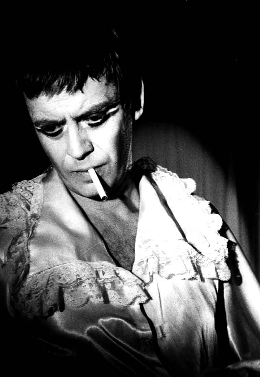
I guess most of everyone who may read this would have no idea of who Carmelo Bene is. And this is fine since he was an Italian avant-garde playwright and actor who died about 10 years ago and was probably the most important figure in Theater that we had.

I mention him here, this blog, because he was inspired by a similar sets of ideas, or beliefs. At some point he worked closely with Gilles Deleuze and was interested in the complete annihilation of the “self”, intended as a conscious entity. From my point of view he essentially represented in “art” Scott Bakker’s Blind Brain Theory. He refused to “exist” and became a rather popular figure in Italy because he was controversial and every time he appeared on TV he aroused all kinds of outrage and scandal. In particular he was accused of speaking in riddles, of nothing and being just a clever trickster who kept fooling the audience with his nonsensical, artificially shocking performances, just to draw the attention. Most of everyone was against him, he was deliberately an antagonist, and had a very troubled and animated relationships with his critics, who were continuously trying to frame him, diminish him or celebrate him, depending on their credo.
But he had a point. This is what happens when you are “misunderstood”. You keep talking of THIS, but people think it’s about THAT. Your stream of (post)consciousness goes in a direction, but everyone else is on another frequency. But when you instead understand the symbols he uses, the hooks, then the ephemeral nonsense of his words transforms into absolute clarity. He then used those ideas to speak about everything: theater, literature, philosophy, politics, his work, his private life.

His purpose, if there was a purpose, was to perform a checkmate on theater and literature. Destroy and deny everything there is, going beyond the post-modern, to some non-entity lying beyond. In order to be “there”, he had to deconstruct, not as conscious analysis, but to remove himself from the scene, to transform the voice and language in a form of non-language. In order to be there he had to “turn off the lights”. To quote Erikson again, two posts down, “look away to see”.

This is not a theory, he only works on the art, and so he only tries to represent it, give it some shape. He described himself as an “actorial machine”, he himself becoming a performance. Only by channeling some demon inside he could say something true. Get closer to the whole, the misshapen lack of identity and voluntary act.

“He considered his work to be about a “constant becoming” in a perpetual state of incompletion. Bene believed that to merely repeat the written lines of famous playwrights was to murder theater. His art, therefore, is an art of repetition through extreme variation. By experimenting with classical dramatic texts, Bene became known as a notorious destroyer of texts.”

I’ll try to translate some of his ideas to better understand what feeds the process. If you’re curious you can also see here one of his performances (it seems the whole thing can be seen here, but obviously in Italian. It’s, huh, quite NSFW). Instead I extracted some of the quotes from a TV show where he spoke directly with the public about himself and his work. The public was, obviously, badly attuned, but it made the show lively.

If someone has defined the “phonè” as a dialectic of thought, then I deny being part of it. I’m looking for the emptiness, which is the end of every art, of every story, of every world. The language of the Great Theater, incomprehensible by definition, becomes completely comprehensible on a different level of understanding, being all about the signifier, and not the signified, or sense.

Language creates failures, it is only made of black holes and failures: (quoting Montale/Nietzsche) “Only this we can now say: what we are not, what we do not want.” Who says “I say I exist, I say this” is two times a stupid. First because he believes in his self, secondly because he’s convinced of saying, and even a third time because he’s convinced of saying what he’s thinking. Because he believes that what he thinks is not signifier, but signified, a sense. That happens under his authority. It’s all noise. I think conscious intelligence is misery. I refuse to consider the ontology.

I do not speak, I am being spoken.

“The gods, plural is the noun, played yourself. The gods returned you to the mythical dawn of times. They carved you empty of simulation. Freed you of codes.”

“We are but ghost lights, representation and model. You and I, in the illusion of being. Sincerity in the lie, truth in contradiction. As truth does not exist, given only in the delirium of language.”

“Voice and language, delirium of omnipotence. Delirium because it’s not there. It does not exist.”

(talking of amplification through a microphone, in theater) The actorial machine is the consequence of the Great Actor, stripped of expressive corporeal human capabilities (vocal, facial expression, gestures, etc..) to wear an amplified attire, both visual and voiced. The voice of the actorial machine is not just a simple amplification, but an extension of the tonal range, becoming a whole. The autorial machine is a fusion between actor and machine; amplification is not a prosthesis, but a further organic extension where the voice is defined by the process. In the same way one doesn’t “have a body” but one “IS a body”, so one is or becomes amplification, equalization, etc…

This amplification is not a mere enlargement of the sound. As an example, it’s as if I’m reading this page at this distance. So I see and understand. But if I bring this page very close, the outlines begin to blur. Closer and closer till they vanish, and I see nothing. At this point, “everyone has his own visions”. What is infinitely large, as discovered in physics, corresponds to what is infinitely small. A step beyond the threshold. That’s why I make myself smaller, “so that he can augment, I have to wane”. It’s the conscious “self” that needs to get smaller. The emptying of the “I”, the abrogation of subject, and so of history. I refuse to be in history. I stepped out of thought.

Art has always been bourgeois, consolatory, idiotic, stupid, it has been especially blathering, whorish and pandering. Art has to be incommunicable. Art has only to overcome itself. That’s why it’s up to us, once we get outside ourselves, to become masterworks. Exit modality to reach the place where modality ceases to be. I can only try to explain my discomfort. I can’t engage with what’s real, what’s obvious, what’s rational. The darkness. Turning off the lights. I even hate symbolism as an artistic language. Poetry is shit. We’re still within words, trying to find a way and unable to come out. I have found in myself a desert, and I speak to the desert who’s the other, and not to someone else’s desert. I possess absence. That’s all. I am being honest because I am not myself.

Universe is one, one only. The pluriverse… is. One can’t say the pluriverse is “what’s left”. The universe is just a tiny, tiny sliver of pluriverse.

(question) What can I do to not exist?

Depose your will. Cut the strings. Will and consciousness are never good. Consciousness does not exist. Look for surrender if you can. But you can’t. You can’t find it. Because when we are not in surrender, we do not realize it. Because once we are in surrender we aren’t “us” anymore. You can’t even exploit it, because you aren’t there anymore when you are there. It doesn’t belong anymore to the dialectic, it comes before and after words.

When early explorers first set out west across the Atlantic, most people thought the world was flat.
Most people thought if you sailed far enough west you would drop off a plane into nothing.
These vessels sailing out into the unknown…

We’re not real.

We’re a projection of the imagination of Earth Two.

It would be very hard to think “I am over there”…
And “Can I go meet me?”…
And “Is that me better than this me?”
“Can I learn from the other me?”
“Has the other me made the same mistakes I’ve made?”
Or “Can I sit down and have a conversation with me?”
Wouldn’t that be an interesting thing?

The truth is, we do that all day long every day.
People don’t admit it and they don’t think about it too much, but they do.
Everyday, they’re talking in their own head.
”What’s he doing?”
”Why’d he do that?”
“What did she think?”
“Did I say the right thing?”

In this case, there is another you out there.

In Plato’s allegory of the cave, the people living in the cave all they knew what was in the cave, and one day one of them gets out… and goes out and sees the real world, comes back and tells the others.
You know what happened to him?
They beat him up. They didn’t believe it.
“That can’t be,” they said.
I don’t think we’re ready to know what’s out there. It’s a bad idea.

So you’d rather stay in the cave?
I mean, if Galileo had felt that, we’d still think we’re the center of the universe, that the sun is orbiting us.
I mean- They tried to burn him at the stake for that.

Yeah, maybe they should have.
We still think we’re the center of the universe.
We call ourselves Earth One, and them Earth Two.

Within our lifetimes, we have marveled.
As biologists have managed to look at ever smaller and smaller things.
And astronomers have looked further and further… into the dark night sky, back in time and out in space.
But maybe the most mysterious of all…
Is neither the small nor the large.
It’s us, up close.

Could we even recognize ourselves?
And if we did, would we know ourselves?
What would we say to ourselves?
What would we learn from ourselves?
What would we really like to see if we could stand outside ourselves…
and look at us?

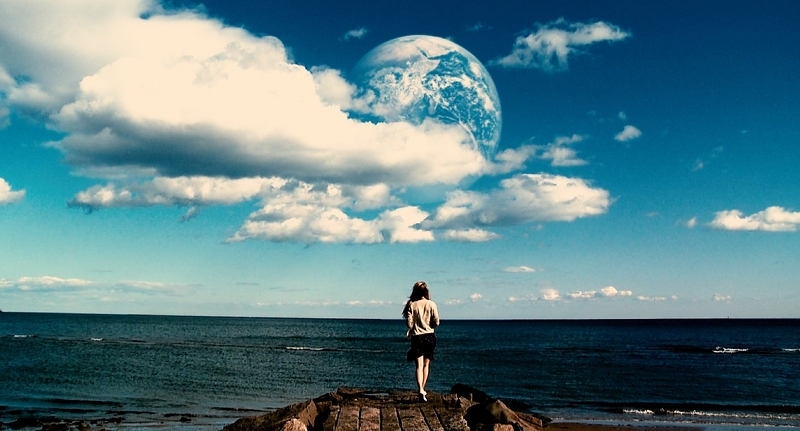
A visit to Christopher Priest’s site drew my attention to this movie (and made me bump up his book in my reading queue, so you should see “A Dream of Wessex” up there now). It’s a very good one and I recommend that you watch it.

The quotes above are extracted from the script but they may even give a wrong idea of what this movie is about. It carries its Sci-Fi “gimmick” (suddenly “another earth” appears in the sky, looking exactly as our own) well and convincingly, but the gimmick is not the point. This is a movie about characters and their stories, the focus never shifts away. It’s not like what they clumsily tried to do with Alcatraz (TV series), where they added to the standard procedural some mysterious elements as “flavor”. This isn’t a weird mix of parts that do not belong. The gimmick is instead just a point of view to observe something specific. A lens. You’re supposed to look through it, not at it.

“We structured it as a typical, straight drama, with all the reversals and character arcs, and then embedded it in this larger science fiction concept just for metaphor.”

I think it’s a movie that fulfills its goals perfectly and deals with its mystery well even if it’s not the focus. It illustrates well the distinction I make between “ambiguous” and “ambivalent”. It’s just a simplifying schema I use to define the ending of a mystery drama. Ambiguous is when you get no definite answers, what happened stays quite murky, you’re left confused and without an explanation about what went on. David Lynch, for example, usually falls in this category. And then there are ambivalent endings. These I consider much more satisfying because you’re given all the pieces to complete the puzzle. The movie is not deliberately obscure and ungenerous. The only problem is that you’re not given a definite, univocal solution. It’s open-ended. Meaning that you’re offered more than one solution to the puzzle. The movie doesn’t say which one is specifically the right one, it’s up to you to imagine the rest, you’re given this kind of power. But there aren’t parts that are missing or that you cannot properly reach, things that the director deliberately took away to prevent you to understand things as clearly as possible.

A very good quality of this movie compared to, say, Donnie Darko, is that it lacks pretentiousness and can be “held”. The end of the movie will spark a lot of questions, but you aren’t forced to watch it a second time with the hope to catch things you missed. What you need to know to understand it fully is all there. As a metaphor, its meaning is in the intent, not in the gimmick.

It’s curious because it’s part of the style of the movie too. It resembles some “found footage” movies or documentaries, where the “eye” of the camera is discreet. Giving the idea of observing objectively and passively. Yet in this movie I perceive a contradiction, since this eye is not discreet at all and is at times even invasive. See for example some conspicuous, sudden zooms. It almost seems creepy because it makes felt the presence of an observer, whose eye lingers and is precisely interested in details. It’s not a passive observer that disappears and is unnoticeable. It’s instead very deliberate. Usually I would criticize something like this, but in this context it matches the gimmick as a very deliberate and specific point of view. In this, it doesn’t pretend to be “true” or clinging to a pathetic idea of truth, but just tries to have an honest insight into this impossible situation. It’s fiction, it doesn’t pretend to be true, but it is honest.

In about a month a kind of companion work titled “Sound of My Voice” should come out in theaters in the US, I’d definitely watch it if I could.

Someone said that Sound of My Voice just keeps going deeper and deeper into more claustrophobic situations, while Another Earth just keeps going more open and open. They’re moving in different directions, and yet they’re working on something subconscious and magical.

Briefly on TV shows. The last episode of Fringe (4×14) was fine and made the plot move a bit, but it also shot itself in the foot by explaining Observers as a gimmick. I don’t think that mysteries to be effective have to stay unsolved, so it’s not that Observers were overexplained, but it just ended up a dead end not so unlike some explanations in LOST, that also sucked because they lead to nothing. Satisfying mystery “opens up” possibilities and interpretation, explains other stuff and gives it a new spin.

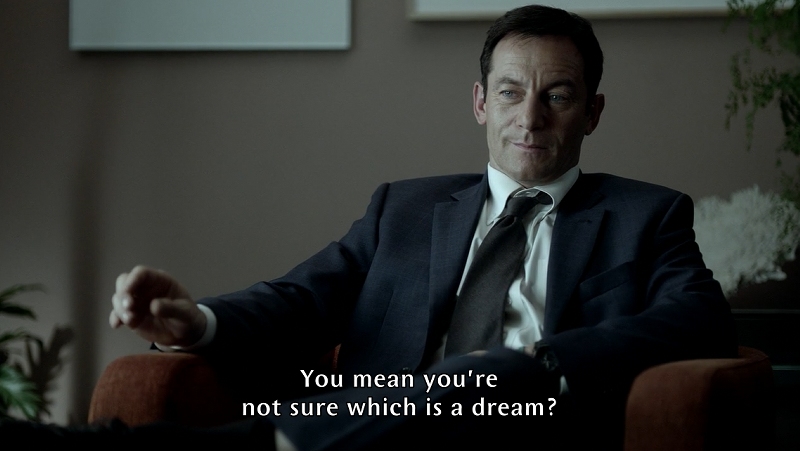
Now there’s a month break for Fringe, but I read about this new TV series, “Awake” (on NBC), that relies on a similar trick: the main protagonist is stuck between two realities and unable to figure out which one is the “dream”. I watched the first episode and it’s GLORIOUS. It plays wonderfully with its possibilities and it’s highly evocative. Way, way better than Fringe or Alcatraz. The latter feeling also like a very shallow gimmick, looking as a bad, plain procedural that moves the mystery plot in the last minute of every episode. It’s like it hits the formula for irritation.

“Awake” starts playing its cards perfectly. It doesn’t indulge in the drama of its premise as I expected, instead has it coming out of the rest. It puts the melodrama aside, and feels more authentic. It is playful with its possibilities, with the two shrinks in the two realities that try to outsmart each other. The show has a metalinguistic level that just tastes delicious, while not overshooting it into parody. The way this first episode struck a balance is already a statement of competency. I really hope the public sticks to it despite its “complexity”, because it deserves going on.

The stakes are put so it can also quickly become a disaster. Many ways that the show can take a wrong turn or lose that balance that make it feel right and plausible, but at least it got my trust solely with the pilot. Hopefully it continues to deliver.

And it’s fitting with the “groove”. I’m reading right now “The Wayward Mind”, that I ordered as soon as Scott Bakker wrote about it. I see in these pages many, many arguments that I dealt with in the past year, many fancy theories and lines of thoughts. Written so clearly so that one sees the “order” in the scheme instead of feeling lost in the myriad of sidetracks. That and Bakker’s own “The Blind Brain Theory of Consciousness” (he sent me the file he was working on) are eye-openers in ways that can’t be dismissed. Dramatic advancements for me. I almost feel like I’m understanding something. Or at least having a lot more tools to work with the problems, instead of staring at them without a clue.

So this show is like a way to relax while soaking in the same semantic level. The two realities becoming possible dreams constructed by the mind and dense with symbolic purposes. Conscious mind versus unconscious, the limits and tricks of perception. Watch this show, it plays well with its themes, manages to keep its consistency, and doesn’t seem to proceed conservatively to artificially continue as a serial with no end in sight (or so I hope).

I don’t read many mangas these days but I make exceptions for those masterpieces that set themselves apart. There are certain signature works in every medium and genre, Homunculus isn’t very much “signature” because it doesn’t seem to represent any canon, but it sets itself apart as one of those rare, significant works. It is a true masterpiece, of the kind you can count on your hands. I’m writing about it also because it’s finally complete. It’s 15 volumes, the last one came out in Japan in April 2011 and translated in English two days ago. Yes, it’s not officially licensed, but it also means that there’s the possibility to read it online, all 15 volumes for free, thanks to the work of fans who did the translation. It’s not the same experience of actually having the volumes in your hands (I read most of the volumes as they were published in Italy), but believe me that this is something you can’t miss.
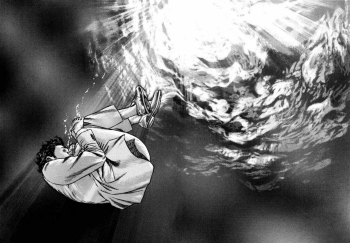
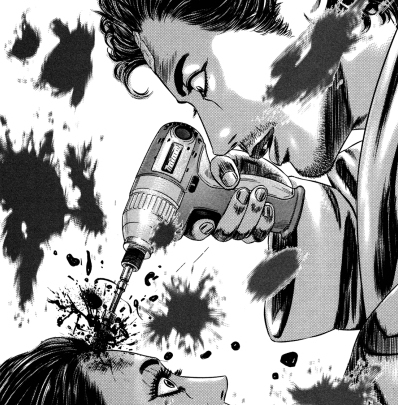
Considering the gruesome picture I decided to use one would expect some kind of brutal manga about violence or serial killers. While Yamamoto, the writer and artist, is the guy behind the more famous “Ichi the Killer”, that you may know for the movie adaptation by Takashi Miike, Homunculus is an entirely different thing. There’s not much violence, or action. It’s instead a deep psychological and metaphysical journey into consciousness. In that scene you see Nakoshi, the protagonist, trying to drill a hole into the girl’s skull. It’s gruesome, but he does not intend to kill her. It’s part of the metaphysical conceit the manga is based on, by drilling that hole you stimulate the brain to a different kind of activity, augmenting perception. In the specific case the hole allows the protagonist, by covering his right eye, to see the “truth”. To see demons, or “homunculus”, which are essentially symbolic constructs of the people he sees around himself.

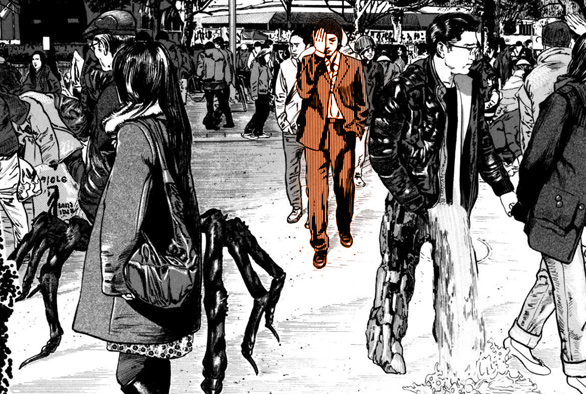
They aren’t the demons “outside”, from the outer world, those typical in horror movies. They aren’t supernatural or magical. They are the demons inside, those who live truly within each of us, every day, and that we can’t exorcize since those demons are “us”. As real as everything you can touch and feel. Deep psychology and symbols, the stuff we live off. And it’s here that this manga reaches its apex. From the first to the last page, beside the single case of the premise of the trepanation, there’s nothing fantastic or that falls outside science. You’ll see all kinds of weird, freaky stuff, it flirts with the occult, but it will all be slowly explained in logical terms. Everything will be explained.

It is a masterpiece because of how it keeps the tension for 15 volumes straight, unrelenting. It’s an unbelievable crescendo that reaches the top right at the end. Truly ambitious works usually have problems finding a worthwhile ending that matches expectations and wraps up all mysteries and plots. This is an example of “flawless victory”. It does everything perfectly, with an ending I feel powerful. Recently I was discussing the difference between “ambiguous” and “ambivalent”. It’s a meaningful difference because I consider one satisfying and the other frustrating and infuriating. Ambiguous endings are infuriating, because you don’t get the answers you seek, the ending is open-ended, you’re left wondering what the authors wanted to say, you can’t come to grips with it. It’s not over and you can’t let it go, but you can’t do much with it either, because you feel like you can’t solve it, or that it was all a fraud, with no solution (hello LOST). Instead ambivalent endings are fine. They are still open-ended because you don’t get to know “exactly” a specific solution or truth, but at the same time you are given more than one specific solution. Each explaining plausibly what happened. You get your answers, mysteries are solved and explained, but there’s more than one single solution. You’re given more than one combination, but they all potentially open the lock. You don’t get to see the one that does it, but you know one of them will. The path is clear, the message delivered.

During the course of this manga, page after page, the protagonist will face the homunculus of other people that he needs to “solve”. Each is its own mystery, bound to the whole life of a real person. You’ll see stories surfacing and every single mystery about them slowly being explained. At the same time every chunk of these stories will go to build up the bigger picture, it will build up to the mystery of the homunculus. What these homunculi are, where they come from. The mystery will be revealed and the whole manga is built so that everything leads up to it. It’s a masterpiece because how every story exists on its own and yet builds up to that ultimate mystery. And it’s a masterpiece because how every single image, frame after frame, goes to acquire a symbolic meaning. Yamamoto is a genius, you’ll see the deep, meticulous research after every symbol, taking often hundreds of pages for the “descent into truth”.

“Truth” is what lurks deep down, in that pit that is the symbolic unconscious. You’ll get to see some of those truths, see their freaky shapes. All the while, remember, without any “magic”. This is the real thing.

It can be quite disturbing. But the truth rarely isn’t.