Author Archives: Abalieno

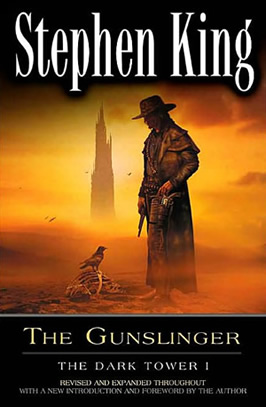
I began to read the book almost a year ago but got sidetracked after about 70 pages, so when I took it again a couple of weeks ago I had to restart from the first page since I had a very vague idea about the part I had read. Not that it got so much better the second time through, the story defies control and one has to struggle to distill from the book some form of logic progression. Reading this, day after day, feels like you never make any progress, which I guess is the point. There’s a direction, a sort of abstraction of the concept of the “quest” in its most absolute form. The endless, ultimate journey toward something that is perceived as the definitive “Truth”. Or better, this is the conceit, the Mac Guffin. Roland, the Gunslinger, on his journey toward a mythical, capitalized Dark Tower. Only that this is one book, part of a series. So for this single instance Roland is chasing after another Mac Guffin, the “man in black”, who, when caught, would hopefully point Roland in the right direction.

The starting point is not present. We see this chase when the chase has become a consolidated reality that seemed to go on forever. The beginning is a blur, a movement whose beginning was lost. It starts with a desert that represents the absence of a definite space and time. An infinity whose confines are misty and dream-like. The quest is a journey, but here it seems trapped in a stasis: the longing for something that can’t be achieved, the distance that never closes. I’d say it doesn’t even work as a “tease” because we can’t grasp anything meaningful of Roland himself or the object of his longing. Merely an assumption. You witness obsession without motives. One has to reach the very last few pages of the book to have at least a glimpse of what the tower represents. The story is not one built to entice the reader and follow along. The place is haunted and inhospitable, but it’s maybe in these traits that someone may find some fascination.

The introduction written by King himself is the most revelatory part. It explains the origin of the idea, especially its naive ambition. The rest of the book is, at the same time, talented, immature and pretentious. All together in a mix that represents the real quality to find here. There are no restraints typical of the established writer, no control of the parts, but this has the consequence of “freeing” the creativity and let it go wild and uncaring. The writing is powerful as it is naive. A core of talent as wordsmith mixed with the pretentiousness, egocentricity and impudence of the young. It takes itself so seriously that it builds a wall of detachment, not reaching out to the reader or gaining his sympathy or empathy. The place is haunted, all characters being like phantoms of momentary conscience, fading in and out, being themselves lost too and living aimlessly. There’s everywhere, on the characters and the places, a sense of nostalgia. Something missing or forgotten that can’t be pinpointed. Even if nostalgia should be a thing of memory. Everyone is missing something but without being able to remember what it was. Nostalgia of the future. A suspended and undefined state of agony.

The scenes are all dream-like, evanescent. Their symbolic meaning more important than the factual one, but at the same time esoteric and impenetrable. The book is filled with symbolic myths but nothing at all is explained or even placed into context. These are shattered lives, like glass whose pieces do not connect anymore. I guess the purpose is to to establish this mythology that will only start to make sense later and in retrospective, when the story will loop on itself. There’s already here the impression that the pattern has been repeated, that these characters are themselves victims that follow trails that are merely their own. Condemned to retrace themselves, only to forget again. It sounds, and is pictured, like a torture.

If anything, Roland is the only character who seems to have maintained some tangibility. Of self-awareness. Other characters are all hopelessly lost, unrecoverable. Roland seems the only one who produces a difference, sometimes catastrophically, but still a change or a disruption of that agony. When he exterminates a small town the feeling is one of gratitude for having put those ghosts out of their misery, but at the same time he certainly doesn’t win a sympathy in the reader. Roland is himself haunted and hallucinated way beyond any hope of recovery. We have no insight and so one cannot sympathize or understand. This first book works merely as a framework and I’m sure the character will grow toward something more human later on, in this first he stays obscure and maybe for this reason vaguely fascinating. A twisted, black anti-hero that plays maybe too much with being against the convention. A kind of anti-stereotype that is itself a stereotype.

In the end this book taken as a single entity is not generous and rather opaque, I didn’t get much out of it beside the fancy, dislocated atmosphere. Abstraction without substance. It closes, before setting up the sequel, with a trippy space journey taken straight out of ‘2001: A Space Odissey’, but here the meaning is painfully obvious and plain, revelatory of the fraud hidden behind. Containing just a promise of something more meaningful to be revealed later on, coinciding with the promise of the Tower and the conclusion of the series itself. It dresses itself as wise and resourceful but the conceit is evident. As Roland, I have no solid motivation to carry on with the hopeless and insubstantial chase. You need to entice me with with something more than mystical mumbo-jumbo and esoteric made-up terms. What’s actually there? A boy being sacrificed for ludicrous reasons, largely foreshadowed but delivered in a way so forceful that it defies every purpose that part of the story may have had. Follows a host of prophecies again grounded on nothing, neither abstract nor concrete, if not in offering bland hooks to the following book. Instead of building curiosity for the mysteries set within a context it may easily lead simply to irritation, with the man in black representing perfectly that feeling. Inhuman, inconsistent, pretentious and ridicule. His display of powers does not impress anyone and that part of the story is so inconsequential that it’s like watching animated puppets play a trippy script whose pages were thrown into the air and scattered.

What is good? The sheer talent and creative pretentiousness. The lack of restraints. The outrageous metaphorical descriptions filling the pages. ‘The artificial glow from the wet rock was suddenly hateful’. All this being not only something glaringly obvious in the text, but it’s King himself explaining it. “On being nineteen”. And the book has to be appreciated in regard of this creative, unhampered recklessness. The ambition and courage that coincide with carelessness. It becomes then, in potential, a strength if one considers the series as a whole. With the latter books representing a conciliation of all this with the wisdom and moderation that one can legitimately expect to come with the mature, more broken King. Coming to terms with his own creation and trying to tie loose ends in some sort of coherence and meaningfulness, maybe.

The rest is magic, or sleight of hand.
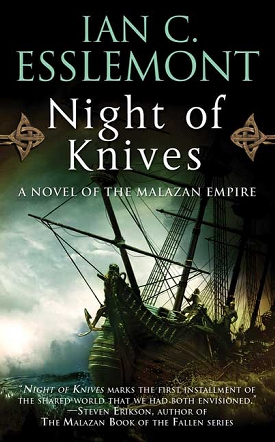
“Night of Knives” is the first novel(-la) written by Ian Cameron Esslemont set in the Malazan world co-created with Steven Erikson. It’s a much leaner book, 300 pages in the american Tor edition, compared to Malazan standard, and chronologically set between the prologue and first chapter of “Gardens of the Moon”, the first book in the series. Yet, the fans recommend to read the book only before the sixth because of some connections, while I decided to anticipate it right after the fourth, since “House of Chains” deals more directly with the matters of the Malazan empire and I wanted to approach “Night of Knives” when that strand of story was still fresh in my memory.
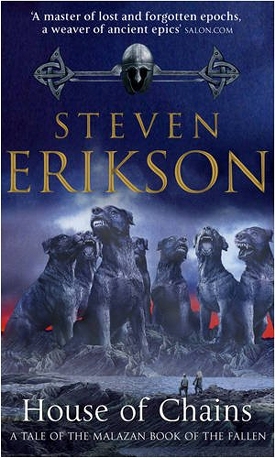
The content and purpose of the book fit as a retrospective: from one side we get to see what happened in the particular night Surly/Laseen claimed the throne of the Malazan empire while declaring the death of the previous ruler, Kellanved, who had been missing for quite some time giving Surly the opportunity to solidify her position. From the other, through flashbacks, we get a close-up of “The Sword”, the six bodyguards/champions around Dassem Ultor, champion of the Malazan empire, and particularly Dassem’s betrayal that was vaguely commented between Paran and Wiskeyjack in that GotM prologue.

Here comparisons between writers are impossible to avoid since we have two of them writing the same material and aiming for complementarity. So the big question is if Esslemont can match Erikson or at least stay relevant and add something worthwhile, with expectations being very high and not playing in Esslemont’s favor since it’s complicate to debut when the main series is already established and halfway through. That was also my main concern: trying to weigh Esslemont potential not just for this book, but also for the upcoming contributions. The first 50 pages were quite revelatory for me. Esslemont is a rather competent writer, the beginning of the book is well handled, solid prose, written and paced perfectly. There wasn’t anything suggesting it was a debut instead of the work of an established writer. I also thought the style was distinctive and not clashing or conforming to Erikson. Especially, I think Esslemont did a wonderful work on Malaz itself, the city. The place comes to life, the shadowy atmosphere rendered perfectly with its narrow, twisted alleys, the very quiet and suspicious people on the brink of insanity. From Mock’s Hold perched on the cliff (and the inevitable wink to Mock’s Vane), down to the sprawling ramshackle houses. It gives a sense of real place and I still now consider this the biggest quality of the novel. The town being the true real protagonist, interpreting perfectly the understatement of the conflict it gets tangled in. The true heart of the empire, yet far from the celebration of triumph or glory of a capital. It’s a haunted town everyone would get away from, sullying and miserable. So weak and vulnerable, yet caught in the eye of the storm and holding desperately. Reminds me of a place that would fit perfectly in a Lovecraft story, madness stalking behind every corner.

Speaking of tones and atmosphere, I think that, more than Erikson, Esslemont draws plenty and openly from Glen Cook. The whole novel echoes with the first chapter of The Black Company and even more with the whole second book, “Shadows Linger”. Lots of elements in common, the first chapter of The Black Company was similar to an horror story, with the company caught in an unusual situation and slowly drifting toward dread, discovering corpses everywhere while the town they were stuck in descended into chaos, the Hounds of Shadow in “Night of Knives” filling perfectly the role of the “forvalaka”. Same for “Shadows Linger”, also set in a gloomy small town, inside filthy inns and nearby mysterious places. Townsfolk involved in ominous practices that slowly escalate to a disaster. Inspiration here is not a flaw, since Esslemont uses all this competently and functional to the story he writes, without giving the impression of a diminished copy.

There are problems, though. Everything is set perfectly in those initial pages, but as the story progresses it also loses its strength. Instead of escalating it kind of folds without delivering its potential. From my point of view the problem is that Esslemont fails to switch gear when needed. There’s a moment in the story when the spooky “fairy tales” and legends descend, truly, on the real world. Kiska fits well as a POV there, because we have a naive perspective on a situation that is quickly transforming. But when hell breaks loose the story is stuck in the preceding naive tone and the dramatic intensity is underachieved or lost. Esslemont stays too much on one fantastic, dreamy level that is excused when the story is still in the build-up phase and what is to come has to feel distant, the menace being remote. But when it closes it lacks realism and the characters are still lulled by the writer, never at risk, never exposed outside their own cliche. They stay put, characters as devices, their perimeter containing them, and them carefully stepping to never dare becoming real characters. This is the kind of babysitting that never lets the story run wild and deliver. Somewhat like a cheat.

Kiska fails to become a real character, ideally she should be hammered out of her fancy fantasies (echoing Paran’s own “I want to be a soldier. A hero.”) and crushing on reality. She starts wishing to be the heroine, admirably skilled in her dreamy land, but she stays there even after. She glides over everything, undamaged, in truth, beside a few minor bruises. The kid outskills everyone else, she lives her dream in reality WITHOUT EVEN PERCEIVING THE TRANSITION. She enters and exits the novel with the exact same mindset, nothing learned. She’s lulled in her dream as the world comes to coincide with it, instead of her coming to grips with reality. She starts naive, and ends up with all her dreams fulfilled without even once confronting reality. Her role, as cliche, fits perfectly, if only at some point the cliche would be used to spring her (and the escalation of the plot toward dramatic intensity) to a whole new level. Instead the whole structure folds. We have these two levels. The low-ground perception of townsfolk, with all their superstitions, and then the crushing of the convergence, the Shadow Realm that descends on the city itself, becoming very real and tangible. The townsfolk barred in their own houses, praying the dream to end soon, the storm outside. Yet, on the level of the novel, it’s the “reality” that is lifted up to “fairy” level, with magic becoming magic, old wizened and long-bearded guys becoming wise wizards, the heroine being tested through riddles. Lots of blood, corpses everywhere, but it’s just tomato juice on redshirts, come the morning the bad guys are dead, the roads relatively filthy as usual, some fallen bricks and crumpled walls, heroes survived heroically, the heroine got her alluring, mysterious boyfriend. When do I wake up?

Erikson’s work on the series can be summarized as: “Nothing is as it seems”. Here it’s the opposite: everything is as it seems. No subtlety, no tricks on perceptions, no layers. Leading to another consideration. Esslemont’s characterization is actually well done, at least in presenting the characters if not in their development. His overall style of prose, narration and characterization is traditional compared to Erikson, but “traditional” doesn’t mean “bad”. The introspection here is “full-on” and helps leading the narrative. You get into the characters’ thoughts in a way that you never find in Erikson. This meaning that this book can be more readable and accessible, even enjoyable. Erikson’s style, being infinitely layered, prompts you to put down the book and think about implications, Esslemont is more like the page-turner, pushing the story onward, curiosity taking the lead and the reader more involved in the destiny of characters. A more emotive/empathic approach of a character-driven story. The book can be read quickly and is quite fun but it stays on that level.

Thinking of “purpose”, the story is aimed to shed some light on a crucial point of the history of the empire. The book is filled with juicy details that can please the fans of the series. Lots of “fanservice”, which is a good thing. Yet, this is not a necessary read, nor a recommended one. Concretely, it adds nothing worthwhile. It uses and consumes without creating. We see lots of details about what went on, but they all seem disposable and none really clarifying. The real deep motives stay deep and unrevealed, deliberately untouched in this book. The betrayal of Dassem Ultor is a pivot of the novel, yet absolutely nothing is added to what we knew. We see it happen, but what we see explains nothing about what happened. Another instance of “everything is as it seems”, or there’s nothing more than what meets the eyes. Another big flaw being that the more is revealed, the weaker the story. Instead of enhancing and realizing complexity, it kills it. No surprises, no revelations that open new interpretations and scenarios. The few answers that come only close some dead-ends of the overall plot without producing anything. Lots of potential when it comes to Laseen, but the character is flat and hiding absolutely nothing. She’s merely there and passive, with the lack of active presence hiding absolutely nothing: she’s really doing nothing if not what is plain. Mystery that hides nothing. Same for the confrontation between Claws and Talons, reduced to a confused ninja battle between caped figures. Shadowy capes hiding nothing. Conspirators whose conspiracy is held on plain sight.

From this perspective the book is immature. Not again in the competency of Esslemont as a writer, but in failing to cross that line between adolescence and maturity and everything it represents. The falling of myths and naive dreams, the facing of failure or helplessness. The same done by some “fantasy” (as genre) trying to come out of its stereotype as “young-adult” escapist entertainment, whether it is George Martin or Erikson or whoever else, trying to open up the genre to a more mature type of narration, more complex, layered and unbound from strict conventions and types. “Maturity” or even modernity: no more absolutes, but points of view, layers, perspectives. This book fails to cross that border. The characters are caged into themselves, being plainly what they seem to be and within their narrow stereotype or functional role in the plot. In various occasions the story directly reminds of “young-adult” tropes (here straight from “Neverending Story”):

If she did succeed in returning, Kiska vowed she would head straight to Agayla’s. If anyone knew what was going on – and what to do – it would be her. Never mind all this insane mumbling of the Return, the Deadhouse, and Shadow. What a tale she had for her aunt!

And ending with:

‘Yes, I will. Thank you, Auntie. Thank you for everything.’
Agayla took her in her arms and hugged her, kissed her brow. ‘Send word soon or I swear I will send you a curse.’
‘I will.’
‘Good. Now run. Don’t keep Artan waiting.’

“Don’t keep your boyfriend waiting”. It’s then hard to lift the plot to dramatic intensity when this distance of perception never closes. Brutal fights are witnessed, but so alien and detached (or described through morbid badassness) that they never come real. Threat never getting close if not in a fake way. Kiska never falters, no matter how unbelievable is that behavior even for a prodigious child. Every impossible action or behavior excused by mere exceptionality. Temper, the other POV, is not different. Even here the character is initially very solid and well presented. A paranoid veteran hiding from his past. But all plot points are fortuitous and convenient, and even the flashbacks recount battles between invulnerable champions with a lot of useless redshirts around them. Halfway through the character moves from a well realized one, to click into his functional stereotype. When he exits the story he’s the hero who saved the day whose deeds remain unknown. Close your eyes and shadows become monsters crawling out from under the bed. You wake up, it was a dream. Esslemont fails to play properly with this and switch tone. Everything stays up there, suspended into adolescent mythology. The mythical story described exactly as the cleaned-up myth wants. Nothing being ever threatened or compromised.

The series is not powerful for its mythology and form, but because Erikson, as a writer, instilled meaningfulness into it. Made it relevant for what it has to say and the way it challenges perceptions. But Esslemont doesn’t seem to add something of his own. He delivers the story without delivering a purpose. If Erikson writes to reach far outside mere “escapism”, Esslemont stays strongly rooted into it. The story sits on the surface level, which I guess explains why the fans of Esslemont himself are often those who judge Erikson’s book as overlong and slow. Erikson digs deep on the level of meaning, is concerned about the reason to say something, is tormented for reaching out to the reader and shake him. Esslemont fails to have a drive in this novel. There’s no “necessity” of the narrative intent. Outside the entertainment value, being said or unsaid is the same. Why reading this book? Because it’s still a good read and if you are a Malazan fan you’d want to know more and enjoy the story, but I thought that the mysteries revealed would stay better mysterious and ambiguous. Instead of being revealed so plain. It’s a fun and well executed roller coaster if you enjoy Malazan mythology, but it’s still a roller coaster.

House of Chains is the fourth in the 10-books Malazan series. These days, these hours, Erikson is intensely busy writing the last chapters of the last book and bring to a close a journey of staggering ambition. Reading this fourth felt like standing on the shoulder of a very tall (jade-colored) giant. As with similar(?) long series it’s interesting to see the power-game, the ebb and flow of the single book compared to the others. When I was at page 700 or so (on a total of 1000) it dawned on me that this would become, with certainty, my favorite. 100 pages from the end the story proceeded resolute with a sense of finality and inevitability. Like the dramatic ending a movie whose sound is deafened, muted, so that the intensity of what you see comes out unadulterated and with all its power. But it is immediately past this apex, in the very slight and calmer descent that follows, the remaining 30-40 pages, that the more meaningful and stronger revelations are delivered, and the characters reached down for my soul. The book had already gauged his way as my true favorite and was set for a foreshadowed ending. I only expected closure and rest, yet the book still had PLENTY to deliver, and surprise me, and offer emotions to share.
These weeks I spent reading House of Chains were also the weeks of Lost ending season (the TV series), which lead me to draw certain parallels, both thematic and about the plot. Similarities are evident even on the superficial level, and on the forums I was explaining that I was watching Lost for some of the reasons I was reading this series of books. The staggering ambition, the exponential layering, the subversion and reversals in the plot, the continuous challenge to perceptions. The difference, as I already discussed, is that Lost always left me (and many others) unsatisfied. Even the very end left the plot unresolved. With the Malazan series instead it’s a whole different deal. Reading this book, at various points, I thought that if it was to end right there, in the middle of the narrative, it would still feel completely satisfying and accomplished. Erikson as an author is far more generous and I feel that what he does is always honest. I never once felt cheated. Which also leads to the broad theme of “truthfulness”, that Erikson fulfills for me. Reading this series is not an easy task for anyone, but I know that it largely rewarded my effort. It delivers all it promises, then more, far beyond expectations that continue to rise as the story goes and branches out to embrace what you don’t think can be embraced. I am humbled because I know that this is one rare effort that won’t likely be matched anytime soon, if ever. I’m glad that I find it so close to things that matter for me, at the core, and that I seek in a book. It completes what I think and I follow devotedly because it already proved aplenty that this journey is worth all the dedication I can give to it. This to say: Erikson, especially in this book, doesn’t lull and drag you along with vane promises. He delivers, page after page. The physical shape of the book, right there, weighting far more than you think. Worlds that the written word can open, and worlds that, deep down, feed on something true.

This, for me, has nothing to do with the notion of escapism. At least if you don’t consider escapism the illusion of the discovery of something meaningful, that matters. And so the thematic aspects. I guess that this couldn’t be more misleading. “Themes” make me think of very boring books that have nowhere to go and preach on banalities or feast on rhetoric. Or the celebration of some sort of morale. I have a natural tendency to oppose and refuse these things because I always find them trite or partial. Erikson instead makes these aspects very real and makes surface their contradictions. The narrative is driven by purpose, a lucid intent, that doesn’t lead recursively to itself, going nowhere. Turning a wheel that turns and turns but goes nowhere. Those themes, taken as abstraction, are always brought back to the ground. They don’t wander on a detached level, different from the plot. They are intricately woven and matter on a concrete one. The biggest revelations can please a reader just for what they are, the fun of following an engaging story filled with unexpected twists. The last 70 pages of this book are a frenzy of plot threads that get tied and resolved one after the other. And each, if not to be carried away by this surging tide, turning the pages, would make you look back with unprecedented clarity. The thematic aspects here bind the narrative.

‘The stigma of meaning ever comes later, like a brushing away of dust to reveal shapes in stone.’

The structure of this book is slightly different from the preceding ones. It starts with about 250 pages from a single point of view instead of jumping all over the place. I think this choice is perfectly placed. It’s not easy to have the story move again after the ending of ‘Memories of Ice’. Starting from a blank point, apparently unrelated, offers the narrative the possibility to gain momentum. Especially because all we learned through three books here becomes the cipher of what is going on behind the curtain of deception. An higher level of awareness that you have, as a reader, above the level of the narrow point of view. An second-level of observation that reveals a bigger truth, as you are yourself, as reader, deceived in turn, when you thought your position let you see clearly where the deception actually was. A clever trick indeed. But again, done to understand the story on a deeper level, and bring the reader right into it, with an active role. Not so many books do this. You may think this is some ‘mental’ stuff I imagined, but no. This is why I said the book is generous. It has not the esotericism and bloated pretentiousness of Pynchon, this book BEGS you to understand it. It doesn’t hide for the simple pleasure of obfuscation, nor it lulls lathering in redundancy.

‘In any case, to speak plainly is a true talent; to bury beneath obfuscation is a poet’s calling these days.’

Now this review is coming out rather abstract and vague, yet I’ve pages of notes about specific aspects but I don’t think I can go anywhere with them. This book offers a myriad of suggestions that you can taste and elaborate any way you want. Take for example the book of Dryjhna. It’s a story that starts in book 2. This is Erikson doing his typical play on some established fantasy conventions (and in book 2 he resolves it delivering a spectacular surprise). In this case the ‘book of prophecies’. We’ve had these plot devices dealt in every possible way in the fantasy genre. Here the running joke is that prophecies are left vague because through this very quality they can be pragmatically adapted to the changes of time. A way to keep them relevant and useful for those who actually wield that power for their own secular purposes. In the end prophecies are nothing more than excuses to exploit a population. But it’s the real revelation of the truth (or better, the deceit) behind the book that makes it ultimately worth saving. The book is revealed as a fraud, but this revelation makes the book valuable for what it actually is, which consequently infuses it of the power it lost. A full circle, but, as it closes, the power of the book goes from misplaced and false, to something true and valid. It got somewhat cleansed in the process. This I’ve just explained is a very minor plot thread, almost invisible. Maybe two pages in total name it, yet, by ways of Erikson, what this book (of prophecies) represents echoes with everything else that goes on the major level. Everything intricately woven together at different levels.

There are certain plot threads, on a second inspection, after the tide of the last 100 pages passed, that seem somewhat spurious. Though this is typical of Erikson as the plot branches out to previous and following books. They are the most obvious links. But the reason why they are there is because they are part of larger loops. They are meaningful in the single book, have an impact and purpose, but the story arc isn’t brought to conclusion right there. When I finished book 3, I thought that Erikson was at his maximum possible reach. Controlling so many characters and plot threads while delivering a so huge conclusion was absolutely spectacular. House of Chains is on a somewhat smaller scale and more personal. It continues directly from book 2 and draws from the qualities found there. Yet, this smaller scale was only apparent and Erikson shows here a stronger control of plot. He still improves. Book 3 had from my point of view a more uneven quality compared to the 2nd, even if as a whole it came out far above just because of its impact and staggering ambition. House of Chains shows a tight control and a clear intent. It is lucid in a way no previous book was. More effective and straight to the point. Every aspect I can consider is overall improved. The prose itself stays terse as is typical of Erikson, and gains efficacy. No wasted words, no lingering, yet also not as wasteful as it happened in Memories of Ice. On some of my notes I wrote how in books 1-3 we saw an expansion of the plot. An exponential multiplications of different factions and factions within factions. House of Chains instead represents a kind of contraption that doesn’t reduce the reach of ambition of the plot, but that actually leads to an absorption of the various branches into an unitarian mythology. The nature and truth of many things is revealed, and this revelation draws everything together. It all makes sense and even sheds more light on previous books in a way that makes them shine even more. Following books improve the previous in retrospective, add significance. Especially in this case for book 2, that was already excellent. House of Chains is an open celebration of Deadhouse Gates, yet this doesn’t put it in its shadow in any way. They just contribute to each other.

Want one flaw? Named characters lead the story. Yes, there are A LOT of them in that “named” list, but the terse style of Erikson lacks some naturalness if you care for it in a book. I’ve pointed this out in the past. There are no slices of life scenes here. No getting used to the characters or lingering with them for the mundane. This story has momentum and moves on. We don’t get to see what isn’t strictly relevant. Yet, this also means that these plots are sometimes too neatly wrapped up. Too coincidental and convenient. Everything pivots exactly where it should, and no matter how HUGE is the landmass itself, characters that travel seem to ineluctably constantly bump into each other. Sometimes it feels as if the “real world” is missing. As if the plot was eradicated from its natural place and made an example of. I doubt you could tell such story in a different way, though.

I loved this book. Not just because it has an excellent execution, but because I loved it also on a more personal level. The biggest mystery is how Erikson is able to gather the strength and will to start again from a blank page after such a huge showdown. I’m merely a reader, yet this was exhausting in a positive way. So much was brought to a satisfying closure. No idea where this will bring me next, but I have trust in the writer that it will be more than worth it.

The last few lines of the epilogue, in italics, are probably the biggest and more powerful revelation ever. Sustaining the whole series. (hopefully enough to keep Erikson himself afloat)

It seems there’s some stir today as Tor begins to promote Sanderson’s latest and most ambitious epic. I’m enjoying the atmosphere, honestly. In spite of all the seemingly negative things I’ve written about Sanderson I still said I plan to buy the book on day 1 and read it. I also expect at the very least to enjoy it. But if it doesn’t offer something that stands apart the next volumes will probably sit back on the reading pile.

Anyway, part of the promotion are the first 50 pages or so of the book, right now. Or at least Prologue and Prelude, the rest requires some sort of registration.

I haven’t read that, and I will likely wait for the full book before commenting, but that first word is a bad way to start a novel, especially for something that is going to span 10 books.

This isn’t really criticism to Sanderson, it’s just that I always thought it’s awful to open a book with a first name. “Kakak rounded a rocky stone ridge”. Why should I care? First names are something you acquire. They are meaningful when they define someone you know. But throwing the name before everything else is like an unnatural thrust into a character that expects you to know him already. It’s like forcing familiarity to the reader without earning that familiarity.

Let’s make examples. I have recently written about Pynchon, so take Gravity’s Rainbow:

– A screaming comes across the sky.

That’s a hell of way to start a book. It sets the tone and definitely lacerates the curtain to let the reader in. (I appreciate the present tense)

Another of Pynchon I have here:

– “Now single up all lines!”

Yeah! Let’s fly!

Philip Roth:

– She was so deeply imbedded in my consciousness that for the first year of school I seem to have believed that each of my teachers was my mother in disguise.

I guess literary guys know how to begin their books.

James Joyce, Finnegans Wake.

– A way a lone a last a loved a long the riverrun, past Eve and Adam’s, from swerve of shore to bend of bay, brings us by a commodius vicus of recirculation back to Howth Castle and Environs.

No comment.

Gene Wolfe’s New Sun:

– “It is possible I already had some presentiment of my future.”

It couldn’t have set the tone and eccentricity any better.

David Copperfield:

– Whether I shall turn out to be the hero of my own life, or whether that station will be held by anybody else, these pages must show.

Well yes, I’m unfair. You can’t beat that.

R. Scott Bakker:

– One cannot rise walls against what has been forgotten.

That’s Bakker. It’s him telling it’s him. “Hey, it’s me.”

Glen Cook:

– There were prodigies and portents enough, One-Eye says.

This gets a first name, but as you see the precedence is given to what is being said, which fits.

Ayn Rand, The Fountainhead:

– Howard Roark laughed.

OK. First name. BUT IT IS AYN RAND. If she isn’t allowed to open a book with a first name than no one else can.

Which naturally leads to Terry Goodkind:

– It was an odd-looking vine.

…Huh?

Volcano cloud be damned, but I’ve still got my 5-book order from the UK today. 1 wrap for each book, for a total of 5 wraps and 13 books (?) to unwrap with glee like if it’s Christmas again.

All of 5(13) part of the same lineage: Warhammer 40k.

One would think that books based on the Warhammer universe are in the same league of novelization of movies or books based on Star Wars, Star Trek or AD&D and similar, which means basically little more than garbage and totally forgettable. Instead the reason why I got interested in this (and invested enough to make this order) is because the premise is totally different. I read everywhere that these are damn good books that are worth reading even if one has not played Warhammer (the miniature wargame) or hasn’t a particular interest or knowledge of the setting. They say these books are good on their own terms and written well: read them, it’s cool stuff.

So: do not come with prejudices.

Which fits me. So I come, and with great hype! The great majority of this supposed quality comes from a particular writer who consolidated as the main pillar of the whole Black Library, and so of the Warhammer 40k universe in literary form: Dan Abnett.

After a lengthy and careful research among reviews and forums of every kind I narrowed a list of “best of the best” of these 5 books that I have then ordered in one block:

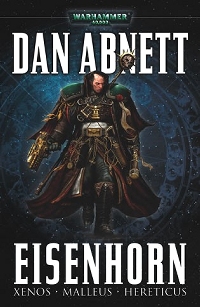
Eisenhorn – Dan Abnett – 760 pag
This is an omnibus, written small, and contains a complete series. It tells the story of an inquisitor, written in first person. This is considered by fans and reviews as the very best and most famous thing of the whole Black Library, recommended even to those who don’t have a particular interest in reading in the Warhammer universe. It should have a grand scale even if it focuses on one protagonist and should be filled with political intrigue.
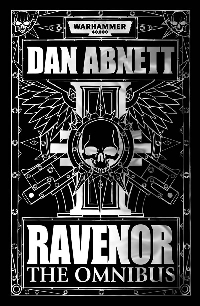
Ravenor – Dan Abnett – 890 pag
Another omnibus even more massive than the previous. This is truly sexy with the black cover and the stylized silvery embossing, spectacular edition. It should be a sort of follow-up to Eisenhorn, with various characters reappearing. Ravenor is the name of the inquisitor featured in this omnibus. Quality-wise this is compared to Eisenhorn, the first series is still considered the better one but the quality is supposed to be similar and if someone liked the first he should like this too.
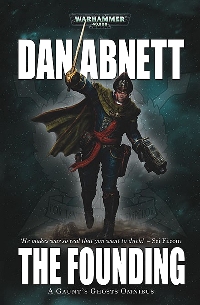
The Founding – Dan Abnett – 760 pag
Another omnibus, part of the series Gaunt’s Ghosts. There are two other omnibuses already published and a fourth in preparation. Quite a bit to read considering the others exceed the 1000 pages. It’s with this series that Abnett starts writing in the Warhammer 40k universe. Even if this is the earliest work, it’s here that Abnett got his reputation and in the introduction (all omnibuses have one) he says he’s absolutely proud of what he did here. I know the third book contained (Necropolis, which comes with a pretty map) got enthusiastic reviews and should tell the desperate story of a city under siege. From the handful pages I read I got the impression of World War II stories, down in the trenches and face to face with soldiers and their obsessions. The whole series has a good reputation, with the books filled with unrelenting action and good characters. It’s considered as some of the best military Sci-fi even outside the Warhammer setting (for example John Scalzi).
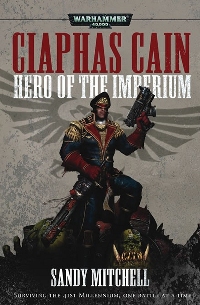
Ciaphas Cain – Sandy Mitchell – 760 pag
Another omnibus, but non-Abnett. Good edition with plasticized cover. From what I read this was heartily recommended as very good stuff much different from the dark, gloomy apocalyptic setting typical of Warhammer 40k. More lightweight and humorous. The subtitle reads: “Surviving the 4ist millennium, one battle at a time”. It tells the story of a “hero of the Imperium” written down by himself years later. The peculiar part is that this hero is in truth a coward who only tries to come alive out of the most desperate situations with a mix of luck and survival instinct. This even got notes at the bottom of the page and commentary written by the “editor”, so I guess with humor emergent from the interaction of these parts. The series doesn’t end with this omnibus since there’s already another out and a third in preparation.
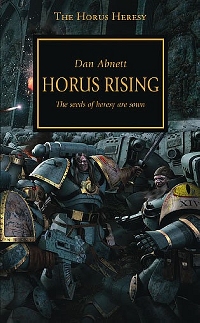
Horus Rising – Dan Abnett – 412 pag
Back with Abnett but not omnibus this time. Meaning that instead of a 800 pages monster this one is 400 pages (written bigger). This should be the founding pillar of a series of 15 books “The Horus Heresy” (halfway through at this time) written by different authors. It’s the tale of probably the most important event in the whole 40k universe, with plenty of repercussions. The book is considered the best of the best Abnett wrote as of yet, on par with Eisenhorn (Abnett then has a total of three books of his own planned in this 15-book series, and even if quality depends on who’s writing, overall the series should stay high).

That solves the mystery of 5 books for a total of 13. Four omnibuses with 3 books each.

Lots of stuff to read. I’m rather sure that I narrowed the best stuff to get here. I’ve read mention even of other good authors but this should be (way) more than enough to figure if it’s good stuff or not. I expect at the very least some good fun and a “calmer” companion while I tackle Erikson.

I started this book while I was well into Infinite Jest and I needed something else that I could read with the brain turned off so that I could sleep afterward. Infinite Jest was getting me obsessed and The Dragon Reborn was perfect and made me sleep rather peacefully. With such premise one would think I’m already putting the book under a negative light, but that’s not completely true. I’m not masochist, I read slowly and have no time to read (and comment) books that I think are terrible, so if I finished even this one it means that I have at least enjoyed it to an extent. The kind of extent of enjoyment is a key element that I think is rather important not only from my personal perspective, but also in defining what is that makes this series so widely successful and popular.

It is accessible, I’ve already said this before and it’s an important element, but what is truly meaningful to understand is something that was exposed in a snarky review written by this Adam Roberts guy and that I’m quoting:

The writerly-technical term for this is ‘padding’; but the prolixity is such a fundamental part of what Jordan is doing that I suspect it misses the point to object to it. I was reminded a little of Scott, and his swaddling swathes of garrulous prosifying (except that, unlike Scott, by bulk, about half of Jordan’s padding is dialogue). It has specific textual effects; and the one that struck me, on reading through it, is of upholstery. It’s a comfortable sort of style, like settling into a bath; a mix of stiff little archaic touches and chattily modern waffle.

Putting aside the (deserved or not) snark, what rings true for me is that reading this series is kind of pleasant. The comparison with settling into a warm bath is the most fitting he could imagine and one of the most important elements to which I ascribe the success of the series. Calling it in a different way, I’d define this perk as redundancy. It’s the redundancy that stands out in this series and in this book in particular, and that is a strength because in the same way the prose can soothe and ease into a bath, the redundancy helps to ease into a fantasy world and induce “immersion” (fitting word, thinking of baths). This redundancy, despite its negatives, is used as a quality here. It’s not just redundancy of prose style, but also reflects in the way characters are portrayed (idiosyncrasies that have fallen now into parodies well known among readers, with the infinite tugging of braids, smoothing of skirts or all three male protagonists convinced how the other is better dealing with women) and even the worldbuilding.

About worldbuilding. I’m still waiting. I’ve read how the series goes much deeper into describing the world and its cultures. The second book in the series opened things a bit and made them look more interesting and convincing than just a Tolkien-translated world, but this third book doesn’t really expand anything. Characters move and visit some key cities but the way these are described doesn’t add any meaningful depth beside listing some traits and differences. Which brings me back to the redundancy. Cultures are described in a simplistic way, mostly observed through the eyes of characters who know nothing about them, but this helps to define the perimeter of the setting. Nothing in the book appears out of the grasp of the reader. We get to know things in a way that is never staggering or unmanageable and, soon, we build familiarity. Familiarity leads back to redundancy and both have the effect of easing into the story and tag along. This is why it works. It comfortable and familiar, tension is kept under control and the redundancy helps to never feel like missing something important. The more the familiarity builds up, the more the ease into reading. Then he, Jordan, lets it flow.

It flows well even if I consider this book sensibly worse than the second in the series (that I thought was much better than the first, since it was starting to flesh out the world instead of simply mimicking devotedly Tolkien). In a total of 700 pages, the 650 in the middle are a very boring travelogue that doesn’t really add enough to the story to be considered entertaining. The second book had travel, but somehow Jordan was able to put at least something meaningful in each chapter, forming a deliberate structure that I thought was keeping the book going relatively strong. This one is just more ephemeral in meaningful content, it relies too much on the characters’ personalities which I also thought were particularly weak this time. While I didn’t overly noticed the characters’ idiosyncrasies in the first and second book, I felt as if this one was itself a parody of everything readers complain on forums and reviews. An endless stream of repetitive actions and thoughts that were themselves kind of circular and leading nowhere. This gave me a feeling of stall that made the travelogue even worse.

Bad habits in the writing style flare in this book, much more than the second. The whole first section of the book is one long coed sleepover with not one redeeming feature. The plot is rather stupid and utterly fails to build up a mystery that was already revealed as it formed. Characters and plots gets sensibly worse as they get separated and lack the friction and build up between each other. In this book they move on on separate stories too soon and by the time they converge there are only six pages left. The supporting cast is also thinner so, as a whole, I thought this one book failed to build something relevant. It felt too unwound and going nowhere.

Yet there’s something that I consider positive: characters evolve. Even if the book oozes immobility in plot, worldbuilding and characters, at least something happened between the books. This is important because it’s part of a strong thematic aspect of the book that I consider successful: there’s no turning back. As the series starts you see from the perspective of these farmboys and girls too scared of adventure and that would rather just return to their normal life. The book exposes enough of that familiar life so that it is familiar for the reader as well, so you get the feeling of how the scenery changes, you feel some of that estrangement and then nostalgia for the initial bucolic world. All stories seem built cyclically so that defeating the evil will bring you back right to the start and the happy life. Suspect builds, on a series of 12+ books, about plots being cyclical as well, one book copying the one that precedes it with slight changes. Instead despite the redundancy of certain aspects and structure, I felt that the characters are definitely moving on, that there’s no return and that the plot has at least a direction and that isn’t simply folding on itself and repeating. There’s a process of maturation that, even if it doesn’t fully affects personalities (being characters rather dumb), at least affects their roles.

I got again a certain satisfaction toward the last 60 pages, with the convergence. It feels like things start moving again and have a point. Jordan has still the quality of weaving the tapestry and having a control of the big picture, so when the pieces actually move in context this is satisfying, but the satisfaction didn’t last long because the actual final confrontation was stupid. Here comes the usual abstract battle between Rand and the evil guy, leading to one big revelation that left me completely indifferent since it changes absolutely nothing nor feeds any purpose. It’s just one unnecessary deus ex machina that fails even to build surprise (one also wonders why “evil guy” tries to strike Rand only the one moment when Rand is able to strike back). All characters are particularly retarded in this part, even worse between each other which made me dislike this (brief) reunion I was awaiting. Mat himself transformed for the whole book into a walking deus ex machina who can seemingly do everything simply because he’s “lucky”. So he pulls every kind of stupid stunts, makes plots align “by chance”, and even becomes an undefeatable warrior with a staff confronting veteran soldiers and whatever comes on his path. Boring, and on top of a character whose insubordination comes so much as a stereotype that I found it only annoying and arid. A character used poorly. Along Zarine, another character who could be at the very least fun, but that is destroyed by reflection upon Perrin, whose reaction to Zarine is totally pathetic and, simply, dull & unfun. It fizzles. Like damp fireworks.

This book puts aside much of the lore and infodumps that I at least enjoyed in book 2. They were at least shaping things up. Here instead there’s a dearth of ideas supporting the 700 pages. No new ideas, nor novelty in dealing with old ideas with potential. There’s some repetition. Only a very brief glimpse toward the end at the nature of evil, still done better in book 1 & 2. The bad guys are more willingly to say the truth than the good guys. There’s still a gray area that makes the bad side vaguely more interesting than just a stereotypical foe, something that works because Jordan takes it from a deeper truth coming from the real world, but that isn’t used well or up to the potential in this book.

I’m aware book 4 is considered by many the best in the series and adding some to the worldbuilding. Up to this book the setting has been traced not unlike the characters, with very typical and broad traits “borrowed” from real-world culture and often without original twists. I’m waiting for depth or even breadth. The characters still mostly don’t work for me. The traits that define them not only aren’t convincing but they also get annoying and I find myself enjoying a lot more supporting characters (Zarine here despite the mishandling of potential, Thom a bit less than usual since he’s been downplayed so that Mat could put his super powers on display, Loial, Liandrin, Min). I still enjoy the broad scope that sporadically surfaces and hints at more. If anything I found this third book as the most juvenile of the three while I hoped things would have progressed, even slowly, toward a more convincing (and engaging) maturity. Not all is lost and I still enjoyed the book enough to make to the end (and peeking at the first chapter of Shadow Rising, where’s the prologue?).

P.S.
There are various aspects I forgot to comment, one I wanted to add: I’m aware that the careful description of clothes has been criticized and considered excessive. I don’t agree, up to this book there’s always a purpose when it is used. The way people are dressed is a way to recognize who they are. Not only it differentiates cultures, but it also defines social structure and roles, and what you can expect from who’s in front of you. I don’t know if Jordan lingers too much in later books but here it’s done deliberately for a reason and provides infos that are useful in context. Another aspect is that, as I said at the beginning, I find Jordan extremely easy to read. I can read it before I go to sleep and when I’m tired. Not so much with other writers. There are fantasy writers that I enjoy much, much more than Jordan, yet Jordan is the one I return to more easily. That’s why when I begin to read just the first chapter of the next book there’s always the risk I won’t stop ;)

In the last two years, since I first discovered his books, Erikson has quickly became not only my favorite fantasy writer, but one of my favorite writers among all genres and classifications. And I started to ask myself what is that makes me “click” perfectly with some writers and not so much with others. What have Steven Erikson, David Foster Wallace and Roberto Bolano in common (the three most disparate writers I recently read)? I also got myself an answer: truthfulness. They write on the page things that are true. And I imagine the spontaneously arising question: how can a fantasy story be “true”? It can very well, and “Crack’d Pot Trail” is a most fitting example.

Recently I read a review of the first three novellas (not including this one, that comes fourth) that considered them a bit disappointing because they lacked a “serious” depth or actually gave something more to the characters primarily involved ( the necromancer Bauchelain & Korbal Broach, plus their manservant Emancipor Reese, the real star). This reminds me that the most devious aspect of everything that comes from Erikson’s pen/quill/keyboard is about the approach. Thus my warning, right here: this story of Bauchelain & Korbal Broach takes place, in-truth (and out-spoilers, trust me, for the whole length of this commentary), at the periphery of these characters. It is a story about them, but not featuring them. On the other side you get Erikson. Erikson himself, the writer, who put himself in the story unlike, not like, but still somehow similarly, Stephen King did with The Dark Tower. He’s there in the page and sometimes even pointing his finger and laughing at you, the reader. But, again, I remind you of the devious approach: the laugh is not scorn, just affinity. Sympathy.

The novella has a plot, it has a direction and drive, it moves toward a resolution already from the start. Akin to other fantasy and non-fantasy plots, it is also a journey. But in this case the plot isn’t the idea that truly builds the novella, there’s a metaphorical one that more strongly takes the scene. So two parallel binaries of purpose and narrative intent, both requiring payoff before the end, while also getting entwined enough to not be simply juxtaposed. Succeeding in doing that is not easy task at all. The novella is written beautifully, as I already raved weeks ago, almost to the point of showing off, stylistically brilliant, but in the second half I started having some serious doubts that it could get a satisfying resolution. Doubt that increased exponentially when I had just 10 pages left to read and still unable to see things possibly coming together in a decent way (no matter my own doubts were repeatedly voiced in the story itself by both characters and narrator). Then Erikson is able to pull it, masterly, in like 3 pages. It comes all together in three pages.

While the plot moves in a direction (an hapless bunch of artists, hunters, and champions of rectitude, together in necessity, on the heels of our infamous necromancers), the real story is about the relationship between art and audience. The artist, the critics and the public, seen from all possible perspectives and often metaphorically, but in such a case that a metaphor is, right the story, always executed literally, very real and sound (which I don’t explain here to not ruin the greatest idea/association in the novella). The tortuous relationship is made focus and explored without filters. What, elsewhere, readers often mistake for boisterous arrogance (on the part of Erikson, toward readers) and are ready to jump upright and accuse, is instead a skewed perspective because Erikson never defends univocally one side, and what appears as spite and mockery (sometimes even truly, but healthy, as part of all relationships) is also always parody of all parts included. The audience as well the writer (self-parody as well self-doubt are featured, hopefully not smothered and forgotten after the ending, that does take a side but that shouldn’t be interpreted as the author’s own true belief that erases all doubts before, in a kind of very, you know, un-subtle way, on the part of the reader. But we’re spinning again here and you never know which side you end up facing).

Which falls perfectly in the trick that makes the book, as subjects and objects mingle together and you can’t discern anymore if you are reading a parody or if you are yourself the object of parody, the one who’s laughing or the one who’s being laughed at, or maybe just staring at yourself in a mirror, playing both roles, that also connects with other layers inside the novella, both as themes and plots. Which novella essentially is: a satire, a parody. Totally un-subtle, not even trying. As satires are meant to be: all-encompassing, clever, malicious, deceitful, outrageous, disrespectful, defiant, very politically un-correct. And, essentially: truly subversive at its core since it lacks even a verse. There’s no safe ground. Everything and everyone is subject of scorn as well as compassion. No filters nor prejudices, just a razor sharp sight that spares no one.

Well, no one besides Bauchelain & Korbal Broach, who, you already know, are just meant to win even when they lose.

The premise that founds the story: who’s more useless in the world than an “artist”? (especially a world where first priority is just surviving) And what if, to justify their existence, the artists were made to pay with their own life if their art was judged not entertaining enough?

And what if democracy (voting for: life or gallows) was made of stupids and illiterates who would only reward the worst of the artists?

As you can imagine I loved this novella as much I loved the previous three. It’s not a mad rush as The Lees of Laughter’s End, not as funny and as entertaining, but it has a similar drive of The Healthy Dead and quality-wise I judge it above. Sharper and more outrageous. Plot-wise it only shines toward the end and slacks a bit in the middle, but the payoff in the end redeems that aspect, as long you don’t expect the plot and just the plot to drag you along for 180 pages. As in all cases, you have to be interested in what the writer is writing about, and in THAT case there’s no slacking or word wasted even here.

“So I pose the following provision. Should she decide, at any time in your telling, that you are simply… shall we say, padding your narrative, why, one or both of the knights shall swing their swords.”

It also reminded me I love reading.

P.S.
In the 181 pages there’s also space for zombies (yes zombies, not T’lan Imass) and a good amount of graphic sex that will make you chuckle a lot (in a good way). Oh, and also a god addicted to masturbation.