I’m watching these interesting lessons on Kabbalah and this one deals again with another aspect that is featured predominantly in Fantasy as well. Being normal since Fantasy also deals with the pillars of our culture and Kabbalah deals directly with that as well.
In this case the theme is the Theodicy and its possible explanations:
— First Method: Nature
Hence, although He watches over the existence of reality with wondrous wisdom, yet He Himself is mindless, and does all that senselessly. If there had been any reason and feeling in Him, He would certainly not leave such malfunctions in the provision of reality without pity and compassion for the tormented. For this reason, they named Him “Nature,” meaning a mindless, heartless supervisor. And for that reason, they believe that there is no one to be angry at, to pray to, or to justify oneself to.
Second Method: Two Authorities
In consequence, they came to a second assumption that there are two supervisors here: one creates and sustains the good, and the other creates and sustains the bad. And they have greatly elaborated that method with evidence and proof along their way.
Third Method: Multiple Gods
This method was born out of the bosom of the method of two authorities. This is because they have divided and separated each of the general actions for itself, meaning strength, wealth, domination, beauty, famine, death, disorder, and so on. They appointed each its own supervisor, and expanded the system as they wished.
Fourth Method: Left His Operation
Recently, when knowledge increased and they saw the tight linkage among all the parts of Creation, they recognized the concept of multiple gods to be completely impossible. Thus, the question of the oppositeness sensed in Creation reawakened.
This led them to a new assumption: that the Supervisor of reality is indeed wise and caring. Yet, because of His exaltedness, which is beyond conception, our world is deemed a grain of sand, nothing in His eyes. It is not worthwhile for Him to bother with our petty businesses, and this is why our livelihood is so disordered and every man does that which is right in his own eyes.
Alongside these methods, there existed religious methods of Godly unity.
—
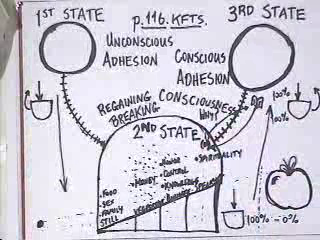
Then the lesson proceeds explaining Kabbalah’s solution of the problem through this simple graph:
Almost a year ago I gathered some info about the Kabbalah, but then curiosity was quenched and I didn’t go very far. Now curiosity rose again and I’m determined to get further into it.
It also means I’m starting to draw parallels, of the most disparate kind. Here I’ll collect a couple of posts where I link the Kabbalah, Scott Bakker, Steven Erikson, James Hillman, Niklas Luhmann, Evangelion, Lost and The Matrix. It’s a nice geeky party.
—
Not trying to close the circle because I don’t feel I have enough elements.
Just a few suggestions.
“a way to successfully manipulate and interact with monstrously complicated systems”
Niklas Luhmann is a sociologist I studied that I still base my fundamental beliefs on. His theory has a place for pretty much everything and is usually dead on (explaining from the evolution of men till modern days).
One of the fundamental ideas is that beliefs systems, religion and modern systems were essentially created to go against uncertainty. Linguistic acts. If the answer to whatever question is always “yes” and “no”, then you need some kind of system that reduces the complexity and makes something just “yes”, or just “no”. Put linguistic order into chaos.
So religion is basically a way to set a “yes” (or “no”) and have no one who can go against it (it’s more elaborated and, well, convincing of this, but the essence is this). “Faith” being the premise for this system to work, so the prohibition of returning to ambivalence and complexity.
Today, he says, it’s pretty much the same but the reduction systems are much more elaborated and he calls them something that translated sounds like “media of communication symbolically generalized”. And so more complex relationships about values, truth (science), love, art, money, property, rights and so on.
I was thinking about this: anthropology basically tells us the same. Religion we know as being totally “wrong”. We know it doesn’t rain because a god is pissed, so the belief system is wrong. Yet today we also know that all these belief systems had a pragmatic purpose and helped societies to survive.
Which means that in the end the same structure you describe is repeated: “He doesn’t care so much whether intentionality is real, as he cares whether its useful”
Religion too. Doesn’t matter if religion says something true. The point is that it can say something useful that can lead us (somewhere?).
“Of course, the problem is that ‘we’ are just a small part of our brains.”
And this reminds me a comment I wrote down on the Malazan reread. Where I go from the ideas of Kabbalah (I explain them wrong btw, but they serve the point) to the idea that “magic” is still well alive under the stream of consciousness (while we are only “aware” on the surface, the conscious, logic level).
—
(here’s the comment about Kabbalah, James Hillman, and how magic exits through a door, Science, only to reenter from another, the undercurrents, the Midnight Tides)
I wanted to go off for a bit on a tangent to see if maybe someone else got curious like I was. I find fascinating what Erikson says about the way he deals with symbolic subtext because that kind of subtext and complexity is one of those aspects I enjoy the most in this series, and overall in general.
Erikson (not really) demanded if his way of writing is an odd personal quirk. I haven’t read Robin Hobb yet, but Gene Wolfe surely writes in a way where everything is openly symbolic. For me even too much because I consider Wolfe too cryptic and so most of the subtext is lost without having a bottomless knowledge to draw from. Too often to truly understand his book you have to have with you knowledge that isn’t offered within the novel. It’s “esoteric” writing, meaning that one truly understands it only if one has the “code” to interpret it, and so belongs to the group of those “enlightened” (the Illuminati, the typical esoteric group).
From my point of view Erikson satisfies a vaguely similar demand, in the way symbolic meaning and subtext are often quite important, but doing it in a way so that everyone has access to it, as long one pays attention and has patience. It wants to be accessible, and it is a similar quality that I find in David Foster Wallace, whose “Infinite Jest” is, if I can say, even more complex and intricate than the Malazan series, and also exceeding in subtext and symbolic meaning. Yet it is completely accessible, as long one has the patience to go through a 1000+ pages book with that kind of complexity.
These days I was reading about the Kabbalah, just for pure curiosity. The Kabbalah is all based on the fact that its holy books can’t be read for what is literally written in them. You read about things and concepts that are normally part of the world, but all those things are actually “symbols” for something that belongs to the world of spirituality. These books are in truth only “codes”, and to understand them you need a Kabbalist that slowly teaches you how to attain this higher world of spirituality.
Now, through the anthropological mindset, this is quite easy to debunk. The moment an idea can’t be expressed in words, that idea acquires magic power. It can’t be scientifically known. It’s the old trick of the “magic healing bones”, that, if you aren’t one of the shamans in the tribe, can’t see or touch, because you’d then recognize that they are “just bones”.
Magic is meaning by absence. Magic is language. Or: magic is the absence of language. Magic defines the perimeter of something unknown and untouched. “Holy”. Forbidden. Removed.
The magic quality is in the premise of “faith”. Acceptance of blindness.
So it seems to me that the Kabbalah works on similar premises. The knowledge is somewhat elitist, because the world of spirituality is essentially esoteric, can’t be put directly into words.
Now I even accept that because I think writing corresponds to omnipotence (how’s that for a writer’s ego?). And it’s not an abstract idea. It is easily explained.
Writing is not one of the many human activities. Writing simply INCLUDES everything that a human being can experience. What we are is contained within the perimeter of language. People sometimes think that a “thought” precedes language. But if one makes some simple linguistic studies it’s easily learned that “thinking” is always a linguistic act. There’s no separation between thought and language.
So we are fictional beings. All of us. There’s absolutely no difference between a character in a book and us real beings. Or, the only difference is in the complexity (speed) of perception. Meaning that an instant of our life would require millions of pages to be expressed in its entirety. (this Total Awareness is a theme in Infinite Jest)
It’s then consequent that magic, the supernatural, spirituality (so the Kabbalah, in my example), need to stay outside language. Outside the human perception.
But then it seems that language is only a surface. Psychological studies done by Freud and similar demonstrates how much moves behind the scenes, and below conscious thought. People think of acting logically, but are instead moved by way stronger undercurrents that they rarely understand or are consciously aware of. We learn of how fucked we can be if a trauma may have devastating consequences on our daily life.
And then there’s more, which is the point where I wanted to arrive. After Freud there’s a deeper level that is usually represented by Jung. And then there’s another, even deeper, represented by James Hillman (and btw, all I know comes by just look up the wikipedia and having read some parts of his most known book “The Dream and the Underworld”, so if you’re curious you can just look up the wikipedia and there’s already enough to deal with). Whose ideas may sound as crazy as those of Freud to someone who never heard about these kinds of psychological studies.
What he thinks is that our dreams not only are dense in symbolic meaning, but that this symbolic meaning is rooted far below: in myths. So he analyzes dreams through things like Greek mythology. And even if this sounds completely absurd, it’s still as grounded and concrete as every other psychological study and has obtained attention from those who study this kind of stuff.
Erikson’s pantheon and magic system have more than one thing or two in common with Hillman’s archetypal psychology. I’m reading now Midnight Tides where dreams again have a significant role and divinities are dealt with in a “literal” way. But all I’ve written here wants to hint that there’s more than a fictional dress. More than entertainment. And even Hillman’s principle seems to adapt well to describe Erikson’s work: “dreams tell us where we are, not what to do.”
And so back to what Erikson said about his symbolic writing and especially: “I had a film teacher once tell me that I see the world like a Russian novel. I asked him what he meant and he said that I see subtext in all of reality, that for me environment was symbolic.”
In the end it goes back at finding something authentic to write about. I’m simply saying that this process of looking for symbols isn’t an authorial quirk and actually carries with it in potential a huge power. It is universal. And, in the hunt for meaning, if the building blocks are authentic then the outcome will be too. The truth that builds the foundation is inherited by the rest. Whether completely conscious or not.
—
I want to quote one of those poem of Erikson I just read:
“There are tides beneath every tide
And the surface of water
Holds no weight”
“The problem is the chasm that seems to be opening between the world we experience versus the world we know”
What about the chasm between the world we don’t see (deep symbolic level) and still has a determinant impact on us?
(thanks to the accumulating horror that is the subconscious)
“I think we are hardwired to believe in magic of various kinds”
But magic in the end is a linguistic structure. I’ve studied a bit of Chomsky and I know that we are hardwired for language before we are hardwired for anything else.
NOTE: I plan to add here a video that will look like the weirdest mix of The Matrix, the Kabbalah, Evangelion and Lost/DHARMA Orientation videos.
Curiously enough, my reaction to this book reflects the palindromic structure that defines a powerful form of poetry called “ketek” used in the book: I did not like at all the first and last 50 pages, but thankfully enjoyed enough everything in between (that for a book of 1000 pages is quite enough). I wrote already about some of my concerns about the writing in the Prelude/Prologue, while what I didn’t like about the last 50 pages was more structural. 150 pages from the end of the book I already know the ending was going to disappoint me, in fact it did, for the reasons I had envisioned, but that last chunk was worse because it makes me reconsider critically the whole thing.
Without spoilers, I can say the Epilogue questions the true value of art. It reads somewhat like a “meta” discussion on the genre, and implicitly Sanderson’s role as a writer of Fantasy:
“In this,” Wit said, “as in all things, our actions give us away. If an artist creates a work of powerful beauty – using new and innovative techniques – she will be lauded as a master, and will launch a new movement in aesthetics. Yet what if another, working independently with that exact level of skill, were to make the same accomplishments the very next month? Would she find similar acclaim? No. She’d be called derivative.
“So it’s not beauty itself we admire. It’s not the force of intellect. It’s not the invention, aesthetics, or capacity itself. The greatest talent we think a man can have?” He plucked a final string. “Seems to me that it must be nothing more than novelty.”
So it’s “novelty” to be the heart of art, but that’s only the partial answer, because then the Epilogue goes further to suggest the ultimate one:
“What is it we value?” Wit whispered. “Innovation. Originality. Novelty. But most importantly… timeliness.”
Now… Am I too naughty if I just can’t avoid thinking this last line as a prank on Sanderson’s own doings? If “The Way of Kings” can’t be innovative, original or novel, then maybe it can still be used fruitfully if it’s at least “timely”. And what’s more “timely” than launching your own 10-books series right amidst the release of the very end of the Wheel of Time, when the interest in said writer is at the highest peak? The Way of Kings is indeed quite timely. Well, I don’t understand what Sanderson wanted to do with this Epilogue, but I doubt very much he wanted it to be interpreted like this.
A step back. This is the first book of a 10 book series and Sanderson’s most ambitious effort. And not only since he already hinted at an even much bigger structure (especially “Hoid”, a mysterious character that transcends what happens in this book) of which this whole series is only a part. This doesn’t discourage me at all since I enjoy insane ambition and I also, contrary to most readers, prefer to read books in a series spread out instead of in quick succession. So I start here and expect to follow along whenever Sanderson will finish the next book (it will be a while and the wait will likely renovate my interest). But it should be said that, as it is now the habit, the book does a nice job offering a storyline that is concluded in a satisfying way within the book, while hinting more about what is to come. It means that one shouldn’t be discouraged by the fact it’s only one book, with the following one not coming out for a couple of years.
Can’t say anything how this book stands compared to those the author already published since this is the first thing I read of him. The writing style of the Prologue was for me so awful that I wondered if I could go on, but then those issues vanished from the first chapter onward. Partly because I was drawn more into the story and characters, easing to the writing style and so not using up all my attention nitpicking, but also because those aspects I dislike were more diluted and less prevalent. There’s something in the style of writing that works at the same time as a strength and weakness. I’d define it as overall “didactic”. Not a bad word, but it could be seen as problematic in this context. Sanderson is very good at explaining stuff, teaching somehow. For a first book in a series this is a strength because there’s a lot of attention in giving the setting a distinctive sense of place. The nature of the world demands that details like plants and atmospheric interaction with these plants are strictly involved with what is going on in the story, so the book carries the reader along in a learning experience about this world, letting all (important, not simply incidental) details being slowly absorbed. There’s some redundancy involved, that at times feels excessive and giving the idea that the writer doesn’t trust enough the receptiveness of the reader, but there’s more to it that can’t be dismissed. The book, on a higher level, is “curious”, and stimulates curiosity in the readers. This is why exposition or “infodumps” that take a significant part of the book aren’t detrimental or heavy. The recipe, I think, is the most successful part of the book. You have a very manageable number of characters, well defined, easily understood, and you borrow some of their positive traits, including the curiosity for the world. Constructive, well measured. An aspect I noticed that is linked to this overall “didactic” writing style is an excess of question marks. There are questions crowding every single page. Many questions. The question is the most significant foundation the characterization relies on here. The effect is that the main characters that drive the book are very transparent to the reader. Every thought is introduced by questions, explained, rehashed. Open books. Characters whose totality is easily grasped, so easing the identification and understanding of actions. Even in those few cases where characters have some secrets (Kaladin’s past and flashbacks through the book) you are only forbid the premises, but you still see clearly the consequences and left wondering what caused them. It tickles the curiosity without making characters act unpredictably. You know exactly who’s doing what and why, and this usually leads to a decent characterization.
Everything I said leads to another problem, though. The micro and macro levels, about which I’m more critical. What I mean is that the book works on two levels, as an overall structure. In general all long epics rely on a similar structure. The “micro” level is the single character PoV, his own plans and actions, his range of troubles and expectations. The “macro” level is the higher level of the plot, the overarching structure of greater import that links all characters and make them face much bigger scenarios. The fate of a world VS the fate of a character. It’s like a shifting level of detail: you can zoom in closely on a character, get carried on with his daily life, slice of life. Character’s stories on a personal level. A fantasy world is like a huge container of millions of lives and millions of stories, so you can ideally always zoom in and find something personal that is worth narrating and that will catch the attention. Kaladin and Shallan are the two main characters in this book that carry the most this “micro” level. The interest is focused on the immediate troubles and their potential solutions. The various chapters are neatly organized to drive the reader on, ending up teasing for more. Then there’s a macro level that defines where these and more characters stand in the greater scheme of things. The book does not hide one level from the other and makes the macro level very visible right from the start. You always have the idea there’s more at stake than what is immediately close, the larger horizon. But this is where for me the book didn’t quite reach. What I anticipated through the book didn’t happen within the book and I’m not even sure of how late it will come in the series. There’s a very long and large build-up, both macro and micro. The micro works (with reservations I’ll explain), but the macro is entirely undelivered.
In the end, having read the whole book, the structure feels too much like ASoIaF: imminent danger coming from a side of the world (east, this time), but the kingdom is divided and not prepared. And, as in ASoIaF, this is the situation at the beginning of the book, and it is the exact same situation by the time the book ends. Nothing moved on the “macro” in a sensible and significant way. Even worse, the end of the book gives a strong idea of sweeping changes that to me look like blatant illusions thrown at the reader. I fear that book 2 will show how nothing at all changed and we’ll be plunged for another 1000 pages in minor character squabbles, only to arrive to the last 50 pages and have again sudden hints of major plot twists that in the end consolidate to almost nothing. Too much set-up and too much economizing on this level. It feels very drawn out.
On the micro it works much better. There’s plenty of payoff, lots of plot twists and unexpected surprises, all cleverly handled and satisfying. It works on these details, but I have some reservations. The first is that with a slow moving, carefully detailed plot, you can see where things are heading sometimes HUNDREDS of pages before they happen. While this micro level is fun to read, this kind of predictable horizon can cast on it a negative shadow. You know where things are headed, even if you don’t know the specifics of how it will be done. These specifics are well built and receive a significant care from Sanderson, but if you know where they are going then you also have a jaded and tired reaction, and it detracts from building momentum and make for a fast, satisfying read (what other readers call “the book could lose another 200 pages”). The other reservation is the odd structure. With three or so major viewpoints one expect the chapters to alternate regularly, but not here. Kaladin is basically the only one constant through the book, alternating with whoever is on stage at that point. Shallan viewpoint is a significant presence for half the book, but then it vanishes in the middle only to reappear in the last 100 pages. Similarly, Dalinar arrives late, then vanishes for 300+ pages before resurfacing again, and it wasn’t something I enjoyed much since it was my favorite to read. Obviously there are good reasons why this uneven structure is used, but it adds to the negative feel of plot moving slowly (not exactly, I explained in this same paragraph what I mean) when you consider that these viewpoints depart for hundreds of pages before they can lead to something.
Another concern I have comes out in the latter part of the book and has to do with the plot being too clearly driven by hand. While Sanderson does a very good work explaining characters’ motivations and actions, so making a reader accept the number of fancy elements of the plot, giving it an idea of coherence and credibility (worldbuilding included), in the latter part things are drawn together in a very blatant and obvious way that makes everything fit in place for the intended effect. Said intended effect predictable in a number of cases. Too much straight heroic, a bit trite. Also by the end of the book Kaladin still is the recalcitrant hero he was at the beginning, and that side of him was getting particularly annoying. I had expected to see him changed in a more significant way beside the superpowers. And feels too much like another Rand, on this level.
Instead I liked what was going on the political level and liked particularly the conclusion on the micro level here. I felt like this book somewhat “healed” a wound open since “A Game of Thrones”. As if Sanderson wanted to tell that story in his own way. I think it worked well and I enjoyed it. Obviously I can’t tell anything more without spoilers, but, even if this book won’t challenge Martin’s, I still liked Sanderson’s take. The politics and internal struggles are far more simplified than in A Game of Thrones, not actually the focus, but the interplay is well done and well built. Well connected with the worldbuilding related to it.
Not surprising that Sanderson is not between my favorite writers, I didn’t come with that kind of expectations. But I enjoyed the book even if I expected something more significant to happen before it ended, something more bold in exposition (and a number of suspicions I had stay unconfirmed since the book didn’t provide answers for most those questions I thought intriguing). It’s an accessible book that can be easily recommended to readers who enjoy lingering with characters and feel immersed. It has many qualities on its own, but I think it misses something like a major draw for the public that the Wheel of Time has. Sanderson will have to work harder if he actually aims at excellence. For now he has a nice following and in the end I think he deserves it. He’s a good guy, clever enough to be interesting to read, and would make a very good teacher, actually. He’s one of the guys who “care”, or at least it’s the impression I get from reading the book.
P.S.
Couldn’t fit in the flow of the review, but my favorite parts of the book were the interludes, especially Axies who reminded me a bit of Malazan’s Heboric, and chapter 33 “Cymatic” with Shallan, for how it engaged with the macro level and was quite interesting to read.
Collecting some comments I wrote in the Malazan series re-read at Tor.
— Tyrion or Jaime or Sansa in GRRM’s series where there’s more transition that leads to personality changes and development.
Oh, I so disagree. Martin, in those cases and more, just expertly pulls at heart strings. Whatever he does with a character is VERY deliberate and very precise.
If even one reader develops antipathy for a character like Tyrion, then it means the book failed. There’s nothing truly open to interpretation if not the illusion of it. Martin always chases an effect as is typical of Hollywood/western writing. Nothing can be accidental or uncertain. Which is why he writes and rewrites incessantly till the experience isn’t absolutely perfect and works the way he wants for everyone. The book is built to be successful when EVERY reader has the exact same response to it.
Tyrion is one of those characters whose negative traits are cleverly exploited to ADD to his sympathy. It’s anti-hero done in a trivial way (written and executed well).
With Felisin instead Erikson creates a character that can trigger a different response depending on how you approach her, and there’s no “right” or “wrong” way to get the character. I’m not more “right” than you saying that I loved Felisin. Erikson doesn’t shove the reader in a specific direction that “feels” natural but that is instead carefully defined. It’s not on rails. Whatever you draw from that story is up to you, a subjective emotional response and all the “truth” about it, you keep it to yourself and no one can say you’re wrong. The character arc has nothing of the typical uplifting destination, and a lot of true ambiguity.
People always tell say they love gray characters when what they love is to read heroes who are “gray” only in a slight, but pleasing, nonconformity that feels very “hip” and “modern”.
Martin is a great executor and a very good writer. But it’s all pre-chewed material.
I also kind of chuckle when I see that “maturity” is taken as synonym of wisdom and moderation. But it very rarely is. Maturity only defines someone more broken than another. It’s just a collection of the number of pieces you’ve shattered into and how deluded you are about them.
Nope, you’ll rarely get to put the pieces back together. And that’s is valid both for Felisin and everyone else in the real world. Well, besides fantasy stories. In fantasy stories you can.
—
When I started to read the prologue of DG it was right after finishing the last page of GotM, I was well aware of who Felisin was and also of the fact she was going to be a major character in the next book.
The prologue starts with a very cinematic scene. You can see the camera panning while following the Hood Priest. The Priest is the initial focus of the scene and the PoV follows it as it walks toward its mysterious destination. Only after this initial set-up Felisin comes into play and we discover that it’s instead her PoV. We see the Priest approaching right toward Felisin, who’s merely an observer of something that seems to have gone “wrong”. Feelings of foreboding, the slaughter, the season of Rot, the mule, but still no mention of how this is going to be related to the plot (or to Felisin, she’s still out of the scene, out of perceived threat).
So up to this point Felisin is an external/passive observer. It came to me as a total shock that she was chained with the others. You have this Priest walking toward someone or something. Felisin wonders if it’s really her to be the target. But for the reader this becomes about discovering that it’s her the *victim* already. There’s no way out. We have been shown a Felisin chained right from the start, without any hope to get free. The fate is sealed.
Usually we see a character who faces danger and struggles to find a way though. We read anxiously how the story develops. It builds tension. Here we are thrown in a situation in which “possibility” is crushed. The chains locked before the first written line but the reader’s realization comes with delay, and in the text is completely understated, almost tangential. The scene is then followed by an escalation of brutality that shows clearly that there’s no way to turn back. It’s a path carved deeply into hell and the more you go down the worse it is. Even if you find a way through and up again the price you’ve paid would be already way too much to find any sort of absolution or justification in it. The threshold has been already passed and the reader somewhat forbidden to experience any sense of hopeful possibility.
What’s worth saving is already irremediably lost.
I’m still awed by the prologue and how it works spectacularly on its own. In two pages the reader goes through the feeling of having chains locked by having Felisin only entering the scene last. It’s her PoV right from the start but Erikson structures the scene so that the perceived PoV is completely overturned as one reads. From a side we have a cinematic scene, from the other we have an effect that is basically impossible with a camera, since the PoV would be already “bound” to the character.
Erikson uses cleverly everything that is unique to the writing medium. Even a small scene like this is brilliant not just because of what happens, but in how it is carefully structured and narrated word by word. Defiant of expectations, and ambitious.
— Whichever way you look at it, I don’t like the idea—it makes me deeply uncomfortable.
I guess it’s worth discussing. On your blog you posed the question whether “rape” can be “art”. The discussion is broad, but also quite straightforward from my point of view.
What’s the purpose of a book? Flatter its reader with edifying stories and encouragements?
Is “art” whatever we enjoy, and non-art whatever we despise and contemn? Is art exclusively self-congratulatory?
The point here is that the book will tell its story. The book has EVERY right and legitimation to tell its story without censorship. It’s the reader who decides how to personally weigh what he reads.
So should a book just tell a story that makes its readers comfortable and content? Nope, all stories are legitimate as long there’s someone who wants to hear them.
At the same time not feeling comfortable with a story and refuse to read it, is a personal and legitimate choice that should always be respected.
So I really won’t support the idea that criticizes Erikson for tackling certain themes that may hurt common sensibilities. Every reader can make there a personal choice whether or not to read it, but one can’t attack a writer for writing outside certain expectations.
Writing, as part of culture, MUST break through imposed or perceived barriers and limits.
And I write this not because someone has stated the opposite, but because that idea always lingers in these types of discussions.
— I think it is too ingrained in some people to be judgmental about her trading sex for favors in the prison camp. Or the drinking and smoking scenes, just because we tend to frown on that as a modern society
You can as well stop that first line at “it is too ingrained in some people to be judgmental”. That’s enough.
I’m very, very uncomfortable even thinking of JUDGING Felisin personally. I feel it very wrong and perverse.
I think personal choices are always to be respected because the external point of view is so hypocritical and partial. It’s too easy to nitpick from the outside about the personal choices someone else makes. It’s haughty and arrogant.
Felisin makes choices that are solely about her. She hurts herself in some cases. She never deliberately takes action against someone else (at least up to this point).
So, whatever is her choice, I would always respect it because it’s not a restraint on someone else’s choice. Maybe not approve it, but respect it.
People shouldn’t tread carelessly and be judgmental over pain and trauma of others. It’s a delicate topic.
Even posing the question whether one of her choice is “right” or “wrong” is about taking a truth out of it and rationalize what can’t be rationalized.
The pain with this book more than reading it is trying to write a review. How to frame it? It left me reeling for sure. There are a number of ideas explored that seemed to echo with some my own thoughts pre-existing the book, this further reflected toward the end of the book by a strong in and out of text deja-vu whose implications are far too tangled for me to make any sense of them (I should also try to second-guess some that Bakker did, that would bring a whole new level of complication). Just to say: the book messed a bit with my head. But that was almost expected, knowing well the kind of writer. The blending in and out of character, in and out of the book, and between facets of different characters echoing each other is a prevalent defining trait.
I’ll try to introduce things. This is a lean book, 249 pages, written in first-person by a private detective that at once fills the canon and pushes it beyond extreme. Bakker is the kind of writer that when sees a boundary pushes down on the accelerator. What’s absolutely banished and tabu is any idea of moderation or compromise. But in the beginning we have the broke and cynical private detective with his filthy office next a filthy road, who fucks his secretary and is a smartass all around. Very anti-hero. Very pulpy, very effective in positioning itself in a category easily recognizable. The story in the book will be about investigating the case of a missing attractive young woman that was caught in a religious cult of weirdos who think the world is about to end and that everyone of us is only playing a role on the stage of a fake theater. All Matrix-like (including the technology, but don’t focus on this distracting element). The catchphrase supposed to sell the book is: “Imagine being able to remember everything you’ve ever experienced.” That’s the peculiarity of our detective but, voided of its implications, only sounds as quirky and not all that potentially intriguing. I’m sure the cult’s belief is much more seductive for the occasional reader.
Coming from this perspective the core of the book is in how the two aspects feed and become mirrors of each other. We have different layers that repeat the same idea, we have parts of the books that repeat, we have characters that repeat, and we have “repeat” as an concept thoroughly developed. Having a “perfect” memory here isn’t the meta-device for the unreliable narrator, its implications are much more far reaching and pervasive. It messes with reality, it lifts a veil, it reveals what one won’t be able to endure and adapt to. It’s a door. Once you pass through the threshold there’s no way of coming back. It’s THE enlightenment:
“Psycho? What do you think happens when God – the God Almighty – lands in your brain? You think you stay sane? Read your Bible, bitch. All his vessels crack. All of ’em!”
Only that is one, of the many, false trails. One twisted mirror. A hint of truth dressed as the blatant lie. It puts in the seed of suspicion and lets it soak. This books actively manipulates you, and it does it blatantly as more subtly at the same time, without you noticing it. One consequence of having a perfect memory, the one that is the most representative of its unsettling potency, is about the perception of “people”, as I already described it:
We, “normal people”, perceive expressions and attitudes of others like something transitory, while the people themselves are real and come first. But for him, his perfect memory makes him recognize the same expressions and attitudes across different people, to the point that it’s those expressions that he recognizes and categorizes, while the people themselves become transitory. People that appear as collections of deja-vus and known patterns. People that repeat. Masks. Oblivious actors playing a role, rehashing over and over.
The perfect memory is a bug in the system. An error. A joke the nature played on him. Birth defect. As a human he simply does not function correctly. But what if this condition reveals a truth that wasn’t supposed to be disclosed? What if this truth is too painful to endure? What happens if you lift the veil of reality and watch in horror what’s beyond? What if there’s no way to pull it back down and pretend you haven’t seen anything? “All his vessels crack.”
Bakker is more known as a fantasy writer. “The Prince of Nothing” series I’ve recently started to read. Facing Disciple Manning, the cynical detective of this book, is the same as facing Kellhus, the prophet from The Prince of Nothing. In the prologue of that book Kellhus meets Leweth, a guy living a solitary life in a forest. In the short time they pass together Kellhus “lifts the veil” on Leweth’s life and makes him realize that his life was all built on lies he fabricated by and for himself. With that realization comes the death.
Ignore the Merge sign long enough, and sooner or later somebody gets killed.
Truth destroys, it doesn’t heal. Breaks you. Forgetting is healing. Even the idea that “truth” is desirable is a conceit, a lie we tell ourselves. The point is: we are hardwired to be stupid, to be hypocrite. Hypocrisy implies a certain amount of forgetfulness. To forget all those things that can’t be manipulated to our own advantage. The brain shields from truth, it has safety triggers so that we can lead a functional life. Truth instead has the power to “dislodge”. The insight you gain is dangerous and may well destroy you. Once it’s done there’s no Matrix-like blue pill that can save you. You stop working the way you’re supposed to, think out of the frame and you’re doomed. You bit the apple from the Tree of Knowledge: God hates you. (Hint: David Foster Wallace didn’t survive himself, Hal in Infinite Jest freaks out once he becomes too aware and can’t sort things anymore. People break all the time when they start seeing too much. Insomnia is the state of the mind when it works too well for its own sake.) Living with a perfect memory corresponds to see the horror, without pause. Every instant. You can’t filter, sort, select, reinterpret. You can’t find a way out that makes life and suffering bearable. You can’t find meaning, belief or excuse. There’s no place to hide from yourself.
Reading this book is like having a face down directly with Kellhus. With the difference that you do not have a Leweth playing as a filter, here Kellhus/Disciple talks directly with you and his “social commentary” will stick needles in your skin. He is an ass, he is egocentric, he is arrogant:
I sit in perpetual judgment.
But it’s through understanding that you see all the flaws as necessary and justified. Stepping back, it’s like Bakker himself is trying to pick flaws in his reasoning, try every possible perspective to find a breach, whether through cold reasoning or through defiant irreverence and constant scorn, but the result is all the same.
“The Framers” is the name of this religious cult and their belief becomes a very slightly distorted version of what Disciple represents. They have two opposite stances, him and the cult, appear as adversaries of opinions, but soon you’ll see how the two different perspectives overlap and match almost perfectly. Disciple sees people as actors and collections of deja-vu. Self-deluding machines who build their own conceits and prosper in false belief. The Framers believe that everyone is an actor with no perception of the actual “true self”. The difference is merely in context and visualization. Where Disciple stops at showing the conceit without providing answers, The Framers “dress” it and contextualize: the world is about to end and we live a dream as the only way to escape.
I’m aware that Bakker’s first effort out of the fantasy genre, Neuropath, was criticized because it was too much “theory” and not enough story and characters. As if reading like a textbook. What Bakker achieves in this book is about soaking the theory into something concrete and available as direct experience. You don’t have to chase the writer through pindaric flights that are hard to follow, everything is grounded in the matters at hand, contextualized, practical and pragmatic. This book drops all frills and decorations, all diversions and derails, it goes straight to the point. Its strength is in the lack of hypocrisy that is built-in the narrative voice. The writing is teeth and nails, it goes for the bone. It’s stripped of everything superfluous and that way it’s much more effective and searing than his fantasy series. It goes to the point in the first three pages, that work like a manifesto for the rest of the book. This to say: it can’t feel any more authentic and direct. It pulls no punches.
On the other side, the type of journey isn’t that of typical thriller even if all the elements of typical thrillers are all present, done cleverly, and fully delivered, including a number of surprises and reversals in the last few pages (20 pages from the end one feels hanging from too many threads, but they are all wrapped up neatly, while also leaving space for thought once the book is finished). It’s still heavy in introspection and the plot itself moves slowly. Most of the surprises that build the bigger block of the book are all on the very subtle side, while true surprises that bend the plot only come to enliven the finale. What drives the book and makes it so brilliant that it won’t possibly bore is the “insight”, the depth and incisiveness of observation, and, especially, the sense of humor that holds all of this together. A sense of humor that is obviously nailed on the character, so filled with cynicism, awful puns and shocking, outrageous commentary.
I’d say that this is one of the most, if not the most, extraordinary books I’ve read. Literally. Extra-ordinary. Far from whatever you may have read up to this point. You just can’t find (easily?) a book like this and I can imagine it won’t easily find its public. Not everyone likes to be punched right in the face. Many, and it’s not a fault, read to be lulled, Bakker instead messes with you and tries everything he can and then more to shake the reader. His writing is subversive to the core, outrageous and irreverent. Filled with venom. Disciples says as much: “I’m not safe. I’m poison.” And he doesn’t do this as a tease, but because it’s true: you’re warned. This book lifts a few veils, it all depends if you really want to see what’s beyond. There are risks. It isn’t fun, and it’s not pretty. There is also a dearth of answers.
God’s greatest trick was convincing the world that belief was hard.
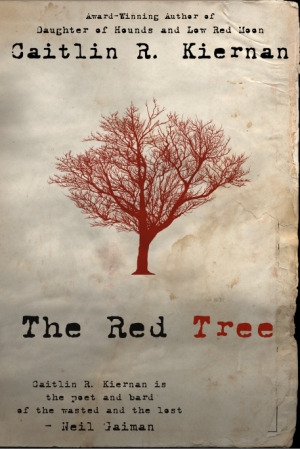
Another attempt at polishing the review I’ve written. I usually adjust a few things after I post one but in this case I was less satisfied than usual because I gave too much importance to certain aspects and almost ignored others that I think are more important. The biggest problem was that I wrote my comments just an hour after finishing the book and I started to understand the book better while writing those comments, which caused them to be even more rambling than usual. So I’ll do some cut & paste and restructuring.
The framework first. “The Red Tree” is a supernatural, horror, psychological journey that borrows heavily from the long and solid tradition in the respective genres and whose best parallel in themes, atmosphere and development is Lovecraft. It is not conceived or delivered as an homage or imitation, it’s not a book existing in a “shadow” of something else, nor it is one that uses conventions to break out of their prison and open on a new, “modern” world. What it achieves is about recovering the deeper and most powerful elements of that tradition and reveal that they are not dusty, opaque and antique, but still alive today, relatively uncompromised. The book is structured in a way similar to Danielewski’s House of Leaves, with nested texts, stories within stories, and dreams that leak into reality. So it’s up to the reader to take an active role and second-guess and interpret/rebuild what is going on. The basic form is the diary so everything comes through an unreliable narrator and a fragmented narrative that can leave gaps of days and then only re-interpret and fictionalize what happened. Without another authoritative point of view the reader can only cling to the voice of the diary, trust it, and go through the most unnerving parts as in a first-person narration, making it quite effective. All this is at the same time simplified and complicated by a strong meta-narrative. If one gives a look online (and yes, you’re supposed to, I’ll explain why) would discover that Caitlín R. Kiernan has more than a few analogies with Sarah Crowe, the fictional writer of the book. Both are lesbian writers who had to deal with the death of their partner, both suffer from epileptic attacks that add another dimension of precariousness to the story. I don’t want to delve further because I feel like invading a personal space and the boundary between reality and fiction is best left blurred. Yet I think a reader should be aware of this layer as it offers a way to better understand the implications and the origin of the book. No book prescinds from its writer, and here this fact is particularly important.
The semi-autobiographical story is about this alter-ego fictional writer, Sarah Crowe, who is fleeing from her former life in Atlanta to rent an house in the countryside of Rhode Island. Without the motivation or the focus to start writing a long postponed novel, she begins instead keeping a diary mostly to describe some weird, unpleasant dreams that are haunting her. After exploring the basement of the house she discovers an incomplete manuscript next to an old typewriter. The manuscript is written by “Dr. Charles Harvey”, a name she’s never heard, so she “googles” it and finds out it belongs to a professor who “was on an extended sabbatical from the university, supposedly writing a book on the evolution and propagation of fakelore”. A professor with “an interest in urban legends and occultism” who lived in that house for three years, and died in the property by hanging himself. The title of his manuscript and research is the same that is shared between these three layers, “THE RED TREE”. Title respectively of Kiernan’s book, of Sarah Crowe fictional diary, and of Harvey’s unfinished manuscript. Soon the bits of legends Sarah reads seep into her reality and slowly build an estrangement from the “real” world. This red tree being a huge oak tree not too far from the house, becoming Harvey’s former and Sarah’s current obsession. One doesn’t even have to speculate the woman will likely share the previous tenant’s fatal destiny as that is already spoiled right in the introduction of the book. It’s a descent into madness when the solid reality under one’s feet starts to crack and give way. The “abscess” that opens and swallows, and that one’s too frightened to look into.
The ideal spook story would then end with a plausible rationalization that explains everything but with the supernatural element still very possible and not completely fended off. The reader left wondering if it was all true or not, and so the resulting haunting ambiguity. All this stays true to this book. While I was reading I kept waiting for some reversal of canons that would bring novelty and would justify the great praises the book received, but that didn’t come. Or it didn’t come from the direction I was expecting it. The story stays well within the canons, it’s not a “modern” interpretation in its structure. It doesn’t drop some classic conceits: it appropriates the canons. And that is where it hits. It’s about looking straight into the darkness and understanding it. The horrors of the book are always perceived and off the page, just out of the corner of the eye, never completely undeniable. The idea of movement, of sounds, of impossible perspectives. As a teenager I fed so much on the horror genre that nowadays it hardly has anything to offer. The “psychological” horror is a concept that I know quite well but it is how it is used to determine its power. Whether or not the “roots” feed on something true or just a weak conceit. The strength of this book is about knowing those roots and, instead of obfuscating, reveal the original darkness that can’t be defeated by modernity. That it’s still not even notched today. Whether it’s written by Lovecraft of Kiernan, the source is the same and ageless.
I try to avoid spoilers and I’ll say that by the end of the book I was busy trying to put together the pieces of the puzzles. Turning the last page doesn’t mean closing the lid. The book won’t be done with you and will continue to haunt. You’ll have to deal with contrasting interpretations and contradictions, with pieces that don’t fit or that you can’t place. Maybe, if you like me have a necessity to strictly define a space, feel frustration because the story defies control and because rationalization is here antidote to comprehension, as it would be in a dream. The book requires and forces a certain readjustment to be understood. But it is important to say that these details of the plot are just a surface. The desire to pin down even the smallest thing. The overall purpose, I think, would be clear. The real explanation is one that contains the different ones within, because at the core there’s the human soul, and the darkness within. What one does or doesn’t make of it. What you can’t push down and deny or forget.
Sarah’s isn’t alone in this journey, and of this I was thankful since it would have risked of making the story too oppressive and hostile. The wonderful strength of the writing is to be appreciated the most in the description of human relationships, and all the meaningful complexities that come out of them. Constance, a character sharing certain sensibilities with Sarah while also being almost her opposite, will soon join her in the house and the relationship building between them is maybe the best aspect of the book. A relationship devoid of idealization as Sarah’s character is cynic and caustic, often her attempts to reach Constance leading to both of them getting hurt and further apart in spite of necessity. Sarah and Constance won me before everything else and I was wondering how the book would proceed if I continued to be so weirdly biased toward the mundane while having very little interest for the supernatural aspect. I think that this effect was intended because it’s from those relationships that the meaningfulness of the story is entirely derived. Consequences. On the foreground stay these characters, their relationship, their truth. There’s some sex, written well for once, not too graphic and yet not embellished or mystified as it always happens. It should be better to say that there’s honesty, and that sex is part of that honesty, and, being that, it becomes extremely important. The language is modern and tight, the voice surprisingly authentic. There’s no use of classical language or rhetoric or fancy flourishes. It doesn’t read like a dusty old tome. This even affects the plot, while Sarah can be seen as the typical solitary character stranded in a mysterious house, she still has internet, looks up things she needs, goes back to the town and library various times, receives calls from her editor who asks if she’s well and is progressing with her book, travels on a car for a couple of days with Constance. There are no artificial boundaries to contain Sarah’s story, if not those entirely made by herself. I even interpreted this “freedom” of breaking through certain rules as a hint to the reader: explore, look things up online if you feel like missing something. The book can be as well enhanced by what’s outside. Do not worry to step out of the page. The darkness will be kind enough to follow you.
The supernatural aspect comes up with more strength toward the end of the book, obviously, but it does so in an unexpected way. It’s the mundane to become horror, and it’s one own feelings to open on the pit no one dares look into. The darkness is the human being. Or, to quote Bakker, the darkness comes AFTER:
It’s only after that we understand what has come before, then we understand nothing. Thus we shall define the soul as follows: that which precedes everything.
Superstition. Everywhere and in everything, Leweth had confused that which came after with that which came before, confused the effect for the cause. Men came after, so he placed them before and called them “gods” or “demons.” Words came after, so he placed them before and called them “scriptures” or “incantations.” Confined to the aftermath of events and blind to the causes that preceded him, he merely fastened upon the ruin itself, men and the acts of men, as the model of what came before.
But there’s obviously some ambiguity, embraced by alternative interpretations and whatever you decide it to be. The darkness comes “after”, produced and shaped by men. Belonging to them. As well its opposite, the darkness comes “before”, something inhuman, eternal, absolute. Universal. Ageless. Meaning that Sarah’s hallucinations were real and used her as a vehicle. But at this point the journey has already become so personal for the reader that even the last answer becomes entirely personal. The descent into madness is proportional to clarity and self-awareness. That’s another unconventional and unexpected aspect of the book. The “unreliable narrator” is a device presented in a self-aware way, used to give the text that ambiguity that keeps the disparate interpretations plausible at the same time. But toward the end this unreliable narrator becomes the only authoritative guide. One assumes that madness corresponds to a loss of contact with truth, but here the whole meta-narrative becomes clear in the mind of the character and she even seems to mock herself for it, and maybe it’s this to provide a way to escape madness by sacrificing an envelope to it.
It’s quite an awesome book that should be read even outside its genre. I enjoyed the characters and the style of writing so much that I would have loved it with or without the supernatural aspects. I love how painfully truthfully it is written. A kind of desperation that destroys any attempt for embellishment or rhetoric. Even WITHIN fiction:
I am usually at my most brutally forthright when making shit up. That’s the paradox of me. And having lied, it doesn’t mean that I was necessarily dishonest.
A book whose stronger aspect is, paradoxically, the demystification. And, maybe, literature as a form of therapy. One of the most emotionally involving and authentic novels I’ve read.
This is a lean book that took me to read way more than expected, mostly because it fits the “other read” while I was engaged with more meaty books. A debut, as a writer writing books instead of comics, and first in a rather long series made of standalones. This is where Dan Abnett started writing Warhammer 40K, accordingly to the internet not his best effort in the field, but a decent and solid one still. Optional as a starting point since one could start right with Eisenhorn or the multi-writer crossover of the “Horus Heresy” currently being published. Instead this specific series, whose opening volume is “First and Only”, is made of twelve books already released with more planned, but the number shouldn’t discourage as the story moves either through standalone stories or story arcs that are over in three or four books. There are also these nice & cheap omnibus that pack together those arcs in mammoths of 800-1000 pages, so you’re not chasing in frustration a conclusion that never comes. You can satisfyingly read just one and stop, or go on as far as you want, guilt-free.
Genre is military sci-fi. Common theme to the series are “Gaunt’s Ghosts” a specific regiment in the Imperial Guard faction and the ongoing campaign on Sabbat Worlds, whose name correctly implies dealing with Chaos and defining Abnett’s own playground. Gaunt being the name of their leader and main character/hero, Ghosts being the nickname of said squad (the story will give some insight into the choice of the name and origin). It’s effectively tie-in fiction, and so branded with prejudice, but the fact is that Abnett is a competent writer who can stay perfectly within the canon, know what his public wants, and deliver a successful product. There’s nothing bleeding edge, innovative, or breaking the boundaries of the 40K setting, but the execution is good and the book delivers what it is meant to. Abnett can understand and squeeze out of the setting all the specific tropes that make it interesting and fascinating, and can write it so that it doesn’t feel plain and spoiled by the game it’s based on. Meaning that the “canon” successfully empowers instead of trivialize and conform. That’s always the gamble, knowing the canon and so knowing the “range” of the possible story, tiptoeing within the strictly defined perimeter. Abnett proves then that you can have fun with those toys instead of creating new ones, that there are qualities within to exploit.
Writing a good book here pairs with giving a specific audience “tied-in” the canon what it wants. I’m not really familiar with the setting so I can’t comment if the picture Abnett gives is a faithful one, but he definitely seem to get the basics that make it work. WH40K is an apocalyptic setting about excess and exaggeration, but also about human traits and artifacts brought to the extremes. The potential for drama is high, but also the potential for something spectacular and epic and ultimately fun. In this book Abnett bundles epic infantry warfare with military/political intrigue, so while the plot goes through a number of setpieces/key battles on various worlds, there’s also an overarching story that links and gives meaning to these battles, leading to a culmination where the import of all happened before is finally revealed. Both of these story threads are handled well through a structure that alternates the main battles with flashbacks from Gaunt’s life that slowly build the character and plot, and why the reader should care about them. Every “block” adds a piece, chunking the story in an episodic way, in which each battle/chapter is brought to a conclusion, and then linked to the specific arc that starts and ends within this lean book (vaguely similar to the first Black Company book). This results in a tight structure and plot where nothing is superfluous and where the pacing doesn’t slow down. The aim is set from the first page and the pacing is resolute and constant. The “fun” is there on plain sight, the action scenes equally distributed, and you don’t have to wade through weak parts to get to it. If you enjoy the ride you’ll enjoy it on every page without being let down.
Daylight rolled in with a wet stain of cloud, underlit by the continued bombardment. The lightening sky was streaked and cross-hatched by contrails, shell-wakes and arcs of fire from the massive Shriven emplacements in the distant shrouded hills. Lower, in the wide valley and the trench lines, the accumulated smoke of the onslaught, which had now been going on for just about twenty-one hours, dropping two or three shells a second, curdled like fog, thick, creamy and repellent with the stink of cordite and fycelene.
Abnett is rather good at writing what takes the stage the most: action scenes and some spectacular setpieces. There’s a sort of unintended anticlimactic effect since the battles escalate in size and impact, but the first one is the most successful because it mimics some aspect of WWII, with infantry moving through trenches and trying to survive heavy bombardments. The perspective of those men caught in the mess just works and resonates with the real scenes one is already familiar with. Some acts of desperate heroism, some unlucky sudden deaths, sudden change of plans, last minute saves. You can see some canonical situations taken from a number of movies that are here reinterpreted in the new setting, all the while, but without pushing too much, trying to give a name to those soldiers, slowly learning their roles and a couple of personality traits for each. The recipe is well known, after all. At the end of the book I was still struggling recognizing who’s who and there’s no character that delivered substantial depth or anything more than two-dimensional, but I also don’t think the book tried to go in that direction. It’s relatively unpretentious and focused on the fun things. It doesn’t take itself too seriously and it is not even shallow. Characterization is proportional to its use and purpose within the scene. Some characters are even made for just one or two scenes, to then step out again (often dead). Fun, fast paced, straightforward, and with characters that are good enough to fit the situation and make it work. No more, no less.
The prose is functional too. It’s not bloated and at the same time it gives some impressive and effective imagery. Battles on a big scale are a complicate thing to deal with, especially battles that have so strong fantastic elements. Abnett deals with all this with ease and familiarity, not betraying the fact the book is a “debut”. Action is crystal clear, never confused and keeping a pace that doesn’t disrupt the flow. I guess that’s the most important aspect in writing this sub genre of military sci-fi. With the plot filled with surprises and the mysterious aspects being well managed, the book is quite successful all over. The only quirk in the prose I don’t personally like is that it can be way too pompous and rhetorical, including the metaphors used and the uncompromising manly men described. “Subtlety” is something banished here, everything is upfront and direct and explicit.
Fire patterns winked in the russet darkness. Yellow traceries of venomous death.
The turret guns screamed into life, blitzing out a scarlet-tinged, boiling stream of hypervelocity fire.
The plasma guns howled phosphorescent death into the void.
One has to wait the final battle develop to get the big revelation about what it was that Gaunt and his Ghosts chased for all the previous pages. While I said the structure of the book is solid and well executed, this can also be a problem because it’s as if the import and meaningfulness of what happens is left hanging and undecided till the end. It’s hard to trust the book because one can’t say till the last 20 pages if it’s going to be worth it or if it will be an hoax. The pre-finale, after the big revelation is dropped, is painfully predictable, but there are a number of pages left and even if the plot seems to have exhausted its fuel, it keeps going on and keeps surprising, tying together every small subplot even too neatly, including a nice bow. The surprises continue to come till the very last line, so even if the whole conclusion is made by a number of scenes that all feel somewhat trite and cliche, the overall result is fun and convincing thanks to the good execution of those traditional elements and scenes. Like an action movie that doesn’t disappoint.
I haven’t read any military sci-fi before this book, so I can’t gauge how it may compare. I think it is well executed and its strength are in its deliberate focus on action and intrigue, making a reckless and fun journey. The battles excellent and varied, from huge showdowns of thousands of men to chainsword duels, described in vivid gory detail. The downsides are built-in the model, many of the elements that compose both the story and characters are cliche and drawn/taking inspiration from the multitude of books and movies that have something in common with the genre, but I wouldn’t point this as a “flaw”, since the use of these conventional elements is competent and well realized. Even if dipped in predictability in various points I wasn’t bored by the plot and the pacing was perfect. I only faltered about the trust in the book, since as I said the stakes are only revealed at the very end and so the reader is kept in the dark about some major motivations. Also consider that this is a starting point and, accordingly to other readers’ comment who read more than me, Abnett only gets better. Truly recommended for those who look forward to some pulpy military sci-fi with a fast paced plot and epic battles that rock whole worlds.

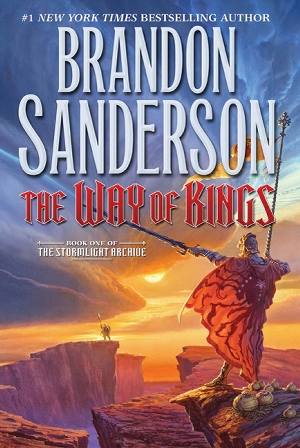 Curiously enough, my reaction to this book reflects the palindromic structure that defines a powerful form of poetry called “ketek” used in the book: I did not like at all the first and last 50 pages, but thankfully enjoyed enough everything in between (that for a book of 1000 pages is quite enough). I wrote already about some of my concerns about the writing in the
  The pain with this book more than reading it is trying to write a review. How to frame it? It left me reeling for sure. There are a number of ideas explored that seemed to echo with some my own thoughts pre-existing the book, this further reflected toward the end of the book by a strong in and out of text deja-vu whose implications are far too tangled for me to make any sense of them (I should also try to second-guess some that Bakker did, that would bring a whole new level of complication). Just to say: the book messed a bit with my head. But that was almost expected, knowing well the kind of writer. The blending in and out of character, in and out of the book, and between facets of different characters echoing each other is a prevalent defining trait.
 Another attempt at polishing the review I’ve written. I usually adjust a few things after I post one but in this case I was less satisfied than usual because I gave too much importance to certain aspects and almost ignored others that I think are more important. The biggest problem was that I wrote my comments just an hour after finishing the book and I started to understand the book better while writing those comments, which caused them to be even more rambling than usual. So I’ll do some cut & paste and restructuring.
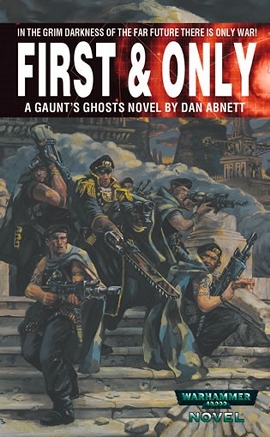 This is a lean book that took me to read way more than expected, mostly because it fits the “other read” while I was engaged with more meaty books. A debut, as a writer writing books instead of comics, and first in a rather long series made of standalones. This is where Dan Abnett started writing Warhammer 40K, accordingly to the internet not his best effort in the field, but a decent and solid one still. Optional as a starting point since one could start right with Eisenhorn or the multi-writer crossover of the “Horus Heresy” currently being published. Instead this specific series, whose opening volume is “First and Only”, is made of twelve books already released with more planned, but the number shouldn’t discourage as the story moves either through standalone stories or story arcs that are over in three or four books. There are also these nice & cheap omnibus that pack together those arcs in mammoths of 800-1000 pages, so you’re not chasing in frustration a conclusion that never comes. You can satisfyingly read just one and stop, or go on as far as you want, guilt-free.