Category Archives: Blog


Just noticed this link on Bakker’s blog.

Quoting:

Abstract: Reasoning is generally seen as a means to improve knowledge and make better decisions. However, much evidence shows that reasoning often leads to epistemic distortions and poor decisions. This suggests that the function of reasoning should be rethought. Our hypothesis is that the function of reasoning is argumentative. It is to devise and evaluate arguments intended to persuade. Reasoning so conceived is adaptive given the exceptional dependence of humans on communication and their vulnerability to misinformation. A wide range of evidence in the psychology of reasoning and decision making can be reinterpreted and better explained in the light of this hypothesis. Poor performance in standard reasoning tasks is explained by the lack of argumentative context. When the same problems are placed in a proper argumentative setting, people turn out to be skilled arguers. Skilled arguers, however, are not after the truth but after arguments supporting their views. This explains the notorious confirmation bias. This bias is apparent not only when people are actually arguing, but also when they are reasoning proactively from the perspective of having to defend their opinions. Reasoning so motivated can distort evaluations and attitudes and allow erroneous beliefs to persist. Proactively used reasoning also favors decisions that are easy to justify but not necessarily better. In all these instances traditionally described as failures or flaws, reasoning does exactly what can be expected of an argumentative device: Look for arguments that support a given conclusion, and, ceteris paribus, favor conclusions for which arguments can be found.

I was thinking that these scenarios are consistent in the direction they all point to. Life without happiness. The more you are “aware” of the world and of yourself, the more happiness is precluded to you. Happiness can only be found in consolatory lies and story-telling. The more receptive and open you are, the more you’ll suffer. True self-knowledge only leads to despair and loss. Of everything.

You have the choice between being a lie, or nothing at all.

Fringe is one of those TV shows that I’d have never watched if it wasn’t for the fans affirming it was getting much better after the first season. The couple of episodes I watched were cliched and forgettable. It seemed like an homage to X-Files without anything worthwhile to say on its own. Homages are all good, but only as long you can also raise the stakes at some point.

Fringe did it. The second season started right at a beginning like an “all in” attempt. They pulled out all the stops and started daring. Many episodes were still weak and dull, but overall it was gaining steam and the characters strong enough that they could carry the show during the slow moments. Season 3 was even better, it felt like the writers were having fun. Still plenty of weak spots, but tolerable. The two parts ending to Season 3 was half made of suck and half made of win, in the end still keeping hopes up for a wonderful continuation.

Season 4 started… fine. Definitely a low key compared to the beginning of season 2 or 3. But at least they seemed to do something interesting with the mythological device of the Observers. But it was an HOAX. Instead of building momentum and grow, it sank into the mud. Sluggish and contrived.

From the third episode onward, and for what seems going to comprise the entire season, it became full of indulgent wankery. The whole arc is essentially an USELESS SEASON-LONG DETOUR. Meaningless because the whole time is wasted re-introducing clones of former characters in cloned universes that ultimately will disappear when this season is over and Peter returns to the former timeline. I wonder WHO among Fringe writers believed this was a good idea. Make a whole season of cloned characters in rewritten/rebooted universes while expecting the public will give a fuck. WORSE than comic books reboots. Nothing relevant is being added, episode after episode with recycled characters and stories in a “what if” flavor. Reheated food, formulaic writing and self-referential homages.

I’m pissed at J. J. Abrams because this is clearly the result of “too much love”. You know, when a guy breaks through in BOTH Hollywood and Television. All he does gets a huge attention, so the guy believes his ideas are made of gold and he is a Genius. Currently he has three shows going on TV at the same time, along with his “minor side projects” like blockbusters in the cinemas. Fringe is one of the things that go to shit because HE COULDN’T CARE LESS. Both Hollywood and television love him and he’d always have his other gigs to really care about anything specifically. Success leads to pampering, and suck. Nothing is at stake for him and I even doubt he is involved in production. He’s the Boss now, others can do the work for him and took the blame. He’ll surely be there to take the praises.

If the creator of a series shows no interest for it, why should the fans?

Fringe will be obviously cancelled. It deserves to be cancelled because the writers decided it was better to plan a whole season around a formulaic “what if” than to actually solve any mystery. They had PLENTY of time to bring the show to a wonderful conclusion, but decided to piss all over it because of OVERCONFIDENCE (the one thing that Abrams himself surely has provided on his own). The kind of overconfidence that makes you think it’s a good idea to revisit the same stuff over and over and over through a sly, clever, full-of-itself perspective.

So the show is going to be canceled because it lost most of its public and the writers decided that it was better to use what (plenty) time they had left to go on a full wankery detour than to actually give the show the conclusion it deserved. I hope they do not give it any second chances because they clearly do not deserve them. Abrams replied to the concerns by saying: “I would say without question that if Fringe comes back, I would do anything in my power to direct an episode.”

My reply is this:
WHO FUCKING CARES!

Not only he helped dig Fringe’s grave, but now he wants to come back in a time of need so that he’ll look like a SAVIOR. Go fuck yourself, and possibly regain some humility and sincere interest in what you do. Next time do one thing, and give it your best.

I’ll probably write more about this.

(that image goes with this song)

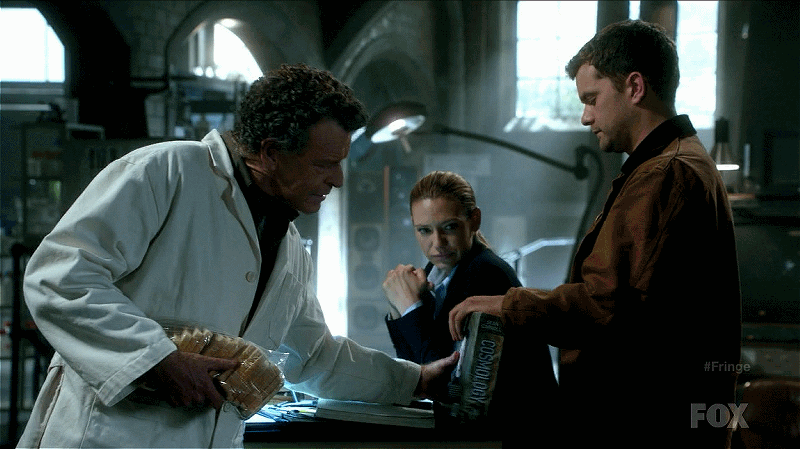
The last episode of Fringe (3X06) was a very good one. As usual I try to track some references, this time a book that Walter takes away from Peter. The book is a MASSIVE tome titled “Cosmology”, by Sean Carroll.

I found out there are two of them, a Sean B. Carroll and a Sean M. Carroll, both actually interesting in the greater discourse but it’s the latter who’s a cosmologist and published something. Though, no massive “Cosmology” seems to exist. The closest thing I found is this.

Looking at the wikipedia it seems his work is mostly about the idea of the arrow of time, which seems to tread dangerous ground (see previous discussions):

1- It is vividly recognized by consciousness.
2- It is equally insisted on by our reasoning faculty, which tells us that a reversal of the arrow would render the external world nonsensical.
3- It makes no appearance in physical science except in the study of organization of a number of individuals.

So consciousness and time, as if isolated from scientific objectivity. I can imagine this line of thoughts leading to places…

While looking for these things I also randomly found this curious book.

Accordingly to Scott Bakker (and sorry for the simplification) the purpose of “literature” should be to target a popular medium that can reach a wide and diverse public and then “spike” the food so that, instead of confirming beliefs and repeat canons, the effect would be explosive and shake the foundations of the fixed establishment.

The fantasy literary genre is his choice, but I think another ideal medium could be manga and anime. They already work in certain similar ways. They create both conditions: they reach a diverse public and they are differentiated within themselves in sub-genres and groups. Manga and anime make their own sub-worlds, with their esoteric and self-referential jargon. It’s an extremely structured medium, but at the same time this lends to plenty of hybridization. So, while the canons are very strict and defined, they are also constantly played with and defied. A kind of post-modern way of playing with boundaries and mixing ideas on all levels (and, thankfully, still with a freedom and levity that is unmatched elsewhere, for example religion and sexuality).

“Homunculus” is a manga by Hideo Yamamoto that I’ve been reading for some years. It’s finally complete in Japanese, 15 volumes, but only 13 have been translated by fans in English. I consider it an extraordinary work and it is a compelling read. After you start you can’t stop as it works as a big mystery that starts from completely absurd, crazy premises, and then moves, every single page an incremental step forward, moving toward a final reveal that makes sense and explains perfectly all the absurdity that preceded it. It’s at times gross and violent, but it serves the purpose of the story.

It’s a kind of “spiked” food I’d recommend having, and it touches parts of this recent discussion about the ideas on reality and the “self”. There may not be an happy end, your mileage may vary.

(it’s Japanese, you you’re supposed to read the balloons and sequence of images as “mirrored”, from right to left)

This post has no answers and only doubts, but reading it you’d see what is that Kabbalah is (or wants to be). This is an “answer” to the 12th self-study lesson (a introductory study) and it contains my doubts about it. To see the self-study you’d have to register here, for free. There are 14 lessons in that self-study.

I’ve also included the 12th lesson (about 25 minutes) if one doesn’t want to go through that registration, but I actually encourage you to register and watch the rest as it’s all quite interesting and at least enriching.


I was rewatching lesson 12 of the self-study and got some doubts. I know that Kabbalah can’t be understood simply logically, but as long I’m not “there” I still have to relate to it with my own logic and the ideas I get from the lessons.

It seems to me that the difference between Kabbalah and other religions is not the one described in that video. The difference I understand is that Kabbalah is entirely about spirituality, so it isn’t interested about the physical world. This marks a true difference with all other religions as all religions (as far as I know) do have systems of rules that apply to corporeality. From what you can or can’t eat to when and how you should pray. Even anthropologically all religions were “meant” to regulate the corporeal world and build a certain society.

But instead I can’t stop my doubts about what is explained in the video. I only know well Christianity since it’s where I’m born but, while the people could certainly believe that it’s about “bribing God”, that’s not a good representation of that religion, and the real one isn’t very different from how the Kabbalistic model is described.

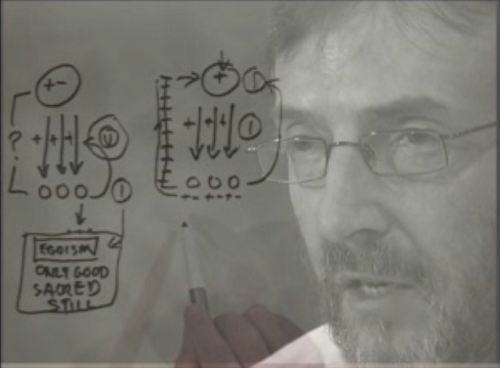
The part that gives me the doubts is that one could say that the Kabbalistic process is equally “delusional”. As long the upper light is invariable and the events also invariable (so what changes is solely the self), then it means that the pain itself can’t be stopped or diverted. The pain is instead “understood”, as one, through bestowal, would perceive the “long range”, so the wider purpose beside the egoistical self.

Which essentially would lead one to “endure” the pains of life in the name of a greater purpose that says: there’s indeed a purpose, and it is good willed. One could see his sons killed in front of him, or go through great pains, but always knowing that there’s a “meaning”, and that life is eternal.

So it is true that the suffering is always relative to a perspective, and if one shifts the perspective a momentary suffering becomes bearable. Through life eternal all suffering is bearable as it is momentary. But both these ideas are essentially “consolatory” and Kabbalah would be defined itself as consolatory, as it is all based on two principles that regulate the rest:

1- That life is eternal (and so suffering momentary)
2- That God is good willed, and everything happens for a purpose

If one had the CERTAINTY of those two points, then it is true that pain would be bearable. But isn’t this perspective consolatory and delusional? As you can’t change what happens to you (invariable upper light and events) you have to “endure” it, hoping there’s a good willed purpose even when everything looks very bleak.

The other difference between the Kabbalah and religion is that in religion the salvation or the enlightenment, more often than not, happen after death. So they are “promises” of salvation or enlightenment, and one lives with the “hope” that they are true, clinging desperately to these ideas as they can only justify the pain of life, and give life a sense.

Kabbalah is different as the promise of attaining the “upper world” is here and right now. You say it’s a “science” as it has to be experienced and attained personally, first hand. It’s not a theory or an abstract idea. But the skepticism here is about “when”. One listens to the video courses, reads the books and slowly understands what is Kabbalah, but what’s that ideal point that brings back up to that “tangible certainty”? The distinguishable certainty that Kabbalah is a science and not a consolatory delusion?

I’m explaining the subjective point of view: one comes to Kabbalah trying to learn, but learning leads me to define these ideas of life eternal and purpose as “consolatory”. This can only be solved through a certainty. In other religion you achieve that certainty through “faith”, but in Kabbalah faith is not required, as having doubts and asking questions is encouraged (as in science). I am right there.

This will have spoilers for Fringe, that you should watch if you haven’t already.


One point that Fringe seems to underline is that the Observers observe the flux of time, as from an external position. Looking from the outside in. What triggered the whole disaster is the fact that the Observers observe “time” without perceiving themselves in it. That’s why September messed everything when Walter(nate) saw him and was distracted from finding a cure for Peter. This intervention from the Observer was accidental (and everything else was an attempt to try to “fix” it). And again this is because the Observers can observe everything but make mistakes because they don’t perceive themselves (and so the impact they have on reality). This is again confirmed (episode 1, season 4) by how naively the Observer replies to the guy asking him for what he needed those TV parts (to make the machine needed to erase Peter from time).

Now bring all that within our reality, take Heisenberg’s uncertainty principle: “observations affect the observed so as to obliterate the observer’s hope of prediction. i.e. his uncertainty is absolute”

“Given these changes in scientific thinking, we are now in possession of the truism that a description (of the universe) implies one who describes (observes it).”

“Implies” as: in the picture. A kind of recursive loop (for more on this read: “Godel, Escher, Bach”):

So the Observers in Fringe are like a metaphor of what is going on in our world. Those Observers are incapable of seeing themselves in the picture and so make an “objective” observation. With the point being: we also are observers who are incapable of perceiving reality for what it is.

There’s actually an “happy end” though, as these theories seem to ultimately lead to an amplification of freedom.

I mean, these Observers are fucking retarded. It wouldn’t be that hard to put on a wig, or even make an invisibility cloak.

P.S.
About this and everything below on this blog. I found out that Bakker is miles ahead of me. As I should have expected. Maybe I’ll write about that next.