Category Archives: Blog


Following, from Italy, the Obama/Romney debate the other day I was dismayed about how simplistic was it all.

Some of the most relevant claims used from a side or the other are a constant in all political debates, in most countries I guess. On top of this, there seem to be a much greater attention in the US, about the “form” over substance. Who smiled the most, who sounded more secure of himself, who kept more control of his facial expressions. So it is a rather obvious claim I’d make: it wasn’t a “political” debate. The politic I heard from both parties was fake. It was instead just a show, theater.

A simplistic analysis could cover all the meaningful points. For example it is very obvious to see Romney’s weakness by just looking at his speech patterns:
“I know what it takes to…”
“I understand what it takes.”
“We must…”

He affirms the obvious, without ever saying HOW. Or WHAT. It evokes politics without ever saying something concrete. Every phrase he says is missing one half: how he intends to carry out the things he promises.

The “intention” is manifest. Romney intends to tell American people whatever it takes to win. It is that simple.

The entire deal stops there. Romney is not interested in explaining what he’ll do if he’s elected. He’s interested on winning the elections. Generalizing: the “now” is more important that what will happen afterwards.

This idea crosses over to the political idea. You need energy and more jobs? Then Romney gives them now. Drill more for more oil. Exploit all the natural source America has left. Squeeze it all out, right now. Because he isn’t in the least concerned to what happens long-term. Obama shows more concern for long-term impact of his choices, but long-term doesn’t pay off in a political election. Most people are selfish and think short-term by constitution.

The rest of the political debate is about the game of the three boxes:

TAXES – DEFICIT – SERVICES

The relationship between these three “boxes” is not political. It is not a subjective thing. It’s simply factual and depends on the real world. If you want to lower TAXES overall and still want to keep the same level of SERVICES, then the DEFICIT goes up. If you want to lower TAXES without affecting the DEFICIT, then you’ll have to cut SERVICES.

Romney promises that he’ll lower taxes across the board for EVERYONE. That the deficit will go down, and that he’ll provide excellent services. This is not a political plan, it’s simply an objective FRAUD. So let’s call things with the proper name empty of rhetoric.

When he brings up the example of some desperate woman without a job asking him if he can help with her situation, he says “Yes, that’s what I can do.” This isn’t just a lie, but it is speculation on other people’s suffering for personal interest. It’s a sign of how ruthless he is. It is unacceptable, disrespectful and criminal. Because the grater the NEED, the most careful and honest you HAVE to be when you promise a solution. Because not only he won’t be able to help that woman, but he’s also doing it for a personal advantage.

But Romney isn’t interested on being earnest. He’s interested on *appearing* as earnest. He’s not himself. He plays a role. He doesn’t say what he thinks, he says what you want to hear. Whatever you want to hear. He’ll say something to someone, and then the exact opposite to someone else. Romney will say that he’ll help exactly the % of people in front of him right at that moment, because it’s convenient. He can say one moment that he’ll work for 100% of people and another moment that 47% of people are govern-dependent victims. It’s absolutely logical. Why? Because when he was speaking in the second circumstance he was in front of people that wanted to hear just that. Romney says what you want to hear, so you vote for him. And that’s why a lot of the debate with Obama ends with a sort of “me too”. With the difference that Obama at least tries to restraint his political idea within the boundaries of reality, whereas Romney will say exactly what he think people want to hear. No matter how completely absurd it is. To win the elections you need to make people dream.

Romney will create more jobs, lower taxes for everyone, cut the deficit, make America autonomous with energy, take care of the environment, strengthen the use of green power, reduce criminality, crack down on China and cure cancer. Because he believes he can say whatever the fuck pleases him. He’s burden free, responsibility free. He only wants one thing: your trust and your vote.

The model he uses for himself is a winner. Real politics is about people getting involved. And not observing things from far away and nodding their approval. But the great majority of people don’t care about politics and won’t get involved. They want to delegate the choice-making and responsibilities to someone who takes charge of EVERYTHING. They want the holy savior. They want to have faith on a President that will take care of everything. And then, one day, they’ll want someone to blame for everything so that this wheel will make another turn. They do not care HOW things will be done. They only want them being done, right now. Romney knows this. He knows that people voting for him aren’t interested in HOW he’ll lower taxes, create more jobs and everything else.

On the bottom of all this there’s some real politics. One handhold Romney has is that a way to rig the game of the three boxes above is economical growth. Economical growth brings more jobs, lowers the deficit and can lower the taxes for each, because it increases directly the volume of money that those three boxes deal with. But usually economic growth requires money being spent to jumpstart it, the deficit increasing, and America can’t afford that kind of program. So if he can hope of achieving something similar then it is about removing all rules. Deregulate everything and let businessmen go wild. Let everything loose so that there can be a net earning. Go after profit AT ALL COSTS. The lack of rules can offer a short term advantage and, again, long term is not a problem because he won’t be President by then. Some people will be crushed underfoot by this process, but that’s the price to pay. They’ll be guilty of not being rich and not having taken advantage of all the opportunities America offered. The American dream is paved with bones.

The other handhold Romney has over Obama is what Obama himself exploited to become President. When Obama was elected the first time, he was something new staked against a system. He could promise change, and he won because of those promises. But today Obama IS the system. He’s stuck in a role and he can’t promise changes. This pattern is the same no matter in what country you live. The current political party is always at a disadvantage against the competitor. And that’s why Romney gains points whenever he focuses his arguments on what Obama has or hasn’t done.

On top of all this, Obama has his hands tied, whereas Romney is free to take advantage of every opportunity. For Obama this is like playing a game of chess where your opponent plays with a different set of rules. And that’s why I think Obama’s strategy should be to overturn the whole table. This is not a game where the two players are in their own fields. Obama has NO HOPE of describing a political plan that can look better than Romney’s plan, because Romney isn’t playing by the same rules. It doesn’t need to “add up”. You can’t win that kind of match if not by accepting to do the same. And if that happens then there’s zero difference between Romney and Obama. So what Obama should do is not focus on his own plan, but focus on the rules and the game that Romney’s playing. He should treat Romney as a parody to show exactly how Romney’s agenda is working. More simply: he should expose how simplistic, self-focused and dishonest is that plan.

And to do that he can’t simply state “Romney’s plan is”, and Romney then saying, “Nope, that’s not my plan, my plan is.” Because that kind of back and forth establishes the kind of balance where Romney PROSPERS. Obama can’t play the politically-correct game, because that’s where Romney built his own strategy.

Romney will keep a relevant advantage as long America continues to focus on the participants, and not on the rules.


As probably most people I never heard the name of this writer, so started looking on Amazon and Wikipedia. I ended up buying a book.

Two titles I tracked that are most interesting:
Life and Death Are Wearing Me Out
The Republic of Wine

And extrapolated comments that piqued my interest:

“there are three major features in his works: extraordinary characters; language with absurd local flavor (or somewhat black humor of the absurd); and plots with symbolic meaning.”

“Whatever the subject matter is, a torrential flow of rich, unpredictable and often lacerating words remains his trademark.”

“Today’s most revered, feared, and controversial Chinese novelist offers a tour de force in which the real, the absurd, the comical, and the tragic are blended into a fascinating read.”

“He flouts literary conformity, spiking his earthy realism with fantasy, hallucination and metafiction.”

“This “lumbering animal of a story,” as he calls it, combines the appeal of a family saga set against tumultuous events with the technical bravura of innovative fiction. Catch a ride on this wheel of transmigration.”

“use of multiple narrators”

“Much of the book is very funny, especially when the narrator is one of the animal reincarnations Of Ximen Nao (he returns as a donkey, an ox, a pig, and a dog) commenting on the foibles of humans and the many reforms of the Mao era.”

“This book is written masterfully and encompasses a half century with sorrow and wit.”

“Set in the fictional province of Liquorland, this tall tale begins with a rumor of cannibal feasts featuring children as the delectable main course. In response, Chinese officials send special investigator Ding Gou’er to look into the allegations. He arrives by coal truck at the Mount Lao Coal Mine, where he meets the legendary Diamond Jin, Vice-Minister of the Liquorland Municipal Party Committee Propaganda Bureau, a man known for an epic ability to hold his booze. Almost at once, Ding’s worst fears seem to be realized when he is invited to a special dinner, given enough alcohol to stun an ox, and then served what appears to be “a golden, incredibly fragrant little boy.” Despite his hosts’ explanation that the boy’s arms are made of lotus root, his legs of ham sausage, and his head from a silver melon, Ding remains suspicious–until he is rendered so addled by wine that he ends up eating half an arm all on his own.”

“A lesser novelist might be satisfied with just this one narrative thread; Mo Yan, however, has bigger ambitions. The correspondence between fictional character and author allows Mo Yan to wax satirical on the subject of art, politics, and the troubling point where the two intersect in a Socialist society: “One of the tenets of the communism envisioned by Marx,” the hopeful Yidou writes, “was the integration of art with the working people and of the working people with art. So when communism has been realized, everyone will be a novelist.””

“only a first-rate artist like Mo Yan could pull off such a subversive and darkly comic metafiction.”

“he waxes metafictional in this savage, hallucinatory farce.”

“The novel grows progressively more febrile in tone, with pervasive, striking imagery and wildly imaginative digressions that cumulatively reveal the tremendous scope of his vision.”

Some more speculative garbage ;)

One of the Internet phenomenons I never understood, though I tried at least a few times already, is MS Paint Adventures. Especially its last, epic and mythical, incarnation, Homestuck (somewhere around 5200 “pages” right now), that can reach a rather impressive depth in its mythology. It is easier to grasp how it started since Jail Break was modeled after a classic point&click adventure game. You can call it a typical post-modernist “deconstruction” of the medium. The guy posted an illustration on a forum, and then prompted people to suggest an action. So it was something like interactive writing, where the original author still had control over it, as he still picked one suggestion among many and showed its outcome.

Today I was going through the first “pages” of Homestuck and noticed something else instead. The story is again presented as if a “game”, complete with a parody of a rudimentary interface. The protagonist of the story is a not-so-good programmer who happens to be working on a game, called SBURB. You can play the beta. And you can see that it’s exactly the beginning of Homestuck, with very minimal differences. A game within a game. A world within a world. The protagonist of the story, putting himself into the story. All of this being the exquisite post-modernist quality: playing with frames.

“Sometimes you feel like you are trapped in this room. Stuck, if you will, in a sense which possibly borders on the titular.”

So this time my interest was tickled by this different perspective. Think of a programmer, putting himself in the game he’s making. Is it possible, from within the boundaries of the game, to reconstruct the world outside? How do you think out of the frame? How do you punch holes through it?

It becomes a parody on reality, metaphorically strong. See my analogy with dreams and reality. The creator and his creation. The dreamer and the dreamee, trapped into the dream, unconscious about the dream. And here in this case, the protagonist of a game, unconscious of himself in a game, but playing within the rules. This blinkered look at reality that makes you take everything for granted, because the brain is hardwired to make sense of what is fed to it. WYSIATI, What You See Is All There Is. Sufficiency. The brain projects a world using a severely limited set of features. An abstract.

This is exactly like in a game, where you program and defines just a few features of the world. Is it a limited top-down 2D view? So what would the characters see if they were to look up, out of the “frame”? You don’t know. You can’t know. And, more precisely, you don’t ask questions. Because the question itself is out of the frame. Not only it can’t be answered from within, but it also cannot exist. Because it’s outside the bounding rules. Out of the physics that regulate and frame your world.

Take the idea of “time” into this frame. The character of a game experiences time. The game story has a natural flow. It starts and then goes on. The character may have a sense of previous history even at that starting point, so “misperceiving” it. But is the game a “beta”, or a final version? How many iterations that world has gone through? What was written “before”, and what “after”? The timeline experienced in the game is not the timeline that exists in the world that built that game. You could perceive an embryonic state where instead there’s a final one. So it gets to the point where time collapses, like in the other example I was making.

Once again, this is all the result of reflexive properties. Things that self-describe through recursive processes. And, in these endless loops, the impossibility to escape.

P.S.
I’ve seen a similar concept mentioned here. Though I’d stay more with the world itself, “closure”, describing precisely the “binding” of these worlds. As I think the property of doing without the details, erasing them, is more meaningful than the property of “filling in”.

Some speculative garbage ;)

I was watching this video, and its two children. Stephen Hawking’s Grand Design, The Meaning of Life.

Quite a bombastic title. The documentaries are nice to watch, with flashy editing. Content may appear a bit superficial, though, but they are meant for the large public and not the specialized one. I wrote some comments over at Bakker’s blog.

The summary is that I think it could be possible to see progress and science as the opposite they usually represent. The more science develop, the more we think we have a better grasp on reality. We have more knowledge and disproved ideas such as the sun orbiting around earth. We know physics, we can use electricity, make fancy things and so on. All of this possible because we know better how reality works.

Though you could say that, with this kind of progress, we are emancipating from reality. We concretely live in meaning-full worlds. The internet becomes a good chunk of life. We watch movies, play games. We live into fancy cities with skyscrapers. The environment we actually live in looks nothing like a “natural” world. We still die, suffer of illness and all those things that remind us where the real world is, but there’s still a drift toward a virtual world that is made, opposed to a real world that we are subject to.

The more we achieve progress, the more we purchase virtual land. We take from reality and build anew.

Where does it lead? To a point where reality is completely reclaimed and stops existing. Reality becomes subjective. That threshold may well mean that the notion of “reality” stops to matter. Philosophically you can decide what is true and what is not.

An idea suggested in one of Bakker’s books is that all this could have already happened, in the future. So stretch that same fancy hypothesis. Take the biggest idea like the one about the many worlds, of which the one we know, from the Big Bang to the final collapse is just a grain of sand. What if this impossibly large construct is also man made?

If reality stops existing, then time stops existing. The future collapses into the now. So we have now, a reality that will be built in the future. God, making reality, in this case would be an advanced human being far in the future, who built reality as we see it.

Now think that if reality is completely virtual and man-made, then it means that the actual “real” reality we started from is lost. Men end up living within their imaginary worlds, leaving “real” reality behind. Reality vanishes.

Take the acronym: “GNU’s Not Unix!”. It’s recursive, built by itself. It’s as if the “G” is an original state that is lost and then absorbed into the rest of the body. The same way, virtual reality spawns from “real” reality, but when virtual reality becomes complete, reality disappears. It’s like a “ladder” that you use to reach an high place.

You climb the ladder, then look down. There’s no ladder. It’s like the time paradox where you go back in time to give someone an object so that in the future he’ll give it to you so you can go back in time and give it to him. Strange loops.

Merely noticed this quote on another blog, and reproducing it:

“I gotta tell you, I just think to look across the room and automatically assume that somebody else is less aware than me, or that somehow their interior life is less rich, and complicated, and acutely perceived than mine, makes me not as good a writer. Because that means I’m going to be performing for a faceless audience, instead of trying to have a conversation with a person.”

I still consider BAFFLING that the name of Charles Manson still today evokes the idea of the most terrible and dangerous serial killer in US history. A figure not even remotely comparable to the recent true horror in Aurora, Colorado.

Yet the name Charles Watson, the one who was actually responsible of the murders attributed to Manson, is essentially unknown. He is still in jail, like Manson, but operates through friends a disconcertingly named site: aboundinglove.org

Yet, no matter what theory you can decide to embrace, Charles Manson never killed ANYONE. This is the only uncontested truth in the whole thing, but almost no one knows it because the image of the serial killer was superimposed on him. I wonder how a country can live and prosper upon such a skeleton, but then I also think that every country does. Every country has its own dismaying skeletons, terrible crimes and abuse of power in the name of some greater good that is wielded like a weapon.

The most dreadful aspect in this thing, a real assault on truth and freedom of speech, is that Manson was found guilty of “conspiracy” (so not serial-killing). But he’s known as serial killer for the media and general public because in America’s law system there’s a rule that basically says that planning a crime is equivalent to performing it. So if you tell someone to go kill someone else, and he goes and does it, both of you are guilty of murder. Hence Manson “inherited” crimes performed by others who claimed of having done them by following Manson’s instructions.

This gets real dangerous the more you get closer to the blurry edges: say you are a writer or a musician. You write a text that is highly symbolic and ambiguous. Some maniac reads it and interprets it in his own foolish way and then proceeds to commit crimes in YOUR name. Because he claims he simply follows those messages that were hidden in your work. So next you find yourself in jail, with a death sentence.

You may consider my example extreme and totally unplausible, but this is a big theme. I was discussing it when trying to defend R. Scott Bakker from the assault of the followers of RequiresHate internet cult. This was my message on abstract, describing another of those fanciful scenarios that look completely impossible, but that become more possible with every passing day (as long the blurry edges aren’t cleared):

Let’s try an experiment and COMPLETELY switch the context so that it is cleared of all pre-existing judgements:

Let’s say I’m a movie director who decides to make a documentary on the horrors of Hiroshima. I want to show the deaths and the consequences of the bomb, the radiations, the mutations that the people had to cope with along many years. In order to achieve this, I want to make it shocking. I want to show the real images of that horror, without any censorship and without employing a consolatory narrative filled with feel-good rhetoric. I want it to be a punch in the gut so that who sees it won’t easily forget it. Like a memory scar, because some things shouldn’t be allowed to be forgotten, especially if painful.

So the movie is indeed very crude. It comes out and one day a random guy goes to see it. When he comes out he makes the following statement: “This documentary shows the obsession that the director must have had with Hiroshima for a very long time. You can even find implicit traces of it in all his previous works. It is evidently an endorsement for war and slaughter as everything is shown in a so inhuman way that no one sane could have sustained. By showing only Japanese victims it reveals an hidden racist vein, imparting systematically that violence on a specific race, without any mention of similar tragedies that happened in history. The images of the mutations are so crude that they could be described as pornographic and I can imagine the director having edited this while masturbating to them. The whole thing is like an ode to that slaughter, filled with nostalgia as if it was some great event that he’d like to reenact in some way. He is a very sick, deranged person that should seek medical attention, and a real danger to us all.”

Now obviously, being the director, I can’t feel offended by this, nor I should defend my work and its actual purpose I tried to achieve with it.

Instead I should say: “I’m dismayed to hear that guy’s declarations. I can now see clearly what I’ve done. Evidently that spectator was able to reach a so deep insight that he opened a window into my subconscious and reveal what I truly wanted all along, but that I’m too scared to accept. Yes, I am a sick man and now detest myself. Help me, I need medical attention, or I may hurt someone for real if that part of my subconscious takes over me.”


Now simply answer me: do you find anything wrong with that?

This theme even returns in the last interview with Erikson I linked in the previous post, but he only circles around it by saying that the possibility of misunderstanding and misinterpretation can lead to self-censorship and that he kinda tries to address this by having a moral positive subtext. But the theme of responsibility is a big open wound, and one that isn’t easily treated at all. I have no answers myself because I recognize both the responsibility AND the right to express yourself without restraints. Because I believe that any form of censorship only exacerbates the problem and is never a solution.

In the case of Manson the man was used for a social function. Made into a symbol that he didn’t seek himself, but that was needed by the American culture to put a brake to the dissolution it was falling in. Manson was made into an example. Communities of hippies, that were becoming a REAL risk to the integrity of America’s social structure, with their free drugs and licentiousness, became criminalized.

This was the story that was needed to steer the masses back into control. The most absurd conspiracy theories were fabricated and attributed to Manson, who could only “play” the demon that was painted on him. He was indeed a shaman. He accepted the role, becoming a victim so that he could exorcize America of the crimes it was responsible of. He was made, simply, into a scapegoat. A sacrifice.

I have no idea if there was value in Manson, the man. Because what arrived to us is only Manson the demon. He’s not a myth of mine, but I do find a certain depth in the things he said to the jury when he was allowed to speak for more than an hour, freely.

Manson surely wasn’t a kind, lovable man. But he also wasn’t a murderer (even less a serial-killer). This is a fact. You can then guess whether or not he was a conspirator who sent his men to commit the murders. No one can say for sure because these things are always ambiguous, but if you were to read the details you’d be aware of how absurd, illogical and implausible was the accuse, and how linear and significant was the alternative theory that never had a chance to be brought up in the trial. This doesn’t make anything CERTAIN, but it should be enough to rise legitimate doubts.

The alternative theory is that this story was a cover-up to something big that was happening and that caused the murders. A cover-up made with the complicity of the police. It was related to the Mafia, the drug distribution and rival clans that competed for the “high places”. It is likely that the Mafia at the time had a VERY strong grasp on the whole Hollywood ambient, and the drug rings that circled around it. Manson, the artist, poet, musician, was the weirdo hippie that was often celebrated and invited into these parties of celebrities.

But the state wasn’t interested in the shadow of the Mafia and its pervasiveness in all things, it was interested in Manson, the symbol of a counter-culture threating the status-quo. It took three months before Manson’s name was brought up and linked to these murders. Three months to fabricate the story exactly as it was needed. Obviously, the role of the mafia in these murders was completely hidden, and Manson considered the only responsible, organizing a conspiracy entirely based on hidden messages heard by playing The Beatles’ records backwards. True story. The official story. The story that could fire the imagination of the media and general public, a perfect cliche of satanism mixed with rock bands and sensationalism. The story that many people wanted to be true, and made it so. Sometimes I wonder, regardless of which country you live in, if the “law” is only a thin coat of paint laid upon a huge rotten core. I know that in Italy where I live we had and maybe still have similar problems, with the Mafia deeply rooted into the economy and the politics, possibly replacing what is usually called a “state”.

To add color to folklore there’s also this little true trivia: the judge in Manson’s trial liked to go in the court room with a gun holstered under his dress.

But the most baffling thing I noticed and that gave me the motivation to bring this up again, is that I found out that the fancily named (and famous, since he wrote a book that made a lot of money, something I don’t think is exactly morally acceptable on such a theme and direct involvement) Vincent Bugliosi, the Manson’s prosecutor, and the one who came up with the most absurd conspiracy theory even conceived (and fabricated), wrote in 2008 a book of 1612 pages (!!!) on Kennedy’s assassination. Claims this is his “magnum opus”, like something he should be proud off.

He puts a bombastic title on this ultimate work of his: Reclaiming History: The Assassination of President John F. Kennedy”

Reclaiming history.

In his career at the L.A. County District Attorney’s office, he successfully prosecuted 105 out of 106 felony jury trials, including 21 murder convictions without a single loss. His most famous trial, the Charles Manson case, became the basis of his classic, Helter Skelter , the biggest selling true-crime book in publishing history.

Notice that the book on Manson was titled “The True Story”. Just to make sure his readers don’t incur into doubts.

Reclaiming History: The Assassination of President John F. Kennedy was a New York Times bestseller and has been heralded as “epic” and “a book for the ages.” HBO, in association with Tom Hanks’ PlayTone Productions, will be producing this as an eight-hour miniseries in 2013, the 50th anniversary of the Kennedy assassination.

Quoting:

Unless this fraud is finally exposed, the word believe will be forgotten by future generations and John F. Kennedy will have unquestionably become the victim of a conspiracy. Belief will have become unchallenged fact, and the faith of the American people in their institutions further eroded. If that is allowed to happen, Lee Harvey Oswald, a man who hated his country and everything for which it stands, will have triumphed even beyond his intent on that fateful day in November.”

John F. Kennedy, the victim of a conspiracy.

I really can’t understand how the man who fabricated the most insane, absurd and convoluted conspiracy theory ever (to pin on Manson and give the media the colorful story they needed), can so candidly affirm that nothing happened with Kennedy’s assassination. A fool just shot the president. It happens.

That’s your story. That’s your country. That’s the bones you crunch underfoot. Live and prosper, swimming in truth. And sleep well.

P.S.
Interesting idea: Charles Manson as a mhybe (sorry Erikson, for perverting your idea). An empty vessel. Something you slice away from you and project/inject in it the worst of you. To then banish it and feel purified.

And a bit of Malazan and Prince of Nothing too (men are ever deceived).

Anyone noticed a number of plot points shared? I’ll go through some spoilers assuming you’ve seen both Fringe and Final Fantasy 13 (and a bit of 13-2). Some of these things I have commented already.

Despite the 13 being the worst Final Fantasy gameplay-wise, it has a wonderful setting, with a great story and the best mythology in the series. Some themes even in common with Malazan, like the relationship between gods and human beings, and the number of times a revelation completely overturns what you believed up to that point.

The setting is essentially split between two worlds, Pulse is the huge earth-like world that is wild, filled with weird creatures and other colossal monsters roaming around. And Cocoon, that is a smaller planet hovering in the sky within Pulse’s atmosphere. Human beings live here nourished and protected by their gods, who also keep Cocoon afloat.

Cyclically Pulse sends up an attack to Cocoon, and Cocoon’s gods “mark” some human beings of choice to defend them from the attack. If they fail they get turned into mindless, misshapen monsters, if they succeed, they get turned into crystals for eternity (such a great reward for being your god’s bitch). FF13 begins during one of these attacks, with a chunk of the population of Cocoon being “deported”, since they suspect someone may be “contaminated” (by Pulse gods, marking some other human beings on Cocoon).

In the beginning of the game the party is split between characters marked by Cocoon gods, and two (Vanille, Fang) by Pulse gods. Only they get together because of a chain of events and some complicate misdirection and manipulation going on. With a wicked touch of genius: the trope of the naive, airhead girl is subverted by this girl doing most of the manipulation, “steering” around the other characters by relying on the fact that no one takes her seriously (including the player, who’s caught in this subversion). By playing the naive, totally clueless girl that she appears, she candidly drives the party.

Much later in the game not only it is revealed that the girl herself knew very little and was also being manipulated and used as a pawn in a larger plan, but that the party had been constantly followed by an “invisible hand” that nudged them onward, kept them on their course and even helped them at crucial moments, literally saving their life. All the while, though, the characters were ALWAYS convinced of following their own will, their morals, fighting for freedom and other noble ideals with lots and lots of self proclaimed rhetoric that was used to establish the characters as REAL HEROES. That amusingly never knew what they were doing for all the 60 hours the game lasted, wrongly “appropriating” the responsibility and merit of their actions, up to the final scenes, until the control is almost symbolically wrestled out from the player and the last CG sequence starts.
In truth, it was a god called Barthandelus who drove the plot like a supreme Deus ex Machina, making the characters believe they were responsible of their own actions when they were just being manipulated and ended up acting in predictable ways (doing every time exactly what Barthandelus wanted, while believing instead they were going AGAINST him, the goons).

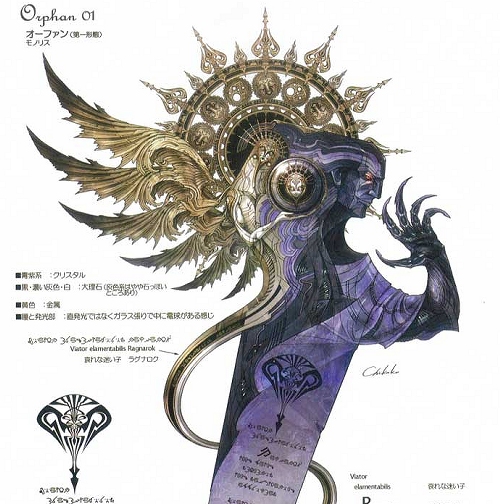
The first revelation was: the gods weren’t keeping human beings in Eden-like Cocoon because they were benevolent, but because Cocoon was something like a FARM. They were only getting human beings prepared and fattened, so that they could then mercilessly MASS SLAUGHTER them at once. Such lovingly gods. Their goal was about opening a sort of portal, that the mass sacrifice would have triggered, and so forcefully pull back in the physical world the primal god that was responsible for creating the world and the gods themselves (the MAKER), but that ended up abandoning them all to their own sad destiny (one of the gods is appropriately named “Orphan”).

The second revelation was: Barthandelus was manipulating everything, and subverting even the plan itself. It was not anymore about opening a portal to pull the MAKER this side, but about the world being destroyed so that Barthandelus could himself abandon it and travel over, through the portal, to the side where the MAKER is. First FRINGE analogy: this reminds me when William Bell actually decides to destroy two worlds so that he himself could cross over and make his own. Same as Barthandelus, destroying two worlds so that he could gain access to something new (after having manipulated all characters for a whole season/game behind the scenes to align perfectly to his will).

At the end of the game Barthandelus is (predictably) defeated, but the characters continue being stuck to his plan. In fact they end up fighting Orphan, the god that sustains Cocoon. When Orphan is defeated, the game ends with a CG sequence. Cocoon starts to plunge toward the earth/Pulse. It’s the end of the world as Barthandelus planned it (even if he’s not there to rejoice). But in the end Fang and Vanille sacrifice themselves, transform into a pillar of crystal and prevent Cocoon to crash on Pulse. Eventually the survivors move down on Pulse and settle there, everyone living happily ever after.

Something like the end of Fringe season 3. The two worlds originally separated and fighting each other finally linked by a bridge/crystal pillar. Only that Lightning/Peter gets ERASED from the timeline by all seeing being(s) called Etro/Observers. But it’s not over, because while everyone else has forgotten about Lightning/Peter, her sister still does remember her thanks to the power of loveā„¢.

So begins Final Fantasy XIII-2. Due to the big fuckup of Etro/Walter trying to save Lightning/Peter and messing the timeline, all the timelines/worlds now are in collision and merging. There are anomalies all over, and the game will be about fixing this stuff. Being helped by Lightning that in this case is out of the timeline and can see past and future, sending her agents around.

Deja-vu.

P.S.
The ending of Final Fantasy 13 is a wonderful ANTI-Final Fantasy going right against all forms of conventional storytelling, only doing it so subtly that no one ever notices. The game does to you, the player, what Barthandelus did to the characters through the whole game. The ending, lavished with typical Final Fantasy rhetoric, makes the player believe that the characters of the game succeeded and survived because of their own strength as human beings, their uncompromising values, heroic efforts and so on. But the truth is that a god was watching this whole thing and found it so melodramatic and pathetic that she took pity of them (actually it’s shame, since this god was originally responsible for creating humanity) and decided to save them (another literal Deus ex Machina). The most amusing part is that she was so pitiful that she kept herself completely hidden and let the characters believe that they saved the day on their own without receiving any help.

Must keep them happy, and ever deceived.

P.P.S.
You can actually push this to another level. The game mirrors its own message. Final Fantasy 13 is the game in the series where the player has the least control. It’s completely (and horribly) linear and on rails. You go through the whole of it as if going down a narrow corridor. See the irony? As if: the player has no control, mimicked by the characters having no control of their own actions within the frame of the story.

The post-modern game of framing can go on: in Scott Bakker’s work the message is precisely that you don’t have the control you think you have and that you’re only hopelessly and deeply deluded. Your life is strictly not different than watching a cutscene in a game, you’ve literally as much control even if you keep taking credit of your actions and showering yourself with praise. Now I don’t know if Motomu Toriyama wanted the game to send this message, but it certainly allows to be read that way. Or more likely: Toriyama mirrored as much real life as to have unwillingly carried some of its bleak truths.