Author Archives: Abalieno

“The point is, Mrs MacDonagh, that the universe is exactly the size that your soul can encompass. Some people live in extremely small worlds, and some live in a world of infinite possibility.”

As mentioned in the previous post I appreciated that roundtable between Pat Rothfuss and the three other “urban fantasy” writers. The genre doesn’t appeal to me all that much but in the end they convinced me to read one that belongs to none of those participants to the roundtable, but that all seemed to agree was a fresh and worthwhile entry. Actually Jim Butcher’s Dresden Files is quite often mentioned and recommended by Malazan readers as some material to chill off and relax between those big and demanding books. A kind of “sit back and enjoy” without any heavy lifting. While these days this Iron Druid series, that’s already at volume number 5 and has one coming out every six months, on average, is often recommended in the Dresden Files forum threads. So after looking online at some of the recommended series this one was the one that sparked my interest, with its focus more on the mythical aspects than the defused horror story in urban setting.

That’s exactly what I found and I can say this is a book that is easy to recommend. After I mentioned on another forum I was going to read this book (after a careful search and selection of what the genre had to offer) a few other readers that already read it commented on it positively, and then more readers picked it up and commented favorably. That was already a nice cascading effect that tells me that this book goes down easily. Maybe you won’t think all that much of it, but you’ll hardly think it overstayed its welcome. It’s relatively unpretentious, or at least it is if you don’t count its “all in” approach that pulls out all the stops. It doesn’t have to bargain at all with reader’s expectations since it knows exactly what it is, and puts it on full display like an shameless exhibitionist. This book is like porn. But it is quality porn that is deeply self-aware, bared of pretentiousness, shrugging off all baggage and just having the best of times. This porn works because it’s positive, guilt-free and filled with pride. Maybe even a lesson on positive-thinking. And even if I could see someone feeling horrified at this description I’m making, I do think this book can only do good in the world. I am certain it’s from one of the good guys.

So I guess in the end this book worked for me because of that trust relationship it built with me. The first note I’ve written down, shortly after beginning to read, is just a word: ridiculous. And that’s precisely what I thought through the whole of it: this book is utterly ridiculous. But, oh, it works. What is to admire here is the fragile balance, the clever brilliance of genius from a side, and the complete ridiculousness from the other. It tiptoes on that thin balance line and makes it appear as it’s the easiest thing in the world. Which is the other big quality here. The sure footing of the writing. This troubles me a bit because that certainty in writing is usually a Bad Thing, but here it works out because a number of preconditions are checked. The writer is constantly smarter than what he writes, but he never underestimates or under appreciates what’s he’s writing. If there’s a recipe-for-success in this book, I think it’s that one.

“It should be clear to you that Wikipedia knows nothing about what a real druid can do.”

All the premises are ridiculous. A millenarian, immortal druid chilling out, off the records, in Arizona working at a book store specialized on the occult, but getting constantly pestered by invasions of fae beings (?) and gods meddling with and around him. The type is: the reluctant (anti-)hero. Skillfully thrust in modern days, hands-down in internet memes, puns and modern geek jokes that keep every page alive with laugh out loud moments. It’s that kind of book where events move at a brisk pace. It doesn’t even specialize on a mythological subset. It’s not about werewolves, vampires, faes or witches. It’s about ALL OF THEM, all in the bigger bowl of gods meddling in both the mortal and immortal world. The quote I put at the beginning pretty much sums up the canon here. Everything works (though coming at a price) and every belief is real. Malazan-like if you want.

In 300 pages the writer makes it work by introducing a number of elements that tangle rather well and deliver a proper conclusion. It picks a selection of Celtic gods playing their game, and it works out because of the druid pragmatic and unfazed attitude. It’s even quite original because you get the exact opposite of the clueless protagonist that slowly discovers a new world. Here the Iron Druid knows it all. Has essentially seen (and participated to, even if he’s more of a neutral, “stay out of my lawn” kind of character) all history and knows extremely well how to cover his ass and stay alive, considering he’s the last of these druids and was able to stay alive for so long. And it works again because the first person narration gives the reader everything that is needed to transform what is potentially a really weird and confusing story into something that couldn’t be more straightforward and traditional, at least in the patterns it follows. The plot is indeed quite conservative and same-y, but it stays fresh because it’s written well and because there’s plenty of clever invention all around it. Keeping it fresh and alive, instead of stilted and redundant.

When you write these kind of stories filled with absurd and ridiculous elements it all depends on the grasp on reality, and there’s a good one here. I think the writer is honest to his characters, and it’s part of why I said I “trusted” the book, so making it work. There’s a coat of “make believe”, but I could feel that these characters were written with respect. So I applaud to that. Is it comfort food? Yes it is, but as I said there’s sometimes more to it, even if it isn’t smashed against your face. When the writer flexes his muscles is always effortlessly and behind the scenes, not demanding attention. I enjoyed the book, have a positive opinion of it. I actually do like things that are more pretentious and elaborate. I can’t say this was a pageturner for me, if it wasn’t for the good pacing that makes it not boring. I’m not entirely interested in what this genre specifically offers. But I can give thumbs up to this entry. While I haven’t read anything else in the genre, I am at least convinced that I couldn’t have picked a better one.

The best written character ends up being the Morrigan.

Merely noticed this quote on another blog, and reproducing it:

“I gotta tell you, I just think to look across the room and automatically assume that somebody else is less aware than me, or that somehow their interior life is less rich, and complicated, and acutely perceived than mine, makes me not as good a writer. Because that means I’m going to be performing for a faceless audience, instead of trying to have a conversation with a person.”

I wrote this on a forum but I might as well post it here since I think it’s relevant and I won’t have to go in the detail if I get to write some sort of review at a later point.

If we were to pick one the most important elements that may make Erikson unpalatable for a bigger public it would be the high number of PoVs within a single book. These guys here know perfectly what they are talking about, they are good exactly because they understand so well the expectations of the public and how to meet them. At 43:05 Rothfuss begins talking about PoVs and how they can kill a book for a reader. I’ll transcribe the relevant part (but suggest to watch the whole of it because it’s quite good and interesting):

Rothfuss: You are right that the first person or the narrow third-person is one of those things that you have almost as a standard in Urban Fantasy that the opposite is true in like, Traditional or Epic Fantasy, where it’s more like, well, you have like Tolkien or Martin where… I mean, you’ve got eight… I don’t know how many points of view Martin has… And Martin can pull it off, because he’s really good at his craft but I see a lot of novels sometimes, and I read them, and I’m like.. Wow… Man… You’re NOT Martin. Please don’t have eight points of view in your story because that means effectively you’re telling eight stories at once, and you have to be nigh God-like in your powers as a writer to pull it off.

Emma Bull: And with every one of those characters who gets to tell a story the reader has to invest in them and then the reader has to be prepared to let go of them, reluctantly, when you switch point of view and get invested in the new character, and then the same thing happens again at the end of the scene in which you let go of that character and… after a while the reader goes: Ahh, screw it. There are too many people at this cocktail party.

Rothfuss: That’s actually a great analogy. I hate parties. Too many people, too much noise, too much to keep track of. Whereas I really enjoy a gathering. The same thing is true with my books where if it’s a gathering of three or four, as we have here, we can have a nice conversation. But if I had eight people? It would be madness and we don’t really get to know anyone really well.

This is actually quite true and when I heard that part I thought it applies extremely well to Erikson in describing some readers’ reactions, so that’s one element. But as usual with these things, especially writing as an “art”, so extremely hard to pinpoint, good rules like this one are never “absolutes”. They are more like guidelines and warning signs that simply tell a writer to only cross when there’s a really good motivation to do so. As if saying: take your risks, but be wary of consequences, because there will be consequences.

It’s also worth noticing that this discussion came up after discussing the popularity of Urban Fantasy, and narrowing down to a matter of accessibility and meeting the readers’ expectations.

Yet I’m relishing the fragmentation of PoVs in The Forge of Darkness (Erikson’s latest). I’m enjoying reading this book a lot more than the five in the main Malazan series I’ve read. 85 pages in, but I continue to think this is the best Erikson I’ve read and so much better writer than the supposed apex of Deadhouse Gates and Memories of Ice. Page by page I’m simply having more fun reading, even if it’s really a different flavor of book. I have no idea where the plot is going, but I don’t care because the book holds me page by page.

Example, page 86, there’s this PoV about Faror Hend, at this point a nondescript character that appears marginal in the story, so a perfect candidate to complain about unnecessary PoVs. But it’s so great to read. She starts musing about Gallan’s poetry and how its meaning becomes a personal and suggestive thing. A moment later she talks with her cousin about some acid sea and its mysterious properties, and they mention that Mother Dark could be the answer to it. So she quotes Gallan:

“In unrelieved darkness waits every answer.”

This obviously associates Mother Dark with the theme, and the mystery of the Vitr. But the comment of the cousin is interesting:

“Even a bare handful of words from a poet, and I lose all sense of meaning. Such arts are not for me.”

The dialogue that follows just gets better and better. She says: “One learns subtlety.” And she’s then outperformed, by the cousin who was playing coy the whole time, because that obscure line of the poet isn’t anymore a comment on Mother Dark and the Vitr, but the suggestion of sex in the dark, giving in to passions that her cousin so obviously read in her.

And it all brings back to the beginning:

These were the truths that found their own flavours and made personal the taste, until it seemed that Gallan spoke directly to each and every listener, each and every reader.

This is just delicious and an example why I think it’s so good. In four pages Erikson set up a new context and environment, tied it back to previous scenes in the book, introduced great characters that feel real in an handful of pages, handed smoothly information about the setting, sprinkled with great dialogue and great scene’s closure.

So I can see that an high number of PoVs is a turn off for many readers, but for me it’s another element that makes this book so great. Only 85 pages in, but not a page was wasted or felt flat or trivial.

I still consider BAFFLING that the name of Charles Manson still today evokes the idea of the most terrible and dangerous serial killer in US history. A figure not even remotely comparable to the recent true horror in Aurora, Colorado.

Yet the name Charles Watson, the one who was actually responsible of the murders attributed to Manson, is essentially unknown. He is still in jail, like Manson, but operates through friends a disconcertingly named site: aboundinglove.org

Yet, no matter what theory you can decide to embrace, Charles Manson never killed ANYONE. This is the only uncontested truth in the whole thing, but almost no one knows it because the image of the serial killer was superimposed on him. I wonder how a country can live and prosper upon such a skeleton, but then I also think that every country does. Every country has its own dismaying skeletons, terrible crimes and abuse of power in the name of some greater good that is wielded like a weapon.

The most dreadful aspect in this thing, a real assault on truth and freedom of speech, is that Manson was found guilty of “conspiracy” (so not serial-killing). But he’s known as serial killer for the media and general public because in America’s law system there’s a rule that basically says that planning a crime is equivalent to performing it. So if you tell someone to go kill someone else, and he goes and does it, both of you are guilty of murder. Hence Manson “inherited” crimes performed by others who claimed of having done them by following Manson’s instructions.

This gets real dangerous the more you get closer to the blurry edges: say you are a writer or a musician. You write a text that is highly symbolic and ambiguous. Some maniac reads it and interprets it in his own foolish way and then proceeds to commit crimes in YOUR name. Because he claims he simply follows those messages that were hidden in your work. So next you find yourself in jail, with a death sentence.

You may consider my example extreme and totally unplausible, but this is a big theme. I was discussing it when trying to defend R. Scott Bakker from the assault of the followers of RequiresHate internet cult. This was my message on abstract, describing another of those fanciful scenarios that look completely impossible, but that become more possible with every passing day (as long the blurry edges aren’t cleared):

Let’s try an experiment and COMPLETELY switch the context so that it is cleared of all pre-existing judgements:

Let’s say I’m a movie director who decides to make a documentary on the horrors of Hiroshima. I want to show the deaths and the consequences of the bomb, the radiations, the mutations that the people had to cope with along many years. In order to achieve this, I want to make it shocking. I want to show the real images of that horror, without any censorship and without employing a consolatory narrative filled with feel-good rhetoric. I want it to be a punch in the gut so that who sees it won’t easily forget it. Like a memory scar, because some things shouldn’t be allowed to be forgotten, especially if painful.

So the movie is indeed very crude. It comes out and one day a random guy goes to see it. When he comes out he makes the following statement: “This documentary shows the obsession that the director must have had with Hiroshima for a very long time. You can even find implicit traces of it in all his previous works. It is evidently an endorsement for war and slaughter as everything is shown in a so inhuman way that no one sane could have sustained. By showing only Japanese victims it reveals an hidden racist vein, imparting systematically that violence on a specific race, without any mention of similar tragedies that happened in history. The images of the mutations are so crude that they could be described as pornographic and I can imagine the director having edited this while masturbating to them. The whole thing is like an ode to that slaughter, filled with nostalgia as if it was some great event that he’d like to reenact in some way. He is a very sick, deranged person that should seek medical attention, and a real danger to us all.”

Now obviously, being the director, I can’t feel offended by this, nor I should defend my work and its actual purpose I tried to achieve with it.

Instead I should say: “I’m dismayed to hear that guy’s declarations. I can now see clearly what I’ve done. Evidently that spectator was able to reach a so deep insight that he opened a window into my subconscious and reveal what I truly wanted all along, but that I’m too scared to accept. Yes, I am a sick man and now detest myself. Help me, I need medical attention, or I may hurt someone for real if that part of my subconscious takes over me.”

–
Now simply answer me: do you find anything wrong with that?

This theme even returns in the last interview with Erikson I linked in the previous post, but he only circles around it by saying that the possibility of misunderstanding and misinterpretation can lead to self-censorship and that he kinda tries to address this by having a moral positive subtext. But the theme of responsibility is a big open wound, and one that isn’t easily treated at all. I have no answers myself because I recognize both the responsibility AND the right to express yourself without restraints. Because I believe that any form of censorship only exacerbates the problem and is never a solution.

In the case of Manson the man was used for a social function. Made into a symbol that he didn’t seek himself, but that was needed by the American culture to put a brake to the dissolution it was falling in. Manson was made into an example. Communities of hippies, that were becoming a REAL risk to the integrity of America’s social structure, with their free drugs and licentiousness, became criminalized.

This was the story that was needed to steer the masses back into control. The most absurd conspiracy theories were fabricated and attributed to Manson, who could only “play” the demon that was painted on him. He was indeed a shaman. He accepted the role, becoming a victim so that he could exorcize America of the crimes it was responsible of. He was made, simply, into a scapegoat. A sacrifice.

I have no idea if there was value in Manson, the man. Because what arrived to us is only Manson the demon. He’s not a myth of mine, but I do find a certain depth in the things he said to the jury when he was allowed to speak for more than an hour, freely.

Manson surely wasn’t a kind, lovable man. But he also wasn’t a murderer (even less a serial-killer). This is a fact. You can then guess whether or not he was a conspirator who sent his men to commit the murders. No one can say for sure because these things are always ambiguous, but if you were to read the details you’d be aware of how absurd, illogical and implausible was the accuse, and how linear and significant was the alternative theory that never had a chance to be brought up in the trial. This doesn’t make anything CERTAIN, but it should be enough to rise legitimate doubts.

The alternative theory is that this story was a cover-up to something big that was happening and that caused the murders. A cover-up made with the complicity of the police. It was related to the Mafia, the drug distribution and rival clans that competed for the “high places”. It is likely that the Mafia at the time had a VERY strong grasp on the whole Hollywood ambient, and the drug rings that circled around it. Manson, the artist, poet, musician, was the weirdo hippie that was often celebrated and invited into these parties of celebrities.

But the state wasn’t interested in the shadow of the Mafia and its pervasiveness in all things, it was interested in Manson, the symbol of a counter-culture threating the status-quo. It took three months before Manson’s name was brought up and linked to these murders. Three months to fabricate the story exactly as it was needed. Obviously, the role of the mafia in these murders was completely hidden, and Manson considered the only responsible, organizing a conspiracy entirely based on hidden messages heard by playing The Beatles’ records backwards. True story. The official story. The story that could fire the imagination of the media and general public, a perfect cliche of satanism mixed with rock bands and sensationalism. The story that many people wanted to be true, and made it so. Sometimes I wonder, regardless of which country you live in, if the “law” is only a thin coat of paint laid upon a huge rotten core. I know that in Italy where I live we had and maybe still have similar problems, with the Mafia deeply rooted into the economy and the politics, possibly replacing what is usually called a “state”.

To add color to folklore there’s also this little true trivia: the judge in Manson’s trial liked to go in the court room with a gun holstered under his dress.

But the most baffling thing I noticed and that gave me the motivation to bring this up again, is that I found out that the fancily named (and famous, since he wrote a book that made a lot of money, something I don’t think is exactly morally acceptable on such a theme and direct involvement) Vincent Bugliosi, the Manson’s prosecutor, and the one who came up with the most absurd conspiracy theory even conceived (and fabricated), wrote in 2008 a book of 1612 pages (!!!) on Kennedy’s assassination. Claims this is his “magnum opus”, like something he should be proud off.

He puts a bombastic title on this ultimate work of his: “Reclaiming History: The Assassination of President John F. Kennedy”

Reclaiming history.

In his career at the L.A. County District Attorney’s office, he successfully prosecuted 105 out of 106 felony jury trials, including 21 murder convictions without a single loss. His most famous trial, the Charles Manson case, became the basis of his classic, Helter Skelter , the biggest selling true-crime book in publishing history.

Notice that the book on Manson was titled “The True Story”. Just to make sure his readers don’t incur into doubts.

Reclaiming History: The Assassination of President John F. Kennedy was a New York Times bestseller and has been heralded as “epic” and “a book for the ages.” HBO, in association with Tom Hanks’ PlayTone Productions, will be producing this as an eight-hour miniseries in 2013, the 50th anniversary of the Kennedy assassination.

Quoting:

“Unless this fraud is finally exposed, the word believe will be forgotten by future generations and John F. Kennedy will have unquestionably become the victim of a conspiracy. Belief will have become unchallenged fact, and the faith of the American people in their institutions further eroded. If that is allowed to happen, Lee Harvey Oswald, a man who hated his country and everything for which it stands, will have triumphed even beyond his intent on that fateful day in November.”

John F. Kennedy, the victim of a conspiracy.

I really can’t understand how the man who fabricated the most insane, absurd and convoluted conspiracy theory ever (to pin on Manson and give the media the colorful story they needed), can so candidly affirm that nothing happened with Kennedy’s assassination. A fool just shot the president. It happens.

That’s your story. That’s your country. That’s the bones you crunch underfoot. Live and prosper, swimming in truth. And sleep well.

P.S.
Interesting idea: Charles Manson as a mhybe (sorry Erikson, for perverting your idea). An empty vessel. Something you slice away from you and project/inject in it the worst of you. To then banish it and feel purified.

The blog continues its summer drowsiness while I’m reading (slowly, savoring) The Forge of Darkness, and studying hard C++ to work on a roguelike project. The new Erikson book is quite a marvel. The writing quality has made a leap forward compared to the first half of the Malazan series I’ve read. He’s much more measured and in control, showing a playfulness with words that was at the highest only in the novellas. Here he is able to sustain it and go deeper. I’m only 50 pages in, but every line is delicious.

Here instead some thoughts fed by lack of sleep (mostly), this interview with Steven Erikson (the part about the search of meaning), and this nice picture of the Curiosity on Mars.

The starting point for this train of thought is that an artist wants his audience within his creation. That’s the highest ambition. The writer wants you there in the page, living through the characters. The more you are “caught within”, the better. Captured. I was also thinking that Erikson seems to expose an awareness that we usually ignore. We know we are mortal, and that goes quite deep. No one actually believes, within himself or explicitly, to live forever. It something that even defies personal romances. Yet no one really considers, or even assumes, that human beings as a species could be on the way out. We obviously perceive the risks about some mid-term ecological crisis, but we don’t consider that our extinction could as well happen without a reason or direct responsibility. If it happens we assume it’s because we deserved it, made some very bad choices and caused it. But the truth may be that an end WILL come, sooner or later, because an end is in all things.

So while we perceive our own mortality, we still consider our history as a species as something that extends way back, and into the future. Indefinitely. The idea is that it comprises the universe, because the universe needs to be observable to exist, and so it’s there for us, just us. We don’t comprehend what an universe is if it doesn’t contain us. This anthropocentrism is much deeper and ingrained. Yet it may well be that in the same way human beings “arrived” at a certain point in the life of the universe, not in the beginning, and not likely in an ideal “middle”, in the same way this private journey will end, and the universe will continue without us. So we (as human beings) hang in there. A mote of dust suspended in a universe, that may be just an universe among many. The scale works like an unending spiral.

In another post I was explaining that this scenario creates a paradoxical effect. This singularity of the human experience has value BECAUSE it ends. Because it has a beginning and an end. If things stretched out and repeated in continuity, you only get the idea of a tide, whose worth is always at the last point it reached. But instead our value is in the “here and now”. The scale is staggering. There may be infinite universes, parallel universes that make us as human beings infinitely small in the great picture. And every single person even smaller, completely irrelevant. Yet this is exactly what empowers and what makes every single human being the master of his universe. In the here and now, no one else exist. This single place in the breadth of the universe is entirely yours. Right here, right now, there is only YOU. You command everything because, while the universe is huge, this single place you have is absolute and unique. Irreplaceable. You are part of it, and this part is wholly yours, as precious as everything else.

We have an exclusive place in the universe because every place is exclusive. And it has a value because it is finite. With a beginning and an end. Dreams work the same way. In order for dreams to “work”, you have to be there, caught inside. Oblivious to the simulation. You have to believe, and you live in dreams exactly as you live in reality. You rely on what you can perceive, and try to live through the best you can. If there’s a threat you try to overcome it. You suffer, you rejoice. And if dreams have a purpose in human biology and psychology, then they require the “occluded horizon” that make your belief in them possible.

The creator of the dream is still “you”. In order for a dream to happen there must be a split, between the creator of a dream and the you who is caught within. A double is created. The dream forms a shell, a bubble around you, you’re trapped within. The dream fulfills its purpose as long you can’t see nothing of what’s outside, as long you are caught in its rules and follow them, believing. As long the shell remains completely opaque. With Bakker we often talked about an “occluded horizon” that is at the origin of this bubble. It builds that effect of “self-sufficiency” that is central both in the theory of consciousness AND is modeled into dreams. We (usually) never question the mad logic of our dreams, when we are “trapped” into them, because we are built to accept whatever our brain feeds us, no matter how crazy it appears when we wake up. Why can we proper judge it when we wake up, but have to take it unquestioningly when we are dreaming? Because of that occluded horizon. Or rather: the impossibility to distinguish.

This is central for example in Spencer Brown’s Theory of Form: a form is perceived as consequence of an ACT of observation. Through this act we perceive a form because we distinguish this form from the rest. So, in order to make ANY observation, you always need two parts, the one you point to (and see), and everything else, or its opposite. Or, if you want it from an only slightly different angle:

Baudrillard thought, as do many post-structuralists, that meaning is brought about through systems of signs working together. Following on from the structuralist linguist Ferdinand de Saussure, Baudrillard argued that meaning (value) is created through difference – through what something is not (so “dog” means “dog” because it is not-“cat”, not-“goat”, not-“tree”, etc.). In fact, he viewed meaning as near enough self-referential: objects, images of objects, words and signs are situated in a web of meaning; one object’s meaning is only understandable through its relation to the meaning of other objects; in other words, one thing’s prestige relates to another’s mundanity.

The mechanics of dreams are explained in a way similar to the mechanics of consciousness: through that idea of self-sufficiency, that, by occluding the horizon and so limiting our possibility to perceive forms and evaluate them, makes the perception of an “elsewhere” impossible, and so traps you there in an undivided space. That’s why in lucid dreams you DO question the logic and reality of your perception: because you have a link back to another world, and so perceive the boundaries of the bubble you’re trapped in.

“introspection is nothing but a keyhole glimpse that only seems as wide as the sky because it lacks any information regarding the lock and door.”

This model (of dream/world) corresponds to a model in Kabbalah. Their idea of god, or “creator”, is not unlike the idea a scientist could have (because the creator is wholly “external” to the world, and so has no super-natural powers on it). It’s more abstract than what the idea of a god usually suggests. In this model we were separated from the creator (the “breaking of the vessel”, in technical terms) so that we could enter reality and experience it. We are essentially made of the same substance of the creator, virtually identical, because what only happened is the “split” that exists in the dream model. The creation of the double. The creator needs to separate itself from the observer, the “you” caught and trapped within the shell. The model of the universe, in the Kabbalah system, mimics the pattern. A creator that is fragmented into individual observers. In the anime Evangelion, that draws heavily from Buddhism and Kabbalah, there’s the idea of the “AT-Field” that is a symbolic membrane dividing each human being. If the membrane is breached, we all flow back to the original whole, as we rejoin our “double” when we awake from a dream. Adam Kadmon, the universe. The dream and the dreamer. The creator and its creation.

We have in a dream a plausible model of the entire universe. But this model is ambivalent. I have two ways of looking at this. One is consolatory. The therapeutic effect of a dream only works because of that limit imposed on you. You can find a similar idea in Christianity:

God lets himself be pushed out of the world onto the cross. He is weak and powerless in the world, and that is precisely the way, the only way, in which he is with us and helps us. Matt. 8:17 makes it quite clear that Christ helps us, not by virtue of his omnipotence, but by virtue of his weakness and suffering.

That suffering from the limited awareness is required, so that you could truly live and be free in the dream. Similarly, you could imagine a dialogue with the creator. You have to suffer because there’s no other way, but eventually you’ll realize why. You’ll understand and forgive the creator because you’ll see that there was an obligatory path to achieve that value. If you aren’t forced into the shell, you can’t truly (be)live.

Then there’s the other nihilistic possibility I was suggesting in other posts. It seems to me that these patterns are truly our own. We don’t experience reality directly, because we live inside an egg called culture (and language). Through the membrane of this culture we think we perceive the outside. The idea is always that you look for sense and meaning, and that you would find it. The obligatory premise sustaining meaning is that it exists out there, and that can be found. Yet, meaning is made, not found. Whether in journalism or fiction we order things so that they make sense. But in science it’s different, because it has to follow its rules, not ours. Scott Bakker perfectly describes math like the tracing of a shadow. Math is not language because language is arbitrary. It’s a convention. Math instead is “found” in the world. Yet Bakker says we know nothing of the world. Math is a shadow projected by a kernel we can’t see. A real shadow would also have properties that have their truth, if you trace a shadow you’re bound to its rules, that are not arbitrary. But still, a shadow is not the same of what projects it.

The nihilistic possibility is that the closer we get to the shell, trying to look outside, the more we seem to perceive some shapes and patterns. We try to look better because we believe we can see something through this shell, into the real world. That we can transcend our condition, pierce through the occluded horizon. Yet it seems to me that the closer we get to the membrane of this shell, the closer we move to a mirror. We think we see outside, but we only see our own reflection. That we do not recognize because we do not know our face. The descriptions of the world we come up with, and the patterns we are able to trace, always seem to be “mise en abyme”. A mirror facing another mirror, downward the spiral. It may well be that we know nothing, absolutely nothing, of what’s truly outside, because we can only fashion copies of ourselves.

The model of the Kabbalah may be absolutely true. But it may describe the model of the creator and the universe as it can symbolically describe the dreamer and the dream.

God as a metaphor.

I received the book a couple of days ago and started reading, but only an handful of pages since I’m busy these days and there are the Olympic games to watch too.

The attempt at an analysis is solely about the very first page (or two), the letter that blind Gallan writes to Fisher kel Tath. You can find this letter and Erikson’s introduction on Tor.com.

This page encapsulates a lot of what I like in Erikson’s approach to writing. In just a couple of pages it packs lots of meaning and themes, it’s resolute and straight to the point, it makes you think of this but shadowy intending that, it defies rhetoric while playing with it, it’s sophisticated but honest, contains subtle but deliberate contradictions, it’s playful and defiant, it knows its place while challenging it, it’s wild but wise, and it’s also deliciously metalinguistic, playing with the frames that contain it. The very basic aspect is that it defies the kind of analysis I can make, and that’s the reason why I’ll try.

The first thing that one could notice is the fictitious writer of the letter, blind Gallan. He’s the implied writer of this prequel trilogy, like Bilbo was for The Hobbit, or Croaker, the annalist of the Black Company. The main Malazan series also had its own fictitious writer, Fisher kel Tath, and Gallan writes this letter to him, even if it’s obviously meant as a message to the reader. You can already see this play on various levels: in and out of the “frame” of the story, between Erikson the real writer and his creation, and both these points being reflected on a third one, represented by readers in general, the “audience” that makes it happen. Erikson likes this type of interplay, I LOVE it, while a writer like Martin would never use it, as it’s a violation of the sanctity of the tale. A tabu.

But it’s not just a game, as this pattern has within itself one of the truths of things, so interesting to explore, but while treading very carefully. Erikson has this wildly challenging and defiant style in everything he writes. He’d go right at the edge of the chasm and dance on it, or play with the edge of the blade. Whenever he makes a statement, you get an inner voice that suggests the opposite. It’s both the bold step forward and the hesitation. Which is for me the only prerequisite: violate all rules, if you want, but do this with motive.

The first legitimate question that leaps out of the page, and then “recurs”, in a loop through this letter, is how it is possible that Gallan knows Fisher kel Tath and so can write a letter that addresses him. This prequel trilogy is set some (hundred of) thousands years BEFORE the main Malazan series. Gallan lived at that time, so Fisher kel Tath is some guy who lived thousands of years after. How do you answer this? These timeline issues are extremely deliberate and the territory that Erikson decided to play with and defy.

A first guess could be that, due to the quirky ways of the Malazan world, Fisher could have been already around at the time of Gallan, and so they knew each other. Though this hypothesis is contradicted by the direct intent at the end of the letter. Another guess could be that Fisher is like an abstract spirit of the writing that encompasses the breath of the story. A symbol more than a fixed entity. Though I’m sure that no one would like this one. A third guess could be that Gallan is a simple invention of Fisher, who “impersonated” an historical figure (since we know Gallan existed “for real” at that time) and attributed the book to him, maybe out of spite, or maybe because he needed a double.

No matter, this is not as important because what matters is how these considerations feed the true purpose. Erikson overthrew the scenario. In the “real world” Erikson, the writer, wrote first the main Malazan series. This prequel trilogy is written after. So in the real order of creation, what came before actually came after (hello Scott Bakker). Gallan is indeed a creation of Fisher/Erikson. And knowing all the discussions that happened on the internet about the timeline inconsistencies and mistakes (to which I fear I’ve contributed) Erikson boldly refers (and challenge) them:

Remember well this tale I tell, Fisher kel Tath. Should you err, the list-makers will eat you alive.

The list-makers are obviously us, the readers (but not only, Erikson is never simplistic and “singular”, and for singular I redirect you again to this letter). Readers that would eat Erikson alive if the story he writes has holes and inconsistencies when compared to the details written in the main (and preceding in order of writing) series. So Gallan’s warning to Fisher, from the past toward the future, is the warning (more than warning, an “awareness”) of today’s Erikson to himself, to the present and back in time. The main Malazan series is written, so he’s in a curious inverted situation of having to make the past “dependent” on the future. Knowing Erikson (the writer), it’s not surprising that he didn’t accept to bow his head to the rules, instead of screwing with them:

Do I look like a man who would kneel?

That for me is the arrogant, defiant claim of an incredibly humble man. I respect Erikson so much because he shows so well that humble doesn’t mean weak. The strength of all he writes comes from that. Knowing his place, but never stepping back. It’s the sure foothold you ought to give yourself, but that is not certainty. It’s the only path that is virtuous.

I see this letter like a change of grip on the story. Erikson declared his terms, and now he’ll play his game. After going through a cycle of questions and contradictory considerations, he’s now surer of himself, and ready to go:

The table is crowded, the feast unending. Join me upon it, amidst the wretched scatter and heaps. The audience is hungry and its hunger is endless. And for that, we are thankful. And if I spoke of sacrifices, I lied.

The letter opens by questioning “memory” and “invention”. All these questions about the correct “order” of things is again the recurring theme of the interplay between the main series and prequel, and the questions that this prequel is supposed to answer: the foundation myth, the cosmology (or better, the cosmoGoNy). All of this reflecting in the process of “remembering”, as the way to create the story. As if the stories are out there. As if they simply need to be lifted out of the dust that submerges them (into consciousness), and that they only arrive to a writer as gifts, a writer who’s not truly responsible of them, or less responsible than what he may believe.

So again the call from Gallan to Fisher, to “remember this tale”.

…and you ask why I love reading Erikson and why he’s unsurpassed?

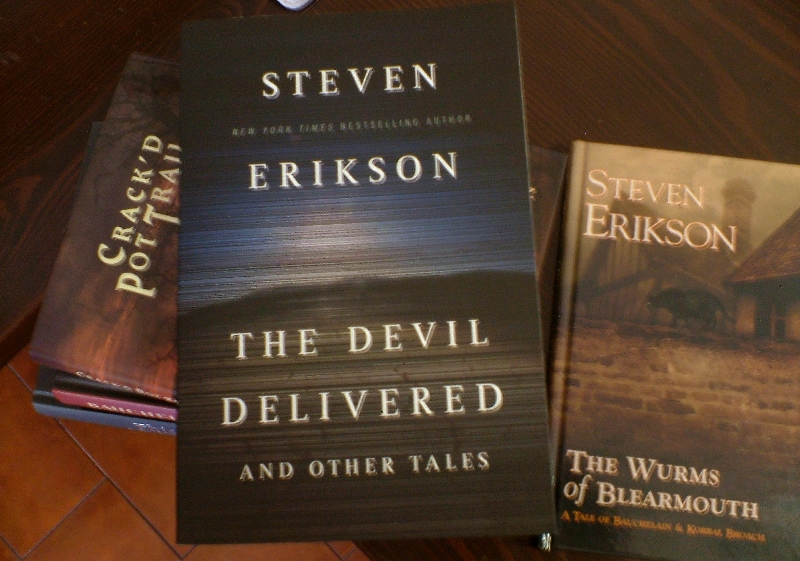
The two at the top arrived this week and now I have to decide which one will keep me busy while I wait for The Forge of Darkness. Skimming through The Devil Delivered (containing also “Revolvo” and “Fishin’ with Grandma Matchie”) made me think it could be another of those “minor” works that amaze me even more than the main courses.

I like the cover of this one too. This slitted view of some landscape. It’s a good metaphor for writing, as a world that is filtered, remade into discrete bits, and the perception of it that creates the illusion of the whole…

The blog has been mostly dead because it’s hot where I have my computer, so I stay away most of the time and don’t feel like typing stuff. I’m also planning to start (maybe) a little side project, that will require me to read another “epic” of 1200 pages. Though it’s not what you think.