Author Archives: Abalieno

This is going to be a little rambly. I only wanted to pick up a quote from episode 5 of True Detective because it repeats a pattern. One that I’ve been using in many of my posts on “mythology”.

This is a world where nothing is solved.
Someone once told me, “Time is a flat circle.”
Everything we’ve ever done or will do
we’re gonna do over and over and over again…
…and that little boy and that little girl,
they’re gonna be in that room again…
and again…
and again…
forever.

You ever heard of something called
the M-brane theory, detectives?
It’s like in this universe,
we process time linearly forward…
but outside of our spacetime,
from what would be a fourth-dimensional perspective,
time wouldn’t exist,
and from that vantage, could we attain it..
we’d see…
our spacetime would look flattened,
like a single sculpture with matter
in a superposition of every place it ever occupied,
our sentience just cycling through our lives
like carts on a track.
See, everything outside our dimension…
that’s eternity,
eternity looking down on us.
Now, to us,
it’s a sphere,
but to them…
it’s a circle.

In eternity, where there is no time,
nothing can grow.
Nothing can become.
Nothing changes.
So death created time
to grow the things that it would kill…
and you are reborn
but into the same life
that you’ve always been born into.
I mean, how many times have we
had this conversation, detectives?
Well, who knows?
When you can’t remember your lives,
you can’t change your lives,
and that is the terrible and the secret fate of all life.
You’re trapped…
by that nightmare you keep waking up into.

The theme of circularity is less clear, but the rest is again about determinism and the loophole. The second block speaks of the fourth-dimensional perspective, but the important aspect is the shift from one perspective to the other. One, ours, is a perspective from within the sandbox, the other, belonging to a theoretical observer we can as well call “God”, is the perspective from outside the sandbox. Where “the sandbox” means the known universe.

What’s important about this sandbox is that all its laws are contained and the sandbox is sealed. The premise of determinism is that there isn’t any intervention to the inside of this sandbox from the outside. This is also the premise of “science”, or the belief that the laws that rule the world are not mutable (if not when subject to bigger rules).

From that perspective, from the outside, everything is cause and effect. If we toss a coin we might interpret the outcome as “random”, but we also know that the face the coin falls on depends on a great number of factors and laws. Ideally, if we could know every factor we could also then predict the trajectory of the coin, how many times it spun in the air, and so predict the face it would fall on. But since this complexity is already far beyond our reach, we still consider it a practical use of randomness: we just don’t have that kind of control when we toss the coin.

But we can imagine a different perspective if one looks from the outside. In this case it would be like a sequence of numbers, of the kind where you have to guess a few missing ones by looking and figuring out the relationship between the numbers that are there. This is a common game. But with the perspective from the outside the game is different: you know already the rule that generates the sequence of numbers, you are given one number at a random point of the sequence, and your job is instead to deduce all the numbers that come before, and all the numbers that come after. That’s determinism.

Within this context, looking from the outside, the life of someone within this box looks like “trapped”. Why trapped?

“if you can’t remember your lives, you can’t change your lives”

If a choice depends, is influenced, by processes that “come before”, then that choice is always the same if the factors leading to it do not change either. But if you have memories, then these different factors will produce different results. Within a single life, linearly, you can see how experiences influence different choices down the line. That’s a perspective from within the box.

The “loophole” is again theoretically personified as “God”. Or: you need a way to escape the sealed sandbox, a kind of loophole that lets you go “take a glimpse” from the outside, and then returning back in, keeping that knowledge, so that you can use it to “change” what happens within the sandbox.

That’s once again the idea playing in those quotes. If “God” granted us, whenever the timeline reboots and we are reborn, “memories” of our past lives, then it would be as if we would obtain the “breaching of the vessel” that grants us the loophole. Knowledge that passes through God, holding our previous memories, is knowledge that is taken from the sandbox, preserved outside it, and then injected in the box to alter its content: this is intervention from the outside, and so the sandbox isn’t sealed anymore (unless there’s another external observer, whose observed system would be a deterministic “sandbox + observed god”).

Why does this matter?

If it’s all a game of infinite perspective shifts, then we are all alike God, playing with sub-creations (see Tolkien on his mythology).

How many times those detectives had their conversation, indeed? I’ve played it at least twice. And it was repeated as many times that show was seen. Every time it’s the exact same conversation. Because those characters are trapped in a movie, and the movie plays always the same. Those characters can show feelings and everything, but they don’t have memories of the repeating acts. You can see “choice” happen, when you move from one episode to the next, those characters react depending on their past experiences, but if you rewatch the show they aren’t going to retain those memories, and so they can only repeat themselves in the exact same way.

(interesting how the genre of games called “roguelike” offers a good example of loophole and sandbox-violation. The sandbox is the game, the player is the god. The character in the game/sandbox can die permanently, but then his “knowledge”/memories passes to the player, who’s going to learn from those characters’ deaths, and play better)

So if god created the world, and sees it as a deterministic system where we don’t have any freedom, the same happens to us and to our sub-creations. We are small gods with small powers, just repeating the same moves in a smaller scale. I guess.

Oh, True Detective, HBO. Singular masterpiece on TV now.

Some pretentiousness and fluff aside, this is serious good writing, excellent use of music, excellent direction, and even more excellent acting, which is rare if taken alone, even more if you expect them to happen all at once. It comes as close as possible to an hour of perfect Television. I’m impressed (I’ve only seen the first three episodes, I’ve heard the fourth is better).

It’s also a fair bit like a TV adaptation of Bakker’s “Disciple of the Dog”. Matthew McConaughey is more than perfect for the role as Detective “Rust”, the most delicious kind of cynicism. Tasting exactly like Rust, who suffers from synesthesia. Bakker’s themes are all there and not /too/ flattened for the broader public either.

This show, contrary to the standard of TV productions, is also run entirely by a single writer and a single director. Eight episodes and the first season is over, but following seasons, if they happen, open up completely new chapters and characters. So this story will come to a close in these eight episodes. It promises and delivers.

To add more genius, the opening shows human interiority as physical landscapes. Human beings as environments. And The King in Yellow was mentioned.

But this post is simply supposed to collect quotes right from the script (or the three episodes I’ve seen).

– People out here, it’s like they don’t even know the outside world exists. Might as well be living on the fucking Moon.

– There’s all kinds of ghettos in the world.

– It’s all one ghetto, man, giant gutter in outer space.

Look. I consider myself a realist, all right, but in philosophical terms, I’m what’s called a pessimist.

– Um, okay. What’s that mean?

– Means I’m bad at parties.

– Heh. Let me tell you. You ain’t great outside of parties either.

– I think human consciousness was a tragic misstep in evolution. We became too self-aware. Nature created an aspect of nature separate from itself. We are creatures that should not exist by natural law. We are things that labor under the illusion of having a self, this accretion of sensory experience and feeling, programmed with total assurance that we are each somebody when, in fact, everybody’s nobody.

– I wouldn’t go around spouting that shit, I was you. People around here don’t think that way.

– I think the honorable thing for species to do is deny our programming, stop reproducing, walk hand in hand into extinction, one last midnight, brothers and sisters, opting out of a raw deal.

– So what’s the point of getting out bed in the morning?

– I tell myself I bear witness, but the real answer is that it’s obviously my programming, and I lack the constitution for suicide.


Ah, that’s not this. This has scope. Now, she articulated a person with vision. Vision is meaning. Meaning is historical.


Yeah, back then, the visions. Yeah, most of the time, I was convinced that I’d lost it. But there were other times… I thought I was mainlining the secret truth of the universe.


– Some folks enjoy community, the common good.

– Yeah? Well, if the common good has got to make up fairy tales, then it’s not good for anybody.

If the only thing keeping a person decent is the expectation of divine reward, then, brother, that person is a piece of shit, and I’d like to get as many of them out in the open as possible.

What’s it say about life, hmm, you got to get together, tell yourself stories that violate every law of the universe just to get through the goddamn day?

Oh, yeah. Been that way since one monkey looked at the sun and told the other monkey, “He said for you to give me your fucking share.”

Transference of fear and self-loathing to an authoritarian vessel. It’s catharsis. He absorbs their dread with his narrative. Because of this, he’s effective in proportion to the amount of certainty he can project.

Certain linguistic anthropologists think that religion is a language virus that rewrites pathways in the brain, dulls critical thinking.

See, we all got what I call a life trap, this gene-deep certainty that things will be different, that you’ll move to another city and meet the people that’ll be the friends for the rest of your life, that you’ll fall in love and be fulfilled. Fucking fulfillment, heh, and closure, whatever the fuck those two– Fucking empty jars to hold this shitstorm, and nothing is ever fulfilled until the very end, and closure– No. No, no. Nothing is ever over.

The ontological fallacy of expecting a light at the end of the tunnel, well, that’s what the preacher sells, same as a shrink. See, the preacher, he encourages your capacity for illusion. Then he tells you it’s a fucking virtue. Always a buck to be had doing that, and it’s such a desperate sense of entitlement, isn’t it? “Surely, this is all for me. Me. Me, me, me. I, I. I’m so fucking important. I’m so fucking important, then, right?” Fuck you.

People. I’ve seen the finale of thousands of lives, man– young, old. Each one is so sure of their realness, that their sensory experience constituted a unique individual with purpose, meaning… so certain that they were more than a biological puppet. Well, the truth wills out, and everybody sees once the strings are cut, all fall down.

Each stilled body so certain that they were more than the sum of their urges, all the useless spinning, tired mind, collision of desire and ignorance.

This– This is what I’m talking about. This is what I mean when I’m talking about time and death and futility. There are broader ideas at work, mainly what is owed between us as a society for our mutual illusions. 14 straight hours of staring at DBs, these are the things you think of. You ever done that? Hmm? You look in their eyes, even in a picture. Doesn’t matter if they’re dead or alive. You can still read them, and you know what you see? They welcomed it, mm-hmm, not at first, but right there in the last instant. It an unmistakable relief, see, because they were afraid and now they saw for the very first time how easy it was to just let go, and they saw– In that last nanosecond, they saw what they were, that you, yourself, this whole big drama, it was never anything but a jerry-rig of presumption and dumb will and you could just let go finally now that you didn’t have to hold on so tight… to realize that all your life– you know, all your love, all your hate, all your memory, all your pain– it was all the same thing. It was all the same dream, a dream that you had inside a locked room, a dream about being a person…

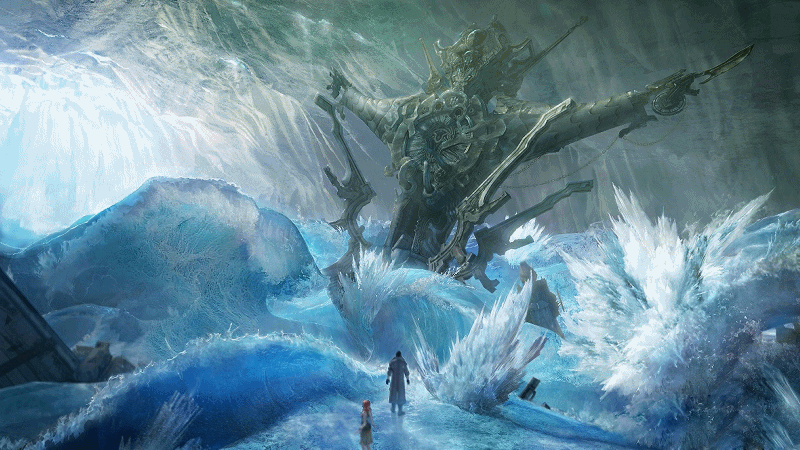
Final Fantasy 13 is still widely considered the worst in the whole series, and rightly so to an extent. It’s pretty clunky and bad as a “game”, but I still do believe that its setting and mythology are rather interesting and the better developed compared to all the other games in the series.

The story in the first FF13 is rather convoluted and it is true that for the most part it makes no sense, but there are aspects of it that are either misunderstood or under appreciated. Recently I’m having fun replaying the first System Shock and it’s another of those games with a brilliant structure and flow. You are alone on this space station, waking up after months of coma. The station is desert and overrun by hostile mutants and robots. All the “plot” and sense of direction is delivered through audio logs that you find around. Each audio log has a date, and you can explore a level in a non-linear way. So it’s like collecting random pages of a book, slowly putting them together. These disconnected pieces eventually form a more comprehensible puzzle as these logs are organized and listed by date, so you can rebuild the chronology of what happened and figure out what you are supposed to do next. FF13 has a somewhat similar structure in the sense that the events that lead up to the events at the beginning of the game are slowly rediscovered through the first part of the game. When the game starts the characters don’t know each other, but all of them are quickly brought together. Instead through the flashbacks we see the story from each character’s perspective, but each adding to a bigger picture and leading up to the big convergence that starts the game. While this is less functional than System Shock, it still allows the game to start big, in medias res, and then start to map out the context and everything else. It sets the characters and then attempts to build a sense of place.

This character-level perspective, where for the most part the characters proceed without any real clue of what they are supposed to do, is sustained through the whole game, including the end. What’s interesting for me is that this plot forms like an “inner circle” that is contained within bigger plots, Grand Scheme of Things, that involve the gods of FF13 mythology. Character-level drama is subordinate to the hidden god’s game in the background. One of the plot points that gets criticized the most is how these gods pick and brand human beings to accomplish some tasks. These tasks are obligatory, in the sense that often they have time limits, and if an human doesn’t fulfill his mission then he gets turned into a soulless monster. Yet the “silly” point is that these agents of a god aren’t given a clear mission. They are left basically clueless trying to figure out in the first place *what* they are supposed to do. Secondarily, this is linked to other themes of freedom: whether or not they could free themselves from the will of the god, act of their own free will, or just being puppets. While all this ambiguity is usually seen as just plot that makes no sense, it’s instead ambiguity that preserves real-life themes. The questions that the characters ask themselves in the game are the questions you wonder about outside the game. Ambiguity and uncertainty are what dominate a life. You are left alone giving an answer to your questions, and even if you find one, it’s never conclusive or completely satisfying. The gods in the game structure and condition the life of the characters as a real world does with its imposition. But the gods themselves do not give answer.

At the end of the game the characters face the gods in battle. It’s a deliberate attack on the imposed structure. A rebellion against control, and against the ambiguity that was imposed on them (even if they end up fulfilling exactly the god’s agenda). They somewhat “self-depend”, find strength within themselves and all the typical idealist babble you expect from a game. Find the truth within yourself, dream, hope and whatnot. It all becomes really hard to follow but if you push away all this typical nonsense and get the actual quotes, things become interesting again.

A heaven.
Yet it must fall ere we be saved.
Too frail a shell, and humans should not thrive.
Too stout a shell, and they would not die.
Slaughter and salvation.

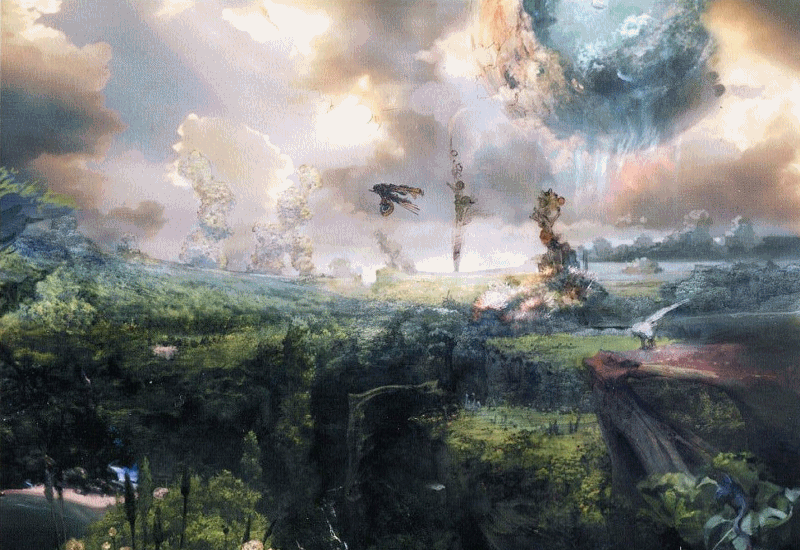
The weak theme here is the dualism good/evil. It’s a conflict within the god and it’s not well realized, but the interesting part is before. A “heaven” is the place that the gods have built for human beings. A place for them to live, protected from the hostility of the world outside. This is a “real” theme, in the sense that human beings are in conflict with their environment, and have to conquer and reshape it in order to survive. In this case the gods protect human beings. If this “shell” is too weak then humans die, because they are too exposed to the world outside (in FF this is unsubtly made real by having the world overrun by huge monsters). But if its too strong, then they wouldn’t develop, become stronger. In the ideal evolution of life the hostile world is necessary for life to develop. The struggle and pain are necessary for growth and improvement, to impose the will to move forward, to act. Nature is always cruel, because it simply follows its own cynical rules. In this case the god simply voices the dualism that is implicit in nature, when nature is observed by the human, and so “judged”. The ambiguity in life is simply projected onto a vessel, a god, then given voice through the god’s speech.

After that, the god speaks some more of the relationship between humans and gods (hint: fal’Cie = gods, l’Cie = humans used by a god as agents):

Have you ever paused to consider our reason for making l’Cie of men? We fal’Cie are crafted for a single purpose and granted finite power to that end. With men it is not so. Men dream, aspire, and through indomitable force of will achieve the impossible. Your power is beyond measure. We take l’Cie that we might wield such strength.
Men dream, aspire, and through indomitable force achieve the impossible. Your power is beyond measure.
We take l’Cie that we might wield such strength.
Through you we obtained freedom from our bondage.

So the gods are single-purpose, created to achieve something and nothing else. What’s the theme here? Determinism. The gods don’t have free choice. They are bound to their single mission, they are built as tools, shaped exactly for one purpose, given no more and no less power than what’s required to achieve it. So this is put as if the gods envy the power and freedom of men. And what’s interesting, even if not “canon” with this mythology, is considering all this in the guise of Bakker’s “WHAT DO YOU SEE?”. The gods, in mythology, and in mythology as something created by men, are vessels that give us answers and revelations. But we are the voice of those gods. These gods are mere mirrors. They need our eyes to see, they need our voice to speak. The silliness of a god speaking aloud is the pretense of finding a voice. The god doesn’t know what he’s going to say before the voice is heard, because the god is a receptacle.

Even in that quote we get again more of the idealistic babble. Men through indomitable force achieve the impossible, power beyond measure. But within Final Fantasy mythology, this has a lot more actual substance. Men, contrary to gods, have a “soul”. It’s because they have a soul that they can tap that source of “power beyond measure”. A source that can’t be predicted, that can’t be manipulated by a god. Something that lets men escape, be free. Being able to self-determine. Only men have power beyond measure because only men have a soul, isn’t this what most of us actually believe?

I have written in the past about this simple but powerful scheme to explain the “structure of the world”, and the place human beings have in the Big Picture. I’ve said that the Kabbalistic god is “compatible” with science. Why? Because science assumes the system of the world is completely closed, without any metaphysical interference. It means that rules are discovered, but not invented. And those rules can’t change, unless subject to a bigger system that also needs to be explained. The Kabbalistic god is compatible with this, because after the world is set in motion, that god can’t interfere. So, looking from the “inside” of this world, the god is unreachable, out there. That god doesn’t “matter”. A world without metaphysics, so without any sort of magical or spiritual interference, is the world of science. All this is important because it’s ordered in the scheme of inside/outside. The scientific, deterministic world of science has only one “inside”. This because an interference from the outside breaches the system. It means that spurious elements are infiltrated, added in the system, and so dynamically changing the system itself. It’s meta-physical interference (derailing: I should make a case of changing “Postmodernism” to the more telling “Meta-modernism”).

Now if we consider human beings as having “free will”, and so real choice, we assume that the brain is its own system that is ADDED to the system of the world. Reality becomes: system + human being. Every human being, so, can influence the system, bring CHANGE to it. But this is our first-person perspective. We know instead that from the perspective of the system itself, we aren’t “added”, but we are simply, always have been, and always will be, just more environment of that system. It means that rules of cause and effect don’t stop when they move through us, get manipulated, and then come out differently, but instead they flow, through the world as through of us. We are still cause and effect, our brain is cause and effect, our thoughts are cause and effect. Formulating a more intuitive, “lite” version of Blind Brain Theory, I could say that, like theory of Chaos, we are only able to backtrack so much cause and effect. After a certain threshold we just can’t grasp the exponential growth of dependencies that rule the world. This means that past this threshold all becomes and indistinguishable blob. And since we can only backtrack a very small minority, and only a few steps back, of our own thoughts, it means that we are not “aware” of the true origins of cause and effect. And without an origin, we claim it as ours. “We” decide, we feel, we are. Because we are that threshold past which the world is too complex to use and realize.

Back to the canon of FF13 mythology, the soul in a human being works in the guise of a tunnel, that connects a man to a metaphysical realm of “Chaos”. The source of that power unique to men, is Chaos. The unpredictability. Chaos in this mythology is synonym of free will. It is what escapes manipulation and determinism. Why is it so? Because this tunnel/soul breaches the closed system of the world, it punches holes through it. It connects the world to a metaphysical dimension that holds Chaos. By breaching the system the determinism is defied, because elements from outside the system are brought in, infiltrated through the soul tunnel, and so the metaphysical realm of Chaos interferes with the real world, brings change, achieves the impossible (or: breaks the deterministic equilibrium and predictability, and so, in this case, violates the order as set by the gods, who instead are deterministic, as explained above).

Final Fantasy XIII’s mythology is praiseworthy because it can actually supports, and openly so, this kind of structure. It’s fairly brilliant. The fact that in the game the characters are “terrorists” whose ultimate mission is to subvert the status quo is rather fitting with the idea of “agents of Chaos” that infiltrate the world, which is what actually happens on the mythological layer. That theme becomes plot.

As she danced she reduced the distinction between heath and sky. The horizon, never convinced of itself, melted. Vera was left crossing and recrossing a space steadily less definable.

This isn’t a review attempt, it is instead an admission of total surrender. I read this post on Harrison’s blog and that’s the perfect thing to catch my curiosity. I’m always for the epic: “this is my last stand, right on the edge of literature”. The idea that this story wouldn’t let go, and haunt its writer is a romantic ideal that has influence on me. So I decided to go read it. In the complete Viriconium paperback I already own this story is only eighteen pages, so it would be quick and I’d get right to the point.

I’ve read already a bit of Viriconium, the first book. I probably made past its middle point, or some sixty page of The Pastel City. I know it isn’t very much representative of what the Viriconium or Harrison’s writing actually is, but I enjoyed and grasped enough the dreamlike quality of setting, story and characters. It certainly has an unique flavor and charm, and it stands apart from everything else. At some point I’ll go back and read all the rest. This story instead, deep into “Viriconium Nights”, the fourth volume made by a collection of short stories, is what I could as well name “unreadable drivel”.

It’s not that I don’t try, but I have to admit failure when it happens. This short story seems to me as if someone took a novel, cut lines and paragraphs all through it, then reassembled them at random, and took every sentence to twist and turn it upside down. But this is not quite. The dreamlike substance that makes Viriconium is present here. This story, and its fictional world, is unstable, as unstable is the fabric of dreams. The instability itself is not perceived, because the fabric of a world defines perception itself. So the sense of wrongness (or weirdness) is perceived by the readers, but the characters go their way without awareness (or sight). Characters, and places, that seem culled from different stories, different worlds. Viriconium, the city, is the improbable intersection where these all meet. An amalgam of different cities, different places. But again it’s even more, because it’s as if the only trace left by all this is only a sort of radiation, a vague imprint. A ghost trace that is reshaped every seconds and receives afterimages from the outside. It’s like an archaeology dig site, a city that was here with its inhabitants, so long ago. Only crumbled walls, pot shards and dust are left. But instead of having the remains of one city, we have countless of them, and from different times.

So this is the structure: different places, different times, coexisting as a backdrop for a story. How would it be living in such a place? The few characters mirror that. As if characters that do not belong together, coming from the most disparate stories. It’s like an earlier movie by Werner Herzog with the actors acting under hypnosis. Characters suddenly standing up and shouting nonsense, then running off in a random direction. The prose, that I know is much praised, has no sense of flow and is actually a deliberate attempt at being clunky, broken, breaking any sense of pacing. Crooked sentences that do not belong to the paragraph they are in. The story is like an assembled puzzle where most pieces aren’t even there, only fragments forced to fit together. It flows and fades in and out, as if only very vaguely leaving behind a trail of coherence. A very weak, and always fading, link with reality.

These regions are full of old cities which differ from Vriko only in the completeness of their deterioration. The traveller in them may be baked to death, or, discovered with his eyelids frozen together, leave behind only a journal which ends in the middle of a sentence.

I guess as an art form it is quite good. It has that link of reality, it has the deliberate creation, it has consistence between style, structure and theme. I kept reading with the fading hope that it would eventually make sense. It obviously didn’t (or maybe it did, an imaginative watchman watching, seeing a story with Viriconium its theater). I can imagine the writer writing this all the while thinking about that. But I couldn’t follow, and in the end this is way more esoteric than Gene Wolfe. I have an intellectual appreciation for the aesthetic, and a respect for the writer and what he attempted. But reading this story was for me quite frustrating and ultimately annoying.

“Ajencis once wrote that all men are frauds. Some, the wise, fool only others. Others, the foolish, fool only themselves. And a rare few fool both others and themselves — they are the rulers of Men…”

World-born men, Kellhus had found, despised complexity as much as they cherished flattery. Most men would rather die in deception than live in uncertainty.

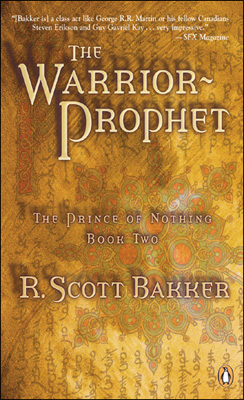
If The Silmarillion and Dune had a baby, and it had a truly dark soul, that baby would be the Prince of Nothing series. The Warrior-Prophet is book 2 in a trilogy sub-series. Another trilogy comes after whose third book is expected to come out later this year, depending on how long Bakker continues working on it since the first draft has been completed already. After that there may still be some other kind of follow-up in the form of duology or something similar, and what is important to consider is that all of this was already part of the original vision and not further extensions to take advantage of some success, since the risk here is the inverse: that the relatively narrow reach of such a work may cut its expression before it reaches the end. At least we know that the final book of the second trilogy is going to happen, and that it should lay out Bakker’s Grand Plan in its full potential, if not exhausting it. Potential new readers should then consider that this is already a satisfying work even in its current state.

Instead I’m still at book 2. This one is by far the biggest in the first trilogy, 200k words for 600 pages. Maybe not that HUGE compared to other typical epic doorstopper, but to me Bakker’s books feel so packed with ideas and tight focus that they lose none of the feel of epic breadth. More to the point, he deliberately channels with his writing style and tone the biblical feel that can make characters and events bigger than they are. I think the greater majority of Bakker’s effort when writing goes in this aspect: make every line of text the bitch of his purpose. Bakker, the writer, is a madman possessed of clear intent and indomitable determination. Nothing escapes his writing. It’s all heightened sight focused on purpose, and you could say that this, right here, is where he loses most potential readers.

Bakker’s writing is, if you let me play a bit, mono-tone. In the sense that every page sustains the same purposes and similar focus. This book has a true center in its protagonist, the nail of the revolving heavens, and there converges everything else. Mono-tone not in the sense of “dull” or “boring”, but meaning that the same obsession that drives every line also drives the story and characters. It drives the events and all the themes that smolder underneath. Other writers can have an advantage playing with a range of different tones, breaking rhythm through a different sense of pacing. Alleviating tension while building familiarity and camaraderie. But Bakker’s writing gains in integrity and consistence. Every part of the book serves its purpose. There’s no digression, no distraction. No “fanservice” to reach for a certain audience to please it. No compromises. It feels, maybe, “driven”. As driven are the people in the book blindly following their holy faith. Everything sacred and holy is what’s at the heart of the book, and Bakker approaches and seizes it with blasphemous ferocity.

And Cnaiür grinned as only a Chieftain of the Utemot could grin. The neck of the world, it seemed, lay pressed against the point of his sword.

I shall butcher.

This is not a tale conceived to be narrated to a reader. It’s more an inward kind of study and, with no compromises, can very easily drive readers away. But it is not hostile, it is not falsely pretentious or esoteric. It definitely tests a reader. It is not a test of “purity” or “worthiness”, but it’s definitely a test in prejudices and a challenge to how far you can reach, or how close you let it cut. It’s even easy for me to acknowledge some criticism against this book, accuses of misogyny and brutal violence. I do think that here and there some compromises would HAVE helped. A few things felt gratuitous and trying too hard. The very last scene could have been removed and the book would have lost absolutely nothing, and maybe gained some from it. The “Circumfix of the Warrior-Prophet” is another of those things that tips the balance over to the ridiculous, mirroring quite closely (I even suspect Bakker may have glimpsed this at some point) the scene where Achamian tells his story, thinks he’s finally reached his audience, when in the end they all burst in laughter. But it is true that Bakker would rather cut himself for playing on that edge over and over again, than back off and desist. He becomes Achamian (a kind of self-reference being played), ready even to humiliate himself just as long he stays “true” to his purpose. The other way, I’m sure, would have been easier. And this, I think, makes Bakker more like an ideal “artist”, who surrenders to art in order to serve it fully.

So “grimdark”. The Prince of Nothing is grimmer and darker than grimdark. Violence, sex, and sexual violence. Monstrosity, blasphemy. There’s filth and this book bathes in it as if the only possible and ideal place where to be. But again all this doesn’t serve a deranged appetite, only truths that are way more complex than how they appear. The horrors in this books are horrors that other books try to hide or completely deny. Like an inverted horror story where you pray the Boogie Man won’t come, but HE IS. Places where you’d rather not be. Other books are harmless, this one is not. But all this “ugliness” isn’t merely justified by some higher purpose, it is there because it is part of everything this story is. It is not simply excused to be there by the kind of setting the story uses, but it’s instead the fabric it is made of. The Inchoroi, the mysterious otherworldly race obsessed over human carnal activities and exploiting them in the ugliest way possible, are described as an “obscene race”. Magic is blasphemy, unclean because it undoes the order of reality. These themes revolving around the idea of purity and its perversion are what the book first and foremost engages with, and if it wants to reach deep it can’t recoil and filter just so the story is more palatable. It goes through an unavoidable path where absolutely no one dares going and conflating this to other books that show and exploit violence and sex is the huge misunderstanding, and the big risk this book takes without resorting to any compromise. “Grimdark” is usually used as a pejorative but it’s the greatest injustice to call this book so. The reason is that it would make this book sit in the center of a genre, but this book couldn’t be less representative of a genre. There’s nothing like it out there, especially in the fantasy genre, and even more specifically the Grimdark genre. The writing has an opposite focus, looks elsewhere. What you can identify as an “act” is instead completely different here.

If anything, Bakker tries to copy the more solemn, scriptural Tolkien (The Silmarillion), and the “vision” of Frank Herbert in Dune. The Prince of Nothing is a direct descendant of those works, maybe even to a fault. But at least it can absolutely stay up to lofty standards. Bakker is radical and takes no sides, including his own. His writing is ruthless, spares no one, carries no prejudices. Its grimdark posture is just that, what it looks from afar but that couldn’t be more alien from it. Look at the moon, not at the finger. Sadly, superficial looks is what books and their writers get most of the times. It is legitimate, and a reader is not to be judged if refusing this book. But there’s more to it than its “act”. So I can only implore, whatever you decide, to still approach this book after leaving behind all prejudices and with an open mind. You will find value, and it’s of a necessary, very rare kind.

To open a book was not only to seize a moment of helplessness, not only to relinquish a jealous handful of heartbeats to the unpredictable mark of another man’s quill, it was to allow oneself to be written. For what was a book if not a long consecutive surrender to the movements of another’s soul?

Characterization is a strong quality. There may be some controversy around this topic but I think that all characters are treated equally, whether Point of View characters or bystanders, women or men, they seem all cared for equally and very precisely characterized. Some choices could appear dubious and sometimes you don’t see the ideal arc of character development being realized, but once again the focus of this book is different and not simply about retracing those ideals. Some characters are described as trapped in their own cages and the reader expects them to eventually get free, to complete that ideal trajectory, but in this case Bakker isn’t interested in going through the standard movements. If you take someone like Martin who’s praised for his strong characterization you can see that every character is bound tightly to his own story, they “make sense” together, drawing an ideal path. There’s a sense of masterful craft in what Martin does, a search for narrative perfection and balance. But for Bakker this kind of idealism is made to be violated, undone. Bakker is an heretical voice, always subversive but never gratuitous. If Martin’s work dances on the edge between beauty and ugliness, Bakker instead explores some dark, bottomless pits where no one dares going and where it’s legitimate a reader refuses to follow. Nudity and shame. Unclean, unclean! He can show beauty too, but it’s often so vulnerable and momentous. Too exposed for the world not to spoil and devour it.

This quality of characterization surprised me not simply because it’s well motivated and coherent or consistent. But because the writer has a very fine attention for the subtler details, the very little gestures or partially hidden reactions that truly make a character into a whole. Bakker’s characters answer directly to the mantra of the book: what they are, the movement of their thoughts, depends on what came before. Who they’ve been, what and how they live determine what they become, the way they think. Being stuck in this middle position ideally constructs this “cage” that represents the universal human condition. So not only Bakker provides the finest characterization I’ve read, as true as possible to the singularity of the personal world of that character, but all this is still facing toward the core of the book, giving it power. He’s true to the small detail without ever forgetting about the sharp intent. The tone and purpose of the book, its direction. And so I admire this mastery where you notice both the sheer quality of the smallest element, yet realize how that element plays the fundamental role within the overall construction. Success on these two levels means reaching a kind of perfection in art, and I think Bakker goes very close.

Yet again this doesn’t mean universal acclaim. The frenzied, extremely lucid, but maybe self-absorbed writing style isn’t ideal to reach a wide public. And it becomes especially easy to misunderstood. Too incomprehensibly bleak and filled with unpleasantries. When Bakker does characterization the focus is on “being”, not “doing”. The cage of being can sometime, with certain characters, become intolerable from the passive position of the reader. After the accuses of misogyny and whatnot I still believe that what happens in the book and what the characters do is always coherent and necessary for this story (if not “opportune”). I do believe that women in the book are treated awfully, and if you reduce the book to this single aspect, everything becomes a catastrophic failure. But doing this is a manipulation, partial, partisan and single-minded. Because I do believe that women are treated equally to the men, it’s just that some readers decide to only see one side while obscuring the rest, and make that one part into the whole. No one is left standing, every single man is made into a pathetic fool and seen through the same lens. Bakker desecrates everything and everyone. Men and women. Offenses are taken personally.

Most, by and large, were born narrow, and cared to see only that which flattered them. Almost without exception, they assumed their hatreds and yearnings to be correct, no matter what the contradictions, simply because they felt correct. Almost all men prized the familiar path over the true. That was the glory of the student, to step from the well-worn path and risk knowledge that oppressed, that horrified.

There’s also to consider the aspect of “worldbuilding”, though I hate to deal with it as a separate thing. As it was with Tolkien, Bakker excels with it. This work is extremely well crafted and lends itself to (and is able to sustain) that type of close examination and speculation the fans love to do, much more than Malazan. Bakker doesn’t quite reach Tolkien’s levels of obsession but I really do believe that right now he absolutely has no rivals in the genre. There’s a great care for all the small details and structure that are only hinted in the background, the idea of a fully realized and consistent world, with its strong personality. And even more than Tolkien this isn’t just pointless detail, but still intricacy that contributes to an unique purpose. Motives that run deep and that aren’t simply scenery and choreography. So the attention for the little things is paid off aplenty, rewarded. For example the way magic works isn’t a “system” that is conceived to be just intriguing, but it engages deeply and meaningfully with the themes of this world, a sustaining force through it. That’s Bakker’s talent at creating a so incredibly complex, yet consistent world where none of its smallest cogs act independently or without reason. No writer I know comes even close, it’s just the way it is.

Lately I’ve heard often the expression “it’s very good at what it does” and I think it applies well to Bakker’s work. What’s most important for me to underline is that there’s no other thing out there like this. It’s epic fantasy, it can be called Grimdark, but there’s absolutely nothing in or outside the genre that does similar things or has a similar ambition (and sheer talent at craft). The only cousins are The Silmarillion and Dune, as I said, but that’s only in tone and as a search for a certain aesthetic, because purpose brings this book into a completely different territory. Bakker can actually channel Tolkien’s epic range and solemnity better than Tolkien himself, but where Tolkien’s world is all completely luminous and ideal, Bakker uses it to shatter the same holiness. To expose the ugly truth under it. The writing in this book feels extremely well measured, always sharp. Erikson can have a more varied tonal range, but Bakker loses that to gain in focus and consistence. In the next years it is likely that we’ll get more good writers in the genre, as it always happens, but Bakker represents exceptionality. Something that will stay unmatched because it goes outside every genre or trend. Books come out every year, in every genre, this is one that isn’t going to be replaced or obscured by anything else.

I recently found a link to a Youtube video with a translation of a scene from a recent Visual Novel. I already mentioned how this particular medium is well suited for these kind of tricks like metafiction and fourth wall breaking.

This one is a good example (beware sexual themes and general meanness):
Part 1Part 2

It’s Part 2 where the interesting stuff happens. Visual Novels are quite often relatively simple “dating sims” where you follow a scripted story and only get to make an handful of choices through the whole game. Usually these choices can be about choosing which one of the girls offered you want to date, and so you branch out from the main plot into a specific, parallel “route” somewhat dedicated to that one girl you picked. And then these games often demand to be replayed so that you go through every route/option and sometimes unlock a “true end” with more mysteries and revelations.

In this case the metafictional play is that one of the girls suddenly drops the pretense of the story and starts talking directly to the “player”. Becoming somehow “aware” of herself as a character and knowing that the player previously went through a different “route”, declaring his “love” to a different character. So she breaches the timeline where she’s trapped in as a fictional character and confronts *the player* on his own choices. The scene is powerful because it actually reaches for a deeper truth: the player is a liar, he promises true love to every girl. Then she goes wild and takes control of the game itself by “rewriting” the script and disabling the possibility to save the game or even “quit”. Like some kind of AI gone mad.

There’s nothing too original about all this, but it still plays with interesting aspects. Metafiction is powerful because it is deeply linked to “truth”. It’s the frame, the condition we are actually in. The game here merely “plays” a reality, and it becomes creepy because it cuts some of the safe distance between fiction and you. When the character starts speaking to the player, and on the basis of true affirmations, it not only breaks the fourth wall, but it threatens to close that distance. Move one step too close.

Metafiction isn’t just one silly trick in the Postmodern deck of cards, but the laying out of the structure we can’t escape. If fictional characters are trapped within their medium, “real” human beings are trapped in their subjective world. You can’t reach outside the same way a character ideally can’t break the fourth wall. Fiction being real, and reality being fiction is just the original sin, the premise of everything. One box within the other. The idea of “self” as something you can observe as if who observes is also the object of observation SPAWNS all possible variations on the theme. Fiction is just the same pattern, an object you observe that in some ways reflects you. It’s the way the mind works.

So metafiction isn’t just a literary device among many, but it’s the structure that contains everything else. The same way as “writing” isn’t one of many possible human activities, but the one that includes all human experience.

Postmodern “awareness”, or the “great postmodern uncertainty” as DFW defines it, is a very specific and precise description of the kind of world we are currently trapped in. It’s not a trend you subscribe to, it’s the authority of this world.

It fits right in: