Author Archives: Abalieno

Just a nicely worded quote from a Kabbalistic text I was reading this morning. Lots of these give me many doubts, but this one is a rather accurate description:

(about the question “What is the meaning of my life?”)

“It is indeed true that historians have grown weary contemplating it, and particularly in our generation. No one ever wishes to consider it. Yet the question stands as bitterly and vehemently as ever. Sometimes it meets us uninvited, pecks at our minds and humiliates us to the ground before we find the famous ploy of flowing mindlessly in the currents of life, as always.”

A follow-up.

Because that framework is so powerful it also leads to other revelations. What Gödel represents for math, he also represents for science.

Science depends on a fixed, independent world, where theories evolve because they can be tested on reality. So reality needs not be mutable. Those rules governing its events need to have the totality of control (and, if there are changes, then the rules have to account for that change). Nothing metaphysical can bleed through, obviously.

But once again science exists only if the world is finite. Only if this world has an “inside” but no outside. Because if the system of the world is contained within a bigger super-system(*), then science would have to embrace that larger system to count for all phenomena. So it’s again the necessity for a one-sided space. The Klein bottle. Science cannot allow for something external (something outside its grasp). And if something external is actually discovered (you could make a case for quantum physics) then it needs to be brought back in, so that science reaches out and includes, integrates. So that the practice of science and theory-making can get closer to the actual ideal of Science: explain everything with no omissions or gaps. Science has the liking of an omniscient light cast upon the world.

From another perspective: science is valid only as long no outside is found (or: only until science conquered everything and there’s nothing left “outside”). Its determinism holds only as long the world is indeed finite and one-sided. Leading directly to Gödel’s paradox (no system seems to be able to fully close itself). If you think about it, it mimics the perspective of “free will”. Free will is possible only UNTIL an outside claims it false. Or: the perspective remains valid only if the wall that defines it, is breached. It exists because it doesn’t. Science postulates determinism, determinism negates free will, on the premise that if the system is closed and one sided, then free will has no leverage, because a mind only exists within the system and so slave to its rules. In determinism the mind is moved, not moving. But in the same way we are vulnerable to science (it denies subjectivity through hard reality and facts, it debunks faiths and beliefs), so science is vulnerable to its own “outside”. Because science for us represents a similar “outside”.

But let’s avoid the ambiguity held in the idealism of language. Let’s call the science that describes the physical world as we know it as Science-1. If a bigger system of reality is then discovered that has total control over the physical world as we knew it, then it’s obvious that Science-2 totally invalidates Science-1. If before we thought Science-1 had the total control (of description) of reality, then instead we discovered that Science-1 was merely under total control of Science-2. Just another slave. Formally, again it’s information from the outside breaching in, demonstrating that Science-1 wasn’t a closed system. The same happens with out mind/consciousness. Experience says that our one sided view is the whole thing. We feel as we have control of ourselves and freedom of choice. But then external knowledge proves us this may be just an illusion, and that the brain is also subject to the rules of the physical world. The problem is that what is “legal” in the example above, isn’t legal in this one. We can’t use that information.

So how is it possible to have both? How can Free Will be made compatible with Determinism? From my point of view, and this framework, it’s a matter of handling the perspectives, because mixing them leads to the paradox that generates the incompatibilities themselves. Science demands a one sided space, that it can fully dominate. Human beings, free will or not, are systems that exist within the “system of the world”, so the domain science casts its claim on. Through science we access knowledge of the world outside of us. Hypothetically even knowledge that unsettles us, like the demonstration that our perception is skewed, or entirely false. But we lack the authority to ACT on that knowledge. We simply discovered how things always were and always will be. So while Free Will is explained away, it still doesn’t render us empty of consciousness. Formally the discovery has no power on us. Meaning: the discovery of us lacking free will couldn’t possibly motivate something like a change in law practices and morality, because we don’t have the Free Will to deal directly with those things and modify them.

Determinism basically says that us, as observing systems, were always “system”. Religion actually explains this much better: we are all part of the same thing, something like spiritual unity with the entire creation. Yet we perceive ourselves as a life with a very narrow perspective (and needs, and selfish desires). Consciousness only sees itself with an idea of “identity”. This perspective can be judged false by information that comes from the outside (science) but it cannot be invalidated. It’s like we are a robot that is programmed to go on its course, able to access knowledge of the impossibility of acting otherwise. So this isn’t a “stage”, like recognizing a lack of free will in order to truly achieve it. It’s just knowledge with no power, invisible. Not there. It’s illusion. Because knowledge that creates no difference is knowledge that does not exist. The lack of free will is itself pure illusion. Why? Because the perspectives get mixed. From our perspectives our actions depend on what we decide. We can’t suddenly stop doing that. Nor the reasons why we do this and that, or the way we organize ourselves, can change on the knowledge of lacking free will. So, again, we can’t use that information. Following that, we cannot not-act. We cannot surrender, or even modify, the free will we think we have.

There are two possible scenarios or ideal worlds. One were we gain some sort of enlightenment and reach some spiritual betterment where we can achieve true free will. The other where we “let it go”, in the sense that we entirely give up the illusion and really start feeling ourselves as the robots lacking will we are. The point is: neither of the two is possible. The first is not possible because we can’t exit the system. The second isn’t possible because robots have to do their thing. What we currently call Free Will isn’t an ideal, but simply us “doing our thing” in the way we always did it. It’s a relative, yet inescapable perspective. It’s fourth wall breaching. Knowledge not possible. So “lack of free will” merely defined the EXACT same thing we until now called “free will”. We swapped the *term*, but what it points to remains the same.

Practically, for us, knowledge of lack of free will doesn’t change the description of the free will we actually have, it changes *what it is*. But being the description the same, it continues doing and behaving the exact same way as before. It continues to appear the same way. Think about this: the “qualia” of consciousness has been described as the perception of a one-sided space (and again the requirement of this type of space to issue the control). Or: lack of perception of what falls beyond the light (of consciousness). Scientific knowledge is just about awareness that there’s something beyond these boundaries. But this knowledge defines and frames the space, it doesn’t remove it. Even though “science” doesn’t merely claim to be a dominating side, but also that no other side can exist, since science is always inclusive and totalitarian.

In the end it bogs down to something truly simple: does a character in a book have free will? Nope. Because we know there’s an author that actually decided what that character does and says. Yet, if you “ask” the character he will explain what he does and what he says in the context of his own “free will”, so the actual motivations of someone thinking himself as a real person. Which one the correct perspective? Depends. You look from the outside and you know it all depends on the writer. Yet if you ever care about a book it is because you are interested in the perspective in there. “As if”. Pretending to see from the inside of that world as if there’s no other outside. That world only exists and matters as long there’s someone willing to be there. A tautology: the perspective is valid as long it is valid. Which is a recursion. A loophole.

(*)
It is also funny to consider that if there’s a super-system that governs reality as we know it, it’s possible that also determinism as we know it is proven entirely false. With this hypothetical entity continuously poking things within our system, at its whims (but in a way that is hidden to us, because it sits in the super-system and is unperceived in ours, like a form of spirituality). Yet we would likely be entirely under the effect of the super-system’s determinism and its rules. It’s just *our* determinism that would be proven false (or merely encapsulated and then occluded, just a spectrum). Which is a variation on the theme of “why is god shaped in the liking of a human?”, or, why should the super-world, and its governing rules, be anything like we see in ours?

How could you possibly look ten women in the face and ask why they had gotten you drunk and made a game of taking your clothes off and putting you to bed?

Every long series has its fan favorite volume and for The Wheel of Time it’s book four, The Shadow Rising, coinciding also with the longest, at almost 400k words and 980 pages in the edition I read. Up to this point and including this one, each book, while relatively slow paced in itself, represented a different stage in the story. So where I expected formula I instead found a well defined arc with clear development. In this fourth book Jordan tends his garden.

There. I don’t think I could summarize what I’m going to write any better. I think it’s telling that this book, peculiarly since they were always there, lacks a Prologue. The way I see it there’s no prologue here because it’s the part of the book that usually teases the point of view of the bad guys (and girls, especially) before handing over the scene to the principal viewpoints (though it’s not a so strict structure and sometime you get other viewpoints as necessary). But book four mainly represents Team Good reforming and reorganizing. I knew already before reading the book that in this one the story opened up and laid the basis for what comes after, that it was essentially a foundation of the larger arc, but it takes quite a lot of pages to get the plot moving. In general, this where Team Good is on the move and plays its hand. So it’s not the bad guys who come forth, but Team Good taking the initiative to shake things up. It’s refreshingly “proactive”, instead of falling back in the norm of defending and confronting an imminent or latent threat. Despite this, Jordan still needs the imminent threat, even a number of them, so in the first part of the book a number of plot contrivances are tossed in just to keeps things supposedly tense, but in truth it’s all silly fakery. A pretense, smoke and mirrors whose purpose is linked to a bigger and more pervasive one I’ll explain later.

From a general outlook for the first 300 pages we mainly have characters looking around themselves to figure out what happened and where they stand, and decide (and argue muchly between them) what to do next. Then another 50 or so to actually get things moving. Past that point the book is split into three main branches, where each relies on a completely separate subplot, as if you get to follow three separate stories happening in different parts of the world to different characters. One follows Rand and his “initiative”, one Perrin and his woes, and another the girls and their affairs. And a fourth, minor page-wise, that deals with stuff elsewhere. They actually never converge, or get unified as the story goes, although some of the characters cross over. So for the first time, maybe, there’s an attempt to shape a world that has its own personality, in the sense that even if everything thematically pivots around Rand, stuff starts tumbling outward and the world outside claims its role. We see the ripples. It’s about the various parts of the world taking autonomy, instead of being empty stages waiting their turn as some main character passes through and experiences adventure. This happens timidly, but at least it happens, it is set as a goal. So while the first third of the book is rather shallow and not exactly matching the expectations for “best in the series”, overall the story is well sustained and interesting.

I imagine that for the fans the highest point is about getting to know more of the mythology and events from the past. There are scenes here that are meant to shape up things in a coherent whole, unify a number of different aspects and deliver more than a few revelations (especially those who enjoy to play with puzzle pieces). That part of the book could be considered fairly generous, and Jordan’s successful attempt to give some specific flavor to his world. But again, I can’t avoid thinking this is a giant fake, and that the true heart of the book is instead that shallow first third where characters bicker and fuss over petty things, and each other. That’s where the recipe is hidden in plain sight. The MUNDANE. Boys liking girls, girls liking boys. Tea times, sleepovers. Romantic love letters. Lots of pretty dresses and cleavages, or transparent silks and implied sauciness. This is it. The actual revelation here is the inverse of what you’d expect: the “fantasy” is meant to spice up the “romantic”, not the opposite. The fantasy is context, not subject. It is flavor, detail. Some window dressing so that the love story is more passionate and epic. Truly romantic and ideal. The fantasy is meant to add the required pathos that elevates a love story to its most idealistic extreme. Made wondrous. The shepherd isn’t a shepherd, but the predestined king in shiny armor that knows how to use a sword. But not just, because the love must be cursed, impossible. Never actually consumed. The longing dominates, because love stories need to be like that, always suspended, always slipping away. The boy wants the girl (or, actually, an harem), but he has more pressing matters because he has to be manly and save the world, first. Basically: adolescence. It’s adolescence stirred up in a mythical world. Essentially poison, in a way. In the sense that it’s super-effective. And that’s how I have (perhaps disrespectfully) reduced its popularity.

“Rand al’Thor,” Moiraine told the air in a low, tight voice, “is a mule-headed, stone-willed fool of a…a… a man!”

Elayne lifted her chin angrily. Her childhood nurse, Lini, used to say you could weave silk from pig bristles before you could make a man anything but a man. But that was no excuse for Rand.

“We breed them that way in the Two Rivers.” Nynaeve was suddenly all half-suppressed smiles and satisfaction. She seldom hid her dislike of the Aes Sedai half as well as she thought she did. “Two Rivers women never have any trouble with them.” From the startled look Egwene gave her, that was a lie big enough to warrant having her mouth washed out.

Moiraine’s brows drew down as if she were about to reply to Nynaeve in harder kind. Elayne stirred, but she could not find anything to say that would head off argument. Rand kept dancing through her head. He had no right! But what right did she have?

Then you may not agree with the extent of what I described, but it’s undeniable that it’s still there. If you think about it Martin’s ASOIAF isn’t all that different. It does the same thing but for more grown-up readers. Those hooks have similar shapes, in similar places. In both cases what’s familiar is used as a breach in the heart of the reader, grasp those familiar emotions and trappings that work so well in all forms of fiction, fantasy or not. The fantasy adds spice, elevates potentials. Inscribes into epic and memorable. Gives the writer unprecedented control (and responsibility). Characterization follows suit. Jordan does go after realism, but goes after iconic. I’d say characterization is extremely detailed and always well defined. Those characters need to stand apart, become familiar in the least amount of time. On top of this Jordan has a style of writing that is very expressive and “outward”, so you don’t find ambiguity and subtlety, but familiarity is the key to understand the characters perfectly and get absorbed in their story and personal woes and cravings. It is also an aspect where a formula shows. The smoothing of skirts and tugging of braids is now legendary and much sneered at, but I kind of respect it and find it as an actual strength that adds to characterization instead of subtracting. Why? Because this bundle of gestures and other small acts are used as a kind of characterization toolkit. So much redundant, but each expressive and carrying a very specific meaning. Each character has its own dedicated package, and each is used to convey a particular mood or sentiment. It makes characterization plain and, if I haven’t repeated it enough, hence familiar. Characters immediately recognizable, near to you so that you want to share. It works and it’s never overwrought because it always serves a point. Since the gesture conveys the state of mind, it is precisely necessary and efficient.

For someone who isn’t a Jordan fan, “best of Jordan” isn’t any better, but this book at least is more consistent and interesting compared to the duller and perfunctory 3rd. Characters step out of their lull on both sides, the evil foes start getting a personality and being more defined between each other, becoming characters and so giving more actual substance to a story that up to this point was merely against the usual abstract threat of some metaphysical evil. This also gets better nailed to the ground, more tangible and familiar. The story actually gains from having more of it revealed instead of shrouded into mystery. But then when you let character make the story it can also happen that they can unmake it. Perrin’s chapters would be at least nice but the way the character behaves makes them quite obnoxious. His relationship with Zarine is jarring because of how forced it is. It’s one of the cases where characters’ stereotypes are way more powerful than any realism. It reads like the most naive fairy tale and loses all its impact. And I actually like Zarine, compared to what I perceived as widespread hostility in the fandom. Thankfully there’s always a little bit of plot movement, myth development or mystery going on with obnoxious characters’ interactions. The book is readable even if slow paced, and overall a good experience comparable to the second volume, the one I liked the most up to this point.

Despite some plot moving parts and a general decent satisfaction in wrapping up the book, it’s not like what happened is so pivotal. Most of it is set-up, and some characters that are newly introduced absolutely go nowhere. They are basically entirely superfluous and it’s very clear they represent a part of the story that will play a role later on. It is a book that builds and moves, but only to load material on the rest of the series. Very little in this book happens for the sake of the book itself, and it’s maybe a success that it still feels satisfactory despite being mostly transition.

As I’m wont to do I started reading the 5th right as I finished this one. The end of the 4th is abrupt and really one big setup. You are meant to wonder: what now? And again it’s also a success that finishing the book made me enjoy a lot reading the prologue of the 5th. If I didn’t have a substantial reading queue I’d really like to just go on. As I said, this present book feeds the rest of the story, so that not only you may had a good experience reading it, but interest is sparked about what happens next. In a way, I could say that the very best part of book 4 is the prologue of book 5. And, less successfully, the more the book stays away from the main characters, the more it actually gets interesting and fun to read.

If one isn’t at peace with what I wrote in the first part, the mundane and the adolescent context, then it’s not going to be a series that can be digested. One would just bounce back on the irrelevant fluff and characters’ contrivances. You can’t even attempt to separate all that from worthwhile myth and worldbuilding. It does feel shallow and artificial. But if one is indeed an adolescent, or at least willing to impersonate one (!), then it’s really an enjoyable, epic story that carries on one’s dreams. It is generous and welcoming, and for this reason more “aware” and extrovert compared to the archaic Tolkien. Yet, while it is built to capture a large audience and remain as a classic, I believe its naive idealism won’t survive the times. Even younger readers now are jaded and cynical, as shaped by the world we live in, and maybe there’s not so much space left for the colorful, larger than life epic tales. It’s Jordan that appears archaic compared to Tolkien.

I had this article on free will bookmarked for quite a while because I wanted to add a few observations of my own to it. So now I’m checking boxes and coming to it.

In that article it’s the term “free will” that is being questioned and I always though that when a complex discussion ends up focusing on a word then the point is being missed. Language is merely convention. A word only means what it is useful for it to mean, and whenever you need a more specific term, then a new one is produced.

If you focus too much on what the term means then you miss the point. When dealing with “free will” I have this scheme that I think helps to frame the problem, and so more easily look for solutions. In this specific case the meaning and usefulness of the term depend exclusively on perspective. So we have two opposite answers that are both valid depending on who’s asking (or, from where he’s asking). And that’s why it all ends up in so much confusion and controversy. But in the end this is not a problem of an ambiguous term, it’s instead a problem of perspective and context.

So once again let’s start from the center. We pose the question. “We” are consciousness, and consciousness happens in the brain. It became evident that the peculiarity of consciousness compared to everything else is associated with language. And the peculiarity of language, and of that association by extension, is one of its functions: the metalingual. What is that makes this function “special”? Reflexivity. Reflexivity is the propriety that lets language describe and define itself, and reflexivity is the property that enables a brain to develop a consciousness as we know and experience it. This reflexivity is the true, fundamental culprit of all these processes. This was all properly identified and described in “Gödel, Escher, Bach” as a “strange loop”, and the peculiarity of a strange loop is again the reflexivity.

In information theory the concept of reflexivity is used on the observation framework. What makes reflexivity (or the loop) “strange” is that recursion on itself. Reflexivity in observation means, essentially, introspection. Which means “confusing” subject with object. When observing, you observe an object. But when self-observing, you end up with this weird duplication: you as a subject observe yourself as an object, so at the same time you are both subject and object, here and there. This split is at the source of what we call the human “condition”. That we also know as Cartesian Dualism. That dualism fundamentally originates in the split and duplication of the observation. The mind detaches itself from a body, perceives itself as something else, “more than”. This “mistake” is the base that causes all consequent conflicts and paradoxes.

So we have reflexivity on one side, and a split of the process on the other. The dichotomy infuses everything else. There’s not just a conflict of subject/object, but also one of inside/outside. If observations (as distinctions) happen in the general structure of system (the subject of observation) and environment (what is observed), then system/object are essentially built as inside/outside. A distinction between a self/subject/inside and an environment/object/outside. So, formally speaking, we already have the paradox laid out: we perceive consciousness as something else than a brain, or, we consider consciousness (a subject) separate and independent from its ambient, which is the physical brain. Otherwise neither reflexivity nor observation are possible. They require distinction, and an object that self-observes without a distinction perceives itself as a wholeness. So as something that is formally not observable (aka: non conscious). A brain without consciousness obviously doesn’t “think”, because it can’t observe. It can’t recognize itself from anything else. So it’s undivided from the flux of all creation. Exactly as all non-conscious things, alive or not. It’s non-discrete.

The problem is embedded in the formality of the process that allows us to be conscious. It means that consciousness is based/enabled by a contradiction. So it’s also obvious that it can’t escape itself. Consciousness is bound to its rules, and so to its limits (aka boundaries). This is important when we’ll define whether “free will” is an useful and appropriate term.

What I just described is a simplification that is useful to “frame” the problem. One of the basic distinctions I took out is inside/outside. This is important because it’s the context that motivates free will as a concept. What is free will? This: something that controls itself independently from the outside. Determinism runs counter to free will because it says, in Bakker terms, that what comes before strictly defines what comes after. Which means that there isn’t any freedom of consciousness in there, at some point, to take control. Everything is already set-up by the pre-conditions. Which also means that it’s the outside (environment) that determines what goes on in the inside (system). So the inside/system/consciousness is merely under the complete control of what’s outside. Everything is already firmly determined. There’s no “freedom” of choice.

Now let’s ask the important question: how would free will happen (if it was truly free and not some surrogate)? Free will, formally, is a system with the possibility to be independent. In the case of a human being, so a system that is part of a much larger system with its rules (physical reality, or the universe), free will means escaping the larger system. So it means the possibility to “exit” the physical reality, escaping it. In religion free will exists because consciousness is seen as a metaphysical entity that ESCAPES rules of physical reality, so religion defines consciousness as something that can’t be merely described by the physical properties it comes from (so consciousness is seen as “more than a brain”). By being “special” (and metaphysical), consciousness acquires its “superpowers”, or: the possibility to punch holes in the physical reality, so transcend it, so, formally, to “exit” the system.

Exit the system. That’s what defines free will as a possibility. But remember that I also said consciousness originates as a paradox, and the paradox allows for consciousness but doesn’t allow consciousness to truly break its rules and boundaries. Which means, from the scientific perspective, that a consciousness isn’t allowed to “transcend” physical reality. So a consciousness can’t exit the system (physical reality), obviously, and so science says that, nope, we don’t have free will, because we are inside this system and subject to all its rules. We are slaves to the system, or, formally, just a system wholly contained within another (and so defined by it, not independent).

How the hell do we exit then? Through information. This is kind of tautological, but if you can actually reach some kind of information external to the system, and bring it inside, then the system is essentially broken. You exited it, by introducing something new into it. So you added variables that were not yet there. Hence forced an outcome that wasn’t previously defined. You obtained “free will”.

Now I’ve defined the superpower but this doesn’t mean I have it, or can obtain it. That’s not the point why I’m writing. The point is that the frame, of outside/inside, is useful to understand the deal with free will. The point is: the system who’s asking the question (whether free will is available or not, or useful as a term) is the same system that pretends to answer it by self-observing. What I mean is that the question CONTAINS the paradox, and then why it then can’t easily obtain an answer. Do I (system) have free will? Who will answer? Still I. So I am both subject and object. I am the entity that asks, analyzes self and then offers the answer. Which means confusing subject and object, inside and outside.

So where’s the mistake? The mistake is that, formally, who says that human beings have no free will is an abstract entity that is not assimilable to a “self”. “You don’t have free will” is not what an human can tell to another human (or to himself). Because the observation “you have not free will” is only possible for the system of reality (that we simplify as a surrogate: science). It’s Science, to whom we give voice, that tells us: you have no free will. So we know we don’t.

We know we don’t, but we don’t EXPERIENCE we don’t. Because Science is not an external entity. We give science its voice. It’s a golem, or a man-made god. Which means that, sure, we have that judgement and may believe it, but since we can’t truly POSSESS that affirmation (we can’t formally tell ourselves we lack free will, because we can’t formally make that observation) then it simply means that knowledge/experience of that affirmation, “you’ve got not free will”, is… useless. It’s *formally* useless. It can’t formally produce any change (or we would have actually enabled free will by not having it, since finally knowing that we have no free will would have actually brought CHANGE, learning something new, and so obtaining actual free will). If we don’t have free will, then it means that knowing we don’t have free will doesn’t “move” the system. So it’s as if we know nothing new. Which means this knowledge is IRRELEVANT, whatever the outcome. We can be sure it’s irrelevant in all possible cases.

The point of this whole deal is that this question isn’t “legal” in the formal system. Only an external system can say we have no free will. The system can’t speak (or it would be equal to “reach god”, or have a transcendent experience). So the system isn’t allowed its answer. We may IMAGINE that answer, but whenever we further consider it we violate a formality, and so produce something false. Like breaking a mathematical rule. So I’m saying we can’t, formally, get an answer. It’s denied. And, in any case, even if we got an answer it would be irrelevant for the reasons I’ve explained. So we covered all possibilities.

The lack of free will is an actual impossibility. We are basically FORCED to have free will. Or: to live as if. We can’t formally live otherwise. This is bound to the human condition: you can’t NOT make use of your free will. You have free will because it’s formally impossible for you to NOT have it (as long you possess consciousness, and so reflexivity, and so possibility to self-observe).

Everything else is just consequence. Morally, considering the possibility of a lack of free will, as discussed in that article, is pointless. Because our morals exist on the premise we have free will. And as far as we are concerned we HAVE free will. Only god (the system) could tell us we got no free will, but god won’t speak to us (if it did, we’d automatically and immediately acquire legit free will). Science could tell us, but science is given a voice. That voice is ours and we aren’t allowed to tell ourselves that sort of thing.

All this simply amounts to going repeatedly at a solid wall. There’s no way through (again because of the formality of the inside/outside rule, you can’t be both inside and outside, so when you try you get the wall in the face). No way around. Which means that the concept of free will as a term is only useful to us in the measure we already use it: the idea of consciousness and free will as we *experience it*. Because that presence of free will applies to us, and exists for us, exactly in that measure.

Which is very similar to the example of the flipped coin. Is a coin being flipped truly “random”? Nope, because we know that the face the coin will fall on depends on a myriad of variables, all dependent on the initial stages that coin was in. The result is already determined, but *for us*, the coin being flipped is an usable approximation of “random”, merely because we just can’t effectively manipulate the outcome. It’s beyond our grasp and so we accept the randomness of a flipped coin even if randomness isn’t a thing in a deterministic world.

Same as “free will”. We can only have a good approximation of it. We are forced to exercise it, as long we live. There’s no way out, there’s no way in. You can only live and use that will, relatively free or not. Knowledge won’t let you free, in this case.

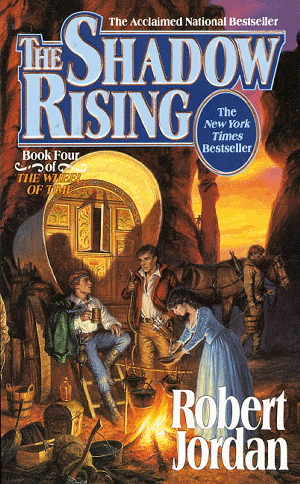
I’m 35 pages from the end of The Shadow Rising and tomorrow I start right away with another “epic”: The Man Without Qualities, Robert Musil.

I’ll read it on the sidelines, the same as I’m reading Parallel Stories by Peter Nadas (another “hefty” 560k volume), so it probably won’t be put on my reading progress tab. I’m also reading the Italian version since I trust more the translation and I know it to be very good.

The Man Without Qualities is unfinished, though. One English version in two volumes out there is 1770 pages, but that includes a bunch of rough sketches and drafts at the end. If counting only the finished to almost-finished part (so including the galley chapters) then it’s around 520k words.

Reading the preface, I was reminded of George R. R. Martin. See if it doesn’t fit perfectly:

The extent to which Musil regarded this novel as experimental was extraordinary. He had begun work on it in earnest in 1924 and was most reluctant when the urging of publishers and worsening external conditions forced him to publish parts of it in 1931 and 1933 (pages 1-1130 in this edition). From his point of view, the entire text ought to have remained “open” from the beginning until it had all been written and he could then revise the text as a whole. He complained that partial publication removed those parts of the novel from the possibility of further alteration, as well as distorting the shape (again, a never defined, “open” shape) he had in mind for the whole work. As it was, in 1938, in less than robust health and apparently apprehensive that he would again be forced into premature publication, he withdrew the first twenty chapters that appear in “From the Posthumous Papers” when they were already set in galleys, in order to rework them still further. These chapters were intended not to conclude the novel but to continue “Into the Millennium.” Like Goethe, Musil had a strange sense of having infinite time stretching out before him in which to complete his task. One is tempted to see in his solitary and stubborn pursuit of his ideal more than a little of Kafka’s Hunger Artist.

Stubborn writers with artistic ideals bigger than life.

This is noir, pure and simple, a small-scale holocaust of the human soul–Lovecraft without the tentacled bodies; Revelations without the horsemen.

Elsewhere I commented the rest of the show saying that after the third episode it normalized itself and became more conservative and harmless. Now that I’ve seen the finale I confirm that view. Narratively the show is extremely conservative and all its stakes are on flawless execution.

But flawless execution it is. Despite the lack of excess of ambition I thought the finale was absolutely excellent and overall the show is the best television I’ve ever seen in such format. So I could accuse it of not pushing enough against the boundaries of convention, but this was only my wish, not the original intention of the show.

I don’t want to write a full review, just pointing out a couple of things. The most important aspect that transcends execution (how it’s written, how it’s acted, how it’s shot) is how the story bounds to its theme and how the mythology is bound to both.

When the King in Yellow was first mentioned we didn’t know anything about what to expect or where the show was going with it. We just thought it was a neat wink to this corner of geek culture. But this blog has a good article on what it means. It explains well what the King in Yellow represented in the life and breadth of work of his author.

What it couldn’t foresee, though, is that that was the key to the show as well. Here’s a good article by proverbial Jeff Jensen (who always enjoys the playful shows, like LOST or Fringe) on the finale and the meaning of it all (his articles are always more interesting for what they suggest than factual interpretations).

What I appreciated is that the King of Yellow isn’t just there to represent an undefined form of threat, that is finally defeated and exorcized/banished, only to reappear at the very last moment as it happens in dreadful horror shows. Because in the horror shows the threat is there, originating where the mythology comes from: some mythical, magic space beyond reality. But in True Detective all this mystical veil is redirected to an actual origin: the human mind. It starts with the human mind, it ends with the human mind. If the King in Yellow, accordingly to that article, was just the sublimation of a certain decadent culture:

This is also the most literal interpretation – The King in Yellow “himself” could also stand for, well, quite a few things. Take, for example, opium. Chambers wrote The King in Yellow following his experiences as an art student in Paris during one of its most decadent eras. Both opium (Thomas de Quincey’s “the dark idol”) and absinthe (“the green muse”) were prevalent – especially amongst the city’s population of Bohemian artists and poets. It isn’t much of a reach to think that “The King in Yellow” – a play that inspires weird genius, but is also addictive, physically debilitating and sanity destroying – is a metaphor…

And maybe even more telling is how Lovecraft criticized Chambers for not sticking to the mythology itself, as a form of purity that doesn’t need to be disguised (or sullied) in worldly matters.

True Detective, then, takes Chamber’s stance. You shouldn’t look at the mythology because it’s just a false idol. True Detective is not a show about the supernatural, and it never gives in to that temptation. Jeff Jensen pulls the curtains nicely:

He was fooling himself. Rust Cohle has always been fooling himself. His cynicism, his callousness were parts of the mask he wore to engage the world, to deal with himself. But it offered no protection when his mind — tweaking from the fetid evil around him — conspired against him and waylaid him with a vision of a coal-black vortex spiraling down to claim him. Maybe you were thinking: They’re going to do it! Cthulhu is coming! Coming to take us away, ha-ha! Ho-ho! Hee-hee! Beam me up, Lovecraft!

But nope.

True Detective was always all about authenticity — or rather, the lack thereof, and the stories we tell ourselves to get us through the day (religion, or nothingness, or our private Carcosa) and in turn imprint (and inflict) upon the world.

Carcosa is then a place of the mind. It’s just environment that contains this specific flavor of human evil. It’s projected and given a name, it’s made ideal and symbolic.

This is also the show’s dualism well represented. The show’s opening with the blending of shapes with landscapes stresses the dualism: we are people, made of solid matter, but we live in thought. Our life is symbolic. The mind is separate from the body, yet the mind is of the body. It’s made of those landscapes, we are part of that, continuous to that.

So Carcosa is our place, the place of the mind, of symbols and myths.

the stories we tell ourselves and in turn imprint (and inflict) upon the world.

We bring Carcosa to the world because Carcosa is our true self. “True” becoming perspective. What’s true, the symbol or the substance? The world as it is, or the world imagined? Matter or thought? Void or form?

As in Bakker’s “the darkness that comes before”, as human beings we enjoy displacing things. We create gods and then place them before us, so the gods can create us. Then we create evil and place it before us, so that we are not responsible.

Hence, the show’s corny final words are coherent with the theme. We decide and make the difference between light and dark. It’s on us. There’s no mythical elsewhere we can blame for our actions (or lack of).

But the ultimate point is also that the darkness is already here, all around us. And there’s no supernatural or fictional elsewhere to banish it to.

(required reading, for the point of view of the writer and context, and brilliant answers about accuses of misogyny)

I think there’s a lot of self-projection going on in certain cases; like the show has become a Rorschach test for a specific contingent of the audience in which they read their own obsessions into it.

I think True Detective is portraying a world where the weak (physically or economically) are lost, ground under by perfidious wheels that lie somewhere behind the visible, wheels powered by greed, perversity, and irrational belief systems, and these lost souls dwell on an exhausted frontier, a fractured coastline beleaguered by industrial pollution and detritus, slowly sinking into the Gulf of Mexico. There’s a sense here that the apocalypse already happened. And in places like this, where there’s little economy and inadequate education, women and children are the first to suffer, by and large.

HA! I’ve got this one in Italy one day BEFORE official US release. Take that, and blame Amazon Europe that didn’t respect the date (and if you are in Germany they got a really low price). Usually it takes me at least one week past release to get a book.

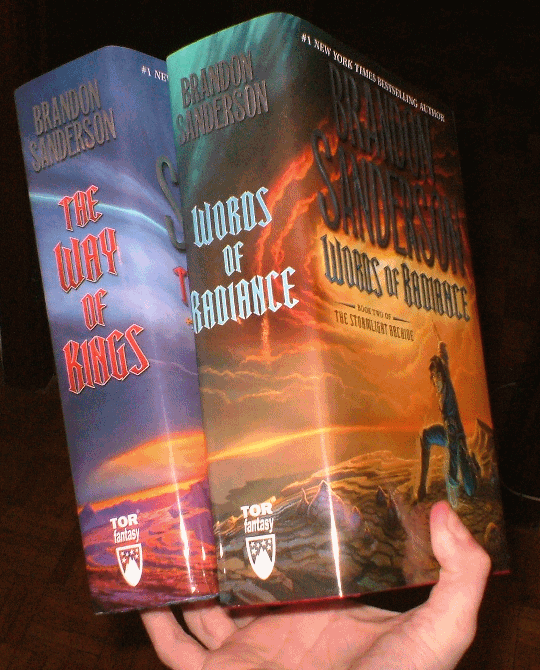
Anyway, while I’m not a big Sanderson fan and this isn’t exactly my preferred reading, I’m still very glad of getting this book and happy to start reading it right away (at my pace). It’s been three years and a few months after The Way of Kings. Maybe I could have planned my reading queue better since right now I was focusing mostly on The Shadow Rising and I consider Sanderson and Jordan relatively similar, in that both are fairly light and leisure kind of reading, but I’ll stick with it.

This Stormlight Archive series is a big investment for Tor, in this age post-Jordan, and you could have seen it concretely in the first book. It wasn’t just a way to deliver words on a page to you, but a rather nice package that had been very carefully built to draw attention and do the best service possible to the words it contained. They wanted this book not a book, but an event.

First, it got Sanderson’s favorite artist for the cover, Michael Whelan, who actually made a really good cover, with warm and strong basic colors and an evocative scene that let transpire the book’s aspired breadth and epic range. It celebrated the scenery more than it celebrated some chosen hero. It then had a bluish hard cover with a sword-like symbol impressed on the front, and a nice texture. Then you flipped the page and there were two gorgeously colored illustrations, one with a map of the regions of the world, the other with a Tree of Life wannabe diagram with fancy symbols. Again the two full-color illustrations mirrored on the back cover, one showing some spiritual equivalent of the map, the other a variation on the Tree of Life theme (and my disappointment was that absolutely none of this was introduced or even glimpsed in the actual text). Than a two-pages acknowledgements by Sanderson telling you how this wasn’t just another book he wrote, but actually the apex of his ambition, the one true project he was really investing himself into. So up the hype.

Then you got an index. And you could see that Sanderson was using every single permutation that he had available. Fantasy books indulge with structure-related artifices, like quotes or poetry to start a chapter, frontispieces, prologues and epilogues, maps. Sanderson took everything (almost, he’s missing family trees and Dramatis Personae). He had a Prelude, sub-division into Five Parts, Prologue, three Interludes (which I enjoyed the most out of everything else in the book), an Epilogue, Endnotes and even a quick & dirty Appendix. And then he took also quotes at the beginning of each chapter, and illustrated chapter headers. But not like WoT chapters headers, with a symbol to represent the chapter. Nope, he had an arc-like thing whose sculpted faces changes as the chapters change AND an illustration within a circle to better represent the theme. And then he got illustrations. Actually good and sometimes useful illustrations. Nineteen of them. Some of which artsy, inspiring maps of cities or other regions.

So the book was overflowing with presentation-driven aids and embellishments. It wanted to make this book more than a book, an experience. It wanted to seduce you with words and colors and art. Because that’s the point: ten of these 1000 pages volumes are planned by Sanderson for this series (without even considering a wider structure to which this series is supposed to belong to). He wants you with him for the long haul. This is his, and Tor, contemporary Wheel of Time, and this time, instead of being found by success, they are planning for it. Planning big, all in.

I can at least enjoy and empathize a little bit with this hype. It doesn’t hurt and I always admire and appreciate ambition. So if I can breath some of that hype it just adds to the experience and makes me actually excited to read the book without overthinking that in the end it’s average fantasy, really. At that point the writing itself is alone to prove itself, but up to that point the presentation made sure to put the writing in the best position possible.

So the point now is: has Tor weakened its effort and marketing push in regards to this second volume? The answer: it’s about the same.

I was worried that after the big splash we’d instead get far less commitment for this second volume, but instead Tor at least made the fist volume into a canon. So this second volume is a very precise copy of what we got with the first, with maybe slightly less love overall. The new cover is rather underwhelming, and nowhere comparable with the one used for the first volume. The chosen hero is now featured prominently on the cover, in a rather cheesy pose/act. The environment is dull, the colors a sickly and drab yellow palette. It seems more like a cover for Peter Pan. The scene has none of the depth of the one in the first volume, and the lance that the character is holding could have at least given the cover some dynamism, but it’s completely obscured by the title. So a mediocre cover overall (if you told me it was made by some dude imitating Whelan’s style I’d believe it). But it retains the style and artist, so it’s the artist in this case who failed to deliver. The book itself is instead red, with a nice silk-like texture to it and another symbol/glyph engraved in the front, different but in the same style of the one in the first volume. You flip the page, but the illustrations with map+Tree of Life are gone. We get instead a two-page illustration by Whelan again with Shallan on a rock, and it’s actually far, far better than the illustration on the cover, whoever chose that one over this is a total fool. On the back cover instead we get a two pages color illustration of the map. Which is basically the same map that you get in black and white within the book. So overall the four gorgeous illustrations in The Way of Kings don’t have an equivalent parallel in Words of Radiance, sadly. A bit of slack.

The inside instead follows closely the first volume. We’ve got again Acknowledgements by Sanderson, this time two pages and half, but only because they greatly embiggened the font. Sanderson again pushes on the hype with this book that is not just a book, and also explains that writing a book is becoming a thing of teamwork, with various “consultants” to help with specific aspects of the writing, like continuity, character psychology and horse behaviors. Then the usual Index listing the exact number of illustrations that were in the first volume, and a similar smattering of Prologue/Interludes/Epilogue. Interestingly, The Way of Kings played with part two and four subtitles: “The Illuminating Storms” and “Storm’s Illumination”. Words of Radiance does something similar with parts two and five: Winds’ Approach” and “Winds Alight”, but where ‘approach’ and ‘alight’ are titles of respective parts. The illustrations appear on a individual basis less cared for compared to the first book, somewhat more perfunctory. Everything else follows the model of the first book. Thankfully We get the exact same font, size, lines on each page. The official wordcount for The Way of Kings was 387k for 1001 pages. Words of Radiance has 1080 pages, and even if I didn’t manage to get a wordcount from Sanderson & assistant, we’re likely around 405-410k since everything is the same, including the wide margins on the page. In the end 400k make for a REALLY long book, but conventionally so. There’s nothing extraordinary about that.

So overall the quality of Words of Radiance, when it comes to the package & presentation, is slightly below the level of the first book, but thankfully Tor maintained the exact same, already lofty, standard. I’m very glad they are sticking to the format, and I roll my eyes thinking that most surely at some point in the life of this series will come an overzealous editor that will start playing with font sizes, pagination and overall layout just to ruin the consistence you expect. Because it always happens.

But for now the two books are a perfect match, and look great side by side.