Author Archives: Abalieno

True Detective, Season 2, Episode 5:

One day you might find cause to ask yourself
what the limit is to some pain you’re experiencing
and…

you’ll find out there is no limit at all.
Pain is inexhaustible.

It’s only people that get exhausted.

I have this new program, see.

Because my powers of influence
are so meager in this sublunar world of ours,
I try to limit the people I can disappoint.

And I make sure to know the difference
between my obligations and somebody else’s.

Note: That line has been pointed at, across medias, as bad writing because of “who talks like that?” My comment to that is: bad writing that comes around and it is good. No one asks for realism when realism doesn’t add anything. There is not intent for authentic dialogue there, and so no fault.

True Detective is “written”. Charged with meaning, an artificial world. It’s set after the world has already ended. All characters are afterimages on a stage, manipulated as puppets without choice. They are only alive because they suffer. Episode 5 is a distillation of why human beings are utter shit. It’s literally post-apocalyptic setting.

Malazan, The Bonehunters:

‘Nothing can be done,’ Heboric said. ‘We each fall into our lives and that’s that. Some choices we make, but most are made for us.’

Both True Detective and Malazan switch focus from characters to environment, and back. How one shapes the other, and back. Environment as character. How one is a domain within the other.

‘Heboric’s chosen this path, but it’s not by accident. Sure, it’s a wasteland now, but it wasn’t always one. I’ve started noticing things, and not just the obvious ones like that ruined city we passed near. We’ve been on old roads – roads that were once bigger, level, often raised. Roads from a civilization that’s all gone now. And look at that stretch of ground over there,’ she pointed southward. ‘See the ripples? That’s furrowing, old, almost worn away, but when the light lengthens you can start to make it out. It was all once tilled. Fertile. I’ve been seeing this for weeks, Cutter. Heboric’s track is taking us through the bones of a dead age. Why?’

‘Death and dying,’ Scillara continued. ‘The way we suck the land dry. The way we squeeze all colour from every scene. And what we do to the land, we also do to each other. We cut each other down.’

Well, that’s an oxymoron. Article on the New Yorker:
http://www.newyorker.com/culture/sarah-larson/an-open-letter-to-the-white-walker-army

Even Jon Snow, who, as several characters reminded us, has a pretty face and a sympathetic backstory, isn’t enough to provide all the human intrigue in a scene with seven million undead C.G.I. assholes.

“Game of Thrones,” which is part fantasy, is also mostly a drama, and those of us who are there for the drama, White Walker Army, and for the comedy, such as it is, rate you very low on the emotional-realism scale. We dread your appearance not just because you threaten Jon Snow and his cohorts but because you threaten to drag the show we love further into a realm that we find tedious. As a friend texted me recently, “It’s turning into a video game.”

The reaction I saw to this was about the attack on the genre elements of the show, that a part of the public certainly likes very much, but I’m not interested specifically on that aspect today.

I also believe, and have written a few times, that the more ASoIaF moves away from the political backstabbing and toward its more fantastic elements, the more it actually loses its shine and appeal. It’s not so much because I personally dislike fantasy in my novels (obviously), but because Martin’s skills don’t seem to be there. He’s good at writing the other stuff. So the series seems more on a downward trend not because of its sprawl, but because its direction (ice and fire) is less brilliant and inspired than its core (game of thrones).

I felt something similar when I was reading Erikson’s “Memories of Ice” the third book, also specifically about another zombie army. I could see what the author was trying to do, but I simply did not think it could be achieved. It would be a failure, for reasons that are similar to those expressed in that New Yorker article. Yet Erikson managed to pull it off by resorting to a certain “trick”. And it worked! It was brilliant and it managed to achieve that ambition I thought simply not possible.

Martin is not done, so we all have to wait to see if he pulls it off, or even WHAT he’s trying to pull off. But I think he has a more traditional interpretation of fantasy and that he’s not interested in digging deep. It’s just a layer. But because of this, there’s the risk of disappointment when the reveals will kind of fizzle out, or will look like dry CGI.

The TV show had the merit of pulling in the general public, but to a lot of them the “fantasy” in it still feels tacked on. Something they tolerate more than something they enjoy.

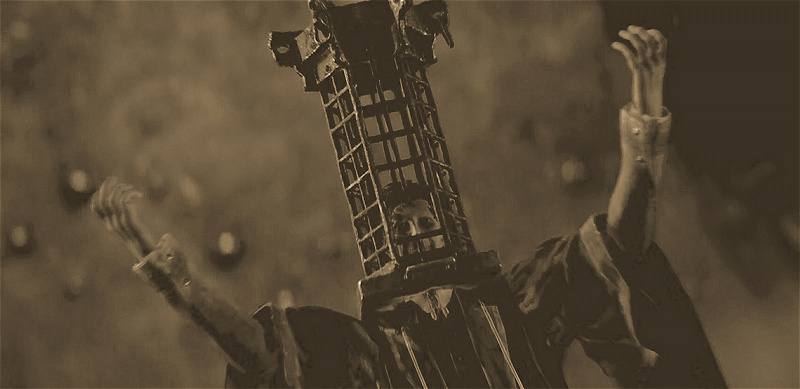
“The School of Mensis controls the Unseen Village.

This hexagonal iron cage suggests their strange ways. The cage is a device that restrains the will of the self, allowing one to see the profane world for what it is.

It also serves as an antenna that facilitates contact with the Great Ones of the dream.

But to an observer, the iron cage appears to be precisely what delivered them to their harrowing nightmare.”

“No, we shall not abandon the dream.”
“Ah hah hah ha! Ooh! Majestic! A hunter is a hunter, even in a dream. But, alas, not too fast! The nightmare swirls and churns unending!”
“As you once did for the vacuous Rom, grant us eyes, grant us eyes. Plant eyes on our brains, to cleanse our beastly idiocy.”
“The cosmos, of course!”
“Let us sit about, and speak feverishly. Chatting into the wee hours of…”
“New ideas, of the higher plane!”
“Now I’m waking up, I’ll forget everything…”

This is an item in the Bloodborne game, but more than trying to figure out the game’s mythology I’m more curious about how you can relate the symbolism to the ideas that actually precede Bloodborne and inspired it.

Without speculating, there are a few aspects that are explicit in the game. One is the idea of a dream, being trapped within without an awareness of the real world. So the dream is like a cage that you can’t escape. If you awake you only find yourself in the same dream, in a circular way without escape (false awakenings). At the same time there’s an idea of transcendence linked to the Great Ones, the Lovecraftian gods of Bloodborne. To escape the cage of a dream one has to transcend the limits of human vision. “Grow more eyes” in the mind, and so being able to see an hidden dimension that was already fused with the normal one.

So, this actual cage around the head is an explicit symbol of the dream as a cage, a consciousness that is trapped within a mind. It is hexagonal because that’s a feature that in the game defines the stuff that pertains the gods, and the existence of the dream/cage depends on the gods, on that hidden layer that is made opaque by the dream itself, the courtain. The gods are the hidden something beyond a veil, an unknown to the current level of experience, which is the dream. The description implies that in order to see the “profane world” one has to surrender the will of the self. But the profane world means the common world, the tangible existence that in this context is represented by “this side” of the dream. That means that the “life in a cage” represented by this symbol only reveals the nature of human-like existence: that of being trapped, with no real will.

It’s interesting because this angle is the same of the stuff I write about, even if it’s nothing in common with Bloodborne. Why the link? Because Bloodborne is inspired by certain structures and mythos, that feed on the basic “truths”.

Yet the description doesn’t end here, it also creates a separation. On one side it reveals the horror of existence: “to an observer, the iron cage appears to be precisely what delivered them to their harrowing nightmare.” Yet, it also represents a “door”, a passage to what’s behind the veil: “it facilitates contact with the Great Ones of the dream”. As if the awareness of an existential cage also offers a gift of transcendence.

Despite loving Malazan and thinking it has no challengers for what it does within its genre, I also do think it’s weak on certain aspects.

I tried to explain as a mix of aesthetic joined with depth and meaningfulness. The same as you’d get when looking at densely decorated architecture, but where each single decoration isn’t meant to be merely beautiful to stare at, but also with a dense symbolism and meaning.

Games, books, movies or whatever else, if there’s support for deep mythology and where no detail is left to chance. This myth comes from Tolkien. It’s not just in service of “realism”, and so immersion, but also as a way to reward digging and discovering what’s hidden in that depth. It means engaging with the medium, being part of it, enjoying revelations and epiphanies in those rare occasions when everything locks perfectly together, or perfectly realigns to show a new perspective.

Looking for hints, have your mind making the connections, slowly getting closer to find a solution, or a compelling interpretation. This is all about complexity and detail worth having. A medium that matures and takes itself seriously.

A lot of what I tried to describe in abstraction is already possible in the Malazan we have. It part of what makes it really good. And it is also what Malazan has in common with the approach to the lore and storytelling in the “Souls” game, including and in particular with the latest: Bloodborne.

Bloodborne is that aspect of Malazan turned into game. That aspect of active entertainment. Where the medium demands and requires that you engage actively. The problem is: Bloodborne does it even better.

If you know very little or nothing about Bloodborne then here’s an article that will tell you about story and mythology:
http://www.kotaku.co.uk/2015/04/09/whats-really-going-on-in-bloodborne

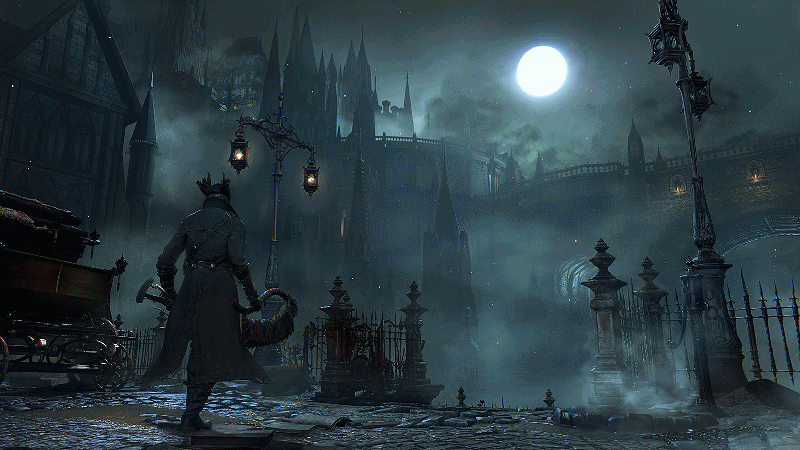
I couldn’t avoid thinking that the whole of Bloodborne not only would fit perfectly in Malazan, but it would be exactly what “Night of Knives” could have been if it was pushed to its full potential. Night of Knives is that same story, only missing that particular “heft” that is instead fully realized within Bloodborne.

The basic structure of the town turned into hunting grounds and dream dimensions bleeding into reality during a special night (and the moon), is not only the common link between the book and the game, but also the manga “Berserk” by Kentaro Miura, that we know for sure has been a major source of inspiration for Hidetaka Miyazaki, the designer of Bloodborne. These three, Berserk, Bloodborne and Malazan go hand in hand (and of course heavily influencing all three is Lovecraft). The only difference is that Malazan swallows them in a much bigger picture. Yet the other two seize aesthetic and mythology, that smaller slice, and realize them even better.

Not to say Night of Knives is a bad book, but it falls shorts (very short) of that potential that was there. And I’m thinking of a potential that not even Erikson could realize.

So this is what I’m trying to point out: some of the ingredients that make Malazan great are ingredients that went into Bloodborne. Those aspects that come out even more clearly in Bloodborne. And what Malazan lacks when compared not to similar works, but when compared to its own ideal potential, is what instead a game like Bloodborne fully delivers.

What if Truth and Subjectivity are separated? Usually one would think that Truth includes Subjectivity, and so that Subjectivity is just a slice that goes to merge into a Big Picture we call Truth.

This was part of a number of comments I wrote over at Bakker blog to explore the idea of lesser, relative truths. Like a kind of dualism of Ontology. But trying to explain that without resorting to abstraction or philosophy.


Let’s say I put you to sleep. In a definitive way. So you’re like a coma patient on a bed, forever, with no possibility of waking up again. You know nothing of this new condition because you lost all memory of what happened or of your previous history.

Then you start dreaming.

Without any perception of the outside, this new dream reality, Thomas Covenant-like, is all that exists for you. A Reality. A fantasy world you’re trapped in, as detailed and complex as the real one.

This is the error. Your partial information and Subjectivity, a perspectival closure.

But instead *for me*, since I’m out and looking at you, you are effectively in error because I know the truth of your condition. I know you are dreaming, that your Reality is imagined.

Now let’s say we have a way of communicating (BBT). So I can tell you some of the truths. I can demonstrate and persuade you that you are indeed just in a coma, and dreaming. That what you perceive, see and live is just an illusion.

Yet, this knowledge doesn’t awaken you. You’re still trapped in subjectivity and the fantasy world. That world is still your Reality. Your truth. That is your ultimate truth as long it’s true that you can’t awake anymore. As soon you understand you cannot return, the Reality becomes absolute.

Saving messages from over there to here. Context not needed? This is still about Free Will and a follow up to the previous post.


It literally bogs down to this:

We live in a world of absolute illusion, but the illusion is recognized as illusory only when you are able cross the boundary and look back. Same as when you wake from a dream and declare you had a dream, but couldn’t tell it was so while dreaming. If the boundary cannot be crossed, then the illusion becomes truth.

This because a truth is relative to a context, and we have an Absolute Truth only as a theoretical, metaphysical abstraction.


Pulling the ladder up after ye. How do you know you’re dealing with an illusion then, if the only way to see such is to cross the boundary and look back? Especially when it’s an absolute illusion, as you say?

…There is such a thing as agnosticism?

I postulated the illusion to show you it makes no difference. But we cannot know if it’s an illusion or not. YOU DON’T KNOW.

It both IS an illusion, but don’t question it because you can’t question it because you can only see an illusion from the outside.

Not it’s NOT an illusion. It MIGHT be one, but you don’t know. Alright?

You can question it, but you cannot have an answer (for the link: scroll to point 36).

And so the result is one of relative truth. A truth that is true as long its context is valid. And being THIS context permanent, I say, the relative truth is all we have, since we cannot achieve a deeper one, EVEN if it MIGHT exist.

So, this MIGHT all be illusory, but since we’ll never know, for us the relative truth becomes an absolute one.

For some god-like entity that has crossed the boundary and looks back to us, we would look like zombies living an illusory life, but as long you don’t believe we GET TO BECOME god-like then this higher existence is only an abstract possibility, not something that is part of our life, and so part of our relative truth.

Whoa, look at that title. The concept I wanted to describe is fairly simple, though. Here we go.

This spawns from a discussion over at Bakker’s blog. I wrote there a lot and about many different things, but the bottom line is that it’s about different facets that belong to the same cluster. Specifically about what I wanted to write here, it seems to me that from whatever angle you look at this you’ll always end in the same place/conclusion. The yarn untangles pretty easily just as long you keep pulling.

The discussion was mostly about ontology, epistemology and Truth. All essentially the same thing, since they imply a way to judge things objectively, and how we can reach an agreement about what can or cannot be known.

Postmodern Maximalism is essentially a writing style, the wikipedia entry about it doesn’t help since it underlines “excess” and “redundancy”, where both of these are completely wrong at describing why Maximalism offers an interesting perspective. Maximalism is a method that makes things appear as if they slow down until they are frozen in time. The observing eye goes through everything on the scene, leaving out nothing. It’s an utopian attempt at seizing a moment for what it is, stop time and analyze everything. It basically defines the failure at observing everything and it also reveals that in order to seize the moment, you need pages and pages and pages. More time, endlessly. A single moment whose description requires a dilatation of time much, much greater.

The epistemological uncertainty is a solid point, arguing what is authentic and what isn’t, is not. Maximalist description is a desire for a truer form. It tests the boundary of what can be done, it underlines the limit. But it’s not a way to include everything because you can’t decide what’s important. What’s inauthentic is the idea that certain things are not needed, that they do not play a role. (The ideal of) Maximalism doesn’t dull the world with excess and redundancy, but it ENRICHES it, makes it flourish and bloom with meaning, flowing in all directions. Every word is important and has purpose.

The important point is to understand that the purpose of Maximalism is to defy a boundary and FAIL. Showing what is not possible to achieve. That you cannot fully grasp a single moment. And that to possibly do it you’d always need more time, exponentially. Formally it means that to analyze information you always use a greater amount of it. In a similar way Bakker’s Blind Brain Theory explains consciousness as founded on a series of heuristics whose purpose is to remove the majority of information. If consciousness had a full access to the activity of the brain then it would be COMPLETELY PARALYZED. Analysis paralysis, that for example David Foster Wallace often binds with Maximalism. They are the same thing. Time frozen because you are lost in the process. Every single instant exploding out in a myriad of states, all fundamental, all unavoidable.

We started from ontology and truth. I use a scheme because it is powerful and reveals the real contradiction that we live in. The dichotomy is BEING / KNOWING. If you are on one side you cannot achieve the other. Mutually exclusive. With the theme of ontology we always fall back in the contradiction where to state something you need to rely on some bigger picture. If you say that everything one can say is just a cartoon, than to say it you rely on another cartoon. Recursively. And we observe this similar recursion and paradox everywhere. Why is it so? Because it’s a reproduction of the observation itself. We merely see echoes, infinite reflections, mise en abyme, of the same original state. This original state is self-observation, as I write often. In order to observe yourself you need to exit yourself and see yourself as if from the outside, object of observation. This is the original split, the first separation between observing system and observed system. It creates a double, and so the original dichotomy that we can then shape in the various ways, like body/soul, or being/knowing I used above. A threshold, a boundary. Ontology reproduces a similar problem because it can never unify a truth. You are always separated from a concept and its unity, from a middle state and a pure, ontological truer one. Which means you cannot cross from a state of knowing to a state of being, because knowing builds up the barrier.

(The Blind Brain Theory says consciousness doesn’t have any idea of the actual processes in the brain, since it can only access a very small amount of information. In the same way we know the writer’s mind, so this consciousness, creates a story by removing all detail. Creating meaning, linearity and purpose where there’s actually none. A place of the mind, not of the world. Writing is always a process of FALSIFICATION of reality. That’s why maximalism is instead an inversion. It isn’t about excess of superfluousness but an attempt to reach a more fundamental truth and escape from the falsehood that otherwise binds all. Though, it is granted, you can’t expect literary critics to be smart enough to understand this…)

If you are really radical about epistemology and ontology, then you reach a point where you cannot say anything. It’s as if knowing you cannot know, and so a deeply nihilistic stance. You know the impossibility of things. But I see this as a profoundly IMMORAL, UNHOLY position to take. Because it’s extremely partial and not at all radical as it wants to be. In order to define nihilism you need to rely on absolutes. Like having endless time. Like the hypothesis of true knowledge that lies always deeper. But the point is that in order to enable nihilism as a legitimate stance, you have to rely on cartoons that are far more abstract compared to everything else. Nihilism doesn’t rely on crude realism, but on idealism. The idea of unachievable perfect dimension, and so sorrow because you can’t go there. It’s a failure to reach and to be, but justified by this distance from truth. Truth being the most abstract and most stupid cartoon. As if the will to avoid speculation just threw you toward the wildest speculation possible. In order to know you have no Free Will, you imagine a place where Free Will truly is. And so a lack.

Nihilism relies on a idealistic and false idea of reality. It relies on cartoon abstractions that it wanted proved wrong in the first place. How do you come out of all this? You come out because the world doesn’t give you a choice. Free Will is a possibility because you are negated a choice, if you accept the paradox. Do we know how the world really works? No, science will lead us there. How long will it take? We don’t know. But then we realistically and pragmatically know that “many” of us will be dead by then. Timelessness is not a thing that belongs to life. We are bound in time. Life imposes on us choices now. You don’t have unlimited amount of borrowed time. You can’t delay a choice until you have all the elements to make a wiser one. In the same way you cannot wait forever so you know better what kind of true role you have in this world. Time is limited. And, in the same way, the brain works with heuristic because full access to information would paralyze all activity.

The same as epistemology, there’s the hypothesis of an ultimate truth that will invalidate the one we have now. The same as in science a new theory replaces an old one. On the horizon there’s always an ideal elsewhere that is more true and more complete. But are we there? No. Will we be there? No, because we’ll be dead. Time binds us again. It’s a boundary that is imposed on. A limit that creates a partiality. A slice.

I say this limit creates Free Will, and limited knowledge creates choice. Same as a character in a book cannot stop on his tracks and think he’s a character in a book. Any less we can do that too. It’s part of a different reality we don’t belong to. It’s knowledge that is possible only if a boundary is crossed, but we don’t get to cross it, and we won’t later on. As single individuals, as well as a species, we are limited by time (and knowledge). Idealistic absolutes like a “science” that explains all, or the ultimate “Truth”, these are the real false gods. The real cartoons in this picture. They speak to us from the other side of a reality that binds us.

And so this is why I say this creates the possibility of relative truth compared to an ultimate one. Or Relative Free Will. A point of view that is bound by time. That becomes true because we don’t have the choice of reaching out and defy the limit of time. This is honest and moral because it makes us equal and empowers us. It makes us human instead of super-human, or compared to super-humans as nihilism or other forms of false realism would pretend.