Category Archives: Books


You thought the Malazan or Wheel of Time books all piled up are an impressive sight. Now look at this Epic Stack:
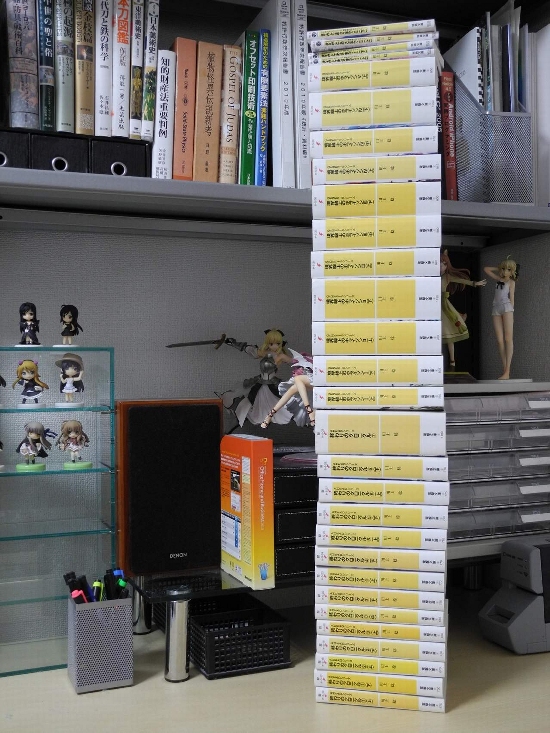
Edit: This picture is outdated. Look below for updated numbers and a good estimate in english wordcount. The Otaku Tower just grew some more. You can easily double what you see in this picture since it misses 12 more big volumes, 15 small ones of the City series, plus an handful of minor ones.

While not “technically” one series, it’s still a story in the same setting written by one guy (actually it’s a ‘she’, I think), and what you see is not even close to being done since the upper half is, accordingly to its writer, just 1/4 of the planned whole. The first half, from the bottom up and including the first bigger volume, is the first completed “series”, a sort of prequel, then from that point all the way up it’s a new ongoing one.

These being Japanese “Light Novels”. Or what you could (vaguely) consider as the Japanese version of “Young Adult”. Most of anime these days are either based on light novels or visual novels (these, too, of fairly epic length, since we’re talking about reading on screen for 50+ hours, with fancy music in the background and most of them also with fully voiced dialogue).

Usually they are dialogue-rich (terse on prose) and tell exactly the kind of stories you’d find in anime. School life mixed with fantasy stuff and so on, but also hybridizing with all kinds of genres. Being very long series with many volumes is the norm, though it’s rarer that the volumes are as big as some of those in the picture and you could expect the standard being around 50-60k words. Lots of these are also quite decent, or at least fun to read. And many are also available in English, one way or another (though it’s only a tiny amount of the total Japanese market).

One way for example is the Haruhi Suzumiya series, which is one of the most popular. The series is currently at 11 volumes in Japan and it will be complete even in English within this year. These are from “Little, Brown Books” and rather cheap even in the hardcover version (about $13 each). But in this case these are smaller “novels” of about 200 pages. Or ranging from 40-90k words. Basically the size of Neil Gaiman last “novel”.

The other way instead is thanks to fan translations: http://www.baka-tsuki.org/project/index.php?title=Main_Page

For example all 30 volumes (edit: we’re at 40 now) of very popular “Toaru Majutsu no Index” are fully translated, available for free in a number of formats. Other stuff like the series written by NisiOisiN has instead more “literary” ambitions and harder to translate, especially because of excess of wordplay.

Edit: his most celebrated series, “Monogatari” is now being officially translated. Kizumonogatari was the first in English even if in Japan it came after Bakemonogatari. Bakemonogatari itself instead was split in two volumes in Japan, and three in the US.

01 Kizumonogatari December 2016
02 Bakemonogatari Part 1 December 2016
03 Bakemonogatari Part 2 February 2017
04 Bakemonogatari Part 3 April 2017
05 Nisemonogatari Part 1 June 2017
06 Nisemonogatari Part 2 August 2017
07 Nekomonogatari Black December 2017 -> LE Box set
08 Nekomonogatari White January 2018
09 Kabukimonogatari April 2018
10 Hanamonogatari June 2018
11 Otorimonogatari August 2018
12 Onimonogatari October 2018
13 Koimonogatari January 2019
14 Tsukimonogatari March 2019

At that current planned point we’ll be at 14 of 28 novels out in Japan, with more planned it seems. The catch-up will take some time.

Disclaimer:

NISIOISIN’s writing is pretty complex; the dialogue he uses contains a lot of Japanese wordplay (such as puns on different readings of kanji, that simply cannot be translated to English), layers of Japanese cultural references (anime, manga, TV shows, folklore, etc), and very little third-person narration to indicate who is speaking when, often leaving the reader to infer which characters are talking during long dialogues.

Bakemonogatari is also being adapted to anime by the best anime studio around, SHAFT, and putting together normal anime episodes to the actual movies, you are looking at something around 30 hours long total, or around 100 episodes total, since every episode is 20 minutes on average. (Kizumonogatari, the actual first novel to come out in the west is being adapted to anime last, as three movies, each part about 1 hour long, so three anime episodes bundled together)

Another nice schema on Monogatari complex structure, for both light novels and anime.

The bottom line is that while it’s all stuff targeted to a specific public, it also has a kind of fresh and insane creativity that you probably can’t find in any other medium. Though you’d probably have better luck going through the Visual Novel side, like Fate/Stay Night (expect about 60 hours of your time), or Ever17 (closer to 30) and Umineko (close to 80 hours, and beware the Steam version, it needs fan patches to add the full Japanese dialogue voices).

About the Epic Stack above, here’s a page attempting an introduction to the world, even if I think it’s more from the anime side, at least it gives an idea of the kind of crazy to expect: http://randomc.net/2012/06/30/kyoukai-senjou-no-horizon-retrospective-part-1-the-premise-the-world-episodes-01-06/

This is the cover of one of the last volumes, which I won’t comment:
https://www.baka-tsuki.org/project/index.php?title=File:Horizon3C_cover.jpg

And this is another slightly more proportioned…:
https://www.baka-tsuki.org/project/index.php?title=File:Horizon4A_cover.jpg

If you instead are ready to begin reading it, you can start from that tiny volume at the very bottom of that huge stack, right here:
http://www.baka-tsuki.org/project/index.php?title=Owari_no_Chronicle:Volume1


UPDATE: I’ll keep this updated section with new stats about this project.
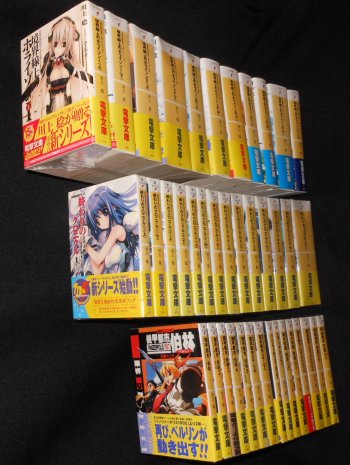
There have been three different main series part of the same universe/project, that is actually structured into six phases. The phases in their internal chronological order are: FORTH – AHEAD (Owari) – EDGE – GENESIS (Horizon) – OBSTACLE (Hexennacht) – CITY. In the image you can see the first series to come out at the bottom (but City phase, so the last), Owari in the middle (but the first in the internal order) and Horizon in the top line (the last being written, but the middle one in internal chronology), but the image there obviously only shows the first 11 volumes of Horizon, and we’re now up to 29. And in the last year, ongoing along Horizon there’s also the new Obstacle series, that seems to shift tone toward a “magical girl” type of story.

This is the output in release order:

“City” series (1996-2002) 15 volumes
“Chronicle of the End” (Owari) series (2003-2005) 14 volumes
“Horizon on the Middle of Nowhere” series (2008-2018) 29 volumes
– “Forth” (Rapid-fire King) series (2013) 2 volumes
“Clash of Hexennacht” series (2015-2017) 4 volumes

Another image. On the right there are again the 15 volumes of the City series (top to bottom, in order), the highest pile is again the first 13 volumes of the main Horizon series (the lighting symbol), with 8 smaller volumes on top that represent the “Kimitoasamade” side stories. Then the 14 volumes of the complete Owari, and finally on the left the two volumes that up to this point represent the entire “FORTH” part of the story, released in 2013. So this image represents the full cycle minus the four Hexennacht volumes and 13 of the latest Horizon. and it’s also put in chronological order: Forth (2 vol) -> Ahead (14 vol) -> Genesis (13+16 missing vol) -> (Obstacle, 4 missing vol) -> City (15 vol)

Here instead you can see all the released Horizon series, all 23 volume of it. The front row is what is available in English fan translation.

These are some stats about wordcount. I’m using the English fan translation (e), for the rest of the Horizon series I’m using estimations based on averages and the number of pages (not accurate but pretty close). It’s likely that the whole thing up to this point is around 5.5 million words total.

City Series (English only)
1) Panzerpolis 1935 | 43k
2) Aerial City | 47k
3) Tune Bust City Hong Kong A | 50k
4) Tune Bust City Hong Kong B | 49k
5) Noise City Osaka A | 58k
6) Noise City Osaka B | 65k
7) Closed City Paris A | 80k
8) Closed City Paris B | 76k
9) Panzerpolis Berlin 1937 | 57k
10) Panzerpolis Berlin 1939 | 59k
11) Panzerpolis Berlin 1942 | 58k
12) Panzerpolis Berlin 1943 | 58k
13) Panzerpolis Berlin 1943 Erste-Ende | 65k

Current total: 765k

Owari no Chronicle (Completed in English)
1) 1A 78k 386(pages) (10 June 2003)
2) 1B 88k 450
3) 2A 67k 386
4) 2B 83k 482
5) 3A 71k
6) 3B 67k
7) 3C 88k
8) 4A 94k
9) 4B 96k
10) 5A 93k
11) 5B 101k
12) 6A 102k
13) 6B 104k
14) 7 165k (10 December 2005)

Total Owari: 1M 297k (e)

Kyoukai Senjou no Horizon (now using x164 for estimation)
1) 1A 116k (e) 543 pages (September 10, 2008)
2) 1B 148k (e) 771 pages
3) 2A 178k (e) 905 pages
4) 2B 220k (e) 1153 pages
5) 3A 136k (e) 737 pages
6) 3B 150k (e) 833 pages
7) 3C 158k (e) 897 pages
8) 4A 112k (e) 673 pages
9) 4B 135k (e) 737 pages
10) 4C 177k (e) 993 pages -17
11) 5A 118k (e) 712 pages -21
12) 5B 162k (e) 1000 pages -34
13) 6A 115k (e) 712 pages -24
14) 6B 116k (e) 840 pages -48
15) 6C 175k (e) 1064 pages -33
16) 7A 137k (e) 808 pages -21
17) 7B 141k (e) 824 pages -20
18) 7C 175k (e) 1016 pages -24
19) 8A 118k (e) 744 pages (February 10, 2015) -27
20) 8B 135k (e) 824 pages -26
21) 8C 172k (e) 1000 pages (June 10, 2015) -24
22) 9A 140k (e) 808 pages (April 10, 2016) -18
23) 9B 165k (e) 1000 pages (June 10, 2016) -31
24) 10A 130k 792 pages (October 7, 2017)
25) 10B 151k 920 pages (December 12, 2017)
26) 10C 174k 1064 pages (March 10, 2018)
27) 11A 145k 888 pages (July 10, 2018)
28) 11B 158k 968 pages (September 7, 2018)
29) 11C 190k 1160 pages (December 7, 2018)

Total Horizon: 4M 347k

Clash of Hexennacht

1) 59k (e)
2) 60k (e)
3) 64k (e) (10 September 2016)
4) 69k (e) (8 April 2017)

Total Hexennacht: 252k


This was originally posted on Westeros forums. The interesting thing is that it spawned a discussion that turned down into racism and dismissing the whole genre of Light Novel as rubbish. Which is interesting because, once you take out the specifics, it’s the exact pattern you can see with “genre” versus “literature”. That’s the kind of effect I expected to trigger, and it did. Sadly a mod didn’t like it and wiped the whole thread. You can’t have subtle discussions on the internet, or even address that kind of racism. This is stupid. We HAVE TO talk about sensitive matters. Not simply ignore them like dust under a carpet. It’s EXTREMELY important to underline how prejudices we get toward “genre” are the exact prejudices that (many) “genre” readers have toward other stuff.

WE ARE NO DIFFERENT. We are no better. We just exchange one set of prejudices for another. We just belong to a different tribe, not a better one.

Anyway, this was my conciliatory post where I was tying back it all to the discussion of “genre” Vs “literature”:


Out of prejudices and expected canons, there’s surely a kind of dangerous line.

Most of these products are indeed filled with tropes, and they are targeted to very specific “genres”. There are hundreds of technical terms defining every possible variation, classifications of plots and characters. The “taxonomy” of these Japanese products would be alone an extremely fascinating topic to analyze. It’s like a whole sub-culture.

That said, you also can’t find anywhere else a similar amount of creativity and mixing of elements. There’s absolutely NO medium I know in western culture that comes close to the broad range you can find in anime (and by extension mangas, VNs, LNs). So that’s the dangerous line. It’s all filled to the brim with tropes and the rich taxonomy, but it also contains so many different elements that it surpasses every other medium.

So if you measure it all by quantity over quality, sure, it’s an ocean that is very hard to navigate. But it still has that fresh, wild creativity that makes it a very powerful medium. Targeting with very little prejudices, constrictions or filters the largest audience possible.

I was coming from one of the latest post on Bakker’s blog where he goes again with the debate about “genre” Vs “literature”: http://rsbakker.wordpress.com/2013/07/04/russell-smith-shrugged/

The bottom line is that genre readers have the tendency to be more eclectic with their reads, and coming from all sort of backgrounds (whereas “literature” secluded itself into predictability, rehash and complacency, getting dusty in their tightly compartmentalized world).

I simply generalized: a medium that closes itself (from the general public, also) becomes stale and can’t say anymore something relevant. It just rises its walls of canon and dies there. And that’s why I see the Japanese “young” market as extremely interesting. Its diversity is unrivaled if you pay attention at the whole range, and all its elements boil together in a huge pot, and so it all gets constantly mixed. A very good and innovative product can have a huge influence and produces an endless list of clones for many years, but the market is always ready for something that sets new trends again.

I’m just being coherent because I see how prejudices against “genre” aren’t that different from prejudices (or even simple difficulties at “getting” these strange products) thrown toward the eastern market of anime/manga/light novels/visual novels.

I personally come with no prejudices and do my best trying to “get” different things and markets. If I fail I blame myself, more than calling “shit” something I’m not getting. It doesn’t mean the stuff I linked here is “quality” and deserves your attention. At all. Most of everything is always mediocre regardless of what you’re looking at, and this is still a very commercial genre with an extremely broad (low? young? unpretentious? uneducated?) target, conceived for entertainment.

While the specific series in the image above looks at least like an interesting “mess”, I haven’t personally read it. So I can’t comment on its merits or lack thereof (though it looks dealing more with fancy battles than fancy boobs, as the covers would make you believe). I’m just pointing at an interesting medium because of how it’s built and how broad its public is.
On the bylines I’m 60 pages into “Everything and More: A Compact History of Infinity” by dear David Foster Wallace. I mentioned the page I’m at because this is a math book, but at least I can say I made so far without major blocks.

In fact this book is excellent. It’s filled to the brim, line by line, with ideas you can spin in every way. It’s deeply connected with everything I write about in this blog and that’s why it should be read. It’s not a book for who is interested about math, it’s a book for who is interested about asking radical questions on pretty much everything. For example it’s interesting the whole deal with the D.B.P. (abbreviation that DFW uses for “Divine Brotherhood of Pythagoras”). They deal with math as with a religion and their “discoveries” (or creations) become the foundation of what we are today. And then the V.I.R. (Vicious Infinite Regress), that recursive hell of infinite regression/mise en abyme. I’m reading the book while thinking about a different context, the stuff I’ve written about recently, and in many cases I was anticipating what DFW would write next. Circling again and again around similar patterns.

To apeiron, the primordial Void, the genesis of the world. This is a book about the mythology of math, and it is exciting to read. Often mindblowing. DFW selective gaze gives you what exactly matters, what makes your life different. It makes the mind race.

Maybe I’ll go quote intensive at some point. Right now I only want to copy over one I pasted over to Bakker’s blog because it repeats what was defined as “the widening gap between knowledge and experience”, and DFW describes this well:

Obvious fact: Never before have there been so many gaping chasms between what the world seems to be and what science tells us it is. ‘Us’ meaning laymen. It’s like a million Copernican Revolutions all happening at the same time. As in for instance we ‘know,’ as high-school graduates and readers of Newsweek, that time is relative, that quantum particles can be both there and not, that space is curved, that colors do not inhere in objects themselves, that astronomic singularities have infinite density, that our love for our children is evolutionarily preprogrammed, that there is a blind spot in our vision that our brains automatically fill in. That our thoughts and feelings are really just chemical transfers in 2.8 pounds of electrified pâté. That we are mostly water, and water is mostly hydrogen, and hydrogen is flammable, and yet we are not flammable. We ‘know’ a near-infinity of truths that contradict our immediate commonsense experience of the world. And yet we have to live and function in the world. So we abstract, compartmentalize: there’s stuff we know and stuff we ‘know’. I ‘know’ my love for my child is a function of natural selection, but I know I love him, and I feel and act on what I know. Viewed objectively, the whole thing is deeply schizoid; yet the fact of the matter is that as subjective laymen we don’t often feel the conflict. Because of course our lives are 99.9% concretely operational, and we operate concretely on what we know, not on what we ‘know’.

Small addendum:
to apeiron is also the computational limit. This is linked to the idea of determinism and closed system. Here DFW talks of the relationship with god, as if math is the language of god, but it is interesting to think about this in systemic terms. There’s also this piece from Bakker and the speculation of math as the shadow projected by an unknown kernel.

And this:

The point being that the D.B.P.’s attempts to articulate the connections between mathematical reality and the physical world were part of the larger project of pre-Socratic philosophy, which was basically to give a rational, nonmythopoetic account of what was real and where it came from. Maybe even more important than the D.B.P., infinity-wise, is the protomystic Parmenides of Elea (c.515-? BCE), not only because his distinction between the “Way of Truth” and “Way of Seeming” framed the terms of Greek metaphysics and (again) influenced Plato, but because Parmenides’ #1 student and defender was the aforementioned Zeno, the most fiendishly clever and upsetting Greek philosopher ever (who can be seen actually kicking Socrates’ ass, argumentatively speaking, in Plato’s Parmenides).

Interesting on one side because that dichotomy is one I mentioned recently. And, more in general, because if we see math as the foundation of science, then it means we’re basically observing how the myth of reality, as we know it, came to be. The mythopoetic origin of science. The disguised gods we all worship in modern times.

DFW declares the ultimate “hope”:

Most of math’s definitions are built up out of other definitions; it’s the really root stuff that has to be defined from scratch. Hopefully, and for reasons that have already been discussed, that scratch will have something to do with the world we all really live in.

But in that interview he gave after the book was published he said:

Infinity was the great albatross for math. Really ever since calculus. Infinitesimals were horseshit, and everybody knew they were horseshit. But the limits thing used natural language stuff like ‘approaches,’ which math isn’t supposed to do. So it’s this great shell game. Weierstrass, Dedekind and Cantor close all those holes, and it’s beautiful, and at the same time they open what turns out to be a much worse one, and that’s Godel. . . .

After Godel, the idea that mathematics was not just a language of god but a language we could decode to understand the universe and understand everything, I mean, that doesn’t work any more. It’s part of the great postmodern uncertainty that we live in. Very few people know about it.

To me, that’s the fil rouge (main theme, common thread, guiding light) connecting everything. Godel paradox is fundamental in Bakker’s studies and theories about the brain, as it is for science and the way we conceive the universe. It’s the fundamental postmodern crisis we live in today. And it’s in the writer/creation relationship. Simulated worlds. The dreams and illusory worlds that you enter the moment you start sleeping and that the brain feeds you, barriers you can’t cross. All this is about the fundamental dualism, and Vicious Infinite Regress, due to the self-reliance and reflexivity, or “strange loops”. Explain one, and you’ve explained Everything.

to apeiron, is again the Greek term that defines the seed of chaos. Uncertainty. Uncertainty that encapsulates the world we live in today that was born from the seed planted by our Greek ancestors.

Anaximander (610-545 BCE), the first of the pre-Socratics to use the term in his metaphysics, basically defines it as “the unlimited substratum from which the world derived”.

Bremermann’s limit.

DFW again:

Note, please, that this lay ability to split our awareness and to ‘know’ things we cannot handle is distinctively modern. The ancient Greeks, for example, could not do it. Or wouldn’t.

This is another of the old and recurring debates that was brought up again by R. Scott Bakker. I’m linking to it because I think there are patterns that go beyond the specific discussion, and have some universal validity.

What caught my attention this time was a little subversion applied by Bakker. Turning this:

There is a paradox at the heart of these complaints: They proclaim the artificiality of genre divisions while simultaneously demanding respect for a specific one. Are we to abolish genres or privilege one? Either you want a level playing field or you don’t.

Into this:

There is a paradox at the heart of these complaints: They proclaim the artificiality of racial divisions while simultaneously demanding respect for a specific one. Are we to abolish races or privilege one? Either you want a level playing field or you don’t.

This is more than a little revelatory because it’s what brings up that pattern that I think goes beyond the “Literature” vs “genre” debate.

In general I agree with Bakker’s position. Literature, with the capital “L”, is just another genre. It has its own canons and it is written for a specific audience. What makes it different is the claim of predominant position. Literature is at the top, the apex of writing as an “art”.

But concretely it repeats some simple tribal patterns. In order to distinguish itself from everything else, literature needs strict canons. Rules. Lines drawn on the ground. Boundaries. It needs to draw its limit so that it can find an identity and protect itself from infiltrations and bastardizations. Literature needs to put itself in the lofty position because the high ground is defensible.

What is interesting is that turning it metaphorically into a racial issue isn’t simply a way to make it more extreme, but to expose the basic pattern. Racists have similar tribal concerns. They fear infiltrations and hybrids. In order to keep their race as pure as possible they need closed confines, they need those barriers. The idea of identity needs to defend what’s on this arbitrary side from everything that is outside. In the end the goal is to keep everything as it is.

Hence Bakker’s accusation to highbrow Literature is consequential: it’s unable to say something relevant. It’s a dead voice. The more it needed to preserve its own identity, the more it drew around itself a Great Wall. Closer, narrower. It became the repetition of a very strict codified canon, and in that repetition art died. To preserve its purity Literature drew around itself a limit, and within that limit it withered. The same old people saying the same old things, drifting into complacence.

In general, art that becomes fossilized is dead art (that’s also why originality is celebrated in art). Art that doesn’t feed on something alive, dies. The Muse is strangled. The dichotomy brings out the universal pattern. A closed system doesn’t stay alive for long, it becomes just an echo. Stale repetition.

On the other side “genre” readers don’t have any blinders. Bakker says genre readers are the most eclectic. They don’t read “fantasy” but they usually breach genres and come from all different kinds of social groups and age ranges. That makes “genre” a genre that is far more open to hybrids. To barbarian incursions. Being more open, it’s also more alive, fresh, in continuous change. All its parts are engaged in a dialogue, not fossilized into a canon, even if obviously it’s not a so distinct dichotomy and you can see even in “genre” all the negative tendencies.

But again, this makes it interesting. A thing that is alive and in continuous evolution as long it remains open and free of prejudices. There are writers who will stay firmly within a genre canon and make the walls their home, but there will be others who will be more ambitious, dare more, trying to say something new and challenging. Tying together tradition with subversion. Lighting the spark of revolution. Keeping up the enthusiasm.

This pattern is as old as life itself. When human beings reproduce the genetic material gets mixed. That’s how life stays alive: through change. Walls can keep you alive, but they can also can kill you if you start to believe that they are the point. Diversity is something to be celebrated, in literature as in culture and between “races”. Including diversity between each human being. That is what makes us rich, and keeps us alive and healthy. The exchange of parts.

In modern life our purpose isn’t anymore just to reproduce. Culture has also a lasting impact on human life and the whole world. But in the same way sex and reproduction are based on an exchange, so is indispensable for culture the exchange of parts. Literature being just a very small, but still essential, piece.

You’ve seen me before putting together the most disparate things, while keeping a straight face and a serious tone. So here’s a quote excised from a review of an anime about “magical girls”:

I’ve always been fascinated with the idea of using animation – and paintings, and music, and words, and etc. – to paint not so much the reality of the world, but the essence of it. If we want to see what something truly looks like, we have pictures and video that can do that, but a Van Gogh still holds up because it shows the world as perceived through the artist’s mind. Enzo once referred to Shinkai Makoto’s work as “more real than real”, and it certainly is in the way he meant it, but to me that phrase has always most resonated when an artist deliberately paints the world not as it appears, but how it is. The truth behind it, not just the reality that we see.

If I manage to write a review of “A Dream of Wessex” by Christopher Priest you’ll see how I’m following a red line of mythological journey, across many mediums, cultures, religions, philosophies and so on. That quote is very pertinent.

The basis, or the structure, of this discussion is what I wrote in “The Throne of the Soul” recapitulation. But already in this quote here you should recognize the important element: Cartesian dualism. He describes two ideas, one is the world as “it appears”, and one is the world as it is revealed through “art”.

What’s interesting in that quote is how he makes the fundamental error of inverting the scheme. He makes the distinction between the reality of the world and its essence. And he turns the “more real than real” into the world as it appears and the “truth” behind it.

What is “art” if not “interpretation” of the real? In my partial analysis of Tolkien’s mythology I examined the part about how art is often seen as a god-like creation. The desire to be like the creator. Tolkien explains this as a natural instinct built into human beings. But this deliberate act of creation should be considered as artificial, not natural (or “true”). We do not take the world as it is, we take the world as we want it, reshaping it.

Where do human beings dwell? If “Reality” is out there, then it’s almost impossible for us to reach it. There’s a membrane we aren’t able to breach. Plato’s cave. But for us, living on “this other side”, reality is made of meaning. Of patterns, symbols. To live and understand reality we rebuild it in a form that makes sense to us. This produces an heightened sense of truth. It’s not “deeper”, it’s somewhat heightened. The “truth” behind the apparent reality reveals the truth of the human condition. Not universal truth, or objective, scientific truths, the world out there. It’s the world “in here”, the one you get caged in your head. The one you live in.

A writer, painter or musician, creates a world through a series of signs. This becomes a secondary, separate dimension. With its rules that must usually be consistent. Characters immersed in that world will have to shape their model of reality, interpret things happening around them. They might be poets, musicians, painters. In a delicious recursive self-reference.

All of this features prominently in Malazan, for example. The post-modern aspect is about the “awareness” of the context. Not of the “ceiling of the world”, meaning the boundaries of the artistic creation, but of the interplay of self-reference. Of the writer writing, of the context that contains the created world.

In Malazan this often creates a delicious, playful interplay filled with double-meaning. A scene can be entirely consistent with the level of plot and artistic “sealed” world. And yet it can still be “aware” of where it comes from. Of the “truth” behind the magical trick. Of the writer writing.

This is a scene from “The Bonehunters” that I bet Steven Erikson had lots of fun writing:

Things were not well. A little stretched, are you, Ammanas? I am not surprised. Cotillion could sympathize, and almost did. Momentarily, before reminding himself that Ammanas had invited most of the risks upon himself. And, by extension, upon me as well.

The paths ahead were narrow, twisted and treacherous. Requiring utmost caution with every measured step.

So be it. After all, we have done this before. And succeeded. Of course, far more was at stake this time. Too much, perhaps.

Cotillion set off for the broken grounds opposite him. Two thousand paces, and before him was a trail leading into a gully. Shadows roiled between the rough rock walls. Reluctant to part as he walked the track, they slid like seaweed in shallows around his legs.

So much in this realm had lost its rightful … place. Confusion triggered a seething tumult in pockets where shadows gathered.

I’ve mentioned before, and now is likely public knowledge, that both Ammanas and Cotillion are sometimes used by Erikson to play with this post-modern layer. On the explicit level that quote is consistent with characters and the world, but from my point of view it reads like playful meta-commentary on the writing itself, especially at that point of the overall series.

Maybe Ammanas and Cotillion “roles” are inverted, but this is the book where Erikson has to pick up all the threads he left behind after five volumes. It’s the first real “convergence” on the series as a whole. So, “a little stretched, are you” reads like something Erikson is telling himself, after all that came before and the monumental task still ahead. “The paths ahead were narrow, twisted and treacherous. Requiring utmost caution with every measured step.” This is again the description of where he’s at, writing the story. Meta-commentary on writing the series, self-reflection.

“Ammanas had invited most of the risks upon himself. And, by extension, upon me as well.” This is also the point in time when Esslemont started to publish his own side of the series. So again, it works as meta-commentary. On the sharing of ambitions, and risks.

“So much in this realm had lost its rightful… place.” This may be again about all the things that changed in the course of five volumes. Both in the story and outside it, I guess.

So be it. After all, we have done this before. And succeeded. Of course, far more was at stake this time. Too much, perhaps.” And here the determination to do it regardless of risks. You definitely can’t hesitate when you’re about to start writing the sixth volume of a ten volumes planned series.

The Shadow realm itself, where Cotillion and Ammanas reside and “scheme”, has similar metaphoric qualities:

Emerging from Shadowkeep, he paused to study the landscape beyond. It was in the habit of changing at a moment’s notice, although not when one was actually looking, which, he supposed, was a saving grace.

It has this dream-like quality. A sort of WYSIATI (What You See Is All There Is). Until things aren’t seen, they lurk in shadows, indistinct. Writing is the same. You put signs on a page. Until those signs aren’t written, nothing exists. And nothing else exists outside what is written. What You Write Is All There Is. The Observer makes reality. The realm of Shadows and Illusions. The illusion of creation.

But then again this treacherous landscape can also concretely refer to the writing itself. Something you are writing may be working well while you are at it. It seems clear, with all the details in your control. But when you are juggling so many different characters and plots, things have a tendency to slip out of control while “you’re not looking” and busy working on some other part. And so the struggle to keep it all together, as if “looking everywhere at the same time”.

“Confusion triggered a seething tumult in pockets where shadows gathered.” This seems describing almost a rebellious behavior of the realm. The moment your grasp slips, the shadows start swarming, threatening what was certain just before. The shape of things. As if you lower your guard, uncertainty devours everything. Including the writer self-doubt. It’s an hostile realm. Cotillion and Ammanas are “usurpers”.

Finally, earlier I saw this link about an interview with David foster Wallace. And in it there’s another link to a different chunk of the interview that I find particularly interesting. DFW also was obsessed about self-reference. This part:

Whereas Cantor, yeah, codifies the transfinite, but Cantor’s paradox is the first step into Godel’s incompleteness and self-reference. It’s at once this beautiful climax of the two hundred years before it and the first note of the funeral dirge for math as something that you can just, ‘You know what, we can explain the entire universe mathematically. All we have to do is come up with the right axioms and the right derivation rules.’ I mean, Cantor’s paradox starts the wheel of self-reference.

I don’t know if you know much about Godel’s incompleteness theorem. But in a lay sense, Godel is able to come up mathematically with a theorem that says, ‘I am not provable.’ And it’s a theorem, which means that math is either not consistent or it’s not complete, by definition. Packed in. He is the devil, for math.

Cantor’s paradox, that whole ‘If it’s not a member of the set, it is a member of the set,’ and then Russell’s paradox about twenty years later, those were the first two . . . You know, when you start coming on a really interesting theme in a piece of music, you usually hear it in echo notes that foreshadow it, those are the foreshadowings. And I don’t imagine Godel would have come up with the self-reference loop if it hadn’t been for Cantor and Russell. [Sotto voce] Whatever. You’re not interested.

“You know, when you start coming on a really interesting theme in a piece of music, you usually hear it in echo notes that foreshadow it, those are the foreshadowings.” That’s a nice description of what I’ve been doing, in my reads and this post too. I’m following this red string that links all these disparate things. It doesn’t matter from which angle you start, because everything leads to everything else.

[Sotto voce] Whatever. You’re not interested.

I’m at about 140 pages into Martin’s A Storm of Swords and once again wondering about the causes of its popularity. I know that this third book is considered by far the best in the series, and that I have to expect things slowing down quite a bit in the next two books, so my expectations here are set very high, maybe that’s why I’ve found those first 140 pages not as the best prelude to the best book. The plot is stuck at the end of the previous book, and Martin needs all those 140 pages merely to go through each PoV to make a summary and set a new starting point.

That’s how you can write a huge 1000+ pages book and still give the impression that not much happened. The structure is rather simple, you have an average of 10-15 pages for each chapter/PoV and it takes about 150 pages to return to one. In the end this produces a 1000 pages book where a single PoV has about 100 pages of available space to tell its story, and 100 pages is the bare minimum to show some development, especially with the kind of detail that Martin writes in. That’s the formula to write these epic sized fantasy books. Just an high number of PoVs, fragmenting the story, but also offering that big breadth one expects precisely from this genre.

My question is why Martin and Jordan series were able to reach a huge popularity and the answer I offer is that both do something similar but from two different angles. I think the keyword is “accessibility”. Martin is popular because his series is what you can easily recommend to all sort of readers. That’s why it’s successful: because it’s a genre novel accessible (and written for) all kinds of readers. You don’t need to be a “genre” reader to engage with Martin story, and so this series can tap into the large audience of general readers.

Whereas Jordan retains a similar level of accessibility. His series also taps directly onto a huge pool of readers: all kinds of adolescent readers. The Wheel of Time has the power to engage all sort of “younger” readers. It’s like a LotR where uncool, clumsy Hobbits are replaced by young future heroes destined to conquer and change the world, becoming celebrities. Because of how it’s built, its strength is about tapping onto a certain audience, in a specific age-range but regardless of whether they are “readers” or not. Or even genre readers. The WoT can convert someone, making him a “reader” in the first place, and a “genre” reader as consequence. It does so because it offers characters and themes that appeal directly to that age-range, it’s the call of the adventure and the writer taking the reader’s hand, offering one of the most immersive and engaging experiences. It’s the stuff younger readers dream about, and it fully embraces it. It gives them the time of their life.

That’s why I used that distinction between “adult” and “young” fantasy. Martin’s series can be seen as representing “adult fantasy” that is extremely popular and successful because it can CONVERT adult readers into “genre” readers. On the other hand Jordan’s series is also hugely popular and successful because it converts readers, but in this case it’s more carefully aimed at an age range. What ASoIaF does for a more adult public, the WoT does for younger readers, recruiting them into “genre”. In both cases, these two series can rise so much in popularity because they draw from a huge pool of readers that aren’t limited by “genre”, and that’s why I’m putting the focus on “accessibility” and “conversion”.

There’s finally another element that plays an important role in all this. It’s usually the writer’s job to engage the reader and make him “care”, keep him reading and turning the pages. But I think this is an illusory description because it overestimates (and romanticizes) the writer’s power and ultimate goal. I think in the best case the writer can only work on the illusion of directing and manipulating the reader’s interest, while it’s probably more correct to say that the writer merely taps and rejuvenates interests that have always been there, with the reader. Like suppressed memories that seem to resurface unbidden. It’s a much more subtle touch, and far less powerful. More sleight of hand than magic.

So why is this sharing of interests important in the case of popularity of these series? Because it’s the real hook that makes possible to reach for that huge pool of readers. Think to Martin’s series. Or even “Fantasy” in general. The common response you get from non-genre readers is: why should I care? Why a normal adult guy who has more immediate concerns should waste hours of his life reading “fantasies”? That’s why the common answer is about conflating Fantasy with “escapism”. It’s the most immediate reaction. But this is also the key to interpret how Martin’s series can be so hugely successful at engaging readers who usually “do not care” about Fantasy. What’s the First Mover in Martin’s series? Family. If you think about it, that’s the whole core. That’s where his series sets its roots. That’s the link to readers who aren’t normally genre readers or have zero interest in reading genre fiction. Its strongest theme is immediately familiar. All the priorities of each characters are simply defined by where he’s born, that will then also define what place he’ll have in the Big Game. Martin has an archetypal grasp on what everyone cares about, and so the possibility to connect with all readers. The first generalized hook that powers the series is about family concerns, mothers worrying about their children. It’s universal even if it’s encased in “fantasy”, and it can immediately engage readers because of its familiarity. The “adult” aspect is merely related to a style. Martin’s series is built on PoVs and these PoVs are selected on a wide range. It’s “adult” because it requires to shift these projections, have interest in this wider range of perspectives, in their breadth and diversity. Adolescents are usually more narrow-minded and self-absorbed to care about what happens outside of themselves (and the WoT reflects this). Then Martin builds the structure of his game by giving voice to different sides, creating contradicting feelings in the readers since there’s not a privileged side the reader can be on (though this is mostly a well crafted illusion).

Compare all this to Jordan and you see why I brought up the “young” angle. The WoT targets younger readers exactly because it selects its PoVs within the narrower range of its expected audience. It more immediately offers PoVs that the reader can recognize and identify with, offering themes that are strong specifically for that audience. And then it at least tries to follow those readers as they get older, by trying to broadening the range of the story. So the WoT is the ideal journey, recruiting and converting “young adults” into faithful readers, and then trying to walk with them into their adult age. That gives enough universal power to explain the popularity.

Now consider Tolkien. In this case Tolkien wasn’t writing for a pool of readers already waiting in potential. He just chased his own interests. This is important because “The Lord of the Rings” isn’t an “accessible” book at all, and so this seem to break the pattern I described above. It’s true. LotR is actually way more “niche” and less accessible than both ASoIaF and WoT. It’s far less easy to pick up and enjoy. And it’s also not a book that easily converts readers that do not have a specific interest in the genre. So why it’s still so hugely popular? Just because it came first? I don’t think so. The reason why Tolkien remains so popular while not being accessible is, the way I see it, because there’s a huge cultural push that overcomes Tolkien’s accessibility issues. His world is now part of mass culture, and being so it means EVERYONE is exposed to it. There’s pressure that comes from general culture that goes in Tolkien’s direction, and so all kinds of readers are pushed in this direction. Works like The Silmarillion are still extremely popular if you consider how nigh inaccessible the book would normally be, impossible to sell commercially. But this happens solely because there’s a general culture push that makes readers overcome those barriers.

Consider Malazan. Malazan, compared to ASoIaF, isn’t easy to recommend at all. It has humongous accessibility issues. This is usually blamed on the “medias res” style of the first book, but I think it’s a wrong angle. The problem with Malazan accessibility is that it’s much harder for a new reader to care about. It takes maybe two chapter in ASoIaF for the reader to figure out what it is about. One chapter in the WoT. Only the Prologue in LotR to set the style. With Malazan the reader feels like hiding in the shadow and chasing after someone on his own obscure agenda. Erikson doesn’t take the reader’s hand and gently leads him on the journey. There are no immediate rewards. You just follow with your own determination, if you want.

Why should a clueless reader care? What’s the big motivation that makes someone pick up a so huge series and overall commitment? But that’s just one aspect. Another crucial one is that all Malazan qualities generate big contradictions. The first book already presents things on a scale that dwarfs most other fantasy series, pulling out all the stops. Then by the time one reaches the third book that scale grew EXPONENTIALLY to levels that are utterly unimaginable. Just unprecedented and with no parallels. And yet, this is counterbalanced by another side that’s deeper, serious and incredibly ambitious. Giving the idea of something that takes itself very “seriously”. This creates different angles that can explode into a strong contradiction. On one side you have readers who engage with the most overt aspects of the series, the breakneck pace of the plot, the insane power levels, great battle and big scale spectacular stuff. The more mindless fun and shiny stuff on the surface, if you want. And then there are readers who instead find all that childish genre reading and instead expect something more “adult” in ASoIaF style. Ideally, one would say that Malazan is a distillation of the best of both worlds, and then even goes its own way to achieve something completely new. But far more commonly readers come with their own set of expectations and what happens is that the average reader is killed in the crossfire of contradictions. “Adult” readers can barely suffer through few pages without branding it as nigh incomprehensible childish fantasy gibberish, while those who are in for the “fun” and immediate pay off felt bogged down later on when the story reveals a depth and requires the reader to engage with more than just the surface. This ends up giving a general and immediate picture of having the WORST of both worlds. It wants to be serious and pretentious, while instead being juvenile and terribly chaotic and rambling. A puzzle that can’t be assembled.

How could Malazan be more successful? Why should the average reader care? It’s definitely NOT aimed to readers who aren’t already “genre” readers. You could maybe picture some serious-looking university professor reading a copy of Martin’s series, but could you imagine him reading Malazan? You need to be part of that inner genre group to even be a potential reader. This already makes the pool of potential readers exponentially smaller. It’s already a niche with a niche interest. And then you can imagine where potential readers come from. Maybe they read on some forum some readers who say how Malazan is so much better (it’s rare, but it happens), and so they approach Malazan expecting something that can compare to ASoIaF. And are immediately turned off by how “genre” Malazan is. Ultimately it engages with a number of themes that aren’t exactly that broad in appeal. There’s very little of those immediate and familiar feelings that give ASoIaF its strength. Malazan is less a traditional narration sprinkled here and there with fantasy elements, the way ASoIaF is. It grasps and deliver what the epic genre is, and why its powerful. It knows where it comes from, and has no identity crisis, or narcissistic pretenses of being appreciated by “everyone”. But then it requires a reader with a very open mind, who can take the challenge of the big commitment and that doesn’t ultimately jumps to conclusion because the book betrayed this or that expectation. The wider the range of interests, the more chances to appreciate Malazan in all its aspects. But this really ends up producing readers who are me, you and a few others. You have to have already developed an interest on that stuff, and the open mind to fully enjoy the “young” and “adult” parts without the feel that they clash horribly with each other.

Finally R. Scott Bakker. He suffers even worse from what I described about Malazan. Even more you have to share the writer’s interest on those specific themes and angles he brings up. Even more his series is precisely aimed, with a very strong thematic focus. This focus is nowhere what you expect to reach a general public, the same as you don’t expect the general public to read his blog because of the content he puts in it. It’s simply stuff not planned or meant to tap onto a big pool of potential readers. If it becomes popular it’s simply because it’s so unique and exceptional that it becomes easily recognized, and so not swallowed in mediocrity.

But what happens then? That lots of readers, all kinds of readers, hear good things and so try Bakker’s books. If they don’t have a serious interest in those themes Bakker offers then they end up noticing just the violence. The violence becomes the point. The edginess, grittiness and all those things that are today negatively branded as “grimdark” as well epitomizing all the problems about misogyny and whatnot. This produces an overall hideous image of Bakker’s series. Seen right now on a forum: “It’s an endless parade of fantasy name salad combined with massive ruminations and internal monologues.” And that’s a positive side. Otherwise it becomes an accusation directly to Bakker of being an horrible human being. Why does all this happen? I think because once you “remove” that deep layer that Bakker engages directly (and it happens whenever a reader “doesn’t care” about that stuff) then only the violence and the ugly remain. They become the one aspect monopolizing the attention, without understanding that all that is built IN SUPPORT of the rest. One element observed in isolation from everything else, and the result is readers who end up feeling offended by what they are reading.

All this to say that it’s all a matter of aims. How big is the pool of readers you try to reach. And matters of “quality” don’t even prominently come up. Only huge cultural pushes can overcome a narrow aim, like in the case of Tolkien. Another example is Neal Stephenson. He also has a very narrow target, writing for those who must already have a serious interest in the things he deals with. Yet he can be so successful because the kind of “geekdom” that makes his public nowadays is so common and widespread that it also became a “general public”, creating a cultural push that isn’t so far from what I described about Tolkien. It’s a wider movement of general culture that makes niche themes become more widely shared.

But I think that at least for the foreseeable future the very big splashes of success (here I think even about the Harry Potter, Twilight or Hunger Games) will come from traditional and familiar narratives sprinkled by “genre” elements. Ending up with a broadening of the genre, indeed, but also reducing the genre to innocuous window dressing. That’s always the risk when some smaller cultural movement is swallowed whole by the mass culture…

“I’m talking about the death of dreams, son. About losing the big, wild make-believes that keep you going. The impossible dreams. That kind of jolly pretend is dead. For me. All I can see is rotten teeth in a killer’s smile.”

This book completes the trilogy that makes the core of The Black Company. There are more books in the series (and I’ll probably get there at some point) but they go in their own separate ways. It took me an excessively long time to read this first segment as I prefer to shift focus over different series to have the broadest vision possible. Still, it’s been five years since I’ve read “Shadows Linger” and this means that, while my memory is decent, I can’t effectively compare these books to each other and can only give a general idea.

I remember that I loved the first book especially for its structure. I thought it was a straightforward, self-contained story with an open ending, but still wrapping up most things in a satisfying way. Each chapter was a cohesive whole, telling its own story, all then linked in a neat sequence so that each contributed to the overall arc, adding some meaningful elements. It was well organized and elegant, the story grew without becoming distracting and unwieldy, with a rather big battle at the end to cap it off with a nice climax. Book two instead shifted the tone, it mimicked more the structure and aims of a local and smaller horror story, but I appreciated that it was spun differently and that this second book didn’t end up formulaic. Overall less satisfying and epic, being a more limited and focused story, but having its own personality. And finally this third. I think there are a number of things that make this conclusion even better than the previous two, the one I’ve likely enjoyed the most. But having now finished it I admit that, while the finale “works”, it’s quite anti-climactic and it left me with a bland feeling, all in the span of a few pages. It definitely does not end on a high note, as if before reaching the last 30 pages the story grew, reached a certain height and acquired an excellent speed, but then right at the final push it suddenly lost all its momentum and made a rather clumsy and awkward landing. There’s nothing particularly wrong with it, or even a delusion of expectations, it actually manages to tie neatly the hanging threads, but it simply has no momentum. The final battle itself is the least interesting and inspired part of the whole book, as well of the whole trilogy. Everything cool happens before those last 30 pages, then it’s just about stuff happening in a predictable pattern, almost falling completely into cliche. There are a couple of nice touches here and there, the kind you expect from this writer, but the overall conclusion is forgettable.

This sours my impression because, as I said, this was the most fun and interesting book to read, of the three. But when you go through a relatively big arc, then an anticlimactic, predictable and bland conclusion can weaken the impression of everything that came before as well. It just sticks in your memory. So let’s talk a bit of the 90% of the good stuff that makes the book. The story jumps forward a number of years, offering again a new beginning and context. New environment, different threats, a few new characters. It serves to reestablish everything without forgetting what came before. As it develops it also serves as an in-character commentary on those events. This means that some interesting past events are slowly retrieved and rediscovered, linking them into the new narrative, and this is especially important for a last book in a trilogy. The need to look back and, hand with hand with the reader, pay homage to the times passed together. Not simply as a shallow celebration, since this rediscovery is also successfully integrated into plot. I was surprised to discover how some past events are given an interesting spin, some nice and unexpected plot twists and puzzles pieces that come together only in this book, building toward a cohesive overall arc. It’s with this third book that the story makes more sense as a trilogy, instead of just separate stories loosely linked together. I didn’t see this coming and it probably shows that Glen Cook had at least a plan to follow, whereas I thought that every new book was simply made “on the spot”, meaning that I thought he just went on writing a new book when he found some fuel, without a definite idea outside of the vague “White Rose” versus Lady/Dominator. This third book is again its own story and separate context, it more successfully links all the parts together, reproducing over the whole trilogy what the first book achieved within itself.

Another positive aspect is that, again as it was the case of book two, the structure of the book feels fresh and far from being just a retread. It pushes even more to the front the story within the story format, running it in parallel with the main one. This secondary a story happens in the past but is told as if it develops in the present, adding mysteries and interesting details that feed directly the main thread. It works like a PoV switch and it’s rather well handled by Cook, keeping the tension on both sides. This dual story progression goes on for most of the book and is probably the most successful part because after the cat is out of the bag everything starts to develop in more predictable ways and that’s where the story loses some of its spark. Structure-wise I’m rather satisfied, with the exception of the ending, that I’ve already commented. The context of the story is also something I enjoyed a lot. A Black Company that for too many years has been on the run and now is tired and battered, giving an even more sharpened edge to that world-weary and cynic style that is typical of Glen Cook (the quote at the top is an example).

I should mention the writing style. As usual Glen Cook has his own recognizable voice. The terse but straight to the point prose. This time I thought that a characteristic of this writer is that he doesn’t weaver. He’s not struggling and wrestling with the language in order to reach some height, or produce some intended effect in the reader. Every sentence is like a stone being placed. It is precisely what it is. One step after the other. There’s no stumbling or dragging. While most writers always oscillate between genius and failure, it’s like Cook is squarely in the middle. He knows exactly who he is and never falters. It gives a sense of self-control. And in this series it matches perfectly, or it fits perfectly, the personality of the narrator, Croaker. Who is, hearing what other readers usually say, what makes this original trilogy truly shine over the rest of the Black Company series. They just fit so well together, Cook and Croaker, that this makes the story even a more personal and authentic affair for the reader: because one connects to that voice and so shares the experience.

That style is also once again what makes the rather quirky setting “work” and feel at least somewhat plausible. This time it seems Cook just wanted to have fun, so we have (slowly) walking trees, teleporting menhirs, flying whales, and a few other non conventional fantasy elements. All this is described in that typical Cook style that means that stuff just is as it is, grounding those fancy elements as if there’s nothing peculiar about them (though he also provides an explanation for what is going on and why). You end up not thinking much at the absurdities, as they are part of the context as every other thing. Haven’t you seen enough weird stuff already?

Considering the trilogy as a whole, and the way this third book fits in, I’d suggest another reader to not follow my example and instead read it all in a relatively shorter time span. That would probably allow one to appreciate more how the story develops and the relationship with the characters, and maybe even enjoy the ending more than I did. The good thing about Glen Cook is that if you appreciate the kind of writer he is and the kind of stories he narrates, then any of his books will deliver on those expectations. A Malazan fan can also dig out an incredible number of influences and little things, and you can feel how much Erikson loved his work. As for me, I’ll likely continue at some point with the “Instrumentalities of the Night” series that, while requiring a greater effort and dedication, I still find more interesting and spinning things in a more original way.

I was just looking around to figure out how things are going with two series I enjoyed and would really like to read their respective endings at some point. In both cases I’m merely past the very first book but it’s quite disappointing knowing that nothing is certain about their future.

The first is the “Instrumentalities of the Night” series by Glen Cook, whose fourth volume has been in limbo for quite a while even if the author confirmed having completed years ago. The problem here is with the publisher, Tor, since it seems this series isn’t exactly selling too well and this fourth book still isn’t listed anywhere. I loved it, but I recognize the first book is dense and hard to get through. It’s brilliant, but also not the stuff you expect to be popular.

I was able to find an interview with Glen Cook that is a year old and he confirms the fourth volume, “Working God’s Mischief” was delivered, but he also mentions a possible FIFTH with an absolutely awesome title: “He Lost His Shadow Somehow”. Along with bad news: “but that is unlikely to happen. Paperback and e-book sales for the series have been disappointing and the fourth book was a hard sell.”

TOR PLEASE. We can never have nice things. This is a superb series, it can’t be left unexpressed. And that book has too an awesome title to not get published.

EDIT: Tor tells me the fourth book should be out this year.

The other series is “The Wars of Light and Shadow” by Janny Wurts. She’s currently working on the 10th and penultimate volume, so a critical time in her series. She posts on her site updates from time to time about how the writing is going, and they are always fun to read. This is the last:

Destiny’s Conflict is moving ahead – the second scene in Chapter 7 was a blasted BEAR to make it tight – finding the angle that worked was an immense frustration (and I will NOT dawdle about – the series is into MAJOR CONVERGENCY and about to bust WIDE OPEN – so each step must be exactly precise to support the ‘before and after’ build. Each day I hammered on the scene in question/hit a wall, then moved to do other productive things so as not to stall the think tank time doing nothing. AT LAST I got the angle – (many convention/publicity interruptions tend to create a wider gap as they take me out of world/and I have to sink back into the ambience – knew that when I signed for the cons, but they are a necessary step/awareness of this series HAS to grow).

I am now working up the second to last scene in Seven – the one that trips the wire, so to speak – the climactic plunge is one wild ride, and it’s looking to be Set 8 that will be the first climax/tipping point – and it’s all Fast Motion reveal from there to the end of Song of the Mysteries – mostly, as the seeds for that volume have to be planted NOW.

It’s all in line with what was planned: the difference now is, I am carrying it ALL/on all the levels – none will be hidden, very shortly, which means I can’t slip into sprawl territory at all – there is no room in the story for sag.

In the earlier days, very sadly, there was NOT THIS NEED FOR AUTHORS TO DO CONSTANT EFFORTS AT PUBLICITY – blogs, websites, social networking/presence out there on the net – now, it is expected – the publisher relies on it….ONE DAY I dream that there will be enough reader response that I don’t have to…that time is not yet. The books aren’t widely known ‘out there’ enough yet to get the enthusiastic mention they deserve. This build takes time/and the period where they were not all in print/or avail in the USA made a lag – there’s still a lot of catching up to do.

Rest assured, I am writing diligently. There are lots of balls in the air/I am NOT WATCHING….drumroll ;) – football. Never have. Never will – in fact, we don’t HAVE any TV service here.

Since she usually does quite extensive editing I’d say the book is still a couple of years away. And then there’s the last volume.

R. Scott Bakker is deep into the third and likely last in this second trilogy, The Unholy Consult (the title of the book, not the trilogy). This is the volume that reveals some big things and opens the way for the final duology. But as far as I know this is the true turning point, so there’s some anticipation around this book.

Despite being an amazing achievement (Bakker is with Erikson the most important and most ambitious writer in the genre by a wide margin), Bakker’s series also isn’t doing spectacularly well with sales, and so the writer can’t write full time as he wishes. This slows things down. It seems the book is almost complete, but it also may require extensive editing/rewriting of earlier chapters. The most recent news was in this forum post (that gives more info than what Bakker offers on his own blog):

Just heard back from Scott this afternoon. He says he’s labouring on the final two chapters of TUC and that the book is getting ridiculously big. And at this point, he has no sense of what the rewrite will entail.

So it probably won’t be out before a year/a year and half. I hope it won’t be split in two. And I hope he goes all out, instead of simply teasing for the final duology. He needs to play things to their full potential.

And finally I also gave a look about what’s up with Malazan stuff. Erikson is rarely (more like never) late, but in the case of the second book in the Kharkanas trilogy, “The Fall of Light”, it seems release has been pushed back to January 2014. Being fair this isn’t really a delay since Erikson’s goal with this new trilogy was a more relaxed pace of 1.5 to 2 years, which is still very fast by the industry standard.

Instead no particular news, as usual, from Esslemont. His “final” book (unless it produces a sequel, since this was mentioned as a possibility, long ago) in the Malazan series, that still hasn’t a definite title, seems still on track for a December release, but it’s all completely unconfirmed and Esslemont simply doesn’t exist on the internet, so we rarely get to know what he’s up to.

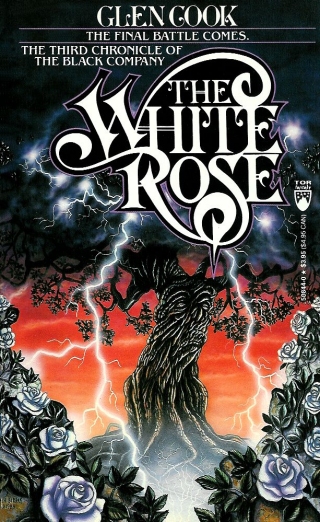
About MY OWN reading progress, I’m going incredibly slow, but mostly because I’m splitting attention between too many things. Don’t even look at the progress bar up there since at some point I think I was reading more than 15 books at the same time. But I’m finally doing some decent progress with Glen Cook’s “The White Rose”, so that’s the one I’ll finish next.

In the last week I’ve ordered four books, and you can see how wildly all over the place my interest goes (even if it follows its own consistency). All four being quite interesting:

The Tunnel, by William H. Glass (his writing is just too good, I’ve read some articles that are deep and written so beautifully)
Imajica, by Clive Barker (his own most ambitious work, though I’ll probably end up reading Weaveworld first)
Phi: A Voyage from the Brain to the Soul, by Giulio Tononi (following Bakker’s suggestion, it’s really a lush book, paper gloss, images)
Where Tigers Are at Home, by Jean-Marie Blas De Robles (French book recently translated in English, I got it in Italian. Quite intriguing.)