
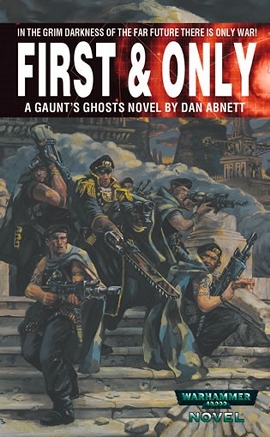
 This is a lean book that took me to read way more than expected, mostly because it fits the “other read” while I was engaged with more meaty books. A debut, as a writer writing books instead of comics, and first in a rather long series made of standalones. This is where Dan Abnett started writing Warhammer 40K, accordingly to the internet not his best effort in the field, but a decent and solid one still. Optional as a starting point since one could start right with Eisenhorn or the multi-writer crossover of the “Horus Heresy” currently being published. Instead this specific series, whose opening volume is “First and Only”, is made of twelve books already released with more planned, but the number shouldn’t discourage as the story moves either through standalone stories or story arcs that are over in three or four books. There are also these nice & cheap omnibus that pack together those arcs in mammoths of 800-1000 pages, so you’re not chasing in frustration a conclusion that never comes. You can satisfyingly read just one and stop, or go on as far as you want, guilt-free.
Genre is military sci-fi. Common theme to the series are “Gaunt’s Ghosts” a specific regiment in the Imperial Guard faction and the ongoing campaign on Sabbat Worlds, whose name correctly implies dealing with Chaos and defining Abnett’s own playground. Gaunt being the name of their leader and main character/hero, Ghosts being the nickname of said squad (the story will give some insight into the choice of the name and origin). It’s effectively tie-in fiction, and so branded with prejudice, but the fact is that Abnett is a competent writer who can stay perfectly within the canon, know what his public wants, and deliver a successful product. There’s nothing bleeding edge, innovative, or breaking the boundaries of the 40K setting, but the execution is good and the book delivers what it is meant to. Abnett can understand and squeeze out of the setting all the specific tropes that make it interesting and fascinating, and can write it so that it doesn’t feel plain and spoiled by the game it’s based on. Meaning that the “canon” successfully empowers instead of trivialize and conform. That’s always the gamble, knowing the canon and so knowing the “range” of the possible story, tiptoeing within the strictly defined perimeter. Abnett proves then that you can have fun with those toys instead of creating new ones, that there are qualities within to exploit.
Writing a good book here pairs with giving a specific audience “tied-in” the canon what it wants. I’m not really familiar with the setting so I can’t comment if the picture Abnett gives is a faithful one, but he definitely seem to get the basics that make it work. WH40K is an apocalyptic setting about excess and exaggeration, but also about human traits and artifacts brought to the extremes. The potential for drama is high, but also the potential for something spectacular and epic and ultimately fun. In this book Abnett bundles epic infantry warfare with military/political intrigue, so while the plot goes through a number of setpieces/key battles on various worlds, there’s also an overarching story that links and gives meaning to these battles, leading to a culmination where the import of all happened before is finally revealed. Both of these story threads are handled well through a structure that alternates the main battles with flashbacks from Gaunt’s life that slowly build the character and plot, and why the reader should care about them. Every “block” adds a piece, chunking the story in an episodic way, in which each battle/chapter is brought to a conclusion, and then linked to the specific arc that starts and ends within this lean book (vaguely similar to the first Black Company book). This results in a tight structure and plot where nothing is superfluous and where the pacing doesn’t slow down. The aim is set from the first page and the pacing is resolute and constant. The “fun” is there on plain sight, the action scenes equally distributed, and you don’t have to wade through weak parts to get to it. If you enjoy the ride you’ll enjoy it on every page without being let down.
Daylight rolled in with a wet stain of cloud, underlit by the continued bombardment. The lightening sky was streaked and cross-hatched by contrails, shell-wakes and arcs of fire from the massive Shriven emplacements in the distant shrouded hills. Lower, in the wide valley and the trench lines, the accumulated smoke of the onslaught, which had now been going on for just about twenty-one hours, dropping two or three shells a second, curdled like fog, thick, creamy and repellent with the stink of cordite and fycelene.
Abnett is rather good at writing what takes the stage the most: action scenes and some spectacular setpieces. There’s a sort of unintended anticlimactic effect since the battles escalate in size and impact, but the first one is the most successful because it mimics some aspect of WWII, with infantry moving through trenches and trying to survive heavy bombardments. The perspective of those men caught in the mess just works and resonates with the real scenes one is already familiar with. Some acts of desperate heroism, some unlucky sudden deaths, sudden change of plans, last minute saves. You can see some canonical situations taken from a number of movies that are here reinterpreted in the new setting, all the while, but without pushing too much, trying to give a name to those soldiers, slowly learning their roles and a couple of personality traits for each. The recipe is well known, after all. At the end of the book I was still struggling recognizing who’s who and there’s no character that delivered substantial depth or anything more than two-dimensional, but I also don’t think the book tried to go in that direction. It’s relatively unpretentious and focused on the fun things. It doesn’t take itself too seriously and it is not even shallow. Characterization is proportional to its use and purpose within the scene. Some characters are even made for just one or two scenes, to then step out again (often dead). Fun, fast paced, straightforward, and with characters that are good enough to fit the situation and make it work. No more, no less.
The prose is functional too. It’s not bloated and at the same time it gives some impressive and effective imagery. Battles on a big scale are a complicate thing to deal with, especially battles that have so strong fantastic elements. Abnett deals with all this with ease and familiarity, not betraying the fact the book is a “debut”. Action is crystal clear, never confused and keeping a pace that doesn’t disrupt the flow. I guess that’s the most important aspect in writing this sub genre of military sci-fi. With the plot filled with surprises and the mysterious aspects being well managed, the book is quite successful all over. The only quirk in the prose I don’t personally like is that it can be way too pompous and rhetorical, including the metaphors used and the uncompromising manly men described. “Subtlety” is something banished here, everything is upfront and direct and explicit.
Fire patterns winked in the russet darkness. Yellow traceries of venomous death.
The turret guns screamed into life, blitzing out a scarlet-tinged, boiling stream of hypervelocity fire.
The plasma guns howled phosphorescent death into the void.
One has to wait the final battle develop to get the big revelation about what it was that Gaunt and his Ghosts chased for all the previous pages. While I said the structure of the book is solid and well executed, this can also be a problem because it’s as if the import and meaningfulness of what happens is left hanging and undecided till the end. It’s hard to trust the book because one can’t say till the last 20 pages if it’s going to be worth it or if it will be an hoax. The pre-finale, after the big revelation is dropped, is painfully predictable, but there are a number of pages left and even if the plot seems to have exhausted its fuel, it keeps going on and keeps surprising, tying together every small subplot even too neatly, including a nice bow. The surprises continue to come till the very last line, so even if the whole conclusion is made by a number of scenes that all feel somewhat trite and cliche, the overall result is fun and convincing thanks to the good execution of those traditional elements and scenes. Like an action movie that doesn’t disappoint.
I haven’t read any military sci-fi before this book, so I can’t gauge how it may compare. I think it is well executed and its strength are in its deliberate focus on action and intrigue, making a reckless and fun journey. The battles excellent and varied, from huge showdowns of thousands of men to chainsword duels, described in vivid gory detail. The downsides are built-in the model, many of the elements that compose both the story and characters are cliche and drawn/taking inspiration from the multitude of books and movies that have something in common with the genre, but I wouldn’t point this as a “flaw”, since the use of these conventional elements is competent and well realized. Even if dipped in predictability in various points I wasn’t bored by the plot and the pacing was perfect. I only faltered about the trust in the book, since as I said the stakes are only revealed at the very end and so the reader is kept in the dark about some major motivations. Also consider that this is a starting point and, accordingly to other readers’ comment who read more than me, Abnett only gets better. Truly recommended for those who look forward to some pulpy military sci-fi with a fast paced plot and epic battles that rock whole worlds.
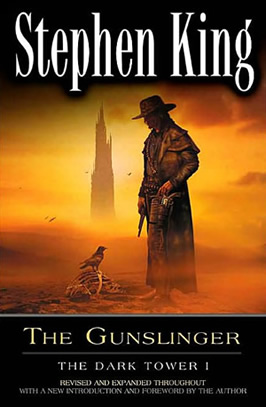 I began to read the book almost a year ago but got sidetracked after about 70 pages, so when I took it again a couple of weeks ago I had to restart from the first page since I had a very vague idea about the part I had read. Not that it got so much better the second time through, the story defies control and one has to struggle to distill from the book some form of logic progression. Reading this, day after day, feels like you never make any progress, which I guess is the point. There’s a direction, a sort of abstraction of the concept of the “quest” in its most absolute form. The endless, ultimate journey toward something that is perceived as the definitive “Truth”. Or better, this is the conceit, the Mac Guffin. Roland, the Gunslinger, on his journey toward a mythical, capitalized Dark Tower. Only that this is one book, part of a series. So for this single instance Roland is chasing after another Mac Guffin, the “man in black”, who, when caught, would hopefully point Roland in the right direction.
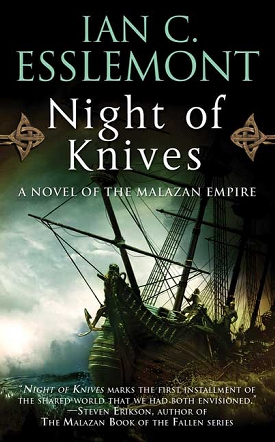 “Night of Knives” is the first novel(-la) written by Ian Cameron Esslemont set in the Malazan world co-created with Steven Erikson. It’s a much leaner book, 300 pages in the american Tor edition, compared to Malazan standard, and chronologically set between the prologue and first chapter of “Gardens of the Moon”, the first book in the series. Yet, the fans recommend to read the book only before the sixth because of some connections, while I decided to anticipate it right after the fourth, since “House of Chains” deals more directly with the matters of the Malazan empire and I wanted to approach “Night of Knives” when that strand of story was still fresh in my memory.
 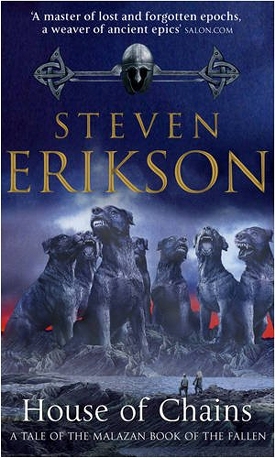 House of Chains is the fourth in the 10-books Malazan series. These days, these hours, Erikson is intensely busy writing the last chapters of the last book and bring to a close a journey of staggering ambition. Reading this fourth felt like standing on the shoulder of a very tall (jade-colored) giant. As with similar(?) long series it’s interesting to see the power-game, the ebb and flow of the single book compared to the others. When I was at page 700 or so (on a total of 1000) it dawned on me that this would become, with certainty, my favorite. 100 pages from the end the story proceeded resolute with a sense of finality and inevitability. Like the dramatic ending a movie whose sound is deafened, muted, so that the intensity of what you see comes out unadulterated and with all its power. But it is immediately past this apex, in the very slight and calmer descent that follows, the remaining 30-40 pages, that the more meaningful and stronger revelations are delivered, and the characters reached down for my soul. The book had already gauged his way as my true favorite and was set for a foreshadowed ending. I only expected closure and rest, yet the book still had PLENTY to deliver, and surprise me, and offer emotions to share.
 I started this book while I was well into Infinite Jest and I needed something else that I could read with the brain turned off so that I could sleep afterward. Infinite Jest was getting me obsessed and The Dragon Reborn was perfect and made me sleep rather peacefully. With such premise one would think I’m already putting the book under a negative light, but that’s not completely true. I’m not masochist, I read slowly and have no time to read (and comment) books that I think are terrible, so if I finished even this one it means that I have at least enjoyed it to an extent. The kind of extent of enjoyment is a key element that I think is rather important not only from my personal perspective, but also in defining what is that makes this series so widely successful and popular.
 In the last two years, since I first discovered his books, Erikson has quickly became not only my favorite fantasy writer, but one of my favorite writers among all genres and classifications. And I started to ask myself what is that makes me “click” perfectly with some writers and not so much with others. What have Steven Erikson, David Foster Wallace and Roberto Bolano in common (the three most disparate writers I recently read)? I also got myself an answer: truthfulness. They write on the page things that are true. And I imagine the spontaneously arising question: how can a fantasy story be “true”? It can very well, and “Crack’d Pot Trail” is a most fitting example.
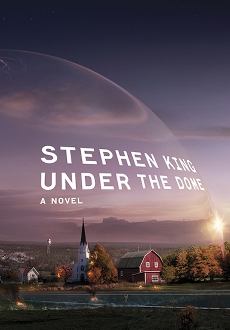 It seems the more book reviews I try to write the harder they get, but I wanted to try anyway. I read this book in slightly more than three weeks, 1070 pages. I’m not a fast reader so it’s quite an achievement for me. I didn’t even expect to read it whole. As I’m used to do, I usually just read the beginning, and, when satisfied, put it away to read fully later on. Especially because I had the Infinite Jest task at hand and I didn’t want to risk of losing track on that. Instead I started reading, curiosity pushed me past page 100 and at that point I just wanted to see what was next and there was no return.