 I began to read the book almost a year ago but got sidetracked after about 70 pages, so when I took it again a couple of weeks ago I had to restart from the first page since I had a very vague idea about the part I had read. Not that it got so much better the second time through, the story defies control and one has to struggle to distill from the book some form of logic progression. Reading this, day after day, feels like you never make any progress, which I guess is the point. There’s a direction, a sort of abstraction of the concept of the “quest” in its most absolute form. The endless, ultimate journey toward something that is perceived as the definitive “Truth”. Or better, this is the conceit, the Mac Guffin. Roland, the Gunslinger, on his journey toward a mythical, capitalized Dark Tower. Only that this is one book, part of a series. So for this single instance Roland is chasing after another Mac Guffin, the “man in black”, who, when caught, would hopefully point Roland in the right direction.
The starting point is not present. We see this chase when the chase has become a consolidated reality that seemed to go on forever. The beginning is a blur, a movement whose beginning was lost. It starts with a desert that represents the absence of a definite space and time. An infinity whose confines are misty and dream-like. The quest is a journey, but here it seems trapped in a stasis: the longing for something that can’t be achieved, the distance that never closes. I’d say it doesn’t even work as a “tease” because we can’t grasp anything meaningful of Roland himself or the object of his longing. Merely an assumption. You witness obsession without motives. One has to reach the very last few pages of the book to have at least a glimpse of what the tower represents. The story is not one built to entice the reader and follow along. The place is haunted and inhospitable, but it’s maybe in these traits that someone may find some fascination.
The introduction written by King himself is the most revelatory part. It explains the origin of the idea, especially its naive ambition. The rest of the book is, at the same time, talented, immature and pretentious. All together in a mix that represents the real quality to find here. There are no restraints typical of the established writer, no control of the parts, but this has the consequence of “freeing” the creativity and let it go wild and uncaring. The writing is powerful as it is naive. A core of talent as wordsmith mixed with the pretentiousness, egocentricity and impudence of the young. It takes itself so seriously that it builds a wall of detachment, not reaching out to the reader or gaining his sympathy or empathy. The place is haunted, all characters being like phantoms of momentary conscience, fading in and out, being themselves lost too and living aimlessly. There’s everywhere, on the characters and the places, a sense of nostalgia. Something missing or forgotten that can’t be pinpointed. Even if nostalgia should be a thing of memory. Everyone is missing something but without being able to remember what it was. Nostalgia of the future. A suspended and undefined state of agony.
The scenes are all dream-like, evanescent. Their symbolic meaning more important than the factual one, but at the same time esoteric and impenetrable. The book is filled with symbolic myths but nothing at all is explained or even placed into context. These are shattered lives, like glass whose pieces do not connect anymore. I guess the purpose is to to establish this mythology that will only start to make sense later and in retrospective, when the story will loop on itself. There’s already here the impression that the pattern has been repeated, that these characters are themselves victims that follow trails that are merely their own. Condemned to retrace themselves, only to forget again. It sounds, and is pictured, like a torture.
If anything, Roland is the only character who seems to have maintained some tangibility. Of self-awareness. Other characters are all hopelessly lost, unrecoverable. Roland seems the only one who produces a difference, sometimes catastrophically, but still a change or a disruption of that agony. When he exterminates a small town the feeling is one of gratitude for having put those ghosts out of their misery, but at the same time he certainly doesn’t win a sympathy in the reader. Roland is himself haunted and hallucinated way beyond any hope of recovery. We have no insight and so one cannot sympathize or understand. This first book works merely as a framework and I’m sure the character will grow toward something more human later on, in this first he stays obscure and maybe for this reason vaguely fascinating. A twisted, black anti-hero that plays maybe too much with being against the convention. A kind of anti-stereotype that is itself a stereotype.
In the end this book taken as a single entity is not generous and rather opaque, I didn’t get much out of it beside the fancy, dislocated atmosphere. Abstraction without substance. It closes, before setting up the sequel, with a trippy space journey taken straight out of ‘2001: A Space Odissey’, but here the meaning is painfully obvious and plain, revelatory of the fraud hidden behind. Containing just a promise of something more meaningful to be revealed later on, coinciding with the promise of the Tower and the conclusion of the series itself. It dresses itself as wise and resourceful but the conceit is evident. As Roland, I have no solid motivation to carry on with the hopeless and insubstantial chase. You need to entice me with with something more than mystical mumbo-jumbo and esoteric made-up terms. What’s actually there? A boy being sacrificed for ludicrous reasons, largely foreshadowed but delivered in a way so forceful that it defies every purpose that part of the story may have had. Follows a host of prophecies again grounded on nothing, neither abstract nor concrete, if not in offering bland hooks to the following book. Instead of building curiosity for the mysteries set within a context it may easily lead simply to irritation, with the man in black representing perfectly that feeling. Inhuman, inconsistent, pretentious and ridicule. His display of powers does not impress anyone and that part of the story is so inconsequential that it’s like watching animated puppets play a trippy script whose pages were thrown into the air and scattered.
What is good? The sheer talent and creative pretentiousness. The lack of restraints. The outrageous metaphorical descriptions filling the pages. ‘The artificial glow from the wet rock was suddenly hateful’. All this being not only something glaringly obvious in the text, but it’s King himself explaining it. “On being nineteen”. And the book has to be appreciated in regard of this creative, unhampered recklessness. The ambition and courage that coincide with carelessness. It becomes then, in potential, a strength if one considers the series as a whole. With the latter books representing a conciliation of all this with the wisdom and moderation that one can legitimately expect to come with the mature, more broken King. Coming to terms with his own creation and trying to tie loose ends in some sort of coherence and meaningfulness, maybe.
The rest is magic, or sleight of hand.
 “Night of Knives” is the first novel(-la) written by Ian Cameron Esslemont set in the Malazan world co-created with Steven Erikson. It’s a much leaner book, 300 pages in the american Tor edition, compared to Malazan standard, and chronologically set between the prologue and first chapter of “Gardens of the Moon”, the first book in the series. Yet, the fans recommend to read the book only before the sixth because of some connections, while I decided to anticipate it right after the fourth, since “House of Chains” deals more directly with the matters of the Malazan empire and I wanted to approach “Night of Knives” when that strand of story was still fresh in my memory.
  House of Chains is the fourth in the 10-books Malazan series. These days, these hours, Erikson is intensely busy writing the last chapters of the last book and bring to a close a journey of staggering ambition. Reading this fourth felt like standing on the shoulder of a very tall (jade-colored) giant. As with similar(?) long series it’s interesting to see the power-game, the ebb and flow of the single book compared to the others. When I was at page 700 or so (on a total of 1000) it dawned on me that this would become, with certainty, my favorite. 100 pages from the end the story proceeded resolute with a sense of finality and inevitability. Like the dramatic ending a movie whose sound is deafened, muted, so that the intensity of what you see comes out unadulterated and with all its power. But it is immediately past this apex, in the very slight and calmer descent that follows, the remaining 30-40 pages, that the more meaningful and stronger revelations are delivered, and the characters reached down for my soul. The book had already gauged his way as my true favorite and was set for a foreshadowed ending. I only expected closure and rest, yet the book still had PLENTY to deliver, and surprise me, and offer emotions to share.
 I started this book while I was well into Infinite Jest and I needed something else that I could read with the brain turned off so that I could sleep afterward. Infinite Jest was getting me obsessed and The Dragon Reborn was perfect and made me sleep rather peacefully. With such premise one would think I’m already putting the book under a negative light, but that’s not completely true. I’m not masochist, I read slowly and have no time to read (and comment) books that I think are terrible, so if I finished even this one it means that I have at least enjoyed it to an extent. The kind of extent of enjoyment is a key element that I think is rather important not only from my personal perspective, but also in defining what is that makes this series so widely successful and popular.
 In the last two years, since I first discovered his books, Erikson has quickly became not only my favorite fantasy writer, but one of my favorite writers among all genres and classifications. And I started to ask myself what is that makes me “click” perfectly with some writers and not so much with others. What have Steven Erikson, David Foster Wallace and Roberto Bolano in common (the three most disparate writers I recently read)? I also got myself an answer: truthfulness. They write on the page things that are true. And I imagine the spontaneously arising question: how can a fantasy story be “true”? It can very well, and “Crack’d Pot Trail” is a most fitting example.
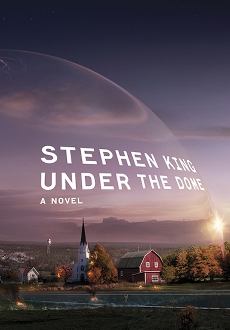 It seems the more book reviews I try to write the harder they get, but I wanted to try anyway. I read this book in slightly more than three weeks, 1070 pages. I’m not a fast reader so it’s quite an achievement for me. I didn’t even expect to read it whole. As I’m used to do, I usually just read the beginning, and, when satisfied, put it away to read fully later on. Especially because I had the Infinite Jest task at hand and I didn’t want to risk of losing track on that. Instead I started reading, curiosity pushed me past page 100 and at that point I just wanted to see what was next and there was no return.
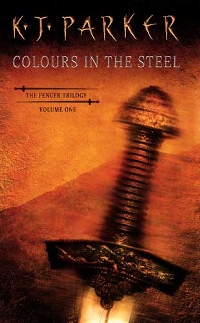 Instead of sticking to a series and read every volume before I move onto something else I try to cover as many authors I can, so that I can have a better idea of the fantasy genre as it is today. The mysterious K.J. Parker isn’t one who gets as much attention as other, more popular writers, but in comments and reviews I read she (we assume it’s a she, but the true identity is unknown and name used just an invention, being mysterious like that) has a very good reputation and more than once caught my attention. Especially when Pat posted