
Category Archives: Blog


The idea was to include this in the previous post, but then those quotes got too long and so I decided to postpone. Evangelion and the Kabbalah is a controversial theme because you have the impression that the anime added religious symbolism merely as window dressing and to appear mysterious. After all, when stuff blows up the resulting explosion is cross-shaped, and this isn’t explained at all.

When I started to look into Kabbalah it was solely because I was fascinated by the complex mythology and imagery. It was deep and so it was fascinating. This interest grew the more I went on because instead of a shallow mythology I was finding patterns that were extremely useful to understand a number of other things. It has nothing to do with “belief”, I still look at Kabbalah as a complete unbeliever. But it offers a number of ideas that work well in a number of different contexts. It’s like when you study psychology and use Greek mythological archetypes, or Shakespeare. Kabbalah incorporates powerful ideas that are deeply embedded in our culture, and describe well the human being.

That’s why Kabbalah “works” as an interpretative framework with Evangelion. To me it’s so obvious that it’s trivial. It’s not so much that you can recognize some Kabbalistic ideas within Evangelion, BUT that if you think at Evangelion in Kabbalistic terms then the story MAKES SENSE. So putting Kabbalah next to Evangelion doesn’t make it even more absurd and complicated, but actually clarifies a lot. That’s why it matters to me. It’s a key that works. And it’s not even so important that Anno deliberately put all this in the show with the exact purpose I mean, because what comes out is actually coherent with everything else.

In fact I don’t like at all reinterpreting some work outside its own context. I don’t like wild speculation and flourishing of fancy theories. But in the case of Evangelion the use of Kabbalah makes it simpler and coherent. Staying completely within the boundaries that Evangelion set for itself. So, in summary, Kabbalah has explanatory power for Evangelion, and that’s why it’s relevant for me (or why it’s relevant in other cases).


One of the ideas that go hand in hand is about “Adam”, and “Adam Kadmon” in the Kabbalistic parallel. The idea here is that “Adam” isn’t the first man, as a kind of first ancestor, in biblical terms, but the Kabbalistic Adam. Representing the idea of the “collective soul”. In Eva(ngelion)’s mythology the waters get a bit muddied (and probably rewritten during the show) because we don’t have just an Adam, but also Lilith. In this mythology human beings didn’t actually originate from Adam, but from Lilith, whereas Adam generated the “Angels”. But the common idea that’s relevant here is that Adam Kadmon represents the totality of life. Each human being is merely a small chunk of that collective soul. At the time of the Big Bang, following the scientific theory that Kabbalah also embraces, the initially undivided light (of God) got broken into pieces. In Kabbalistic terms Adam Kadmon represents the origin, before the “vessel” was broken in individual parts, as well as the final “complementation” (to use one Eva’s term), when all human beings are once again united as one whole.

This idea in Evangelion is directly represented in the image of Lilith, who’s called at first “Adam” (so you can assume that characters in the show also made the mistake, thinking themselves generated from Adam). A body nailed to a cross, whose lower half is missing and showing many human-looking limbs dangling off it, as if not completely formed. In any case, beside the manipulation in Eva’s mythology about Lilith/Adam mix up, there’s still the idea that all human beings are generated by that first “angel”.

Note: Kabbalah has a completely, utterly anthropocentric view. It explicitly says that a single human being is “worth” the totality of non-human life. Or, more accurately, his spiritual impact has power on all the lower three domains. That means: (the totality of) animate – vegetative – still. That for Kabbalah is a way to describe how immense is your power, since you affect directly everything else. This hierarchy simply follows an ideal of growing “desire”, which is the fundamental piece of all Kabbalah.

I’ll try to not derail and keep this focused on the structure of Eva, but it’s tricky because all these parts connect. What’s important to point out is that Eva is not a show with a religious theme. Religion is not its goal, and the authors declared this a number of times. And that’s why religion as a structure works so well. While in traditional Kabbalah “spirituality” is the goal, in Eva the goal is the personal message. It’s about the real world, like a message individually targeted at each spectator. The central theme is about living fully, connecting with others, overcome difficulties and introversion especially. Coming out of a shell, that also becomes the representation of a fictional egg where many people today live, refusing to participate in the “real world”. Hikkikomori. So there’s nothing abstract or metaphysical in Eva’s message. But they use some Kabbalistic framework to analyzes psychology and go deep in the human soul. The message needs to be both individual and universal.

The “Human Instrumentality Project” is an Eva’s term. It coincides with the “Third Impact”, which also means the end of the world. An apocalyptic event. But this also is the event that triggers the transformation of the main character into a “better” human being. It represents success, the breaking of the shell.

In Eva’s original project we read:

“Humanity has reached its evolutionary limit. Their salvation lies in invoking the Human Instrumentality Project.”

This curiously resembles to what I heard in Kabbalistic lessons. They also say we are, right now, at a pivotal time. Kabbalah has been kept hidden for all this time. It was “esoteric” knowledge, so only accessible to initiates. But now it’s different because they believe that humanity has reached the end point, and now Kabbalah needs to be extended to everyone regardless of race, sex, age, religion and so on. They measure this end point in terms of “desire”. And now that men have everything, the ultimate desire can arise everywhere: “spirituality”. In Kabbalah, as in Eva, the personal awakening coincides with a literal end of the world. But while in Eva the goal is tied to its own specific message, in Kabbalah it is obviously about spirituality and connection with god.

In both, the successful “complementation” of human beings, means a fusion, a return to Adam Kadmon. In Eva this is “metaphor made literal”. Eva uses terms like “Absolute Terror Field” and “LCL”, the first is a fancy term to define the ideal barrier that keeps us as individual beings, instead of being fused into Adam Kadmon. The force, or field, keeping us physically separate, with individual minds, fears, desires, memories, feelings. The LCL is instead the “primordial soup”, a generic liquid from where all life is generated. When the A.T Field finally collapses, with human beings literally “popping out”, everything is fused as LCL. All minds are joined. This is the premise of the “Third Impact”, and of the “complementation” of human beings. In Eva, all this is happening literally. You see it onscreen, people exploding and made into liquid soup. But this also follows precisely Kabbalah’s structure, taking those ideas and showing them literally instead of as metaphors. Also in Kabbalah human beings are kept individual by a force, but instead of being fancily named A.T. Field, the force in Kabbalah is simply called “egoism”. Egoism is both a positive and negative idea. Positive because it represents the “will to receive”. The will to fulfill personal desires. And so the will to be alive. Can you see anything wrong with this? But it’s also negative, and in fact Kabbalah is about cleaning and removing egoism. In Kabbalah there’s no way to escape the “will to receive”, because that’s the program embedded into us. That’s what you’re meant to be. But it also holds the principles to return to god, by connecting with other people. Even in Kabbalah the goal is “complementation”. The return to the undivided LCL, or Adam Kadmon.

“Success” in Kabbalah is fairly obvious. The idea is that in spirituality forces that are similar are also the same. Without distinction. Which means that through spirituality men can become “like god”, and so god. This means that the total removal of egoism, including the removal of the “self”, are the goals. In Eva, considering that Eva’s goal isn’t neither religion nor spirituality, “success” is far more ambiguous because successful complementation affirms the “self”. It’s about breaking the shell, affirm oneself as worthy of life, a positive force to move on.

This is also the split between the end of the TV series and the end in the movies. As I already said in the other post, I interpret these as alternative endings, where one includes Anno’s own personal reactions, to the reactions of the public at the TV ending. The message of the TV series, the “successful” complementation and the affirmation of Shinji who got out of his shell, was not received by the public. In the movies, then, Shinji is shown as a lot more passive, as if the character reprises the reactions of the public to the TV show ending. It’s a story of failure. A sort of tragedy where the character is simply crushed under the difficulties. He’s not good enough to solve all his problems and become a successful and praiseworthy human being. Maybe this is the most realistic portrait, because it’s not anymore a “fictional” story where the protagonist has plot armor and is ultimately always successful.

At the end of the movies, the “Third Impact” is triggered as in the TV series (but showing the literal side, instead of the metaphysical one of the TV ending). All human beings are fused in LCL. But during this process the “complementation” fails. Shinji refuses it, affirms his own identity in all the problems and shortcomings he has. He’s not suddenly and automatically a better human being who conquered all his fears, instead he has to face his “real” self. All his fears and limits. His selfishness, his egoism. His “will to receive”. And also his desire to be alive. All this is ambiguous and, because so, authentic. It mimics the complexity of life. Shinji who has done his best, and yet it wasn’t simply enough to overcome all his problems. It’s a non-judgmental view, and because so it is powerful. Shinji is cruelly shown as a shameful character, who failed and only showed his misery and his limits. Almost looks pathetic. The last scene shows another character with Shinji who expresses disgust. But it’s not a definite condemnation. It’s not judgmental because Shinji affirmed himself, his desire to be alive despite all his flaws and his lack of strength. It demands compassion. “Complementation” fails because Shinji has the power to negate it. While in the TV ending the shell is broken and Shinji becomes a new character who conquered his own issues (and this is shown as the goal of a successful complementation, as if all reality was just designed in order to get Shinji through this process), in the movie ending instead Shinji ends up REJECTING complementation, and he restores things as they were before complementation was triggered. Individual human beings are restored.

This obviously creates a controversy of interpretations, between those who think these opposite endings (one successful, the other a failure), and those who think that the end of the movies simply expands and connects back to what was shown in the TV ending: Shinji in both cases affirms his own life. With the slight difference that the movie ending is much less “happy” and unambiguous.

In both cases the Kabbalistic interpretation only enhances these possibilities. The fact that Shinji sabotages Instrumentality, and ends up breaking complementation, is coherent with the Kabbalistic complementation. You can’t trigger it artificially (as it is in Eva, since it’s forced against Shinji’s will). In Kabbalah the “next level” on the evolution, the complementation, only happens if one is ready for it. In Eva, especially the movies, Shinji is simply not ready. The movie shows a Shinji who fails breaking the shell, and ultimately rejects complementation. He’s not ready to strip himself of his “egoism”, so a proper return to Adam Kadmon is not possible, and as a consequence the division in individual beings is once again inevitable. Whether you find a positive or negative value in Shinji’s affirmation of the “self”, this is coherent with the Kabbalistic interpretation. Because in Kabbalah complementation REQUIRES the negation of the self. It requires conquering egoism fully, and only when one is ready for that step. Otherwise what happens is what happens: that we exist as individual beings. That we are selfish and concerned with immediate desires, completely driven by the selfish “will to receive”. We’re stuck in the physical world and all it comprises.

In the Kabbalistic’s vision the physical world is an illusion. It’s exactly like “The Matrix”. A simulation. The exact instant you “let go” of worldy needs, individual desires and embraces spirituality, the physical world collapses as the illusion it is. Instrumentality would be complete and successful. But Shinji isn’t ready, and so is pushed back in the physical world, back with his own problems to overcome.

There’s also an interesting aspect connected with all this. The very visceral idea when you watch the show, and made explicit with the TV ending, that everything that happens has Shinji as a pivot. Shinji-centric. It’s as if all the fictional layer is built FOR Shinji and around him. Built to push him forward through his Hero’s Journey. Without independent existence.

There’s a giant robot classic trope that is fully and willingly embraced by Eva: the hostile Angels that Shinji fights are DESIGNED TO SUCK. Every one has a blatant weakness that will be used to destroy it, and none of the following angels tries to improve or fix previous problems in order to actually try to win. Now, all this also has a post-modernist air. We know that the show has a WRITER, and that enemies in a giant robot show ARE designed to be defeated. That’s the point. But in Eva this isn’t just the truth OUTSIDE the show, it’s the truth INSIDE it. Gendo, Shinji’s father and deus-ex-machina, has always an unfailing faith in the giant robots. He’s always shown as completely emotionless even in the most dire situations. While this “fits” the character for other reasons, the point is that he simply knows how things will go. He’s not blinded by faith, but illuminated by clarity. He knows that what happens follows a pattern of predestination. He is essentially (partially) aware of how the show is written. He has read the plot. The same sense of inevitability as the show rushes to its end, is very similar to the sense of inevitability in the last episode of LOST. And if you were to compare them you’d notice some similar patterns.

Gendo knows that everything, as in a Kabbalistic construction or as in the actual truth, is a very elaborate fictional world that is built solely around Shinji. Nothing truly exists without Shinji. And Shinji can’t fail, because he’s the God in the Machine (Donnie Darko-style), following the unfailing plan of god/writer/Anno. This world would end, literally, without Shinji. It’s his story, his Hero’s Journey. Built for him exclusively. All other characters are puppets (but do not mistake, no more puppets than other people are for “you”), the angels are puppets. It’s all a story, for him. And it’s all, really, a story for us, the audience. Or better, not a generic “audience”, but you, the single spectator. The “self” experiencing this story, or the self who’s merged in reality, alone. The message is personal and aimed straight at you.

There are other small aspects that coincide between Kabbalah and Evangelion. For example in Eva’s mythology the “Dead Sea Scrolls” are simply a manual with the instructions to reach “Instrumentality”. They read in it about the origin of human beings and angels, the “hidden”, esoteric story of humanity. But this is essentially the same for Kabbalah. In our real world the “Dead Sea Scrolls” represent more or less the “Torah”, meaning the ensemble of Kabbalistic texts. And it’s interesting that, for example in the video I’ll link below, Kabbalah is literally defined as nothing more than an “instruction manual”. In Kabbalah as in Eva, these Dead Sea Scrolls are used as instructions to lead humanity to Instrumentality, or Third Impact, or Complementation of Human Beings. Or spirituality in Kabbalah, return to LCL/Adam Kadmon, or the actual end of the physical world, literal in Eva, spiritual in Kabbalah. The trick is simply that in Eva all the Kabbalistic framework is employed as a “metaphor made literal”, then mixed and dressed with “genre” aspects like giant robots and alien monsters, whose goal is introspection. Examining human condition through one character, and through that character specifically the social group of anime fans.

On a forum I concluded:


That solution works on all possible levels of interpretation.

The ending of the TV series represented the ideal of the story Anno wanted to tell. It represents Anno’s wish and desire: that Instrumentality could work and Shinji would fix his issues, as the anime fans fixed their own by embracing the message in the show. But then the sequel movies became for Anno a way to THINK on the series itself and its message. They become meta-commentary: whether or not the message actually was understood and worked.

On BOTH levels, it didn’t. The message failed if you think about the public’s reaction (to the show’s ending). And then Anno realized that Shinji too wasn’t ready for Instrumentality. He wasn’t through his personal issues, as shown in EoE before Instrumentality. His character didn’t grow, it actually regressed. Hence the acknowledgement that the TV series’ “happy end” on one side wasn’t possible because rejected by the public, and then made by Anno into the truth of the story. Shinji not being ready for Instrumentality, as wasn’t the public.

This because the whole core of Eva is: Anno = Shinji = public (or nerds/otakus who can identify with Shinji, see Tsurumaki who literally says “it’s useless for non-anime fans to watch it”)

Or, if you want: God, Jesus Christ, and the Holy Spirit(LCL)

All themes converge on these three. Where’s the god? Nowhere. The god is merely the introspective lens of analysis. On Nerv’s logo (Nerv is the agency that built the giant robots and that wants to trigger Instrumentality) is written: “God’s In His Heaven, All’s Right With The World”. Which is obviously not a reference to some external god, but to the idea of a final peace, or acceptance. It coincides with the theme of Instrumentality. Evangelion is not (and the staff affirmed as much) a religious idea. The show is not about god. Kabbalah is just a pattern or a mean. In true Kabbalah the goal is spirituality. In Evangelion, it’s self discovery or whatever you want to call it.

As for Kabbalah, there’s a video I usually link because it’s presents the framework in a direct and seductive way: http://www.perceivingreality.com/


I’m watching episode 25 again and enjoying the meta-fictional level. Here’s the mindfuck (if the end of TV wasn’t enough of it already):

On one side there’s a very manifest subversion on a Kabbalistic idea. Kabbalah says that at the maximum of evolution (as we are today) human beings reach the maximum of their desires. And yet they feel a “lack” that pushes them toward “spirituality”, which is the sublimation of desire and the consequent breach of the physical world as we know it. They call this feel as “the point in the heart”, which is the mechanic used by Nature to push us toward it, or otherwise we wouldn’t progress further and stop evolving. In Kabbalah evolution is guided by desire.

In Evangelion there’s the exact same concept. The setting explicitly mentions that it portrays humans at their evolutionary peak. The Longinus lance in the TV series is retrieved from the South Pole and thrust by Rei into Lilith in order to temporarily BLOCK the final evolution. When Gendo decides to speed up again the process, Rei pulls the Lance away, and we see Lilith starting to regenerate. When Kaworu meets Lilith, we see her having a swollen belly, all probably hinting that a “birth” was near. In this case this birth is the symbol of the next step on the evolutionary ladder (like in Kabbalah).

Now in episode 25, all this is made quite explicit. Instead of calling it “point in the heart”, Eva directly refers to “the void in the heart”. But its purpose is equivalent. These are exact quotes from the show:

“There is always a void, a part that has been lost in our hearts.
That is what gives rise to the hunger in our hearts
That’s why you’re going to bundle all human souls together,”

And:

“That was the beginning of the instrumentality of people”

Even in Evangelion there’s this “lack” that, as in Kabbalah, is meant to push human beings toward “instrumentality”. Both in Eva and Kabbalah, the lack in the heart is the Natural instinct that drives human beings toward the next evolutionary level.

The second level of this mindfuck is instead related to Anno and the final part of episode 25. What the characters tell Shinji is that the world he sees is EXACTLY the world he “willed”. That everything goes accordingly to his own desires and that this is just one of many possible futures (which also connects to the Rebuild as being “sequels”).

Quoting again:

“There are a lot of realities. This is one of them.
This is the result you wished for.
Yes, annihilation, a world where no one is saved.
This is reality.
It’s your own world where you coexist with time, space, and other people.
It’s a world where you yourself decide how to perceive and accept it.
Right now, this is your world, where everything is given to you.

You’re saying even this darkness and this world of half measures are all things I wished for?
That’s right.
This is one of the many ends that could occur.”

Now consider the relationship I underlined in the past. God, his son, and Holy Spirit. Anno, Shinji, the audience. Anno is the “god”, because he writes the reality of his fiction. He writes the show, the characters, the setting. So, being “outside” of his creation, he has god-like powers. In Christianity the dogma of the Holy Trinity says that each is essentially the same. God imposed on itself human limits and became Jesus in the physical reality. You can read that the “heavenly Son reflected his Father’s qualities and personality”. Anno writes Shinji as if he writes himself within the boundaries of the story. Shinji is Anno in the story, effectively his incarnation, with the limited powers as every other fictional characters. It’s like if there’s an opaque dome that covers the fictional layer, and so Shinji doesn’t know that “outside” there’s an Anno who’s writing it in his liking. He is like Anno, but he’s subject to the rules of the story. Can’t escape them or transcend his condition, and has to suffer like every other human being (like Jesus). And then there’s the audience. The audience is the singular “you” who watches the show and that can identify with Shinji, as well it represents the multitude of all spectators. The same as the Holy Spirit represents the “you”, as well as the rest of humanity sharing it. Shinji is the mediator between god and audience. The same as Jesus brought on earth the message of God. The message of god is Anno’s vision, and we become one with it because we identify with Shinji, and so “complement” with him (and so with god too).

Now reread that last quote while having this context in mind. The “reality” Shinji lives in, IS effectively decided by him, because it’s the Shinji-Anno who’s writing it. He’s effectively, literally the god of his world. He just doesn’t know because there’s the opaque dome that doesn’t let him transcend his dimension. Yet Shinji is one with Anno, he “reflects his Father’s qualities and personality”. He’s his own creation, on which Anno has total control. And so perpetuating the fact that this world follows EXACTLY the will of his heart. Just that hidden part of his heart that is concealed from him, because it belongs to Anno himself.
A follow up to the previous post. Despite the latest (3rd) reboot movie isn’t getting the best feedback from the public, at least there does not seem to be suspicions of a compromised work because of who worked on it. It happens that with popular franchises the original creators move on, and so they lose that kind of original intent and creativity. They become a commercial endeavor. But in the case of Evangelion Hideaki Anno and most of the original staff have always been at the helm, and are still there doing these reboots. So if they ruin it, at least they have the right to (and hopefully a good motivation too, these aren’t guys that do things lightheartedly and without passion).

There was an interview with Anno’s co-director and co-genius, Kazuya Tsurumaki, I think it was included in a booklet that they gave to the people who went to the theatrical release of the second Eva movie, and that I always considered quite interesting. Both for the interpretations on the series, as well as the insight about the production. I firmly believe that Evangelion became a masterpiece especially because it was “art through adversity”. The time and budget restraints forced the staff to stay focused and not take breaks. In Tsurumaki’s words this built a tension that sharpened their focus. It’s as if art becomes a fever, an obsession, and it takes over everything else. Or something that grasps you and drags you onward, willingly or not. Art as possession.

The other aspect that was crucial for the building of Evangelion is that they worked on it in a kind of postmodern active way, since they were continuously incorporating the way the public reacted into the development of the series. It wasn’t a closed and fixed project built in an authorial ivory tower, it was always ongoing, developing and integrating the feedback from the outside, reacting to it. It included that type of recursion and self-observation, putting at the center of the actual development that interplay between Anno, the fictional context, and the public.

I’ll add here a number of quotes that are pertinent to the aspects I consider interesting and that share themes that I brought up on this blog before.

Interview with Tsurumaki (highlights mine):

— So, “Neon Genesis Evangelion” is finally complete.
Why did you decide to conclude the series in the form of a movie?

KT – Yes, it’s finally over. I honestly think it would have been best simply to end it with the TV series. Frankly speaking, I feel that everything after that was a bit of unnecessary work, although I guess normally one should feel happy about having their work made into a movie.

— The conclusion ultimately took the form of a movie with two separate spring and summer releases.

KT – I was aghast when I found out it wouldn’t be concluded only with the spring release, and that our work would be extended until summer. After seeing the reaction of the fans to the spring release, I was pretty depressed. That’s when I started having those feelings of doubt again that, “I knew it – just a lot of unnecessary work.” It was really a shock.

This is interesting because it says that TV series stands on its own and doesn’t require the sequel movies. Those movies were done mostly to meet demands from the fans that were raging at how the TV series ended. And that’s also what triggered Anno’s “vengeful” response.

Tsurumaki says he also felt depressed after the TV series was over, because the work itself failed. The fans refused the ending and they got insults instead of praises. The earnest message they tried to send was completely lost AND deprecated.

— Do you feel that the time you were able to put into the project showed up in the degree of completion of the finished work?

KT – I wonder…. I mean we certainly had enough time, but the psychological uplift I felt during the TV series just wouldn’t come back to me. I’m sorry to sound so retrogressive, but it’s just that the feeling of tension during the TV series was probably the best of my life.

— What do you mean by “feeling of tension”?

KT – It felt really good toward the end — after finishing the work for episode 16, and especially from episode 20 onward. Of course, physically I was dead tired, but my mind was still sharp as a knife. I felt that I was utilizing my natural abilities to their maximum potential.

— What did you think about developments during the second half of the TV series?

KT – I didn’t mind it. The schedule was an utter disaster and the number of cels plummeted, so there were some places where unfortunately the quality suffered. However, the tension of the staff as we all became more desperate and frenzied certainly showed up in the film.

— I see.

KT – About the time that the production system was completely falling apart, there were some opinions to the effect that, “If we can’t do satisfactory work, then what’s the point of continuing?” However, I didn’t feel that way. My opinion was, “Why don’t we show them the entire process including our breakdown.” You know — make it a work that shows everything including our inability to create a satisfactory product. I figured that, “In 10 years or so, if we look back on something that we made while we were drunk out of our minds, we wouldn’t feel bad even if the quality wasn’t so good.”

The last part especially explains the postmodern-like process of self inclusion in the work, and so the typical breach of boundaries. What is meaningful is that it’s not an artsy formality, or a divertissement, but it incorporates a real struggle, so infusing the sense into the fictional story. A sense of truthfulness.

— There was a line in that dialogue — something like, “We can’t weave our lives only out of things we like….” That line was pretty intense. I would have thought it would strike right to the heart of anime fans, but there was almost no reaction from anyone. (laugh)

KT – Well, most people don’t pay close attention to the dialog when watching a TV anime. That is to say, we hear the words, but they don’t enter our minds. I’m that way too. Hideaki Anno understands this, and started to incorporate expressions that convey the message to the viewers in a more direct manner. Thus, elements which attempted to somehow convey the message within the bounds of the story gradually became fewer, and expressions which were more introspective or emotionally expressive became more frequent.

— Changing the subject, the work “Evangelion” is said to essentially reflect Director Anno’s mental images/landscape. Being involved in a project like this, were there any areas where you disagreed with Director Anno’s way of thinking or doing things?

KT – I think that anyone who works as a director should have those aspects. After all, works containing these portions are the most interesting. In that sense, works that are billed as so-called “entertainment” aren’t very entertaining to me.

— So, you were in agreement all the way?

KT – Of course. However, that doesn’t mean that I can synchronize with Shinji’s feelings. It also doesn’t mean that I can sympathize with Shinji’s = Anno’s feelings.

— I see. Then, it’s true that Shinji’s feelings are Director Anno’s feelings?

KT – To tell the truth I’m not sure, but at the very least I tried to work on the project from that viewpoint. That’s why in the scenario planning sessions I was always saying something like, “Isn’t that a little too hero-like for Shinji to say? Hideaki Anno isn’t that much of a hero.”

— In episode 25′ Shinji becomes completely despondent.
Does this mean that Director Anno had also experienced that?

KT – I think Hideaki Anno’s tension after the TV series had ended had probably fallen to about that level.

— Was this cinema edition made to match Director Anno’s state of mind?

KT – I believe so. There was a time when Hideaki Anno clearly wanted to attempt a more cathartic development.
It didn’t end up that way, but I don’t think we lied.

— In the end, Evangelion was a story about communication — at least judging from that last scene.

KT – That was the intent from the start of the TV series. That was what I tried to produce from episode 2 onward.

— Yes, that was the scene where Misato and Shinji talk while measuring distances from each other in Misato’s apartment, right? Although they appeared to be getting along fine with each other, Shinji was thinking, “She seems okay, but….”, while Misato was thinking “I wonder if he sees through me?”

KT – there were other scenes in episode 2 as well. For instance, when Misato talks to Shinji but doesn’t enter his room. Even in episode 3, they are having a casual morning conversation, but are not looking at each other. Like they looking through a slightly opened door, but not connecting. This is the same between Shinji and Rei, and between Shinji and his father. It’s no wonder there was a lot of distant, awkward communication.

— I see. So, the theme remained the same throughout the series?

KT – That’s right.

— What are your thoughts looking back on Evangelion now?

KT – Well, I really liked the atmosphere while we were doing the TV series. A TV series is the only way you can get responses while still in the production phase. We’d take feedback like, “They didn’t like today’s episode,” or “Wow! Today’s episode was a big success!” and reflect it to the episodes we were currently producing. In this sense, it was like a live performance. Hideaki Anno probably felt terrible after reading that absurd e-mail criticism or having the series praised to death in an insulting manner in sub-culture magazines. But that’s because “Evangelion” is a story about communication including misunderstandings such as these.

— Now even businessmen are debating the mysteries of “Eva” in bars. (laugh)

KT – (laugh) For example, Hideaki Anno says that, “Anime fans are too introverted, and need to get out more.” Further, he should be happy that non-anime fans are watching his work, right? But when all is said and done, Hideaki Anno’s comments on “Evangelion” + “Evangelion” are that it is a message aimed at anime fans including himself, and of course, me too. In other words, it’s useless for non-anime fans to watch it. If a person who can already live and communicate normally watches it, they won’t learn anything.

— Finally, do you have some message for the fans?

KT – Don’t drag the past around. Find the next thing that interests you.

— Does that mean not becoming fixated on “Evangelion”?

KT – Yes. It’s always better to let something that has finished end.

More pertinent quotes follow.

What is the appeal of Giant Robot Anime?

“Giant robot anime” is an expression of children’s subconscious desires.

That is to say, the thing called “giant robot anime”

Is compensation for the complexes and various suppressions that children hold, a means of resistance, compensatory behavior.

Adults know “the difficulty of living.”

And, at the same time they also know “the fun of living.”

In order to live, even if they know it is a “lie”

They know that “hope” and the “dream” called “justice and love” are necessary.

We can communicate purely to children with no sense of difference between fiction and reality due to a characteristic of the means of expression called animation, namely, usage of the view of the world where everything are “pictures” drawn by people.

That is the greatest appeal that “giant robot animation” holds.

Anno, on the ongoing process of development and relationship with both the team and public:

“The development of Evangelion gives me the feeling of a ‘Live’ concert. Whether it was the story or character development, I made them without theory. During the development, while listening to various opinions, and analyzing my own state of mind, I kept questioning myself. I got the concepts from this personal stocktaking [self-assessment]. At first I thought I would produce a simple work featuring robots.

But even when the main scene became a high school, it did not differ compared to other productions in the same style. At this point, I did not really think of creating a character with two faces, two identities: one shown at school, and the other inside the organization he belongs to [Nerv]. The impression of ‘Live’ concert that gives me the birth of Eva, was the team joining me in developing it, in the manner of an improvisation: someone plays the guitar and, in response, the drums and bass are added. The performance ended with the TV broadcasting ending. We only started working on the next script once the previous one was done.

It took longer than usual. When we finished a screenplay, we went back and checked it against the previous ones. When we said: ‘Ah, I thought so, that’s wrong there’, we made corrections to the storyboard. In fact, with the last episode approaching, we have not even been able to finish on time.”

This is also another example of metafiction and self-reflection, in fact in the first movie, “Dead & Rebirth”, the characters in the Anime perform a concert for the audience. So this becomes an idea/metaphor directly shown onscreen.

Anno, on his dissatisfaction about modern anime and lack of ambition:

“There is no longer room for absolute originality in the field of anime, especially given that our generation was brought up on mass-produced anime. All stories and techniques inevitably bring with them a sense of déjà vu. The only avenue of expression left open to us is to produce a collage-like effect based on a sampling of existing works.”

“The people who make anime and the people who watch it always want the same things. The creators have been making the same story for about 10 years; the viewers seem to be satisfied and there’s no sense of urgency. There’s no future in that.”

Anno, in 1995 (during production but before the 1st episode was broadcasted):

This is roughly the worldview for Neon Genesis Evangelion. This is a worlview drenched in a vision of pessimism. A worldview where the story starts only after any traces of optimism have been removed.

And in that world, a 14-year-old boy shrinks from human contact. And he tries to live in a closed world where his behavior dooms him, and he has abandoned the attempt to understand himself. A cowardly young man who feels that his father has abandoned him, and so he has convinced himself that he is a completely unnecessary person, so much so that he cannot even commit suicide.

And there is a 29-year-old woman who lives life so lightly as to barely allow the possibility of a human touch. She protects herself by having surface level relationships, and running away.

Both are extremely afraid of being hurt. Both are unsuitable-lacking the positive attitude-for what people call heroes of an adventure. But in any case, they are the heroes of this story.

They say, “To live is to change.” [This is apparently a quote of the last line of Miyazaki’s Nausicaa manga.] I started this production with the wish that once the production complete, the world, and the heroes would change. That was my “true” desire. I tried to include everything of myself in Neon Genesis Evangelion-myself, a broken man who could do nothing for four years. A man who ran away for four years, one who was simply not dead. Then one thought. “You can’t run away,” came to me, and I restarted this production. It is a production where my only thought was to burn my feelings into film. I know my behavior was thoughtless, troublesome, and arrogant. But I tried. I don’t know what the result will be. That is because within me, the story is not yet finished. I don’t know what will happen to Shinji, Misato or Rei. I don’t know where life will take them. Because I don’t know where life is taking the staff of the production. I feel that I am being irresponsible. But… But it’s only natural that we should synchronize ourselves with the world within the production. I’ve taken on a risk: “It’s just an imitation.”

— What was the reason you wanted to do an original work, despite these circumstances?

Anno: Of course, for myself (laughs). There is always a very personal reason for creating [something]. There is probably no need to say any more [than that] here.

— Even so, insisting on something original-?

Anno: It’s probably so my self-existence will remain within the film.

“Fundamentally, Eva is just my life copied out onto film. I’m [still] alive, so the story hasn’t finished.”

“The characters of ‘Eva’ are all composite personalities based around my own personality.”

“Shinji-kun is the current me.”

Shinji does reflect my character, both in conscious and unconscious part. In the process of making Evangelion, I found out what kind of person I am. I acknowledged that I’m a fool.

A Dream World That Hasn’t Forfeited its Goal
Anno Hideaki

There are too many painful things for people to go on living in reality.
Thus, _humans_run_and_hide_in_dreams_.
_They_watch_films_as_entertainment_
Animation, as a means to enjoy everything in a pure, fake world, is a
realization of dreams and has become entrenched in film.
In short, it is a thing where _even_coincidences_are_arranged_ and _everything_
judged cinematically unnecessary _can_be_excized_.
The negative feelings of the real world are no exception.
If the director so desires, even malice toward others could be introduced
straight into film.
I guess that’s one of the attractive things about anime.
_Changing_the_tribulation_of_reality_into_dreams_ and conveying that to the
people…is that what our work is?
For the sake of people who forget reality until the bill comes due, who
_want_to_devote_themselves_to_happy_fallacies_.
I guess that’s our job in the entertainment and service sector.

…I [Anno] really hate the fact that animation – or at least Evangelion, the work I’ve been doing – has become merely a “place of refuge.” Nothing but a place where one escapes from reality – by becoming deeply absorbed in it, [people] simply ran from the pain of reality, and from there was hardly anything that came back to reality. To that extent I feel like [the work] did not arrive [at reality]. Steadily the number of people taking refuge [in the work] increases, and if this keeps up, in the extreme case, it would become a religion.

Anno had been running on empty ever since Nadia finished, but Evangelion seemed to be just the thing to get him up and running again. And once he puts his mind to something, he goes all out…

In the second difference, as perhaps an inevitable result of that temporal compression, in ANNO the successful critique of anime was brought about by the logic of acceleration and multiplication, while in the case of MIYAZAKI and OSHII the critique of anime succeeded because of the logic of removal. The last half of “Evangelion” takes the form of a critique of previous anime works through developing all the narrative possibilities and anime-like expressions and pushing them to their limits; in other words producing a totality of the anime-like. Simply put, in the second half of “Evangelion” ANNO produces a super-complicated and super-high speed anime and thereby achieved a qualitative change. Several compositions were made for the purposes of constructing a 90’s savior narrative were rapidly inverted and were instead employed to tear to shreds the interactive communication among the characters. This means that for ANNO, he deliberately cut off communication with anime fans who supposedly can only appreciate works by identifying themselves with and investing their emotions into the characters….

Azuma: Finally, only one question about the “set up” of the work. The enemy called “Angel” has no concrete image. It might be a pyramid, a ring of light, a virus…. in what way did you intend that?

Anno: They were paradoxically presented as things without form. For me the idea of an “enemy” is ambiguous, because my relationship to “society” is ambiguous….. The adults of the previous generation taught us that, despite fighting against the system, they were not able to accomplish anything.

Anno only makes works for himself, and not for an audience. However, making works is still the only way he can relate to other people. This relationship is like a “masturbation show,” because other people are watching him act to please himself. They decide by themselves how they react to it. He does not directly “pleasure” others. It requires some narcissism to be an author; someone entirely lacking self-confidence wouldn’t “expose” themselves.

After the television broadcast finished, I became worse and worse, and went to see a doctor. I even seriously contemplated death. It’s like [I] was empty, with no meaning to [my] existence. Without the slightest exaggeration, I had put everything I had [into Evangelion]. Really. After that finished I realized that there was nothing [left] inside of me. When I asked [the doctor?] about it afterwards, [he said?] “Ah, that is an “identity crisis” (self-collapse) [自我崩壊].”9 It was a sensation as though I had taken something like extremely bad LSD. I was told, “It’s amazing that you were able to do that without medication.” Yeah, now, I feel very fortunate (laughs).10 In order to determine whether or not I really wanted to die, I went up to the rooftop of this building (the GAINAX building) and stuck my foot out, waiting to lose my balance and fall forward. I did it to personally determine [whether I wanted to live or die], [thinking,] if I really want to die, I should die here, and if I don’t want to die, I’ll step back. Well, it didn’t lead to my death, and so I’m here.

At first I was manic, but I rapidly developed a severe depression. I wouldn’t leave my office at work; I would leave only to use the bathroom, and I would almost never eat meals. A dilemma suddenly arose: I didn’t want to encounter other people, and yet I did want to encounter other people.

I don’t return home [at the end of the day], because the time and effort spent returning is bothersome. I just stay overnight here all the time; I don’t return home more than a few times in a year. At work, when I go to the bathroom, I go across the studio, I have to encounter people. I just wanted to think by myself, so I returned home for the first time in many months. My bed is never made, so there’s nothing to do but crawl into it. When I took my clothes off and lay down – I can’t put it any other way than extraordinarily terrifying, terrifying thoughts [怖い考え] – I had a sensation like my whole body was enveloped in such [thoughts]. When I was enveloped by this, I suddenly leapt to my feet and, in a panicked state, threw on my clothes, grabbed my bag, and went out onto the street, [crying,] “Taxi!” I went back to my workplace, I went back to my office at my workplace and slept. This is the “identity crisis.” I don’t have the feeling that I want to die, or anything like that. There’s nothing I can say [that can explain things]. On the other hand, that was how seriously I took “Evangelion.”

Anno says, “I kept to my house after the TV series of Eva. I lost the point of living. That time, Miya-san called me and say ‘Anyway, take a rest.'”

Postscript. Yesterday, when I was in a state of mental collapse after my latest work had ended, I was moved deep within my heart by an encouraging phone call I received. The words of concern proceeding from the receiver became joy on my end as, with a exaltant face, my whole body was buoyed. In secret, I rejoiced in receiving some recognition for myself. Thank you from the bottom of my heart.

These days Evangelion is once again getting some attention since the third movie of the reboot recently came out in Japan in BD format, and fansubbers are hard at work on it (and fansubbers also usually do a better work than official releases, since a work of love is usually better than work done for money).
While reading some of the comments on the forums I saw links to two commentary videos, specifically on the ending of both the TV series and the two sequel movies (not to be confused with the reboot itself that has still a fourth movie before it’s completed), that suggest a few ideas that I consider better than speculation. They are coherent with all the canon, providing a neat interpretation that doesn’t clash and doesn’t feel forced. Moreover, it could also connect with these recent movies. I’ll repeat for the most part the ideas in these videos, so I suggest watching them, especially the first. Here are the two commentary videos:

http://blip.tv/foldablehuman/s3e2-end-of-evangelion-and-the-audience-author-membrane-6540094
http://blip.tv/foldablehuman/s3e2-1-end-of-eva-follow-up-6558464

I’m definitely not the first to put Evangelion in the wide and blurry basin of postmodernism, it’s just what it is, but usually the aspect the is brought up is about the deconstruction of “genre”, in this case the giant robots, fighting for survival in an apocalyptic setting against unknown alien monsters. Evangelion follows a trend that is common to most genres. It’s especially evident in comics, since you can see easily how even the drawing style moves toward modernity. But you can also notice how the modern super-hero stories are also evolving toward a certain maturity and realism. You take a canon and make it “serious”, add detail, cause and consequence as if they were real. “Gritty” and complex. Evangelion fits perfectly in this trend since it’s an evolved and realistic rewriting of the genre canons, “aware” of itself. So becoming also a sort of meta-commentary on the genre itself, subverting and manipulating all its small parts.

This “deconstruction” is usually the prominent aspect in postmodernism, but I consider it just a part of it, without representing the true core. In the case of Evangelion too, the deconstruction of the genre is not its more relevant aspect. Postmodernism is about breaking rules, more specifically about breaking “frames” and points of view. Breaching boundaries of all kinds, of expectation, physical or metaphoric. It’s then a consequence that the subversion of canons is a direct aspect, but not the meaningful one. Going beyond the frame of a story means an awareness of who’s telling that story and the influence on it. And that’s why it often comes, in postmodern works, in the form of breaking the fourth wall (goes both ways, like an author putting himself in his work). It’s just one possible type of breach. But most importantly, it goes to the core of the issue, that is the relationship between the author and the audience, the message for what it can or cannot be.

Evangelion, while also being a very popular franchise built in collaboration, is also an extremely personal work of his director, Hideaki Anno. It’s his masterpiece and most complex and ambitious work. The core of the show is represented by the explicit interplay of three “actors”. There’s Anno himself as the writer/creator, there’s Shinji, the main character and true fulcrum of the show, and there’s the audience. These three actors exist in every other work, but in this case they exist WITHIN the work itself. All three actors converge and become one, become interchangeable. Anno gives the main character a lot of himself, identifying with him, but Anno is also at the same time the audience of his work, since he’s talking to himself, finding ways and solutions, exploring contradictions and set backs. But the main character is also the archetype of an “otaku”. It speaks to a social reality, its audience at large, its fans. It speaks individually to who’s watching, but it also represents and criticizes society at large. So in this interplay of micro and macrocosms, Evangelion contains its external context. Anno is Shinji, Shinji represents the audience made into a type, to which Anno naturally belongs. Within the fictional world you have a replica of the total “real” world. With all its issues. The subverted canons that the show preserves while manipulating them become metaphor of the wider context. As it is well explained in the video, the giant alien invaders, unexplained and sudden, represent the real world and difficulties in life that force one to grow up, prepared or not. It’s a violence of reality that presses on with its demands. And this metaphor is extremely powerful because it reproduces that despair in front of insurmountable obstacles: giant alien monsters. Those aliens don’t need any further, logic explanation, because Evangelion is first and foremost a powerful metaphor. Explicitly.

The huge controversy exploded when with the last two episodes of the TV show Gainax ran out of everything. Out of time, out of money, out of hope of wrapping everything up. Anno himself was obsessed with the show and struggled to find its message, as if he was constantly fighting the response he was getting from the fans, displeased by their demands. So he made the boldest and most ambitious choice. For those two last episodes he dropped COMPLETELY the dressing up of metaphors to focus solely on the internal spiritual journey. He dropped characters, plot, giant robots and conspirations. The story ending abruptly with nothing more than extremely vague hints, and it instead all become a symbolic journey in the main character’s soul. It shows in the most explicit and powerful way the “message”, directly, without filters. It’s the most explicit part of the whole show, but it’s also a complete mind screw, destroying all kinds of expectations everyone had.

The fans were not happy. Evengelion was at the time a HUGE cultural thing. The backlash was insane and Anno received all kinds of insults and serious death threats. He also fell in depression because he put everything he had on the show to the point of exhaustion, working restlessly on it, a labor of true love that was then received in the most violent way. At that point Evangelion was so big that it wouldn’t be over like that, so Gainax was already fiddling with the idea of producing a theatrical movie, that would have bought some time to do things properly. But due to the outlash of the fans this became for Anno an ongoing dialogue. With himself and his audience. The audience that now was RAGING against him in unprecedented ways.

The common theory about the TV series’ ending and the two theatrical movies that follow it, is that these two represent two inverted faces. The TV finale shows the metaphorical ending (“the message”) while dropping the fictional layer of characters and plot. Whereas the theatrical movies reprise what the fan forcefully pretended: plot and characters, robots and fanservice. Telling how the story ended, with the thematic aspects remaining in the background, symbolic and vague. And here the video commentary above suggests a different interpretation that works much better. Those two aren’t just two sides that were split for creative and practical reasons, but two completely separated possible endings. Not only, but they are also antithetic. The TV show’s ending celebrates “success”. It’s an happy ending. The character achieved what he was meant to achieve, he affirms his life, grows up and is finally cheered and applauded. Instrumentality is successful! But the theatrical ending is, while subtle, the opposite. It’s the celebration of “failure”. Shinji fails to come to grips with his problems, he actually descends into nihilism and self-pity, and rejects instrumentality. He’s unable to overcome his personal problems and difficulties. He unleashes anger and despair, he’s ashamed of himself and rejects everyone around him. He’s unable to love truthfully. It’s the tragic ending. But all this, because of the meta-fictional, postmodern level, is also Anno’s act of vengeance. The three actors, Anno, Shinji and audience. By condemning Shinji, Anno condemns his public, the “otakus”, their reactions and demands. They pretended giant robots fighting, spectacular setpieces, female characters being sexualized, use of mythology and religion to dress up the plot in fancy ways. The theatrical movies, as opposed to the TV show ending, gives all of this aplenty, and in this they determine the “failure” of the message of the show, represented by the failure of Shinji.

Anno is also himself an otaku. He loves what he’s doing. Evangelion is a labor of love, and so he puts his own passion for the giant robots and all those aspects of genre. Anno is Shinji in the story, and he is also audience. This work is overall dialogue between all these parts, as I said representing them within the show itself. The TV show’s ending together with the theatrical ending provide alternate possibilities, opposite between each other. It’s the sublimation of that same dialogue going on. The other potentially interesting idea in the commentary videos is that the new reboot movies may be also part of the same scheme.

He points out how the titles of each movie have a duality similar to the duality of TV show opposed to the theatrical ending. Success or failure. “You Are (Not) Alone”, “You Can (Not) Advance”, “You Can (Not) Redo”. Especially with this third movie there’s a fan theory that is getting increasing attention about the possibility that this isn’t simply a “reboot”, as in the story being readopted and rewritten, but that these movies “follow” what we’ve already seen, instead of overwriting it. It’s as if Anno is wrapping everything up, the TV show, the theatrical end and the reboot movies, together in a broader meta-fictional or even completely fictional context. A bigger story of cycles that repeat oveer and over, of time loops or parallel worlds that follow similar patterns but that ultimately diverge. Evangelion is first and foremost a spiritual journey, that’s what is contained in the “true ending”, and the religious symbolism is actually more than dressing up (the fictional “A.T. Field”, for example, is described in the show as a barrier that keeps human beings separated as single entities, instead of melting into undivided “oneness”, but this is EXACTLY what is described in authentic Kabbalah, explained as the “breaking of the vessel” and the final return to god, achieved by regaining that unity of spirituality, and, exactly as it happens to Shinji, it’s “egoism” and self-absorption that keeps one isolated and “individual”).

The more you think about it the more it’s an extraordinary work. I haven’t even touched on the deep psychological layer and complex relationships that these kids have with their parents. As you see the deconstruction and subversion of genre is what’s more obvious and explicit, awareness of its time and purpose, of its medium, but the true genius is in how the show recreates within itself the macrocosm of reality, using every fictional moving part as a metaphor, giving it meaning and purpose that are much stronger than just a superficial dressing-up. It’s about Anno examining what he loves, but also Anno himself, and his dialogue with his fans. His own vengeance and condemnation on them. It’s a vehement critique of society as well as of the genre itself and all its fans, like a giant FUCK YOU ALL. Anno dares. In one scene at the end of the movie the hate mails and death threats are shown on screen, including scenes from the theater where the first movie was projected. This scene ends by making the people disappear. The theater is deserted. Anno erased them all. It’s the end of the world, and he canceled humanity. But as it often happens it’s at the same time also a celebration, because still filled with the same: spectacular giant robot battles and fanservice. Someone summarized this quite brilliantly: “he wants to have his cake and eat it too”.

I noticed this discussion on twitter and decided to join (it also sports Mark Lawrence and Joe Abercrombie defending their work). Not because I needed so bad to put all the blame on Ian Sales, but because it typifies an attitude that I see frequently, and so I decided to do my best to expose it for what it is.

ian_sales: John Crowley, Mary Gentle, Paul Park, David Herter, Cat Valente. No other authors working in fantasy even comes close to them. And certainly not anyone writing epic fantasy – most of them can barely string coherent sentences together.

If you’ve read one grimdark fantasy, you’ve pretty much read them all.

some types of fantasy attract the better writers. Commercial epic/grimdark fantasy isn’t one of those.

it seems a bit daft to start defending writers of commercial epic fantasy given that we all agree that beautiful prose in such books is neither desirable nor expected.

It seems pretty obvious that ian_sales’ thesis on this forum thread is that all Epic Fantasy is crap, because of what it is and not because of who writes it.

His mistake is the common one of those who absolutely need to put labels on everything, or draw lines on the ground: here’s where there’s quality stuff and where I stand with my lofty standards, over there is the popular, commercial stuff for the uneducated masses. So in order to elevate himself and his literary taste, he needs to mark the difference from the Genre.

The mistake is clumping together stuff so that he can put the “sh*t” label on all Epic Fantasy. It’s a prejudice like any other. It’s what enables him to pick up a book and be able to tell whether its good or crap just by looking at the cover. It should be obvious that this is delusional, as are always delusional prejudices in all forms.

The simple fact that he RESISTS the suggestion of making distinctions within Epic Fantasy, and the rationalization that goes in explaining why Epic Fantasy MUST have crap prose as an unavoidable requirement just exposes his “bias”.


On the matter of prose quality and elaborate obfuscation, I used in the past to compare Erikson and Wolfe. This simply because they can be seen as two opposites. I sometimes criticized Gene Wolfe because he can write in elegant, elaborate ways a simple concept. I don’t consider this an honorable achievement. What’s more praiseworthy is the opposite: express clearly a complex matter.

Wolfe’s prose usually require lots of work to extricate meaning from his sentences, and he loves obfuscation on all levels. It’s as if reading becomes a puzzle itself. And it’s not simply just prose, since everything from the characters to the plots, to the dense symbolism contributes to this puzzle. So I use here another broad scheme: writers that are “esoteric” and those that are “generous”. No matter how hard you try, some subtle meanings and purposes in Wolfe’s books will stay out of your grasp, simply because you lack the knowledge of some external material that Wolfe is referring to. Either you share the “code” to decipher what he writes, or you’re left out staring through a window and figure out a fragment of what’s there to figure out. I sometimes resent this kind of deliberate obfuscation.

Erikson instead I consider more “generous” because the writing style and purpose don’t hamper comprehension. There’s stuff that is complex, but it just requires patience to figure out. He doesn’t write deliberately to obfuscate or to be understood only by cultists who share an hidden code. Some writers like Pynchon, Joyce or Wolfe sometimes work hard to avoid being understood, to obfuscate and hide. This game is interesting to play, but it’s an elitist purpose. You write for a self-appointed minority. Whereas other writers tackle complex matters and demand work from the reader (the same way I put Wolfe and Erikson as opposites, I can do with Pynchon and David Foster Wallace), but the kind that is accessible and that wants you to be part of it, instead of pushing you away. So this is a broad distinction that I sometime use because it works.

That said, even the quality of prose sometimes is still subject to the purpose of the book itself. I enjoy the broad spectrum. For example Glen Cook has a disjointed, blunt prose. You’d think that the prose being not good pulls away from the book, but instead it’s the kind of prose that perfectly fits the story and adds to it. A prose style also is a tool that can fit a specific purpose.

So the broader error is once again trying to decide the formula that is perfect and ideal for every case. The Golden Standard. Writing being art, instead, draws its qualities from its variety and the impossibility to canonize. Or it goes stale and fades.

If you enjoy just one flavor, whether its Literary, or popular, you’re simply missing out by drawing your walls safe and near.

Once again I’m baffled by how little consideration and attention major publishers give even to major Literature writers.

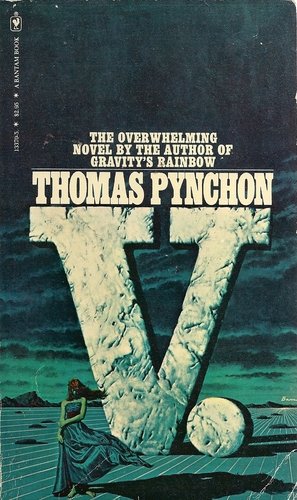
This time I ordered an used, old copy of “V.” by Thomas Pynchon. Shipped from Amazon US, making the shipment cost me twice the price of the used book itself. This simply because I dislike all the most recent covers of this book, and instead I like much more the mass market Bantam edition:

So it was solely a decision about the cover, and the fact that I like a lot the tiny print that was used in the old editions and the yellowy pages that make one feel as if being pushed back in the past when the book came out. Little vanities.

I received the book today after it took almost a month to get over here, and when I gave a look to the wikipedia page I learned that:

In 2012 it emerged that there were multiple versions of V. in circulation. This was due to the fact that Pynchon’s final modifications were made after the first edition was printed and thus were only implemented in the British, or Jonathan Cape, edition and the Bantam paperback. The fact was forgotten soon after in the U.S., so most US editions, including the newly released eBook, follow the first printing and are therefore unauthorized versions of the text, while the British editions, which follow the first edition printed by Jonathan Cape, contain Pynchon’s final revisions.

This is the article that explains it more in detail. I checked my own copy and was glad to find out it’s the revised, “final” version. Such luck. Then I went checking the most common version sold on Amazon and, yep, it’s the unrevised, “unauthorized” version (also notice the crappy cover). I checked the lines inside. PERENNIAL CLASSICS MY ASS.

On twitter they even told me that the newest US editions added errors ON TOP of those already present. Sure, it is not the end of the world because Pynchon is one of those writers who obsess every single word, and from what I’ve read the total of the differences is likely negligible and unnoticeable for the final reader. But still, it’s responsibility of the publisher to obsess at least as much as the writer about every detail. It’s basically their whole job knowing what they are dealing with, knowing all the different editions and take care so that whatever small error is properly dealt with.

From the wikipedia I also read that:

“In 2012 Pynchon’s books were released in e-book format, ending a long holdout by the author. Publisher Penguin Press reported that the books’ length and complex page layouts made it a challenge to convert them to a digital format.

What? Pynchon’s books are too long for e-books? Does the digital binding risk to fail? It required so much work and dedication that they based the text of the e-book too on the wrong version with the errors. Once again.

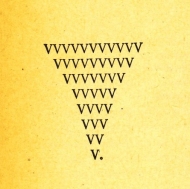
Apparently modern technology isn’t good enough to reproduce this:

For me the show lost steam and interesting things to say with the end of Season 3. The end of a great show. The rest is watchable, but average TV that wouldn’t really deserve attention if it wasn’t for what came before (and Season 1 only is good because how it fits on the bigger picture revealed in Season 2/3).

So I kept watching until the end knowing it would disappoint. The finale did really nothing for me. The plot moved EXACTLY as it was described, with zero surprises or interesting development. The “emotional” moments seem well received from the internet, but they also were repetitions of everything the show already said before, and better.

Now SPOILERS.

Pretty much everyone who saw the finale thought it didn’t really make sense. A twit summarizes what I think was the common reaction. The problem everyone noticed is the following:

– How it is possible that Observers only get erased with the invasion, and not instead through the whole timeline, so preventing September to distract Walternate from the cure, causing Walter to cross universes, kidnap Peter, September again saving Walter & Peter from the lake, and then all the cascading of effects? Everything that happens in seasons 1/2/3 happens as direct consequence of the Observers’ intervention. If you erase the Observers then you remove the WHOLE story. So why is it only from the scene in the park onward that the timeline is affected? Why that arbitrary point? It is a good excuse to give the show the Happy End scene everyone wanted, but it is otherwise a huge plot hole that makes zero sense.

That’s the big problem. I saw the finale and I thought the writers just went with a something the public would enjoy, without giving much thought to the fact it made no sense. It may work for TV, but it’s actually even less consistent than what we got with LOST.

But after a while I realized that my memories of the show aren’t accurate about what ACTUALLY happened, and that with a little bit of hammerin’ one could manage to square this round peg into the square hole, maybe:

– Remember season 3 finale? Peter steps in the machine, ends up being erased. With the beginning of season 4 we got a rebooted universe. Peter only exists in phantom form, Walter lives in the lab and so on. The universe in seasons 1/2/3 was ALREADY erased. What happens then is that Peter is brought back by the Power of Love. It’s a horrible plot point, but it’s what we’ve got. The old universe is NOT restored, and only continues to exist for three people:

1) Peter. Because after he’s back he still has his memories of all that happened.
2) Olivia. Due to drugs and Peter she starts to have mixed memories and finally becomes the Olivia Peter remembered (this was a big plot in season 4, if you remember).
3) Walter. He’s touched by the Observer kid who gives him back all the memories he lost due to the reboot.

Those three, and all of us who watched the show, “witnessed” and remember those events. No one else. It’s a way the show has to tell us we got something somewhat private and exclusive to share with those characters.

When we deal with the erasure of the Observers from the timeline then we only deal with this rebooted universe in seasons 4/5, NOT the universe we got used to in previous seasons, which now continues to exist in memories only. So whatever effect the erasure of Observers will have, it will have in THIS new context.

I don’t have a good memory of how this reboot worked, but as far as I remember the Observers didn’t play a big role in season 4, and only seemed to actually affect the timeline with the invasion itself. So it *may* be possible that the total erasure of the Observers in this timeline doesn’t have other consequences, beside the invasion itself. Filling that plot hole that everyone noticed.

(Late edit: it seems I was wrong and there’s some deep involvement of Observers even in season 4. See episode 14. What I explain below could also give an excuse to why everything went as it should, but I have to admit it’s quite a LEAP. So thee finale may not make sense, after all.)

There are a few things left to explain, though. How was Walter able to send the white tulip to Peter? Well, do you really think that Walter would live happily and quietly in the future? It’s actually a powerful device, if you think about it. It’s an omnipotent Deus Ex Machina that’s entirely plausible in the logic of the show:

I’m being told that there’s a part of my explanation that does not work. They tell me in the reboot universe September STILL distracts Walternate from the cure. The only divergence is that Peter dies in the lake. I actually am not so sure about this, because I remember there was lots of speculation during season 4, so I’m thinking that this may be more a byproduct of speculative deduction than something the show has *shown* explicitly. In any case, the “logical” Deus Ex Machina I was talking about would fix both the problem of the White Tulip AND the problem of the necessity of Walternate being distracted so that things would work the way they worked. How? Do you really think that Walter goes in the future to start a luddite movement and abhor science? The “plan” was NOT to go in the future to obliterate current Observers, but to create BETTER observers. The kid Observer was needed to demonstrate how to achieve that betterment, not simply stop Observers as a destructive evolutionary trend and be done with it. Which means that what we got this: far future technology + Walter at their disposal = UTTER OMNIPOTENCE. Including time travel.

Hence, it would be in the realm of possibilities that Walter and the future at large have plenty of handy tools to make sure that everything that needed to happen would happen, minus the Observers invasion. Handcrafting the past so that Peter & Olivia would have the best life possible.

The White Tulip: the sign that God/Father (Walter) sends his child (Peter). To tell him he’s being taken care of:

When I take his hand
and I lead him…

he’ll know that I love him.

A quick summary of my two main objections to Bakker’s Blind Brain Theory. That’s essentially all I was repeating this past two months on comments on his blog. There are lots of implications, but I think these two points are at the origin. Besides, I largely accept the theory, and what I’m actually arguing are the consequences and implications of that theory.

1) Formal error. I think this is evident to Bakker already, but he may underestimate it. His intent with the Blind Brain Theory is to reverse the approach to how we can explain consciousness. Inverting the frame of reference. So he believes that if we posit that “consciousness” is a perceptive fraud/illusion, then you could explain consciousness from the “outside”. Starting from the natural world. That way, in his intention, the consequence is that consciousness should be “explained away”. In the sense that he should be able to describe how consciousness comes to be, how it works, and why it is perceived in the way it is (and why this is only a sort of hallucination).

The formal error, I think, is evident. We know the concept of “turtles all the way down”. The problem is that, even more specifically when you deal with consciousness, we know exactly the “origin”. It’s the brain/mind. The postulate is that everything begins in the brain, and so every consequent observation and description need to start from the brain. The switch Bakker makes from an internal self-description, to a “scientific” description from the outside is a formal violation. It’s like in a book switching from first person into third. So this is why I called it a literary trick. It’s a magical handwaving, and so negates exactly the possibility of what you were doing (that is: the possibility to have a description from the outside, looking in).

2) The second objection has roots in the first. I wrote this on Bakker’s blog:

I’m going to ask all of you a question.

We could postulate that all characters in fiction live deterministic stories. There is a god who supposedly knows everything and creates every small bits that becomes material substance in that story. If it’s a book, then a writer writes every single word, then is then made into thought and then projected as a world.

Have these characters free will? Obviously not, as consequence of living in a deterministic world. But what makes a “good story” is the fact that the system is closed to the god. The rules are clear and not continuously violated. And that the characters are true to themselves and the world, as they are set up from the beginning.

But does it matter to us? Does it matter that we know those characters have no free will? Do we stop reading simply because we already know “who did it” (the writer)? Or maybe we still feel compelled to continue, because we are trapped in that first person, and that’s all that matters?

So, knowing the first person is an illusion, does empty it of all its value?

The first point explains that you can’t transcend the limited point of view. Hence the formal violation. Even in science we could posit that there’s a god as a first mover. An entity that sits right outside the system of the world. Science, however advanced, CAN’T disprove this. It’s always possible, however improbable. Being this god “external”, it means the god has no power once the system is in place and starts. Everything moves accordingly to its rules. This system is deterministic, which is what science tells us. This means that if you knew a single moment at any point of the lifetime of this system, you could be able to deduce/reconstruct all its history, past and future. Because deterministic means a cascading of consequences, each having always the exact same outcome, like a very complex domino.

The question is: do people living within a deterministic system have free will? The answer is: no. Because deterministic system means that the choices people make are direct and sole consequence of the environment (where the person is itself undifferentiated part of it). But this leads to a false perception. A deterministic world doesn’t mean that there’s someone with a joystick outside the system that pilots us around. It simply means that we are bound to the environment, not independent from it. The “illusion” of free will is simply due to the limited capacity of our brain, that can’t remotely grasp the totality of reality (and if it did it would break the system, because would break the inside/outside rule, and so automatically make it non-deterministic since the system wouldn’t properly “close”, and closure being the necessary condition of a deterministic system), and so is limited to know one perspective. And that’s the key to solve this riddle.

This is a problem of relativity. A deterministic system can both have free will, and then deny it. If you had the capacity to exit the system, and looking in from the outside, then the system is made deterministic, and so free will vanishes. But if instead you are caged in one perspective, bound to it, then this makes free will something true. Whether free will exists or not depends on who’s asking. This is not just a philosophical abstraction, but a concrete thing. The discovery that the system is deterministic (if such a discovery was possible) can have no effect on the first person point of view (neither in abstract nor in concrete, since “effect” implies choice and so free will). It makes a difference if you were able to exit the system completely. But that would mean changing the perspective. It’s the perspective itself that gives or takes free will.

So my conclusion is that it makes no difference no matter how you spin the paradox. Observations are only “legal” if they don’t violate your perspective, and at the same time you know that having one perspective means that this perspective has “authority”, which means it defines what is true for you. In this case, free will is true. As long we have an identity, we have free will. Breaching the system, would still mean we have free will. Free will would be denied only if we were able to depart from ourselves, and then see us in a picture, but losing entirely the possibility to return.