Category Archives: Blog


I’m at about 140 pages into Martin’s A Storm of Swords and once again wondering about the causes of its popularity. I know that this third book is considered by far the best in the series, and that I have to expect things slowing down quite a bit in the next two books, so my expectations here are set very high, maybe that’s why I’ve found those first 140 pages not as the best prelude to the best book. The plot is stuck at the end of the previous book, and Martin needs all those 140 pages merely to go through each PoV to make a summary and set a new starting point.

That’s how you can write a huge 1000+ pages book and still give the impression that not much happened. The structure is rather simple, you have an average of 10-15 pages for each chapter/PoV and it takes about 150 pages to return to one. In the end this produces a 1000 pages book where a single PoV has about 100 pages of available space to tell its story, and 100 pages is the bare minimum to show some development, especially with the kind of detail that Martin writes in. That’s the formula to write these epic sized fantasy books. Just an high number of PoVs, fragmenting the story, but also offering that big breadth one expects precisely from this genre.

My question is why Martin and Jordan series were able to reach a huge popularity and the answer I offer is that both do something similar but from two different angles. I think the keyword is “accessibility”. Martin is popular because his series is what you can easily recommend to all sort of readers. That’s why it’s successful: because it’s a genre novel accessible (and written for) all kinds of readers. You don’t need to be a “genre” reader to engage with Martin story, and so this series can tap into the large audience of general readers.

Whereas Jordan retains a similar level of accessibility. His series also taps directly onto a huge pool of readers: all kinds of adolescent readers. The Wheel of Time has the power to engage all sort of “younger” readers. It’s like a LotR where uncool, clumsy Hobbits are replaced by young future heroes destined to conquer and change the world, becoming celebrities. Because of how it’s built, its strength is about tapping onto a certain audience, in a specific age-range but regardless of whether they are “readers” or not. Or even genre readers. The WoT can convert someone, making him a “reader” in the first place, and a “genre” reader as consequence. It does so because it offers characters and themes that appeal directly to that age-range, it’s the call of the adventure and the writer taking the reader’s hand, offering one of the most immersive and engaging experiences. It’s the stuff younger readers dream about, and it fully embraces it. It gives them the time of their life.

That’s why I used that distinction between “adult” and “young” fantasy. Martin’s series can be seen as representing “adult fantasy” that is extremely popular and successful because it can CONVERT adult readers into “genre” readers. On the other hand Jordan’s series is also hugely popular and successful because it converts readers, but in this case it’s more carefully aimed at an age range. What ASoIaF does for a more adult public, the WoT does for younger readers, recruiting them into “genre”. In both cases, these two series can rise so much in popularity because they draw from a huge pool of readers that aren’t limited by “genre”, and that’s why I’m putting the focus on “accessibility” and “conversion”.

There’s finally another element that plays an important role in all this. It’s usually the writer’s job to engage the reader and make him “care”, keep him reading and turning the pages. But I think this is an illusory description because it overestimates (and romanticizes) the writer’s power and ultimate goal. I think in the best case the writer can only work on the illusion of directing and manipulating the reader’s interest, while it’s probably more correct to say that the writer merely taps and rejuvenates interests that have always been there, with the reader. Like suppressed memories that seem to resurface unbidden. It’s a much more subtle touch, and far less powerful. More sleight of hand than magic.

So why is this sharing of interests important in the case of popularity of these series? Because it’s the real hook that makes possible to reach for that huge pool of readers. Think to Martin’s series. Or even “Fantasy” in general. The common response you get from non-genre readers is: why should I care? Why a normal adult guy who has more immediate concerns should waste hours of his life reading “fantasies”? That’s why the common answer is about conflating Fantasy with “escapism”. It’s the most immediate reaction. But this is also the key to interpret how Martin’s series can be so hugely successful at engaging readers who usually “do not care” about Fantasy. What’s the First Mover in Martin’s series? Family. If you think about it, that’s the whole core. That’s where his series sets its roots. That’s the link to readers who aren’t normally genre readers or have zero interest in reading genre fiction. Its strongest theme is immediately familiar. All the priorities of each characters are simply defined by where he’s born, that will then also define what place he’ll have in the Big Game. Martin has an archetypal grasp on what everyone cares about, and so the possibility to connect with all readers. The first generalized hook that powers the series is about family concerns, mothers worrying about their children. It’s universal even if it’s encased in “fantasy”, and it can immediately engage readers because of its familiarity. The “adult” aspect is merely related to a style. Martin’s series is built on PoVs and these PoVs are selected on a wide range. It’s “adult” because it requires to shift these projections, have interest in this wider range of perspectives, in their breadth and diversity. Adolescents are usually more narrow-minded and self-absorbed to care about what happens outside of themselves (and the WoT reflects this). Then Martin builds the structure of his game by giving voice to different sides, creating contradicting feelings in the readers since there’s not a privileged side the reader can be on (though this is mostly a well crafted illusion).

Compare all this to Jordan and you see why I brought up the “young” angle. The WoT targets younger readers exactly because it selects its PoVs within the narrower range of its expected audience. It more immediately offers PoVs that the reader can recognize and identify with, offering themes that are strong specifically for that audience. And then it at least tries to follow those readers as they get older, by trying to broadening the range of the story. So the WoT is the ideal journey, recruiting and converting “young adults” into faithful readers, and then trying to walk with them into their adult age. That gives enough universal power to explain the popularity.

Now consider Tolkien. In this case Tolkien wasn’t writing for a pool of readers already waiting in potential. He just chased his own interests. This is important because “The Lord of the Rings” isn’t an “accessible” book at all, and so this seem to break the pattern I described above. It’s true. LotR is actually way more “niche” and less accessible than both ASoIaF and WoT. It’s far less easy to pick up and enjoy. And it’s also not a book that easily converts readers that do not have a specific interest in the genre. So why it’s still so hugely popular? Just because it came first? I don’t think so. The reason why Tolkien remains so popular while not being accessible is, the way I see it, because there’s a huge cultural push that overcomes Tolkien’s accessibility issues. His world is now part of mass culture, and being so it means EVERYONE is exposed to it. There’s pressure that comes from general culture that goes in Tolkien’s direction, and so all kinds of readers are pushed in this direction. Works like The Silmarillion are still extremely popular if you consider how nigh inaccessible the book would normally be, impossible to sell commercially. But this happens solely because there’s a general culture push that makes readers overcome those barriers.

Consider Malazan. Malazan, compared to ASoIaF, isn’t easy to recommend at all. It has humongous accessibility issues. This is usually blamed on the “medias res” style of the first book, but I think it’s a wrong angle. The problem with Malazan accessibility is that it’s much harder for a new reader to care about. It takes maybe two chapter in ASoIaF for the reader to figure out what it is about. One chapter in the WoT. Only the Prologue in LotR to set the style. With Malazan the reader feels like hiding in the shadow and chasing after someone on his own obscure agenda. Erikson doesn’t take the reader’s hand and gently leads him on the journey. There are no immediate rewards. You just follow with your own determination, if you want.

Why should a clueless reader care? What’s the big motivation that makes someone pick up a so huge series and overall commitment? But that’s just one aspect. Another crucial one is that all Malazan qualities generate big contradictions. The first book already presents things on a scale that dwarfs most other fantasy series, pulling out all the stops. Then by the time one reaches the third book that scale grew EXPONENTIALLY to levels that are utterly unimaginable. Just unprecedented and with no parallels. And yet, this is counterbalanced by another side that’s deeper, serious and incredibly ambitious. Giving the idea of something that takes itself very “seriously”. This creates different angles that can explode into a strong contradiction. On one side you have readers who engage with the most overt aspects of the series, the breakneck pace of the plot, the insane power levels, great battle and big scale spectacular stuff. The more mindless fun and shiny stuff on the surface, if you want. And then there are readers who instead find all that childish genre reading and instead expect something more “adult” in ASoIaF style. Ideally, one would say that Malazan is a distillation of the best of both worlds, and then even goes its own way to achieve something completely new. But far more commonly readers come with their own set of expectations and what happens is that the average reader is killed in the crossfire of contradictions. “Adult” readers can barely suffer through few pages without branding it as nigh incomprehensible childish fantasy gibberish, while those who are in for the “fun” and immediate pay off felt bogged down later on when the story reveals a depth and requires the reader to engage with more than just the surface. This ends up giving a general and immediate picture of having the WORST of both worlds. It wants to be serious and pretentious, while instead being juvenile and terribly chaotic and rambling. A puzzle that can’t be assembled.

How could Malazan be more successful? Why should the average reader care? It’s definitely NOT aimed to readers who aren’t already “genre” readers. You could maybe picture some serious-looking university professor reading a copy of Martin’s series, but could you imagine him reading Malazan? You need to be part of that inner genre group to even be a potential reader. This already makes the pool of potential readers exponentially smaller. It’s already a niche with a niche interest. And then you can imagine where potential readers come from. Maybe they read on some forum some readers who say how Malazan is so much better (it’s rare, but it happens), and so they approach Malazan expecting something that can compare to ASoIaF. And are immediately turned off by how “genre” Malazan is. Ultimately it engages with a number of themes that aren’t exactly that broad in appeal. There’s very little of those immediate and familiar feelings that give ASoIaF its strength. Malazan is less a traditional narration sprinkled here and there with fantasy elements, the way ASoIaF is. It grasps and deliver what the epic genre is, and why its powerful. It knows where it comes from, and has no identity crisis, or narcissistic pretenses of being appreciated by “everyone”. But then it requires a reader with a very open mind, who can take the challenge of the big commitment and that doesn’t ultimately jumps to conclusion because the book betrayed this or that expectation. The wider the range of interests, the more chances to appreciate Malazan in all its aspects. But this really ends up producing readers who are me, you and a few others. You have to have already developed an interest on that stuff, and the open mind to fully enjoy the “young” and “adult” parts without the feel that they clash horribly with each other.

Finally R. Scott Bakker. He suffers even worse from what I described about Malazan. Even more you have to share the writer’s interest on those specific themes and angles he brings up. Even more his series is precisely aimed, with a very strong thematic focus. This focus is nowhere what you expect to reach a general public, the same as you don’t expect the general public to read his blog because of the content he puts in it. It’s simply stuff not planned or meant to tap onto a big pool of potential readers. If it becomes popular it’s simply because it’s so unique and exceptional that it becomes easily recognized, and so not swallowed in mediocrity.

But what happens then? That lots of readers, all kinds of readers, hear good things and so try Bakker’s books. If they don’t have a serious interest in those themes Bakker offers then they end up noticing just the violence. The violence becomes the point. The edginess, grittiness and all those things that are today negatively branded as “grimdark” as well epitomizing all the problems about misogyny and whatnot. This produces an overall hideous image of Bakker’s series. Seen right now on a forum: “It’s an endless parade of fantasy name salad combined with massive ruminations and internal monologues.” And that’s a positive side. Otherwise it becomes an accusation directly to Bakker of being an horrible human being. Why does all this happen? I think because once you “remove” that deep layer that Bakker engages directly (and it happens whenever a reader “doesn’t care” about that stuff) then only the violence and the ugly remain. They become the one aspect monopolizing the attention, without understanding that all that is built IN SUPPORT of the rest. One element observed in isolation from everything else, and the result is readers who end up feeling offended by what they are reading.

All this to say that it’s all a matter of aims. How big is the pool of readers you try to reach. And matters of “quality” don’t even prominently come up. Only huge cultural pushes can overcome a narrow aim, like in the case of Tolkien. Another example is Neal Stephenson. He also has a very narrow target, writing for those who must already have a serious interest in the things he deals with. Yet he can be so successful because the kind of “geekdom” that makes his public nowadays is so common and widespread that it also became a “general public”, creating a cultural push that isn’t so far from what I described about Tolkien. It’s a wider movement of general culture that makes niche themes become more widely shared.

But I think that at least for the foreseeable future the very big splashes of success (here I think even about the Harry Potter, Twilight or Hunger Games) will come from traditional and familiar narratives sprinkled by “genre” elements. Ending up with a broadening of the genre, indeed, but also reducing the genre to innocuous window dressing. That’s always the risk when some smaller cultural movement is swallowed whole by the mass culture…
Late to the party, but I’ve only seen this movie yesterday. I think that it’s honestly one of the worst movies I’ve ever seen but online it seems the complaints are mostly directed toward the nonsensical plot, while I think instead the plot is more or less straightforward. It’s just a really bad movie. It’s bad as an action movie, visually is only average and doesn’t have a single memorable scene, it’s overflowing with cliches of every kind, and it’s utterly predictable up to its last frame. I just can’t find a single redeeming quality. It’s supposed to ask “big questions” but all its themes are shallow, juvenile and surpassed by average sci-fi. It’s Hollywood at its worst. Big budget spent with zero inspiration whatsoever and a screenplay entirely written by cutting & paste every other Hollywood script. Dull, stupid, naive and clumsy.

But none of these problems are really about “plot holes”, or the movie being too obscure and mysterious. Or complex. This is nothing more than juvenile sci-fi that doesn’t even have the qualities of the Golden Age. Pretentious without doing anything pretentious. That’s why I think that the plot is actually rather straightforward and makes sense. And that’s why I’ll explain some of its mythology, since I’m always interested in figuring out things. Even if in this case there aren’t any worthwhile mysteries to discover.

What’s the “black goo” substance?

That’s one of the most asked questions on the internet, and one I actually didn’t ask myself at all. For me it was so immediately obvious that I never considered it a “mystery” at all. The black goo liquid is just the vehicle of a mutation. Think of a syringe, and how it can contain a poison or a medicine. If you showed a movie to an alien who never saw a syringe and show him a scene where this syringe is used to kill someone, then the alien would naturally associate the idea of the syringe with that effect. But we know that the syringe is merely a tool that can hold different stuff. The black goo works on a similar principle: it’s just how these alien “Engineers” perform their mutations.

In the Prologue scene we see an Engineer, alone on a planet, drink black goo and suddenly collapse, falling in the water (not a coincidence, since life is symbol of the source of life). The black goo carries the mutation itself. In this case the body of the Engineer is first dissolved, and then used to rebuild a new form of life: human beings as we know them. It’s not even necessary to pinpoint if this was the specific case of Earth, what the Prologue shows us is the custom of these Engineers: seeding life on different planets according to their own plans.

The black goo that instead they find in the alien chamber, later in the movie, doesn’t obviously carry the exact same type of mutation agent. It’s the same tool/vehicle, but carrying a different effect. What happens there, and probably a sign of what happened during the “outbreak” that killed most Engineers, is that, as shown in the Prologue, the black goo becomes active when it gets in contact with the air. The room was isolated, but then is opened by these curious human explorers, the black goo activates and there’s a scene showing one of those tiny worms going right into a pool of black goo. Off screen it begins to transform into that bigger snake thing that will kill the two dudes later on. So the pattern is always: black goo + host = new species. This merely to explain logically why we have a difference of effects.

Why does David the android infect Shaw’s love interest (Charlie)?

This is an important plot point with lots of implications. The main (and only) true purpose of the Prometheus mission was to find a way to keep alive the decrepit old Wayland guy. The one who actually pays for the mission and is on the ship in incognito. Before the android starts to play with the black goo we have a scene showing him interacting with Wayland, so instructing the android what to do next. When David is then confronted by Charlize Theron he tells her they have to “try harder”.

Try harder simply means that Wayland cares nothing about secondary purposes, or even the good health of his crew. Like in EVERY OTHER Hollywood movie, we got the powerful rich guy who’s selfish and arrogant, and will do everything to obtain what he wants, even if he has to kill everyone else. That’s what we see. As far as he’s concerned the black goo may be well the elixir of eternal life, so why not test it on one of the crew, especially one who has outlasted his purpose?

That’s the main “plot” reason, but there are also stronger thematic implications. The first is obvious and about the dramatic tension. At that point of the movie we are meant to question the android behavior. Does he knows something we do not? Is he following some hidden agenda? Is he going out of control all HAL 9000 on the crew? All these are essentially dead ends, but they add that shallow ambiguity and mystery this movie aims to.

The second thematic implication is much more important. If you notice David asks Charlie’s “consent”. He explicitly asks how far he’s willingly to go in order to discover the truth about those who “created him” (the Engineers). Charlie’s answer is: “anything and everything”. That’s what David takes as consent. By giving him the black goo and infecting him with it, he gives him that “first contact” with his “maker”. A truth that could even kill him. But there’s an even more important exchange. David first asks why humans made androids (so replicating the pattern of creator/created, father/son, or Engineer/human being) and Charlie answers: “because we could”. David replies: “Can you imagine how disappointing it would be to hear the same thing from your creator?” This is just the most obvious foreshadowing, but it’s important to notice how every character always has that forced and annoying patronizing tone and constant sneer toward the android. For the whole length of the movie. When this happens in a Hollywood movie it’s because they really want to ram on that point.

Why does the awakened Engineer kill Wayland and almost destroys David?

Because once again simplistic THEMES take control of plot. This is a movie called Prometheus, showing a mission called Prometheus, that very openly plays with the Prometheus myth. The myth describes a typical “tabu”: the desire to be like god.

In the specific case of this movie, the tabu is “eternal life”. The ultimate desire of Wayland. So that scene with Wayland in front of the Engineer is a very obvious archetype of a man facing his god and DEMAND he gives him eternal life. Notice how Wayland is portrayed through the whole movie as the arrogant, selfish guy. His stance doesn’t change even when he faces his maker. He’s just there pretending his wish fulfilled.

Now you have to realize this is a movie made by human beings (Ridley Scott and Damon Lindelof). Human beings have this tendency to take Big Unanswerable questions in fiction to try answer them. The typical solution is to make a perfectly legitimate question (why I have to die) into a tabu. An holier-than-thou. A sacred unanswerable thing. Being Holy means that you either accept it, or end up committing a SIN. It’s the typical non-answer. Holy means: righter than you. So if you oppose it, you automatically lose every right, authority or legitimation.

So what happens in fiction when a character demands eternal life? That he’s killed. It’s part of the archetypal script Prometheus is cut&pasted from. Also consider the non-irrelevant fact that, as seen in the Prologue, an Engineer is ready to sacrifice his own life to seed a planet with new life. This means they value evolution far more than personal preservation. Here we have instead Wayland pretending to be given immortality, a very selfish desire, and it’s very obvious that it’s considered by the Engineer the violation of everything he believes in.

Plot-wise the movie hammers on a particular point, in the way you realize it wants no-question-asked. There are two plot-points that are bluntly hammered by the movie. One is about establishing Charlize Theron as non-android (no one really asked until the movie did). The other is the out-of-the-blue revelation that the stone cylinders contain some sort of mass destruction weapon that was then meant to destroy life on earth.

Plot-wise, again, this means the Engineer really shouldn’t have any sympathy for human beings. But more in general it’s the theme of the android/human relationship that carries the action: the same way human beings show no respect or compassion or even consideration for David, throughout the movie, so happens when the pattern is repeated between humans/Engineer. The Engineer shows no compassion.

Why did the Engineers decide to destroy the human life that they themselves seeded in the first place?

This is one of the open ended questions. Those questions that the spectator should interpret his own way. More specifically, this is a question very obviously meant to be answered in a planned sequel.

Without a sequel, my interpretation is that the Engineers didn’t really want to destroy life. They just carry on their quirky experiments. If we accept the fact that the alien ship, carrying the xenomorph goo, was headed for Earth, the purpose here is likely about the experiment itself.

As a weapon of mass destruction the xenomorph aliens aren’t that efficient. You’d guess that aliens that can manipulate genetic code could wipe off a planet far more easily than sending down creatures in hand-to-hand combat. So if they wanted to use the black goo it means they wanted a genetic experiment. Like crossing the genetic code of those aliens with the one of humans, to obtain some hybrid. Or maybe even as a Darwin test, to see if human beings became good enough to survive an invasion: let’s see between humans and xenomorphs who deserves survival.

Btw, this whole deal of thematic depth about the origin of life seeded by aliens and relationship with god is obviously a very shallow and juvenile reproduction of what we have already seen in 2001: A Space Odissey. It’s that plot, made into a Bad Hollywood Movie, that doesn’t even add anything worthwhile to the Aliens mythos.

Btw part-2, Apocalypse, a character from the X-men comics, looks rather similar to the Engineers, and you could say he has their exact same agenda. Including reappearance through history to check on human evolution.

Was Charlize Theron’s character an android?

This could have two answers. If there’s a sequel, it’s possible that she was an android and so would reappear. The movie made clear she’s not one, but her death is a bit suspicious since we only see the ship falling and a whole lot of smoke. Maybe as an android and thanks to the sandy terrain she could survive the impact and play a role in a sequel.

Without a sequel instead it’s very clear she NOT an android. We see her shoving David against a wall, but this is not a test of strength. David has absolutely no reason to harm her, she’s Wayland’s daughter even if Wayland doesn’t have much regard for her. So the scene doesn’t really mean much. Still, it’s very possible that Ridley Scott has this kink for androids who pretend to be human, and so added some ambiguity simply because it’s what you expect from him.

Was that Acheron, the same planet of the first movie?

No.

Why in the classic Alien the alien things come off the egg shaped organic things, whereas in Prometheus the “eggs” are made of stone and contain black goo?

Because the stone cylinders are very obviously not “eggs”. What you see in Prometheus is how Engineers do their job of seeding life. We don’t know if they engineered the xenomorphs, or if they simply took inspiration and copied them, but the black goo is the artificial creation, that embeds with an host and mutates it. Whereas the “eggs” are how living xenomorphs reproduce. The Alien queen lays eggs, it doesn’t build stone cylinders, obviously.

Take the “Chicken or egg” dilemma. This is an obvious transposition. The Alien we know is the chicken, who then lays eggs to reproduce. But how did it come to be? Who laid the first egg? The answer here is: first come the Engineers, who do their job of breeding and crossing species through their “black goo” technology that they put into stone cylinders. So we have (1) stone cylinders -> (2) Alien -> (3) egg.

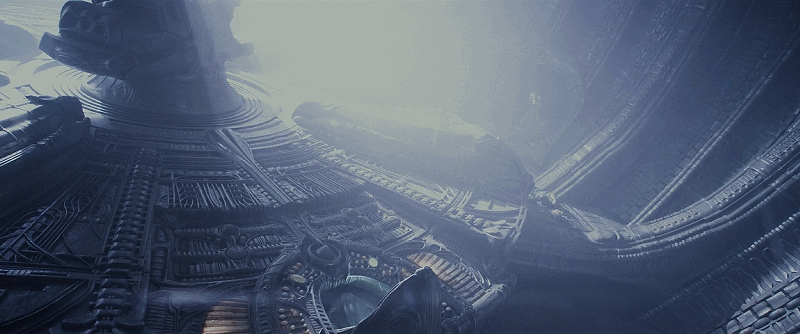
The layout in the Prometheus ship “mimics” the layout of the eggs simply because the Engineers pay homage to it. The same as they paint the murals. It’s just their xenomorph’s shrine.


That’s pretty much everything worth commenting. As I said the movie is shallow and doesn’t even have some good themes. The most ridiculous thing, and where the movie drops the ball without ever picking it up again, is right at the beginning. It’s directly framed as creationist/evolutionist debate and instead of actually grasping that theme we’re given: “it’s what I choose to believe.”

That’s how you give the most idiotic answer in an idiotic movie. The real power of science, as everyone knows, is about going AGAINST your personal choice and desire. Otherwise we would still believe in the whole universe orbiting around Earth. We see Science as a tool to discover “Truth” exactly because it gives answers that aren’t subjective or that follow one own agenda or personal preference.

Yet it’s very obvious that this movie celebrates blind faith. By being a believer that main character is rewarded with survival. Everyone else dies, obviously because no one else had a necklace with a cross. Protected by god.

It’s not that I’m anti-religion. It’s how this movie uses religion in the shallowest way: it’s Plot Armor by way of religious power. That never enters the picture. You are just rewarded for blind faith in some arbitrary mythology.

This should tell you how simplistic and shallow this movie is.

P.S.
I should mention that all Alien movies after the second suck. Is just the Alien franchise being so bad? Nope. Dark Horse long ago published comics made as direct sequels to the second Alien movie, written by Mark Verheiden (who also worked on Battlestar Galactica), that are very good and answer pretty much all questions in the Aliens mythos, including the “space jockey”. Ridley Scott could have made an EXCELLENT movie if he just stuck to these much better stories, believe me.

I guess no amount of Science Fiction can surpass what certain people end up BELIEVING. I just bumped into this conference video. I don’t even remotely know what they talk about, but it sounds like “fun”. It’s as if they live in a different world. X-files by comparison is dull and unimaginative.

I enjoy mythology, so this stuff is at least interesting.

My bad. I made a mistake in the simplified scheme about point of view being trapped in relativity, even more clearly in its summarized version.

Overall, it still makes sense to me and should be solid, but there’s an aspect that I probably got wrong. What’s still correct is that Science sees the world as a closed system, and so there cannot be any meddling of any external entity, as well intervention of metaphysics. Even in this last case metaphysics mean that something external seeps into the system to influence it.

Given this model, it’s still true that no amount of information, information coming from within the system, can produce any real change, or any real “freedom”. From that external point of view of god, we are still trapped in a deterministic system (so, predictable), acting in deterministic ways.

My mistake is here:

So Bakker believes that if we posit that “consciousness” is a perceptive fraud/illusion, then one could explain consciousness from the “outside”. Starting from the natural world. That way, in his intention, consciousness should be “explained away”. In the sense that he should be able to describe how consciousness comes to be, how it works, and why it is perceived in the way it is (and why this is only a sort of hallucination).

The problem is that, even more specifically when you deal with consciousness, we know exactly the “origin”. It’s the brain/mind. The postulate is that everything begins in the brain, and so every consequent observation and description need to start from the brain. The switch Bakker makes from an internal self-description, to a “scientific” description from the outside is a formal violation. It’s like in a book switching from first person into third.

My mistake is about assuming that the same as we believe the universe as a closed system, so could be considered the “brain”. Another closed system. The creation of the world only “really” happens IN the brain. Without a brain that perceives things, there’s no reality. So that’s our closed system that we can’t escape.

This is also why I reverted the model: the metaphysics of consciousness. The dualism through BBT becomes the illusion of consciousness. The way we live as if in a different dimension that is separated from Nature. This dimension of conscious thought. It’s the dualistic model upside down. All the metaphysics happen right here in consciousness. There’s the world of physical reality, with its scientific laws out there, and there’s the world of consciousness, with all its myths and legends, with its gods, spirits, and all the “magic”. If consciousness is the illusion, then we all live WITHIN magic, completely soaked in it. Magic is not “elsewhere”, it’s not exotic, but the world we inhabit. The dualism body/mind becomes reality/magic, physics/metaphysics.

The important point of BBT is that it erases this bi-dimensionality (that I refused to accept because even illusion is still one legitimate point of view). But a model where there’s no dualism is also the model, obviously, where my claim is wrong: the brain isn’t closed in any way. The system doesn’t need to be opened, because it’s already wide open.

And if the system is open, then BBT has the power to alter perception directly. This STILL doesn’t offer any real freedom, since it’s still a deterministic system, and opening one box doesn’t achieve anything, nor can in the future. But from the relative experience within the system this makes a great difference.

It also doesn’t change the validity of the relative freedom we have. The deterministic system only removes this freedom if seen from the external point of view. But we can only theorize this point of view, we can’t get there. And so the subjective experience remains authoritative and valid.

The title should be mostly accurate, minor a slight subversion on the concept of “unreality”. This is an attempt at charting the consequences of Bakker’s Blind Brain Theory, so the hope is that everything I write is an abstraction of what’s entirely possible within the grasp of Science. Hence, for Unreality I do not mean the “impossible”, but the illusory experience that is the “human condition”. In the distinction body/mind (that BBT sets out to remove) is present the distinction between physical world (body) and metaphysics (mind or soul).

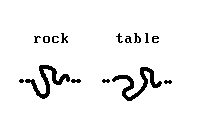
Look at this image:

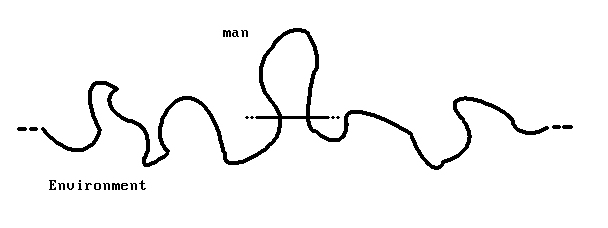
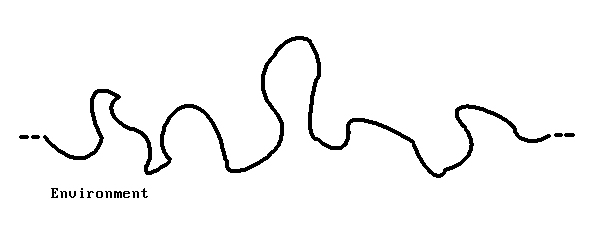
This represents the “environment”. For environment I intend everything that pertains to “Reality”. It includes the planets, the starts, as well as all the laws regulating the behavior of it all, and down to physical objects like a rock or a table. All “environment”, all within the domain of Science. You can see this line in the image as oddly shaped. This because every “object” that we can distinguish in reality has a different configuration, or structure. A table and a rock are both environment, just differently organized, and so abstracted in the image as the line having a different shape.

The first may be the abstract representation of environment configured as a rock, and the second as a table. Now look at this image:

What you see there is instead the abstract pattern that represents a “man”, a single human being. From the perspective of the environment this different shape is no different from everything else: it’s still environment. It has a different configuration than the rock or the table, but it isn’t “special”, or qualitatively different. Just peculiar because that shape specifically defines a “man” instead of something else, and so can be distinguished.

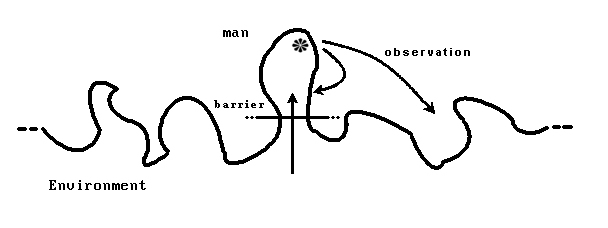
With the course of evolution, and the emergence of complexity, this happens:

The man develops observing capabilities. We can still assume he’s still completely passive, but he can now observe the environment, and so understand it, making distinctions between the various configurations the environment can take. By turning observation on himself, he can also make the distinction between himself and the environment (becoming a system, distinct from environment). From the point of view of the environment, that barrier dividing the man from the rest of the environment simply does not exist, but from the point of view of the man, having observation and now a sense of “self” distinct from everything else, that barrier is real. It’s the barrier giving the man his individuality and so also his personal needs and desires. From that point onward the man acquires knowledge so that he can use the rest of the environment he’s observing for his own end and personal advantage.

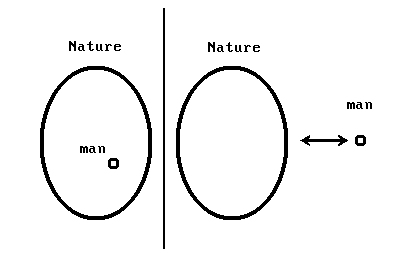
Consider this:

The one on the left is the general idea we all normally embrace, and that is also subscribed by science. It simply means there’s a Reality, that here I call “Nature”, and within Reality human beings exist. Part of it. One element within the bigger set representing all of Nature.

But from the perspective of the man I described above, the way a human being “feels” and lives in the world is better represented by the image on the right. The man exists within a separate dimension, existing out of Nature, and actually in contrast with it. Man and Nature are constantly at war, one against the other. A human being would not survive in Reality, it’s not a natural habitat, and so men create a protective cocoon, an artificial dimension meant to become an “heaven”, where men can survive. A safer space. We can call this “egg” as Culture. Culture, and language, is the dimension within which human consciousness lives and manages to survives. It provides sense and meaning, it provides values and morals. It creates a vision of the world that is tolerable.

Yet we still know that this vision is just an artificial construction, and that the scheme that more accurately describes Reality is the one on the left: men as one element within the bigger set of Nature. This already reproduces the problem of Dualism: the point of view of the environment, versus the point of view of man (or man as consciousness).

Now let’s get to the problem of God. Science is compatible with the idea of God as the First Mover. As long god doesn’t interfere with Reality, and so as long the system of reality is CLOSED, then this view is compatible with Science. Science can only deal with observable reality, and so only opposes the idea of metaphysical intervention /within/ the closed system. It can’t exclude powers or dimensions existing outside our perception and outside Reality.

So let’s assume that there’s an external entity to Reality, our god. He created the System of the World, but from the moment it was created (the Big Bang) this system becomes “sealed”, and so completely closed. From this point onward the god can’t modify anything anymore and can’t meddle with what happens within this system. The god can only “observe” what happens within it.

What I’ve just described is a deterministic system. Everything in this system simply happens accordingly the law of Reality as they were defined from the beginning. From that point onward it’s only about a cascade of effects. This means that from the perspective of our god, given any point in the timeline of this universe and, knowing every element of the system and every law, the god can predict EVERYTHING that happens in the future (of that point) and EVERYTHING that happened in the past. It’s the same as taking an arbitrary point of a movie and that move forward or backwards. Since the movie is a finite thing you are going to see always the same thing, it doesn’t get to “change”. If at some point in the movie a car turn left, it will always turn left no matter how many times you rewind and replay the scene. And since the System of the World was created by the god as closed, then everything that happens is deterministic, and so can be directly deduced as long you know every element and every law within.

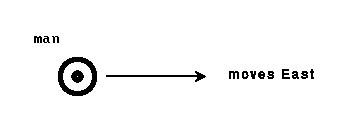
Now let’s assume, as I was doing at the beginning, that one of the particles in this system, a human being, acquires observing capabilities. This is our element:

I’m abstracting to get to the point. This particle represents a human being. He can observe the environment, he can self-observe, and he always, constantly moves “East” as long he stays alive.

During the course of his life this man, since he can observe, has made his own idea why he’s going East. He thinks that moving east is his own choice. Maybe there are all sort of ugly people around him and he said: “what the hell, I’m going East.” Where there are less ugly people. Now let’s say that at some point this man has a big revelation. He finds the Blind Brain Theory and suddenly realizes that he’s not moving east for the reasons he thought, but simply because he’s a particle whose purpose and obligatory need is to “move east”. His nature.

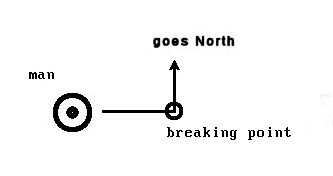
Here’s the PARADIGM SHIFT. He decides to turn and go North:

If our particle suddenly decides to stop going East and go North, after it got the revelation of its true condition, then two, and only two, scenarios open:

1- A formal violation happens. The system of Reality that was supposed to be closed, is not. Because a particle within the system, by gaining consciousness and making a different choice as consequence of the information it acquired, “exited” the system and then re-entered influencing it. It’s like this particle was able to communicate with the external entity called god (so information not originally part of the system) and bring back that information into the system. Producing a change.

2- We are just observing the perpetuation of the illusion. It’s the system that was meant to make the particle go north at some point during the course of its life. The system is still closed, everything still moves accordingly to the original plan. What appeared to be as “change”, or a novel behavior, was only novel for the norm. But it was still caused by the natural law governing this system, in the exact way they were set in motion when the system was sealed.

Let’s assume that (2) describes exactly Reality and that (1) is completely speculative and implausible. This means that a Blind Brain Theory won’t free human beings of their limited perspective. No amount of (accurate) knowledge gives a man a true control on Reality. The closed perspective we’re trapped in can’t be betrayed or breached. Our knowledge can aspire to reach the knowledge that the hypothesized external entity I called god might posses. But it’s still information in this system that belongs to the system. It can never ACT on the system itself to change it, because this would mean the system isn’t closed anymore. That there was a breach. No amount of self-awareness can free one of the Determinism within a system, because that self-awareness is simply an iteration of the Determinism of that system. More of the same.

That’s the point of my counter-argument to BBT. If we have no way to escape our closed perspective, then paradoxically our perspective acquires legitimation. Even if we are able to imagine the other perspective, and assume it “true”, it still can’t change the way we are and feel. We can swap one dream world for another, but we can’t get free even if we are aware of the illusion.

Can then human beings be blamed if they decide to live solely in their fictional bubble, in their artificial and illusory Eden?

The first lines of a post over at Bakker’s blog seem almost unreadable, but at the same time offer a very effective summary of his “Blind Brain Theory” (BBT) and especially why it’s important. It also ties together a number of aspects and brings out the true core of the issue. So I’ll try to give my own exemplification of all this, hoping that I can grasp this transitory moment of clarity (I always feel like I’m ironing. The moment I think I’ve smoothed out a corner, everything else gets wrinkled up again. My mind just isn’t big enough to encompass the whole thing. The blog helps nailing down some issues in a less volatile way.)

The satisfaction here for me is about taking something that sounds incredibly complicated and unexplainable, and unwind it so that it becomes smooth and planar. As when you’ve reached the top of the mountain and finally look down on it:

There are no representations, only recapitulations of environmental structure adapted to various functions. On BBT, ‘representation’ is an artifact of medial neglect, the fact that the brain, as a part of the environment, cannot include itself in its environmental models. All the medial complexities responsible for cognition are occluded, and therefore must be metacognized in low-dimensional effective as opposed to high-dimensional accurate terms. Recapitulations thus seem to hang in a noncausal void yet nevertheless remain systematically related to external environments.

Now let’s smooth this into something that makes sense, I think I can manage to make all this understandable even for non-specialists. “There are no representations”, this is already a very important idea. If you look at this video with Dennett, minute 2:35 and onward (but not for too long), he basically says that in order to think we need language. That’s what can distinguish human beings from animals, the fact that human beings have language, and so can reflect on things. To be able to “think”, Dennett says, we need to have an independent representation system.

What is this “representation(s)” that Bakker refers to? It’s simply a “model of reality”. We know that we don’t have a direct, unfiltered (or “analog” to use a technical term) perception of reality. We only have our five senses, and these five senses transmit information to the brain, information that obviously represents only a small part of total reality. Our brain then takes this information and tries to “organize” it into something that makes sense. So basically through senses the brain receives information, and then organizes this information into a model of reality, a sort of contained simulation. We know that the image itself, the perception of depth, color and so on, are all things that pertain to the model the brain builds. As conscious beings, we feel like we exist in the middle of this simulated reality, built by our brain by using the information it receives through the five senses.

This process I’ve just explained, gives origin to the fundamental idea we deal with here: a dichotomy or duality. There’s reality out there, and there’s the model of reality built by the brain within which consciousness dwells. We can call this organized model of reality “representation”, and it’s also defined in other various ways, like “Cartesian dualism”, or Cartesian theater, or model of the Homunculus. These are synonymous. They all refer to a duplicity between reality and perception. The “Homunculus” is the idea of imagining a “little man” within our brain looking at a screen. On this screen (the “theater”) our brain projects its model of reality, that little man represents our own consciousness. This is also the established religious idea (as well the main scientific one until recently): the fact that we are “more” than just physical matter, that we have a “soul”. And it’s again this duality that makes possible the idea we have “free will”, the possibility through out thoughts to decide and be free. All this is possible only as long we believe in this dualism, a distinction between the physical and the metaphysical. Free will, formally, requires independence from the environment, authority over it, so that we have that control and freedom. A “leap of faith” dividing physical matter and spirituality. You’ll see later what this space, this gap, actually represents. For now just remember I’ve mentioned it as the dividing space between the fundamental dualism (and I should also mention here “the God of the gaps”).

If these days we go watch 3D movies it’s thanks to the model I’ve just described. We can create the illusion of the three-dimensional image because we know the way our brain organizes visual information and so we can feed it information that has been manipulated to appear that way. Ideally this manipulation could be done in two different moments. It could be done, given enough technology, right at the level of the brain, making it organize it the way we want, or at the external level, of the information the eye receives, as we are doing with 3D movies. So this is possible because we give the eyes, and the brain, pre-organized and manipulated visual information. And since we only perceive our model of reality, instead of reality itself, we simply “believe” the representational model that our brain builds for us. But then all cinema works like that, since the illusion of movement also relies on a similar pattern. This simply to say that the Cartesian Dualism isn’t some fancy idea, but it describes the basic belief all of us share and that is ingrained in our culture.

Technically this dichotomy or dualism is defined in a branch of information theory as the “system/environment” distinction. It refers to the same stuff: the “system” building a model of reality, and the environment from which it takes information. This can be found even in popular culture, for example I watched recently episode 16 of Evangelion, an anime, and this is a dialogue from it:

– People have another self within themselves.
– The self is always composed of two people. The self which is actually seen, and the self observing that.

That’s a decent explanation of system/environment, and the Laws of Form by Spencer-Brown. You can find a more complete explanation here. The idea is that every possible observation draws a distinction, between what you’re pointing to, and everything else. That’s why we say, for example, that we need to know “evil” if we want to know “good”, or be able to see “black”, if we want to see “white”. As with language, we perceive the world in “digital” terms, through distinction. An undivided space for us is unknowable. The more distinction, the more specialization, the more detail. Human beings are “digital” beings because we only perceive this separation, and can’t deal with “analog” continuities.

Going back to that last quote you can see how it creates a paradox: in order to perceive a “self” you need to be able to point to it. In order to make the observation, to observe, you need to make your “self” the object. Instead of the subject. You need being, at the same time, both subject and object. As a cat trying to outrun itself to catch its own tail (imagine how it would look like). So you essentially need to build an ideal “double”, or mirror, of yourself. Once you have this double you can “know” it. There would be the observer “self”, and the observed “self”. Which means that in order to make reflection possible you need, in technical terms, to repeat the system/environment distinction. In the same way you (system) observe the world (environment), to know yourself you need to reproduce this distinction by making a system/environment distinction within the system itself. Observation needs subject/object. And in order to self-reflect, you need that the subject makes itself object, so he can observe himself.

As you probably can see the result here is one of “infinite regression”. Mise en Abyme, the effect you get when you put one mirror in front of another. The infinite tunnel of reflections. As in the model of the Homunculus, a little man in your brain looking at the screen, who within his little head has another little man, looking at another screen. In repetition, all the way down INTO THE ABYSS. Are you scared? This is what is going on, right now, into your brain.

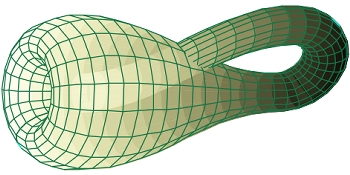
Self-reference, metacognition, present “patterns” that have been abstracted and formalized in Gödel’s incompleteness theorems. But it is a common, almost practical problem. How can you build a formal system if you don’t have an external one on which to rely? Gödel simply explained that even in math a fundamental rule needs to be supported by a more fundamental one. An origin is not possible, you always need something that comes before, and when you have it you need what comes before it. Infinite regression. How can a theory that regulates something also regulate itself if not through another theory, that will also need another definition? It’s as if to hang a painting we need a wall, and then the wall also need to be on top of something, and that something also needs some other sort of support. How is it possible that we don’t all fall down? Cosmologist have the same problem: if the universe is what began with the Big Bang, is there a bigger universe that contained the universe we are in? And that universe is then contained within a larger one? How many iterations? What’s “beyond” all this? The thing is, the paradox of infinite regression contained in our small brain is what we see all around us. The Hermetic mantra “As above, so Below”, or microcosm/macrocosm. In order to see and know something we need to distinguish between it and everything else. So if the universe is “this”, what is that lies beyond it? There’s a mathematical model called the “Klein bottle” that offers an “impossible” image that could help visualize the paradox. The Klein bottle is essentially a one-dimensional (non orientable) space, without an “outside”, and so the “one and boundless” space representing human consciousness, the qualia. And if you think about it, a one-dimensional space solves the contradiction of the distinction system/environment because there’s no inside/outside:

So there are these circular patterns, “strange loops”. The “environment” to observe itself needed to “knot up” into a “system”. Human beings serve as “observers” of the environment, for the environment. We ARE environment. A knotted chunk, become observer. Even widely respected men of science like Stephen Hawking fully embrace this perspective. I could use another popular (and genius-level) anime here, “The Melancholy of Haruhi Suzumiya” that essentially says what Stephen Hawking says at the end of that video:

“How about I observe. Therefore the universe is. Therefore, we can say if the human beings who observe the universe hadn’t actually evolved as far as they did, then there wouldn’t be any observations and the universe wouldn’t have anyone to acknowledge its existence. So it wouldn’t really matter if the universe existed or not. The universe is because human beings know it is.”
— Itsuki Koizumi

Or if you want a more scientific discourse, the Anthropic principle. An observing system, or a human being, is merely a peculiar knot of “environment”, that “looped itself” in this strange way, and became able to “observe” the rest of the environment. Environment becoming “conscious”. In order to “see”, it needed its own separate dominion, so that it could separate itself from the environment, becoming “system”. Thus the original dichotomy. And then, in order to not see just the environment, but also itself as system, it needed reproduce the system/environment distinction within itself. And so on, iterating the same distinction over and over.

These circular iterations, or “strange loops” are the main topic of a famous book that won the Pulitzer, “Gödel, Escher, Bach”. So that’s what you can have fun reading if you want to explore more the nature of these loops, which are the “key to consciousness”. At least in the way consciousness appears.

Because instead here what we want to deal with is not simply how consciousness appears, but how it truly is. And that’s what brings back to Bakker and his BBT theory. That’s why those lines I quoted at the beginning enclose the fundamental question humanity has been asking for two thousands years or more, and give this question a possible answer. That’s what BBT is. A possible answer to the most fundamental question. As Bakker says, a theory is just a theory and it needs to be tested to be proved true or false (or truer or falser than whatever current model we hold), but as it is right now it is at least a proposition that seems able to do what it sets out to do. And it is both elegant and parsimonious, which means that it solves in simple ways a huge number of complicate problems, that then is usually a good hint pointing in the right direction (like Occam’s razor principle).

What is BBT’s answer then? What BBT tries to do is FLATTENING the bi-dimensionality (system/environment, consciousness/natural world, metaphysics/physics) into mono-dimensionality (just environment, just natural world). Or solving what is normally called the “hard problem of consciousness”.

Bakker believes that human introspection is intrinsically tragic. It can only trip itself over and over. Make a clown of itself. That’s why he has no faith in philosophy. It can only be revealed as a most tragic failure. He believes that “consciousness” is a cognitive illusion. So if you were able to turn things inside out, and so describe consciousness NOT as it appears to us from the inside (Plato’s cave) BUT from the outside, then this different model would “explain consciousness away”. Basically it would elegantly do without the need of any “consciousness” or “dualism”. If you were to revert the perspective the cognitive conundrum would be solved, the illusion of consciousness would be cleared.

Bakker subtitled BBT as “the last magic show”. It’s really a nice example because the basic form of “magic” (as we know it) is about the removal of information. You can’t see how the coin changed hands because your eyes didn’t see the movement. The magician “subtracted information” from your perception, and so you saw “magic”. Something impossible because you couldn’t see that link of information, you only saw the impossible leap, and your brain didn’t manage to fill it, if not with “magic”. All this is easily and linearly explained when applied to “consciousness”. Human brain is the result of very slow evolution. At the beginning the brain’s purpose was to navigate the environment in a efficient and efficacious way. So all its “tools” were built to that purpose: model the environment and deal with it. But only very recently the brain developed “introspection”, which is essentially the brain turning to itself in order to model itself too. Bakker says that our “introspective tools”, that he calls “heuristics”, simply weren’t built to effectively be able to model the way the brain itself works, they were built for the environment. And so we ended up with some blunt, clumsy tools that simply created a number of illusory and wrong perceptions. Being these tools extremely unsuitable for self-reflection, we only obtained “cartoons”, or caricatures of the truth.

Philosophy is a complete tragedy because it ends up sharpening the bluntness itself. It’s the superlative, the apex, the exponential maximum of human thought. And so of the human error. Instead of leading us to “truth”, it perpetrates the ILLUSION. Monumental cathedrals of thought, immense, illusory, self-contained constructions. Illusions of autonomy. Self-reliance. Monuments of stupidity. Testifying our very flaws and tragedies. Only the desperation you achieve by using these Broken Tools.

Since the tools we use to model cognition, these heuristic, are so unsuitable and low-resolution, we end up with these caricatures, or cartoons. Just horribly vague approximations that do not even come close to “truth”. Where there’s a “knot” of environment, we just see undefined space. We don’t have enough detail to go there, and so this knot appears unsolvable. Unexplainable qualia. A Feeling. A vague something we just can’t pinpoint. And so we rely on the cartoon we have even if it’s only incidentally linked to the truth.

Simplifying, think to three abstract points, A, B, C. In truth, it’s B that actually links A to C (as in the magic show B represents the subtracted information). But if we are constitutionally blind to B, then in our perceived world we see A directly linked to C. We are CONVINCED of the A to C relationship. Think to superstition in sport and how actually widespread it is. The obsessive compulsive behaviors, if you have done certain things and you end up winning the match, then the next time you feel compelled to repeat them, regardless of what your rationality tells you. Wear the same colors, the same sockets, or all sort of ridiculous habits like sitting always north at a table. This merely because we are subject to our cartoons and simplifications. We tend to accept a relationship between things even if it doesn’t make a lot of sense. We make caricatures out of everything and we actually rely on these caricatures to govern our lives. We act irrationally more often than we act rationally, and this because we lose track very soon of what is what. Too much hassle. When we see a correspondence we embrace it. It’s cartoons all the way down. Poorly organized, inefficient cognitive conundrums.

Now that I explained the overall scheme I return to the original quote. “There are no representations, only recapitulations of environmental structure adapted to various functions.” I explained that “representation” is the model of reality that the brain organizes. For Bakker this is the illusion. What we THINK we see. He says that there’s no duplicity or duplication. No duality. No theaters, no projections and no Homunculus looking at them. There are only the various cogs of our brain, specialized for specific functions. This all in unconscious space, or outside of conscious perception as we have it.

On BBT, ‘representation’ is an artifact of medial neglect. Medial neglect is essentially the unperceived “B” in the example above in the A->C relationship. So he says that what we consider “representation”, the model of reality, is the illusory appearance of a relationship, that we can’t accurately know because we lack the information to be able to. We lack information, detail. So it’s like a blurry picture, the cartoon. The tragic simplification. The superstitious belief of correspondence between the color of socks and a sport match being won. Wild inaccuracies. the fact that the brain, as a part of the environment, cannot include itself in its environmental models. The “fact” here is that evolution didn’t give us good tools for the brain to map itself correctly. So we ended up with a “spandrel”, a bad result of trial and error.

All the medial complexities responsible for cognition are occluded. This should be straightforward. He says that what we need in order to obtain an accurate picture is “occluded”. Or better: we miss access to most of the cogs in our brain, and so what we have isn’t remotely enough even for an acceptable approximation of truth. and therefore must be metacognized in low-dimensional effective as opposed to high-dimensional accurate terms. Low-dimensional means inaccurate. So sketches, cartoons. Vague blobs. And also correlations between stuff that isn’t directly correlated. Incidental correspondences.

Recapitulations thus seem to hang in a noncausal void yet nevertheless remain systematically related to external environments. And that’s it, the qualia. The “recapitulations” are the name Bakker gives to what we perceive as “representation”. The idea is that this model of reality as we see it “seems to hang in a noncausal void”. This represents the origin of the duality, the way we think consciousness as separated from the world, existing in its own metaphysical dimension: the noncausal void. The soul. Hanging there, somewhere. The breath of life. A wind with no origin. It’s suspended in a void because as explained above all the links that tie it to the ground, or reality, are unperceived. Medial neglect. A skyhook. We don’t have the tools to track those links, and so we end up with a picture that isn’t hung to a wall of reality, but just “floats there”, magically.

This is pretty much it. Despite the lengthy explanation my hope is that it seems quite linear. The basic story in the end is simple. The brain was originally meant to deal in a efficient and parsimonious way with the “environment”. Then only very recently in the breadth of evolution the brain started turning on itself. Trying to track not only the environment but also itself. And to do this it was only able to rely on the same tools that it developed for the other purpose. And so required, as it modeled the environment, to put itself in this model too so that it could observe itself (reflection, metacognition, introspection). Hence the “double”, the Cartesian Dualism, and all the consequent problems with consciousness, the soul, God and all other metaphysical ideas. Tangled in the cognitive conundrum, the labyrinth of the soul, trapped with the minotaur and unable to get out.

Daedalus had so cunningly made the Labyrinth that he could barely escape it after he built it.

I’m enjoying the labyrinth. So I hope I’ll stay trapped as long as possible.

I was just looking around to figure out how things are going with two series I enjoyed and would really like to read their respective endings at some point. In both cases I’m merely past the very first book but it’s quite disappointing knowing that nothing is certain about their future.

The first is the “Instrumentalities of the Night” series by Glen Cook, whose fourth volume has been in limbo for quite a while even if the author confirmed having completed years ago. The problem here is with the publisher, Tor, since it seems this series isn’t exactly selling too well and this fourth book still isn’t listed anywhere. I loved it, but I recognize the first book is dense and hard to get through. It’s brilliant, but also not the stuff you expect to be popular.

I was able to find an interview with Glen Cook that is a year old and he confirms the fourth volume, “Working God’s Mischief” was delivered, but he also mentions a possible FIFTH with an absolutely awesome title: “He Lost His Shadow Somehow”. Along with bad news: “but that is unlikely to happen. Paperback and e-book sales for the series have been disappointing and the fourth book was a hard sell.”

TOR PLEASE. We can never have nice things. This is a superb series, it can’t be left unexpressed. And that book has too an awesome title to not get published.

EDIT: Tor tells me the fourth book should be out this year.

The other series is “The Wars of Light and Shadow” by Janny Wurts. She’s currently working on the 10th and penultimate volume, so a critical time in her series. She posts on her site updates from time to time about how the writing is going, and they are always fun to read. This is the last:

Destiny’s Conflict is moving ahead – the second scene in Chapter 7 was a blasted BEAR to make it tight – finding the angle that worked was an immense frustration (and I will NOT dawdle about – the series is into MAJOR CONVERGENCY and about to bust WIDE OPEN – so each step must be exactly precise to support the ‘before and after’ build. Each day I hammered on the scene in question/hit a wall, then moved to do other productive things so as not to stall the think tank time doing nothing. AT LAST I got the angle – (many convention/publicity interruptions tend to create a wider gap as they take me out of world/and I have to sink back into the ambience – knew that when I signed for the cons, but they are a necessary step/awareness of this series HAS to grow).

I am now working up the second to last scene in Seven – the one that trips the wire, so to speak – the climactic plunge is one wild ride, and it’s looking to be Set 8 that will be the first climax/tipping point – and it’s all Fast Motion reveal from there to the end of Song of the Mysteries – mostly, as the seeds for that volume have to be planted NOW.

It’s all in line with what was planned: the difference now is, I am carrying it ALL/on all the levels – none will be hidden, very shortly, which means I can’t slip into sprawl territory at all – there is no room in the story for sag.

In the earlier days, very sadly, there was NOT THIS NEED FOR AUTHORS TO DO CONSTANT EFFORTS AT PUBLICITY – blogs, websites, social networking/presence out there on the net – now, it is expected – the publisher relies on it….ONE DAY I dream that there will be enough reader response that I don’t have to…that time is not yet. The books aren’t widely known ‘out there’ enough yet to get the enthusiastic mention they deserve. This build takes time/and the period where they were not all in print/or avail in the USA made a lag – there’s still a lot of catching up to do.

Rest assured, I am writing diligently. There are lots of balls in the air/I am NOT WATCHING….drumroll ;) – football. Never have. Never will – in fact, we don’t HAVE any TV service here.

Since she usually does quite extensive editing I’d say the book is still a couple of years away. And then there’s the last volume.

R. Scott Bakker is deep into the third and likely last in this second trilogy, The Unholy Consult (the title of the book, not the trilogy). This is the volume that reveals some big things and opens the way for the final duology. But as far as I know this is the true turning point, so there’s some anticipation around this book.

Despite being an amazing achievement (Bakker is with Erikson the most important and most ambitious writer in the genre by a wide margin), Bakker’s series also isn’t doing spectacularly well with sales, and so the writer can’t write full time as he wishes. This slows things down. It seems the book is almost complete, but it also may require extensive editing/rewriting of earlier chapters. The most recent news was in this forum post (that gives more info than what Bakker offers on his own blog):

Just heard back from Scott this afternoon. He says he’s labouring on the final two chapters of TUC and that the book is getting ridiculously big. And at this point, he has no sense of what the rewrite will entail.

So it probably won’t be out before a year/a year and half. I hope it won’t be split in two. And I hope he goes all out, instead of simply teasing for the final duology. He needs to play things to their full potential.

And finally I also gave a look about what’s up with Malazan stuff. Erikson is rarely (more like never) late, but in the case of the second book in the Kharkanas trilogy, “The Fall of Light”, it seems release has been pushed back to January 2014. Being fair this isn’t really a delay since Erikson’s goal with this new trilogy was a more relaxed pace of 1.5 to 2 years, which is still very fast by the industry standard.

Instead no particular news, as usual, from Esslemont. His “final” book (unless it produces a sequel, since this was mentioned as a possibility, long ago) in the Malazan series, that still hasn’t a definite title, seems still on track for a December release, but it’s all completely unconfirmed and Esslemont simply doesn’t exist on the internet, so we rarely get to know what he’s up to.

About MY OWN reading progress, I’m going incredibly slow, but mostly because I’m splitting attention between too many things. Don’t even look at the progress bar up there since at some point I think I was reading more than 15 books at the same time. But I’m finally doing some decent progress with Glen Cook’s “The White Rose”, so that’s the one I’ll finish next.

In the last week I’ve ordered four books, and you can see how wildly all over the place my interest goes (even if it follows its own consistency). All four being quite interesting:

The Tunnel, by William H. Glass (his writing is just too good, I’ve read some articles that are deep and written so beautifully)
Imajica, by Clive Barker (his own most ambitious work, though I’ll probably end up reading Weaveworld first)
Phi: A Voyage from the Brain to the Soul, by Giulio Tononi (following Bakker’s suggestion, it’s really a lush book, paper gloss, images)
Where Tigers Are at Home, by Jean-Marie Blas De Robles (French book recently translated in English, I got it in Italian. Quite intriguing.)