Author Archives: Abalieno

The last episode of Fringe (3X06) was a very good one. As usual I try to track some references, this time a book that Walter takes away from Peter. The book is a MASSIVE tome titled “Cosmology”, by Sean Carroll.

I found out there are two of them, a Sean B. Carroll and a Sean M. Carroll, both actually interesting in the greater discourse but it’s the latter who’s a cosmologist and published something. Though, no massive “Cosmology” seems to exist. The closest thing I found is this.

Looking at the wikipedia it seems his work is mostly about the idea of the arrow of time, which seems to tread dangerous ground (see previous discussions):

1- It is vividly recognized by consciousness.
2- It is equally insisted on by our reasoning faculty, which tells us that a reversal of the arrow would render the external world nonsensical.
3- It makes no appearance in physical science except in the study of organization of a number of individuals.

So consciousness and time, as if isolated from scientific objectivity. I can imagine this line of thoughts leading to places…

While looking for these things I also randomly found this curious book.

I’m now on the last 100 pages of “This River Awakens” and my impression from the first pages was confirmed and reinforced: it’s a masterpiece. I’m wondering if the new version coming in January could be any better or if the changes aren’t modifying stuff that I loved (my suspicion is about removing a 1st person PoV, which I believe works great in the way it was handled). But obviously Erikson should follow his own mind whether or not I “approve”.

But what I wanted to say is about the choice of what book to read. This one specifically is a kind of book that wouldn’t normally have any hope of getting my attention. Within the fantasy genre, being a genre, things are organized and somewhat easier to parse. Only an handful of big debuts during the year, and another handful of blogs and forums where you can easily form an idea of the “scene”, and what book or author deserves your attention.

Outside the “genre” it’s really hard to FIND your book. I always imagine that there are THOUSANDS of books out there that I would absolutely love, but I have no chance of “reaching” them. It’s not a problem of not being immortal and not having enough time, it’s just that you don’t have ways to make your choices. You sample here and there at random, then stick to your genre like a funnel.

“This River Awakens” is specifically one kind of book that I would have no hope to read, if it wasn’t because its fantasy author wrote my favorite fantasy series and SO got that much attention from me to push me to get one of his books outside that specific area of interest. I had no hope to meet Steve Lundin, the author of “This River Awakens”, and it saddens me to realize that this book can’t find its way out on its own. A book like this too easily gets lost in that undistinguished ocean of “mainstream” literature. How can you get your bearings there? It’s impossible.

I guess I’ll try to write a review, but I obviously won’t accomplish anything with it (maybe I’ll trigger the opposite reaction if I end up praising it too much). I’d hope that at least Erikson’s fans will get this book, because it’s GREAT, and in no way a minor, negligible work compared to the masterwork that is the Malazan series. In fact if you ask me right now I’d tell you that it’s THIS book everyone should read, Malazan is optional. But what are the hopes for this book to reach its public? In a genre, the genre itself makes that shared “hook” that leads you to the most interesting works, but outside it, and without the ruthlessness of, say, Bakker (where his ideas can give it its power and unique space), a masterpiece like this is simply doomed to be overlooked and forgotten. Even if a reader like me points it out in forums and blogs and begs people to read it. It’s one of those stories that wants to be listened, but there’s no one around to receive them. Oh, it pains me so much.

If you are a Malazan fan then read this book because you’re going to love it. If instead you are among those who tried to begin reading Malazan because someone recommended it to you and you still didn’t like it at all, stop right there, don’t force your way through and READ THIS BOOK first. “This River Awakens” will tell you whether or not to spend another precious minute reading the Malazan series.

A chunk of the ongoing debate over at Scott Bakker’s blog for my own perusal. I need to plant landmarks on a sprawling discussion, or I get lost too easily and forget the path I went through just now. Lost in the labyrinth and food for the minotaur.

Bakker’s quote:

The dilemma is one of global absurdity. There’s the idea of the sum of human culture up to this moment becoming as quaint and childish and incomprehensible as cave paintings. There’s the idea that the entirety of thought and assumption revolving around responsibility and obligation and [enter ubiquitous normative term] is simply false. There’s the idea that all our social institutions are in some way derived from and dependent upon these concepts and will collapse with them. Need I go on?

I fear it is inevitable, but what’s there to do other than fight or embrace quietism (either in the form of fantasy or nihilism)?

The only way to mobilize people, however, is to convince them the threat is real. But the world is a circle with as many centres as there are people. Everyone has their own redeeming (or exculpating) story – be it New Age, religious, or intellectual – which for them is the baseline, the yardstick they use to make sense of, let alone measure, everything. One of my tactics to make a second order ‘diaphonic’ critique, to observe the diverse, mutually incompatible redemptive views, and to contrast them to the breathtaking theoretical solidarity you find in science.

My part:

—
If I understand this correctly it’s about a form of split between perceived norm and common values, and actual truth (as “revealed” by science). But I was reading of a similar split in the book of Von Foerster, a split that happened already a while ago (and the new one could be just a repetition of it under a new form, or its prosecution).

Here’s the quote:

The scientific conception of reality which emerged in the 17th century is, in large part, responsible for our love affair with causality. “Newton gave the world the first rigorous formulation of the doctrine of causality. Most simply, the doctrine asserts that the same causes generate the same effects.” […]

The doctrine of causality appeared to fulfill man’s perennial search for certainty and objectivity. […] as Robert J. Oppenheimer explains, “The giant machine (the Newtonian universe) was objective in the sense that no human act or intervention qualified its behavior.” […]

And here’s the opening of the dilemma:

Although relativity theory and quantum mechanics have radically altered the physicist’s view of reality, this shift has not touched the average person. Equally, if not more important, many scientists have also failed to revise their thinking about reality and the nature of scientific work. Thus, most people see the world like the 17th century scientists, assuming that it’s possible to have objectivity and to know reality.

Why is it so?

Our 17th century mentality manifests itself in daily life. If this last statement sounds outlandish, stop and consider: Have you recently repaired some mechanical device, gathered data about the stock market, settled a dispute, checked your child’s homework, or sat in a jury? Or, perhaps you earn your living testing new drugs, designing computers, practicing law, or investigating insurance claims? These activities and countless others require gathering data or information – not just any data, but data that are correct or accurate, i.e., that are true.

It’s a practical need of daily life, for which the Newtonian principles are just enough to be functional. “It works.” And the developments of science that are most destabilizing (for theoretical models) are those that actually don’t have much impact on the everyday life.

It’s like the discussion about why believing in science. Because it works. But quantum theory or consciousness seen as a mere process, “do not work”. They have no practical use in daily life. They don’t give you Jedi powers.

“This River Awakens” is a book written by Steven Erikson (as Steve Lundin, his real name) whose publication (1998) precedes “Gardens of the Moon” by one year. This makes probably his first published work ever. It is going to be republished next year by Bantam UK, and it seems that this new version will differ in some ways:

I know I battled with an editor over my first novel, This River Awakens, and on some fronts I lost that battle — which is why the re-release of that novel will see my fixing it and thus bringing it closer to its original, un-surrendered state. And I use the [nonexistent] term ‘un-surrendered’ quite deliberately here, because I felt that in losing those battles I surrendered some of the sanctity of that novel, and that it suffered for it.

Since I was curious about some opinions on that book I was able to get an used copy of the first version. I was expecting to find some talent in embryonic state, that would then develop in the Malazan series as we know it. Something “greener” than Gardens of the Moon, which is usually considered a bumpy ride on its own. Instead I could be totally fooled if you told me this was Erikson’s most recent and mature book, the result of his craft being honed through 3 millions+ words.

One would also expect that a story set in our world and without fantasy elements would have a kind of prose that is far, far away from Malazan stuff. Instead it couldn’t be closer and even more powerful, as there’s not a secondary world to “separate” and insulate the feelings coming from it. Prose and characterization as sharp as they can be, seemingly coming from an author at the very apex of his possibilities.

I wanted to put here some quotes to show a couple aspects. The beginning of the book is similar to the beginning of Memories of Ice, and you can see how the style carries over (to non-fantasy stuff) without losing anything of its power and suggestion (and the first line is worth among the memorable ones).

Memory begins with a stirring. Spring had arrived. There was life in the air, in the wind that turned the cold into currents of muddy warmth. And life in the ground as well – a loosening of the earth and its secrets, a rustling of spirits and the awakening of the dead.

Like remembrance itself, it was a time when things rose to the surface. Forces pushed up from the tomb of wintry darkness, shattering the river’s ice and spreading the fissures wide. Sunlight seeped down, softening the river bottom’s gelid grip. And things were let go.

What I look on now, after all these years, is a place of myth. For this was a place that told us that there was more than just one world.

This instead a quote from later in the book, again displaying a power of prose and anthropomorphic style of description that permeates everything. The “simple” world seen by a young boy.

The machine in the driveway seemed to be decomposing all on its own: every time I looked it was smaller, as if, now that its soul had been exposed, it was crumbling under the sun. Father had removed most of the larger parts and had carried them into the garage, where each part was placed in its own bucket of gasoline, like organs in jars. A pool of black oil had spread out from the machine – a tar pit collecting plant stuff, insects – I grinned at the thought – woolly rhinoceroses, mastodons…

The pool’s placid surface showed nothing – it might be miles deep – there was just no way to tell. Somewhere under that surface might hide the history of mankind, of the whole world. And, somewhere down in the thick, congealing blackness, there might lie giants, suspended for all time.

But when I picked up a stone and dropped it into the pool it was, of course, less than half an inch deep. And the machine was not the body of some god, exposed and bleeding out Creation like an afterthought. It had no soul, only parts, and none of those parts worked. And it was not as massive and imposing as it had once been. Still, since I as yet had no idea of what its function might be, there was an air of mystery about it; a secret with all the clues laid out, yet still a secret.

I left the garage and walked to the front porch. The door opened and Father stepped out, dressed as usual in his blue coveralls. Placing his hands on his hips, he glared at the machine, then sighed.

“Think you’ll get it to work?” I asked.

And finally another little quote because it’s pertinent with the discussion over at Scott Bakker’s blog:

The room reeked of blood and bile, and the hot air seemed laden with steam. Laughter filled Sten’s skull – the monsters. And yet, suspended somewhere in the haze of his thoughts, remained a detached awareness – a small piece of sanity looking outward into the maelstrom, offering comments now and then with a voice cold and sardonic. Of course they’re laughing, the voice told him now – look around you, Sten, smell the air, taste your lips. It’s reality that’s all around you now, Sten, and it’s no different from this pleasant little house that’s in here – right inside your head. You’ve done it, Sten. You’ve achieved the dream of a million philosophers. You’ve shaped reality to fit your ideal, to a tee. Aren’t you proud?

Accordingly to Scott Bakker (and sorry for the simplification) the purpose of “literature” should be to target a popular medium that can reach a wide and diverse public and then “spike” the food so that, instead of confirming beliefs and repeat canons, the effect would be explosive and shake the foundations of the fixed establishment.

The fantasy literary genre is his choice, but I think another ideal medium could be manga and anime. They already work in certain similar ways. They create both conditions: they reach a diverse public and they are differentiated within themselves in sub-genres and groups. Manga and anime make their own sub-worlds, with their esoteric and self-referential jargon. It’s an extremely structured medium, but at the same time this lends to plenty of hybridization. So, while the canons are very strict and defined, they are also constantly played with and defied. A kind of post-modern way of playing with boundaries and mixing ideas on all levels (and, thankfully, still with a freedom and levity that is unmatched elsewhere, for example religion and sexuality).

“Homunculus” is a manga by Hideo Yamamoto that I’ve been reading for some years. It’s finally complete in Japanese, 15 volumes, but only 13 have been translated by fans in English. I consider it an extraordinary work and it is a compelling read. After you start you can’t stop as it works as a big mystery that starts from completely absurd, crazy premises, and then moves, every single page an incremental step forward, moving toward a final reveal that makes sense and explains perfectly all the absurdity that preceded it. It’s at times gross and violent, but it serves the purpose of the story.

It’s a kind of “spiked” food I’d recommend having, and it touches parts of this recent discussion about the ideas on reality and the “self”. There may not be an happy end, your mileage may vary.

(it’s Japanese, you you’re supposed to read the balloons and sequence of images as “mirrored”, from right to left)

I received today an ancient-looking book with a stamp of “Berkeley Library, University of California” that I ordered used from Amazon. Title is “The Dream of Reality”.

This Saturday I was randomly discussing “Infinite Jest” with my friends, I come back home and find out Scott Bakker had posted a review of the book. From there, as you can see in the comments, spawned a long discussion between me and him (mostly) as much about the book as about these extreme theories on “reality” and “science”. One of those coincidences, patterns that bend and return to origin.

Anyway, the discussion is mostly there, in the comments, and I won’t even TRY to give a summary over here.

What I’ll do is paste the last page of this book:

THE FINAL SUMMARY

So we have come full circle. Chapter 1 began by identifying how we live in language, an object language that generates an objective reality. The notion of objectivity was then explained from epistemological, linguistic, and neurological perspectives. The principle of undifferentiated encoding was also discussed.
Chapter 4 through 7 then addressed the question: Can we account for cognition without first positing the existence of an objective reality? A closed computational view of the nervous system was offered as an alternative explanation for cognition and our experience of reality. Thus, we have two different accountings for cognition.
The problem of solipsism was introduced, the identity of another stipulated, and, by evoking the principle of relativity, the world postulated. The observer’s choice to infer the world based upon the experience of perceiving another observer was then offered as the basis for ethical behavior.
The question was then raised: Since these two accountings, these two epistemologies, use and need language, can they account for language? We found that only constructivism’s connotative notion of language allows for the emergence of language – second-order behavior arising in social context.
A denotative language generates an objective reality but cannot generate itself; it cannot account for itself. A connotative language can account for both human experience and the emergence of language.
Thus, the final chapter closes the thoughts in this book by folding Chapter 7 back to Chapter 1, closing this system of ideas – the final closure. Therefore, I would like to suggest that if the reader has the time and interest, it would be extremely useful to reread this book. If one accepts the notion that we are nontrivial machines, then it is but a short step to assume that each recursive journey through these seven chapters will be a different experience.

Heinz Von Foerster, a man of infinite jest.

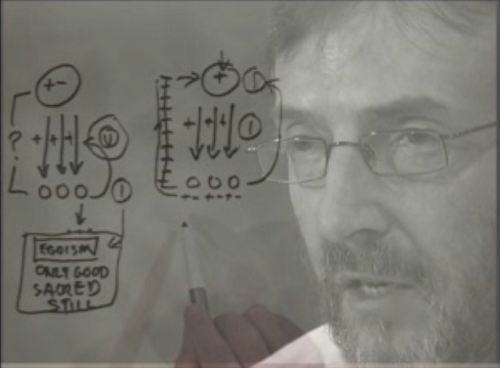
This post has no answers and only doubts, but reading it you’d see what is that Kabbalah is (or wants to be). This is an “answer” to the 12th self-study lesson (a introductory study) and it contains my doubts about it. To see the self-study you’d have to register here, for free. There are 14 lessons in that self-study.

I’ve also included the 12th lesson (about 25 minutes) if one doesn’t want to go through that registration, but I actually encourage you to register and watch the rest as it’s all quite interesting and at least enriching.

—
I was rewatching lesson 12 of the self-study and got some doubts. I know that Kabbalah can’t be understood simply logically, but as long I’m not “there” I still have to relate to it with my own logic and the ideas I get from the lessons.

It seems to me that the difference between Kabbalah and other religions is not the one described in that video. The difference I understand is that Kabbalah is entirely about spirituality, so it isn’t interested about the physical world. This marks a true difference with all other religions as all religions (as far as I know) do have systems of rules that apply to corporeality. From what you can or can’t eat to when and how you should pray. Even anthropologically all religions were “meant” to regulate the corporeal world and build a certain society.

But instead I can’t stop my doubts about what is explained in the video. I only know well Christianity since it’s where I’m born but, while the people could certainly believe that it’s about “bribing God”, that’s not a good representation of that religion, and the real one isn’t very different from how the Kabbalistic model is described.

The part that gives me the doubts is that one could say that the Kabbalistic process is equally “delusional”. As long the upper light is invariable and the events also invariable (so what changes is solely the self), then it means that the pain itself can’t be stopped or diverted. The pain is instead “understood”, as one, through bestowal, would perceive the “long range”, so the wider purpose beside the egoistical self.

Which essentially would lead one to “endure” the pains of life in the name of a greater purpose that says: there’s indeed a purpose, and it is good willed. One could see his sons killed in front of him, or go through great pains, but always knowing that there’s a “meaning”, and that life is eternal.

So it is true that the suffering is always relative to a perspective, and if one shifts the perspective a momentary suffering becomes bearable. Through life eternal all suffering is bearable as it is momentary. But both these ideas are essentially “consolatory” and Kabbalah would be defined itself as consolatory, as it is all based on two principles that regulate the rest:

1- That life is eternal (and so suffering momentary)
2- That God is good willed, and everything happens for a purpose

If one had the CERTAINTY of those two points, then it is true that pain would be bearable. But isn’t this perspective consolatory and delusional? As you can’t change what happens to you (invariable upper light and events) you have to “endure” it, hoping there’s a good willed purpose even when everything looks very bleak.

The other difference between the Kabbalah and religion is that in religion the salvation or the enlightenment, more often than not, happen after death. So they are “promises” of salvation or enlightenment, and one lives with the “hope” that they are true, clinging desperately to these ideas as they can only justify the pain of life, and give life a sense.

Kabbalah is different as the promise of attaining the “upper world” is here and right now. You say it’s a “science” as it has to be experienced and attained personally, first hand. It’s not a theory or an abstract idea. But the skepticism here is about “when”. One listens to the video courses, reads the books and slowly understands what is Kabbalah, but what’s that ideal point that brings back up to that “tangible certainty”? The distinguishable certainty that Kabbalah is a science and not a consolatory delusion?

I’m explaining the subjective point of view: one comes to Kabbalah trying to learn, but learning leads me to define these ideas of life eternal and purpose as “consolatory”. This can only be solved through a certainty. In other religion you achieve that certainty through “faith”, but in Kabbalah faith is not required, as having doubts and asking questions is encouraged (as in science). I am right there.