
I’ll probably write more about this.
(that image goes with this song)
| Looping Wor(l)dWE AWAIT SILENT TRISTERO'S EMPIRE
|
 A couple of things left from the other post. I’m surprised to find here traces of “self-awareness” and use of playful circular devices that are so typical of Postmodernism.
I’ll continue to quote parts of the introduction:
But for all the little hair-cracks that the scholar’s magnifying glass reveals, The Story of the Stone is an amazing achievement and the psychological insight and sophisticated humour with which it is written can often delude a reader into judging it as if it were a modern novel. In fact neither the idea that fiction can be created out of the author’s own experience, nor the idea that it can be concerned as much with inner experience – with motives, attitudes and feelings – as with outward events, both of which are a commonplace with us, had been so much as dreamed of in Xueqin’s day.
As regards the various ‘devices’ which Xueqin employs for converting remembered fact into artistic fiction, one he makes persistent use throughout the novel is the antinomy of zhen and jia, meaning respectively ‘real’ and ‘imaginary’, but both regarded by Xueqin as being different parts of a single underlying Reality:
Truth becomes fiction when the fiction’s true
Real becomes not-real when the unreal’s realis the inscription written up over the gateway to the Land of Illusion which we pass through at the beginning of the novel.
‘Jia’, the surname of the family in the novel, is also a pun on this other jia which means ‘fictitious’. The Jias of the novel are connected in various ways with a mysterious family in Nanking called the Zhens – another word-play – who are a sort of mirror-reflection of the Jia family.
It is easy to imagine that many of the Stone‘s ‘devices’ had their genesis at this stage: the presentation of fiction and reality or reality and illusion or the waking world and the dreaming world as opposite sides of a sort of single super-reality, for example – like the two worlds one on each side of the mirror.
All of it sounding weirdly close to the topic of my blog in the past weeks. No matter what stuff I pick up, I end up again and again in the same places.
What surprises me here is how deliberate it is all, and not really a strained interpretation of today. What Xueqin was doing was about redressing his family and people he knew as fiction, this is a common practice. But he was doing this by incorporating in the novel the awareness for its own device, and so all this playful interplay of fiction with reality, that probably comes back as one of the key to interpret the “secret” of this novel.
Such devices play a functional part in the structure of the novel; but many of the symbols, word-plays and secret patterns with which the novel abounds seem to be used out of sheer ebullience, as though the author was playing some sort of game with himself and did not much care whether he was observed or not.
And finally another striking feature of this novel is that it seems to have its core on the women. Something that is discussed right at the beginning of the book, in Postmodern style as the book describes its own possible frameworks, merits and limits. A sort of self-dialogue:
it contains no examples of moral grandeur among its characters – no statesmanship, no social message of any kind. All I can find in it, in fact, are a number of females, conspicuous, if at all, only for their passion or folly or for some trifling talent or insignificant virtue. Even if I were to copy all this out, I cannot see that it would make a very remarkable book.
‘What makes these romances even more detestable is the stilted, bombastic language – inanities dressed in pompous rhetoric, remote alike from nature and common sense and teeming with the grossest absurdities.
‘Surely my “number of females”, whom I spent half a lifetime studying with my own eyes and ears, are preferable to this kind of stuff? I do not claim that they are better people than the ones who appear in books written before my lifetime; I am only saying that the contemplation of their actions and motives may prove a more effective antidote to boredom and melancholy.
‘All that my story narrates, the meetings and partings, the joys and sorrows, the ups and downs of fortune, are recorded exactly as they happened. I have not dared to add the tiniest bit of touching-up, for fear of losing the true picture.’As consequence of all this, Vanitas, starting off in the Void (which is Truth) came to the contemplation of Form (which is Illusion); and from Form engendered Passion; and by communicating Passion, entered again into Form; and from Form awoke to the Void (which is Truth).
Having made an utter failure of my life, I found myself one day, in the midst of my poverty and wretchedness, thinking about the female companions of my youth. As I went over them one by one, examining and comparing them in my mind’s eye, it suddenly came over me that those slips of girls – which is all they were then – were in every way, both morally and intellectually, superior to the ‘grave and mustachioed signior’ I am now supposed to have become. The realization brought with it an overpowering sense of shame and remorse, and for a while I was plunged in the deepest despair. There and then I resolved to make a record of all the recollections of those days I could muster – those golden days when I dressed in silk and ate delicately, when we still nestled in the protecting shadow of the Ancestors and Heaven still smiled on us.
I might lack learning and literary aptitude, but what was to prevent me from turning it into a story and writing it in the vernacular? In this way the memorial to my beloved girls could at one and the same time serve as a source of harmless entertainment and as a warning to those who were in the same predicament as myself but who were still in need of awakening.
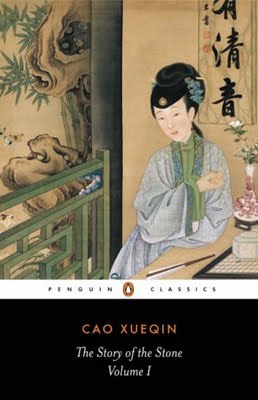
 I received today the first volume (of five, for a total of 2500 pages, give or take) of “The Story of the Stone”, better known as “The Dream of the Red Chamber”. One of the four great Chinese classical novels and the one most known and famous among those four. All these four being “epics” in their own right, especially in size (but not just) since they all exceed the thousand pages.
This Penguin Classics edition has a good 40 pages introduction and it is the reason why I’m writing this. It presents an interesting case of “unreliable narrator” embedded in the book. Actually THREE unreliable narrators that existed for real and only known for their suggestive nicknames: Red Inkstone, Almond and Odd Tablet. With a fourth called Gao E who actually delivered the final edited work and got called liar by the majority of the critics. Obviously the original manuscript was lost, only 80 chapters on the total 120 were finished, and it’s not even sure if those 80 chapters were also rewritten and adjusted, or if the remaining 40 chapters were done from scratch, or followed an outline of the original author, or were instead written by the original author but before said guy went to rewrite and polish the first 80 (“All the evidence suggests that he finished the novel long before he died and was merely revising and correcting during his final years.”).
Essentially it’s a mess, made worse by the fact that there are allusions of it being an elaborate riddle to solve, or even a satirical commentary, but all so buried and successively adulterated that it’s now impossible to get the “true story” out of it. This all explicitly teased right in the text:
Pages full of idle words
Penned with hot and bitter tears:
All men call the author fool;
None his secret message hears.
In fact in China they are all over this like a national sport, writing every years piles of books whose only purpose is to reinterpret, redefine and speculate, over this one book, its history, its hidden meaning, its allusions, its author(s) and so on.
The other fun fact is about timeline problems and similar mistakes:
But the problem of inconsistency which troubled Gao E and continues to trouble translators is by no means all due to the anonymous author of the last forty chapters. Cao Xueqin himself must be held responsible for quite a few of the novel’s minor inconsistencies. This is partly due to the elaborate devices he used for distinguishing the facts of his family history – switching generations, substituting Peking for Nanking, and so forth – which make him peculiarly susceptible to slips about ages, dates, places, and the passage of time.
I guess this is the kind of necessary evil when an author embarks for something truly “epic” and recklessly ambitious, without the guarantee to see it through (in fact, considering the incompleteness, this is more a case of Jordan-Sanderson).
Let’s forgive Erikson for his similar slips, and remember that someone like George RR Martin, who expressly admitted of obsessing over these sort of things, is more likely to succumb than succeed in the process.
 Surfing the Bakker’s wave. Consciousness and whatnot. I just found an interesting link in a comment to an article linked on a forum thread about a Bakker’s story (and this is an example of typical internet loop that is actually quite SHORT).
Here: LessWrong.com
I’m jumping around between the interesting articles, starting from here specifically.
Especially there’s an interesting perspective on Reductionism that kinds of overthrows the term and is maybe dialed closer to truth:
it requires constant vigilance to maintain your perception of yourself as an entity within physics.
The way a belief feels from inside, is that you seem to be looking straight at reality. When it actually seems that you’re looking at a belief, as such, you are really experiencing a belief about belief.
So when your mind simultaneously believes explicit descriptions of many different levels, and believes explicit rules for transiting between levels, as part of an efficient combined model, it feels like you are seeing a system that is made of different level descriptions and their rules for interaction.
But this is just the brain trying to be efficiently compress an object that it cannot remotely begin to model on a fundamental level. The airplane is too large. Even a hydrogen atom would be too large. Quark-to-quark interactions are insanely intractable. You can’t handle the truth.
Reductionism is not a positive belief, but rather, a disbelief that the higher levels of simplified multilevel models are out there in the territory.
This not only appears as true, but it also is kind of supported by an argument that usually is used against it. Science never predicts anything, it can only understand a phenomenon after it happened. As if scientific discovery can only proceed in a direction but can’t really theoretically define anything. It always falls short. Science essentially works like an Oracle pretending to know the future but only able to make prophecies after they already happened. Normally, we would point at it and say it’s a fraud. Is Science a fraud?
Science is the story we tell ourselves to make sense of certain things, but as a framework, it is built by man, and ultimately false. Yet not completely arbitrary. Science is not invented. And this was part of my recent debate with Bakker.
But what makes me think is a kind of positive thinking on top of all of this:
If you choose, and plan, and act, and bring some future into being, in accordance with your desire, then all this requires a lawful sort of reality; you cannot do it amid utter chaos. There must be order over at least over those parts of reality that are being controlled by you. You are within physics, and so you/physics have determined the future. If it were not determined by physics, it could not be determined by you.
The future is determined by physics. What kind of physics? The kind of physics that includes the actions of human beings.
But isn’t kind of curious that the whole site is essentially dedicated to deal with the limits of “thought”, that they believe will be surpassed by thinking HARDER. Isn’t the loop the prison of our mind?
It gives me the image of a cat chasing its tail and realizing it’s all a matter of SPEED.
We should make Iskaral Pust as our rolemodel:
“Shadowthrone… uh… my worthy Lord of Shadow… is thinking. Yes! Thinking furiously! Such is the vastness of his genius that he can outwit even himself!”
A relevant quote from “The Crying of Lot 49” (that is, depending on what chapter you hit, great or infuriating):
“You don’t understand,” getting mad. “You guys, you’re like Puritans are about the Bible. So hung up with words, words. You know where that play exists, not in that file cabinet, not in any paperback you’re looking for, but-” a hand emerged from the veil of shower-steam to indicate his suspended head-“in here. That’s what I’m for. To give the spirit flesh. The words, who cares? They’re rote noises to hold line bashes with, to get past the bone barriers around an actor’s memory, right? But the reality is in this head. Mine. I’m the projector at the planetarium, all the closed little universe visible in the circle of that stage is coming out of my mouth, eyes, sometimes other orifices also…”
I stumbled at random on a Youtube link that ended up full of interesting suggestions. There are a number of class sessions at Yale on American literature that are public.
I started from the one about “Everything is Illuminated” by Jonathan Safran Foer. I haven’t read the book but I knew it was kind of controversial, so I thought it could be interesting to hear about it. Listening through the lesson was indeed very interesting since the teacher makes many links about other writers and styles, especially explaining some notions of post-modernism. I noticed for example how Franzen essentially copied David Foster Wallace’s intent (trying to put together the formal play of the post-modern novel and wrestle it so it can submit to the service of the human sentiment), or the internalization within the novel of a double for the reader, in order to cue or even trick and mislead (Nabokov), the alternate endings of Roth, or putting himself within the novel, or writing about writing (a form of “thinking about thinking”) and certain other “inversions”. And also this ideal of literature as “both sentiment and formal play”. Then when she talks about the themes of the novel she seems to describe Kabbalistic ideals (“desire”, “light”, “connectedness”), which suggests me that when a writer sets to an ambitious journey the themes end up being quite the familiar ones. Each writer adding his own perspective and particular slant, but the core has an idea of stability and constancy, as constant is the pretense of Kabbalah to describe humanity.
Then I moved to listen about “The Crying of Lot 49” (that I’m reading) and this is even more interesting because she goes through a number of literary movements and their position in regard to the perception of reality (within the context of language), and it seems that more than talking about that novel she’s now actually talking directly to me.
It seems that all writers, past and current, end up engaging with this (she expressly calls “the history of literature’s forms and ambitions”). It also seems that more than adding new angles they merely describe different faces of the same thing, in a surprisingly coherent way. I’m wondering here if Scott Bakker really got it and encapsulated the struggle of centuries. I kind of smirk when she (teacher in the video) goes with “the relationship imagined between those visions of language and what is happening outside of fiction, in what we might call the real world”.
For example she says that beginning with O’Connor “embodying a new critical craft of fiction imagining that that craft is reflective of a transcendental order in the world”. Then the Beat Generation and how they did instead reject formalism, or the language mediating with reality. Then passing to the idea (of Nabokov, she says) of the literary work (of art) so autonomous from the world that it could become something like a form of life (and the conceit of author’s immortality, which I guess today is replaced by the “death of the author”). Then to Salinger, believing that the formality of language could lead to communicate the truth of human soul (as in opposite to the Beat Generation, and that I interpret as a kind of solipsistic bliss). Then to Barth who did not believe in the possibility of reaching an unmediated reality, and in this moving closer to Bakker’s perspective and language as a “cage”. She says: “Barth’s idea of language as preceding human understanding”. As a form through which we understand reality, and so not merely mediating, but shaping and “walling” our understanding. Or (and she kinds of quotes this):
The Language That Comes Before
Which also lead me to a pattern of thought about “truth as disabling”, since we always see at the opposite, truth as enabling. What if truth breaks the toy, and what if many writers, in discovering that, recoiled?

Yesterday I was reading again Von Foerster’s book and there were certain fascinating parts.
The problem I have with Bakker’s theory is that I cannot fully grasp it in its entirety. It’s kind of elusive and frustrating. It’s like every time I manage after a struggle to focus on one aspect I lose everything else. Every step in a direction makes me lose track of progress I previously made. Despite all reductions and simplifications I’m always lost and every problem seems to exist on its own without letting me use a constant frame of reference.
The first idea is that, in Constructivism theory, there’s no “confirmation” of reality. No certainty of it. What you do instead is “correlate” your sense experiences. “I see the pencil and I hold the pencil”. So “my sensation of touch, in correlation with my visual sensation, generates an experience”.
This simply to say again that we only construct a world we perceive, but we can’t say how much or how faithful is our model. Or not at all.
Quote from Physicist Sir Arthur Eddington:
Consider how our supposed acquaintance with a lump of matter is attained. Some influence from it plays on the extremity of a nerve, starting a series of physical and chemical changes which are propagated along the nerve to a brain cell; there a mystery happens, and an image or sensation arises in the mind which cannot purport to resemble the stimulus that excites it. Everything known about the material world must be inferred from these stimuli transmitted. . . It is an astonishing feat of deciphering that we should have been able to infer an orderly scheme of natural knowledge from such indirect communication.
Or maybe an astonishing pretense. A lack of humility.
The interesting aspect is that the book addresses the problem of “science” as we discussed it. Why believe in science? Because it works. That’s one of the postulates that sustains Bakker’s theory and that make science “authoritative” over religion, spirituality etc…
Constructivists say:
1- Knowledge, particularly scientific knowledge, IS USEFUL IF it allows us to predict, i.e., to bring about or avoid a certain phenomena.
2- When knowledge no longer serves the purpose it becomes questionable and eventually devalued.
And it all sounds like an act, a choice that is made like a political opinion to me. As if we don’t believe in what is true, but in what is “convenient”. Maybe science has the same place of every other self-serving delusion? Well, as long the delusion doesn’t come crashing down on you.
But then the book goes also to explain some experiments about how perception develops after we’re born.
“Newborns do not have object constancy, the capacity to distinguish stable objects. They cannot compute equivalence, a logical operation that must be performed to perceive an object which changes its structure or position in space as the same object.”
“Developmental studies of children, conducted by the Swiss psychologist Jean Piaget, show that we learn to perceive object constancy. It takes about 18 months.”
“Sensorimotor intelligence organizes reality by constructing broad categories of action which are the schemes of the pertinent object, space, time, causality…”
The book continues explaining that if you show rows of coins to a five year old, all rows having the same number of coins but with one row more widely spaced, and so longer, the kid will say that the longer row contains more coins.
But if you then repeat this experiment with a kid at seven he would say the question is stupid, as it is very obvious that all rows have the same number of coins.
“The older child takes a self-evident, or a priori, what only a few years ago he did not know existed. Once a concept is constructed, it is immediately externalized so that it appears to the subject as a perceptually given property of the object and independent of the subject’s own mental activity. The tendency of mental activities to become automatized and for their results to be perceived as external to the subject is what leads to the conviction that there is a reality independent of thought.”
Toward science, this is the defying stance of Constructivism:
The technological advances show “one” of many possible ways to bring about a result or make a prediction. A proven scientific theory is a successful means for reaching a goal.
It merely means we know one viable way to a goal that we have chosen under specific circumstances in our experiential world.
“A key fits if it opens the lock. It describes the capacity of the key, not of the lock.”
“Scientists rely heavily on mathematics, a system constructed to generate necessary answers to its questions. Necessary answers generate certainty.”
Although here I’m lost because it’s where Constructivism goes metaphysical:
“Radical constructivism maintains that operations by means of which we assemble our experiential world can be explored, and that an awareness of this operating can help us do it differently and, perhaps, better.”
“We can invent keys that unlock our problems, but these inventions only tell us about the key, not about the lock. Although certainty is lost, choice increases.”
But to me ALL this only flows very naturally and coherently into Bakker’s theory. That’s maybe the scary part.
The key (science) really only tells more about us than the world. We strain to see, but we can only see our own reflection. Our science only explores and describes the limited horizon that we see (are), but nothing of what’s outside.
And this seems telling if one considers that:
“only living organisms qualify as observers”
“Scientists obeyed to this rule of separation because, under certain circumstances, when the observer included himself in his description (observations) it led to paradox, like the paradox one finds in the statement: I am a liar.”
Now THIS specific pattern of “paradox and recursion” IS the very thing that “Gödel, Escher, Bach” describes as the ORIGIN of conscience, or the difference that triggers it as emergent.
So it’s as if EVERYTHING simply leads back to this kind of loopy paradox that defines both reality (within the blind box) and ourselves (the loop of conscience, and the limited horizon).
Happy New Year.
