Author Archives: Abalieno

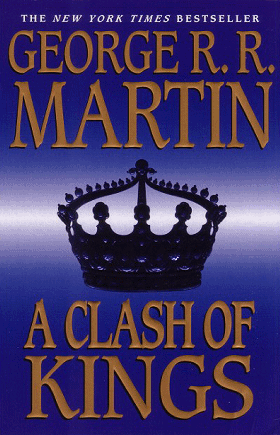
I’ve finished reading A Clash of Kings even if it didn’t show on my reading queue and I’m not going to “officially” review, but I wanted to write down some scattered comments about it and put some kind of content on the blog.

Overall I think it’s not a strong as the first book. Martin did a good job with it, but I think the merit is mostly on the first book, setting up really well all the various parts. Book 2 makes it more a task of running with the ball, and that’s well done. Something that I didn’t expect is that Martin jumps some events more than the first book. The PoVs dictate the flow and the scenes that don’t strictly belong to one are avoided even if they could be significant. I fear that moving on with book 3+ this will become an exception and Martin will feel compelled to bog in unnecessary detail. In fact I remember a recent interview where he said that if he could rewrite ACOK today he would put Robb PoV back in and describe directly the campaign (hint: this wouldn’t improve the book at all and I’d rely more in Martin’s past wit than his most recent…).

Most of the merits of this second book are about sticking to those PoVs and make the characters’ drama drive the story in a way that feels plausible. Some of the best chapters tell a self-contained mini-story that ranges between 8 and 20 pages. In this book Martin begins having a more cumbersome, heavy prose that sometimes indulges into lists of names or other things that one reads only to immediately forget, but being the chapter “chunks” rather short it still makes for a good flow. Every time one of these chapter closes you have the urge to know what happens next (and I often went to read the first pages on the same PoV, sometimes almost 200 pages ahead), and I don’t think anyone else gets this compelling reading formula better than Martin.

Characters are always well written and truly “grey”. I think this is an aspect often misdescribed. It’s not about making a character morally ambiguous, but about making it somewhat plausible. There are definitely “heroes” that Martin wants the reader to root for, taking sides actively. The book is NOT neutral. Its strength is in making it work. Arya, an heroine the reader is supposed to love and recognize/sympathize with, can murder some nameless guy. This is from one side coherent with the character and the truly unforgiving world, and from the other side the reader finds it acceptable. As if this case made the murder totally acceptable. Necessary in some way.

This contrasts with murder that is not necessary, and while considering this I noticed how Martin uses this device every time he seeks for a certain response and shock the reader with some unpredictable death (and there are MANY). What defines these deaths, that are supposed to move and shock the reader, is that they are usually unnecessary (and unexpected). The result of some hate, or spite or brutal violence. But not strictly necessary, it’s an exhibition of violence. That’s how some characters (like Arya) can still be readers’ favorite even when they do something controversial. And I think this prepares the path from some characters’ arc like Jaime. The trick is the PoV, when you get into a character and learn his motivations you get to understand and sympathize.

At the micro level you can appreciate how well written everything is, but at the macro level some evident shortcomings start to show. For example the “pinch” that is made by the two extreme sides that close on the story, Ice/Jon Snow and Fire/Daenerys, is very obviously lagging behind while the center (the clash of kings) is getting bloated out of proportions. It’s not surprising that Martin started to have problem managing the thing (“the story grew in the telling”), since it’s only this central part that gets bigger in comparison with the rest. Daenerys PoV is a total of 60 pages in a book of 950, and in those few pages she’s basically idling or chasing after prophecies that are used to foreshadow how the story develops. Jon PoV is about 100 pages, but it’s mostly all preparation and flavor, used simply to move Jon to a new position. These two PoVs go together because they are disengaged from the rest of the story. They are like side-plots that wait to converge in some later book.

Another observation about the macro level is that the book is filled with Deus Ex Machina. I know people complain about this in Erikson’s books, but if you accept that kind of broad definition of DEM, then Martin have aplenty in this book, and all at crucial points of the story. To begin from the obvious: Melisandre.

In a world soaked in deceit and betrayal, she’s immune to both (the Prologue, to begin with). I guess Martin “has plans” to rule her in the later books, but within this one she’s a personified DEM for the simple reason that all the rules that apply to other characters DO NOT APPLY to her. Being a DEM personified she also leads to crucial DEMs in the plot. She can make prophecies that are NOT revealed as delusions. They really work. She has the DEATH SPELL. When I read that part I was absolutely sure that Martin was tricking me, but he wasn’t. In a world that establishes itself as “low on magic”, so that everything comes down to men and their affairs, she can simply “wish” that someone dies, and they do. At least in the Malazan world the power is in check. An action triggers a reaction, and it’s the power itself being a delusion. I don’t remember anyone dispatched as easily. But here nothing exists to keep the balance. She proceeds by killing a core character and another relevant one. Without these two deaths the WHOLE story would have spun in a totally different direction. About as much as dramatic as that certain death in book 1. And this huge plot bend is entirely a Deus ex Machina. Death spell, no saving throw. In a world with no magic and with kings being the show runners, being able to pick one and kill him in an instant is the exact equal of an I-WIN button.

It’s kind of ridiculous that when matters get serious and she can be used to easily win the war (and kill someone not made into a redshirt) she’s sent away with an excuse: “Your Grace, if the sorceress is with us, afterward men will say it was her victory, not yours. They will say you owe your crown to her spells”. The point being she’s one step away from breaking the whole story, and Martin has to rely on this artificial trick to limit the power he gave to her. Yet, she steps out and the other major DEM enters the picture: wildfire.

This is a sort of “magic” fire, whose DEM potential lies entirely in the fact that, being magic, no one anticipates it (well, Davos does, but only so much as to the lead to the powerless Big “No!” trope). It really gives this feeling of “magic entering the world” and subverting everything, a meta-device that enters the picture to make it change the natural course. On the micro level you have the character dramas that are written very well and work perfectly (in their big-picture-irrelevant stories), but on the bigger level there’s the whole war on the continent and the clash of kings. EVERYTHING on this level is artificially steered through all these Deux ex Machina. First Melisandre changing the course by killing two key characters by wishing it, and then by wildfire, whose power of subversion simply turns around the outcome of the biggest battle in the whole arc of the first two books.

A third major DEM comes with Jon, who has a magic dream (by the way, this book is filled with dream sequences, and I wonder why I don’t see them criticized as similar scenes in other books) that shows him what they are going to find, and so he’s able to save the whole company by making them turn around. Magic dream = magic rescue. A classic Deus ex Machina.

Now you can tell me that there’s very little magic in this world, but Martin has used it in the WORST way possible. By steering artificially the plot whenever something truly major was about to happen. Makes it feel the plot is on a leash. And yet it works, because the characters are so well written and relatively safe within their smaller cocoons of plot. It gives an idea of a complex world because it’s as if the main PoVs are caught in the events and not controlling them, which is the way “reality” usually feels. They try to survive while pieces more around them. Martin is the god moving the pieces from out of the picture, but at least he stays true to the characters.
I’ve been away from the blog because I haven’t been reading (for the most part). I spent these past two weeks rediscovering old game classics on the Amiga and reading online scans of old magazines. Especially RPGs, adventures and simulations dating before 1994. I found a boatload of awesome stuff, including the “Realms of Arkania” trilogy that passed completely under my radar (and as you can see I didn’t stop with the Amiga). Then I spent some time looking into Roguelikes. But it’s so off-topic with the blog that I won’t go in depth about that.

Now I’m slowly returning to habit and hopefully resuming activity on the blog too. This included desperately searching on the internet where I could find a pre-1977, pre-revision copy of The Magus, by John Fowles. Hopefully I got one right.

But in the meantime I forgot to quote this bit I read just before I got sidetracked. A kind of insight into Janny Wurts inner working at the writing process. She’s currently onto her penultimate book of her epic-sized, epic-themed series, all of which I intend to read.

I think it’s cute and adorable:

Well, now – isn’t THIS interesting.

Chapter start – almost ALMOST scrapped. Even with brainstorm – refused to move.

New ideas buying the farm like paper airplanes in a hailstorm.

This morning, finger above the DELETE key – (yeah, at 12 or more pages along, s*** happens)….new whisper from the muse (Author: HEY WAIT, LADY, WHERE HAVE YOU BEEN ALL ALONG WHEN THE AUTHOR WAS KNOCKING A COLD AND SWEATING BULLETS???)

Muse: whisper whisper whisper…!!!

Ah – AUTHOR STOP! Full stop. NO delete….adjustment. Page count upped to 14 pages. Next scene that was two pages along – DEFERRED and kicked ahead to the next sub-chapter/along with the scrambled heap of ideas that were snarled into knots of refusal to move….

Sub-chapter I THOUGHT would be next (vague cloud of ideas with names tagged on) decides to flip places, morph with ANOTHER sub-chapter I had (shows what I know) already punted ahead to ‘down the story road someplace’ – haul that bit back wiggling, as a lovely, argumentative, tensioned follow up to THIS scene and voila.

Behold, this chapter passage is alive and kicking butt after all.

Day in the life of the harassed IDIOT, why not have a SANE job, um, oops, I mean, author who definitely (read that as, (let’s not be hypocritical) when the muse is WORKING) adores their job….;)

Plunge back into the story chase, again, but this time it appears to be hopping.

Page count: 201 – WAIT!!!! – 201? I’ve broken 200! OMG!!! how did I miss that milestone without a beer???

Here’s How: sometimes you get this white HEAT BLAST of inspiration. Other days you get the staggers and the crawls…:-)

(hauls off staggering and crawling toward that magical fifth chapter set, whereupon the story brew is finally shaken to fizz and the lid typically flies off the “start up plod”. I think I need a MUSE CATTLE PROD – yeah! Bring it on, take that, you flighty *sweetheart* – let’s have some steadier inspiration around here…oy.)

For once it’s not the blurriness of quantum physics to be the source of some metaphysical speculation. Nor I’m going to describe again some part of the Kabbalistic system, even if this thought came to me while considering spirituality as I was doing at the end of the previous post.

This speculative backdoor that could link physics to meta-physics comes from reading “about” a book (again through reviews and articles, I don’t have the book itself) written by Michael S. Gazzaniga, “Who’s in Charge?: Free Will and the Science of the Brain”. For me just one random name, nowadays there are hundreds of books on consciousness and there are plenty of theories that contradict each other. Picking the good one is a lottery. In this case, though, Scott Bakker tells me that this author isn’t one random name among many, but:

Everything Gazzaniga says should be taken very seriously. He truly is one of the founder fathers of cognitive neuroscience – whole literatures have cropped up around his split-brain studies.

So I’m looking more into it and I see that Scott preliminary comment is quite correct about what I was going to find:

There’s no shortage of serious supporters of free will, but I tend to find that the more I probe their positions (most recent Steve Wofram’s), the more clear it seems that most are trying to salvage the word, ‘free-will,’ and not the experience. To me that’s simply tendentious: why call it ‘free-will’ if the ‘feeling of willing’ isn’t what you’re talking about? Redefinitional apologia, I call it.

The problem is that the articles I read that summarize the book’s ideas, including this transcript with the author itself, leave me quite baffled. The logic of his theory not only isn’t convincing, but leaves open a crack that is potentially disastrous. That’s the “backdoor” of the title.

Gazzaniga believes that the brain, one day, will be explained completely in a mechanistic way. This means in a deterministic way. Everyone knows that this affirmation directly contradicts the possibility of “free will”, because free will implies the “ghost in the machine”, or the dualism of mind/body. The moment you declare the world (and the brain, or the reverse) deterministic, then you declare the absence of free will, of choice. And of responsibility.

Gazzaniga agrees with these premises, but disagrees with the conclusion. He says that “responsibility” belongs to a “social system”. The brain and the social systems don’t exist on the same level, social systems are… emergent. That’s a keyword that I’ve known and studied for a long while, years ago. But it’s a very tricky, slippery word that, especially when used within science, needs to be used prudently.

Michael Gazzaniga’s “Who’s in Charge?” suggests that we look elsewhere—outward, to the human world beyond the stand-alone brain. Mr. Gazzaniga is a towering figure in contemporary neurobiology. It was he who, back in the 1970s, coined the term “cognitive neuroscience”—with colleague George Miller—in the back seat of a New York taxi.

Unlike many in his profession, Mr. Gazzaniga is philosophically sophisticated. He believes that, while the brain “enables” the mind, mental activity is not reducible to neural events. While he states that thoughts, perceptions, memories, intentions and the exercise of the will are emergent phenomena, he adds that “calling a property emergent does not explain it or how it came to be.”

Crucially, the true locus of this activity is not in the isolated brain but “in the group interactions of many brains,” which is why “analyzing single brains in isolation cannot illuminate the capacity of responsibility.” This, the community of minds, is where our human consciousness is to be found, woven out of the innumerable interactions that our brains make possible. “Responsibility” (or lack of it), Mr. Gazzaniga says, “is not located in the brain.” It is “an interaction between people, a social contract”—an emergent phenomenon, irreducible to brain activity.

This is a very bold claim. The problem isn’t so much that it isn’t a very convincing argument, since it looks more like a way to dodge the issue, but that once you open this kind of “door” in the theory, then you can’t cherry-pick what passes through.

Think about this model: the mind in the center. We receive sensory perception from the world outside and organize it on top of a formal system. The rules that regulate the formal system are logic and mathematics, and what we obtain is “physics”, or science, a system of reality that is built by isomorphically associating sensory perception with theories that make sense of them. Then we verify through practice that these theories are correct: that their effect can be reproduced. This relationship is, back and forth, between the mind and the world outside. “Society” is also something that exists (and is emergent) on this level of relationship, between the mind and the world, the minds, outside. But, as in the Hermetic “as above, so below”, this is just one side of the model. The other side (of macrocosm) is what’s “below”, or inside (the microcosm). Consider spirituality as a very personal thing. Spirituality, like the soul, is “emergent” from the brain. In fact, because we feel the dualism, we believe that the mind can’t be wholly explained in a deterministic way. When we take spirituality and organize it in a formal system, we obtain metaphysics. That’s how I see it. Physics and metaphysics have in common the fact that they are organized as formal systems, and the difference that what they organize belongs to two opposite sides of the model: physics organize external reality (macrocosm), metaphysics organize mental space (microcosm).

Call it mental-physics.

The book “The Wayward Mind” shows how gods, mythologies and religion “emerge” from the depth of the soul. They don’t belong to sensory experience, they don’t come from outside, but they are outward projections (becoming part of society) for the part of the mind that consciousness is unaware of. But this “stuff” exists inside. So the origin of god (in whatever form you intend it) is within. Not outside, sitting beyond the fabric of the world. It’s a byproduct of your “soul”, where for soul I intend unknown mental space. This builds the other half of the model, and it’s a dimension that is as “emergent” as the idea of society. “Emergent” implying: a level that is irreducible to its parts, that is authoritative on itself, to consider independently.

If Gazzaniga gives legitimacy to society as a self-referential and autonomous form that should be trusted for how it APPEARS (or, to be as technically faithfully with terms as possible: how it self-describes), THEN he should accept the legitimacy of metaphysics and spirituality as well: as emergence of the human soul/mind.

The mechanistic view is either totalitarian or it isn’t (this is a tautology).

If “society” (which Gazzaniga uses to justify the idea of responsibility) is independent, and to be judged independently from the physical brain, then its “quality” is indistinguishable from spirituality and metaphysics. Which are even more OBVIOUSLY emergent (from consciousness and the various processes, maybe even non-conscious ones).

Reading the debate between Vox and R. Scott Bakker over at his blog made me think on certain broad themes, but trying to engage with these arguments also means that I approach them with a blank state and the simplicity it carries with it. So I’m sure my views will be extremely simplistic, but will also very clearly show a basic structure, maybe.

When I started reading Ayn Rand (it was a year or two ago) I approached with a similar blank state, even if my political view are the polar opposite of hers. And so despite these ideological differences I thought that her ideas were extremely powerful and moving. I thought they were valid. But at the same time I had the impression that she completely avoided certain GLARINGLY OBVIOUS objections. That she completely avoided them, dealing with themes in her books through the use of dialogue and conveniently making communists into straw men. It’s too easy to champion one own’s idea against straw men. So it’s not that I see Ayn Rand’s ideas as completely invalid, but it seemed that she completely ignored and carefully avoided certain points.

My basic objection to her ideas is that there are many practical cases in which personal gain simply contrasts with the prosperity of a community. It simply happens in the real world and we have plenty of examples in modern capitalism. You can exploit and pollute a territory, achieve a huge economical wealth because of it, as long you don’t get caught. Or, in general, your personal short-term wealth won’t correspond to the long-term wealth of a community. A cynical entrepreneur will find plenty of ways to get richer while exploiting others. You can get richer, wealthier, as long you are able to dodge the consequences, some of these even irreparable. If your moral judgement is based on your personal happiness and nothing else, then it means that your short life span is a factor. That you simply won’t care about what happens next. So this ideal that personal wealth coincides with the communal wealth is factually wrong. That’s why we have governments and rules, so that we can drive the process in ways that won’t create those contrasts. Essentially, we need other, wider systems that keep the power in check. That keep verifying and set rules that are created for the benefit of the collectivity. Without this “scaffolding” Capitalism is an utter disaster, it’s just a system that legitimates oppression and exploitation. A self-validating system.

But a similar patten can be applied to Communism. In this I agree with Scott Bakker. When we think about politics we think how the world should be. So we come up with a picture, and that picture will correspond to our political “beliefs”. But this poses the world as it should be versus the world as it is. If you apply the Communist system to today’s world you obtain a disaster. Because the world doesn’t conform to your utopian, ideal vision.

As in the system of Kabbalah, we live in a “coarse” world. Consider it as a metaphor. The world begins with the emanation of light from god. This light is absolutely pure, and that’s our origin, where we were whole with the god and formed the single body of Adam Kadmon. Then, through the various sephirots the reality is created, moving down like a ladder, and every step makes this light get more coarse, less pure. Down to the world of Malkuth/Assiah that should define the real world, dividing it from the spiritual one. Reality, the tangible one, is the lowest level. Extremely impure. Essentially, the Kabbalistic system is like a huge laundry. Your mortal life, in the way you know it (from being born to death, with everything between), defines your duty. Suffering and desire are the mechanics that, more or less willingly, ultimately push you that way. Your duty is to “cleanse” the little quota of “egoism” you carry with yourself. The purpose is to clean yourself, the world as direct consequence, and climb back the ladder/light to the upper worlds.

Kabbalah defines Communism as an ideal system, and I have a similar view (as I say, Kabbalah is interesting even if you aren’t going to believe in it). Communism is like a destination. You just can’t apply the Communist system in our world, right now. It would fail because we “expect” people to behave in a way that is not realistic. That belong to an ideal way, instead of a REAL way. We’re still in that “coarse” world. We are forced by reality to consider the world the way it is, and not the way we want it to be. You can’t treat politics as wish fulfillment.

You can set an ideal, and then strive for it. The danger is about giving legitimacy to the system itself (as Capitalism wants to be), because value-making has to stay within what’s human. It’s interesting to consider that Kabbalah, while endorsing a Communist society, doesn’t want to establish a New World Order. It deems this purpose as pointless and misleading. What Kabbalah tries to address and “correct” is the single human being, or better, it’s a spiritual, self process. Kabbalah never tells you how the world around you should be, or how it should be reshaped. Believing that change on the world can ONLY happen through that personal, internal correction.

It seems that modern Kabbalists receive with a particular enthusiasm theories about Chaos and the Butterfly effect (which is actually quite coherent with Kabbalistic mythology, since they believe we’re still connected in the body of Adam Kadmon, even if we don’t “feel” it anymore).

“I wanted all things
To seem to make some sense,
So we all could be happy, yes,
Instead of tense.
And I made up lies
So that they all fit nice,
And I made this sad world
A par-a-dise.”

Cat’s Cradle – Kurt Vonnegut

Yesterday I was looking into the Metaphysics of Quality (MOQ). I haven’t read the Zen book, nor the Lila book, so I mostly read reviews of them, wiki articles and so on. In the end I didn’t have the desire to get the books and look more into this. It seems every other guy has created his own metaphysical system and his own “Theory of Everything” in the hope of having won the Magical Belief Lottery, and so the hope that one’s own system of choice is the one that ends up being true. This obviously includes Bakker, myself and so on, maybe with the difference that I’m personally more interested about “framing” the truth, than knowing what it is. What actually annoys me is when someone has to build his own system and technical terms when the system described is essentially the same of another that already exists, with its own shapes, forms and names.

I noticed that at the core of the MOQ, what seems the central idea on which the rest is built, is essentially a Kabbalistic system. This is how the MOQ is simplified: “Phaedrus describes evolution as going through four phases: the inorganic; the biological; the social; and the intellectual.” Already this is almost perfectly identical to the Kabbalistic basic principle, look at the diagram here. It’s confusing but look at the line at the bottom: Still, Vegetative, Animate, Speaking. You can draw the lines where you want, but the “intent” is exactly the same: you establish a hierarchy. Inorganic is the same as Still, Vegetative is equal to Biological. There’s only a little bit of confusion in the way the MOQ divides between “social” and “intellectual”, while the Kabbalah uses “animate” and “speaking”, but certainly “speaking” is “intellectual”.
The next step in the MOQ is about imposing on the model already described a moral hierarchy. So it’s: inorganic -> biological -> social -> intellectual. Each following step marking a “progress”. The “faith” implied in this system is that we’re moving resolutely toward betterment, that there’s a “plan”. Evolution pushes us toward improvement. Morality is simply defined by that direction. Whenever something on one level is sacrificed for something on a lower level, you have amorality. Whenever instead something on the lower level is sacrificed for something higher, then you have a moral and laudable choice. The wiki gives some examples:

Pirsig describes evolution as the moral progression of these patterns of value. For example, a biological pattern overcoming an inorganic pattern (e.g. bird flight which overcomes gravity) is a moral thing because a biological pattern is a higher form of evolution. Likewise, an intellectual pattern of value overcoming a social one (e.g. Civil Rights) is a moral development because intellect is a higher form of evolution than society. Therefore, decisions about one’s conduct during any given day can be made using the Metaphysics of Quality.

This simplistic explanation isn’t exactly convincing and I’m sure the book gives a lot more valid arguments, it’s not that I consider this pattern “weak”. What instead makes me skeptical of this whole MOQ is that it seems an attempt to build a formal system only to justify the author’s opinions. The Lila, where the author drops the narrative to focus especially on the theory, seems mostly focused on offering personal (or personal filtered through a formal, so non-subjective, system) opinions about the most disparate arguments. I read of: anthropology, sexual behaviors, the free market, celebrities, movies based on books, religious fundamentalism, the hippies and free love and so on. It seems like a kitchen sink of opinions, and it’s even plausible because if you go building a system of value then you are supposed to build it so it’s actually useful, and not so that it just lays there in its amorphous, abstract form.

But the true point is that we should shed the formality of these systems, and instead rely on their core ideas. If there’s some “true” value it is there, since the formulation of the system itself can as well be varied depending on who decides to formalize it. The idea at the core needs to be universal, the more it “belongs” to someone specific, the more it’s just a personal vanity. That’s why I get annoyed when one doesn’t simply recognizes structures that already exist and build on top of them. I think it’s way more useful to RECOGNIZE ideas that are in common, finding analogies between religions, in the hope that this redundancy, a recurring aspect, is the hint of something “true”.

This is true even for the Theory of Everything. The bottom line is that the more general is a theory, the more useless it is. The more specific, the more useful. Which is why someone said the Theory of Everything is equal to the Theory of Nothing. It’s so wide and general that it says absolutely nothing useful. Yet again falling in the trap of determinism versus metaphysics, the dualism on which the Zen book is based (to disprove). Once again we have a system caught between two almost specular infinities, the infinitely wide and the infinitely small.

Where I want to go with this? First, I simply want to show that the MOQ is a Kabbalistic system at its core. The fundamental ideas building both are essentially the same. You can draw the lines of the four categories in different places, or you can define six categories instead of four, but they describe the same overall pattern. The struggle for “improvement” that drives evolution in the MOQ is the same of the Kabbalistic “desire” that drives one realm to the next. The difference is that in the Kabbalistic system “desire” also drives from the speaking/intellectual level to seek for spirituality, or to seek answer to the meaning of life and so on (you can also refer to this).

My opinion, so, is that the totality of the MOQ is “encapsulated” within the Kabbalistic system of hierarchies. And I actually do think that the Kabbalistic one is more complete, more convincing and way better articulated than the other. So, as long you want to buy/have faith in this idea of progress driving everything, a “direction” imposed on the world, I’d rather follow the Kabbalistic system since it seems more powerful and have more to say and explain. The MOQ is essentially an important part, but still a small block within the much bigger system that is the Kabbalah. A first step on that ladder.

This was the premise of what I was moving toward. Which is the “isomorphism”. Essentially, the way the MOQ exists within the Kabbalah is something like an “isomorphism” between the MOQ and the Kabbalah (I did something similar when I recognized another isomorphism again between the Kabbalah and its reincarnation myth, and Pythagoras’ beliefs that I read about in “The Wayward Mind”). It is not important to look at the MOQ, and look at the Kabbalah. What IS IMPORTANT is to recognize the isomorphism. I said above that I’m looking for these kinds of equivalences, because they hold the hint of “Truth”. What are isomorphisms, and why I say they are so important?

It’s not me to say this. I was actually reading Gödel, Escher, Bach before I was reading about the MOQ. This time the real book, not wiki articles. It’s an incredible experience reading this book. From time to time it opens cracks into the Truth, and make you feel like you’re seeing what’s beyond. Sometimes there are lines that are oddly phrased to have a strange resonance, and what drew my attention, and what I now believe is the very foundation of REALITY, is this subtle yet very bold line:

I claim that the perception of isomorphisms is what creates meaning in the human mind.

When you read this in the book it seems almost insane, because at that point you’re just analyzing some mathematical/logic systems. He just gives you some games to play with, extremely simple and that could be tackled by a kid. And then at some point he comes out saying that something you’ve just “witnessed” (a result of one of these games), is actually the key to Reality. He says this candidly. This interplay at different levels is what makes this book so grandiose (and by the way, all of this I’m making my argument on, is contained within the first 60 pages of said book).

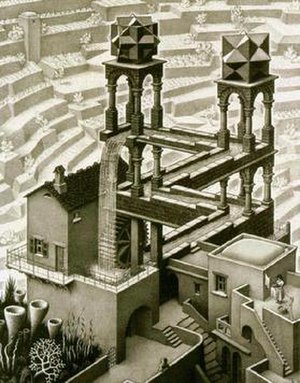
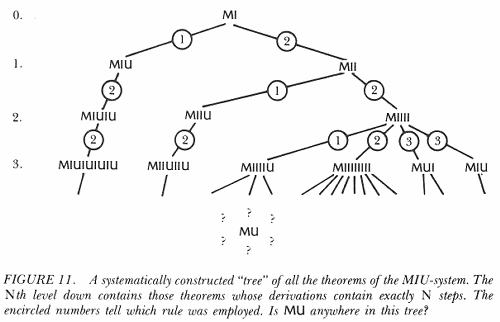
What he was doing is essentially this: he gave a simple game where you started from a string of characters (MI) and, through a number of rules, you could transform this string, some rules making the string longer, some shorter. The purpose of the game is deciding whether or not a particular string (MU) can be created accordingly to those rules. His argument was to show that a computer would start creating all possible strings, applying all rules one by one (as in the diagram above). But this would only produce exponentially more strings. The computer, hence, would go on forever trying all combinations, but without ever being able to “decide” whether or not the given string was possible in the system. What’s different, then, between an Artificial, deterministic, Intelligence and a human mind? The difference is the self-reference. The possibility of (or rather the impossibility of not) self-observing. This creates an impossible loop that creates an infinite hierarchy, a paradox. Gödel, Escher, Bach, in the title of the book, are “isomorphic” between each other because a “Strange Loop” is Gödel’s paradox (that can be simplified outside mathematics as the liar paradox), a Strange Loop is Escher’s Waterfall that you can see on this post (also, if you read DFW’s Infinite Jest, pay attention to that last line in the wiki entry, because IJ is ALL made of Strange Loops), a Strange Loop is Bach’s “Canon per Tonos”, that Hofstadter describes as “Endlessly Rising Canon”, “As the modulation rises, so may the King’s Glory.” “The “Strange Loop” phenomenon occurs whenever, by moving upwards (or downwards) through the levels of some hierarchical system, we unexpectedly find ourselves right back where we started.”

After the MU game described above, Hofstadter offers another similar one he calls “p q -” and it is soon revealed/shown that this system and its rules essentially mimic additions. “p” essentially represents the “+” sign, “q” the “=” and “-“, repeated symbolizes the numbers. He says that when you figure this out you give the system an “interpretation”. Then, he explains the difference between meaningful and meaningless interpretations. In this case the interpretation of the “p q -” formal system as additions is “meaningful” because it “reflects some portion of reality”. Ideally, if we believe in determinism, it should be possible to develop a formal system that reproduces the whole of reality.

What is the process that puts together the “p q -” formal system and additions, and so interprets it?

My answer would be that we have perceived an isomorphism between pq-theorems and additions. In the Introduction, the word “isomorphism” was defined as an information-preserving transformation.

Now look back at the quote above this last one. Could what just occurred in a simple game reveal the process behind the construction of all Reality? We find meaning by making associations. Recognizing this into that. I believe that the more you generalize this idea, the more powerful and revelatory it is. Don’t stay within the specific example. Make it universal. Make it the whole of reality. The perception of isomorphisms as the “canon” of the construction of reality. The implicit rule that defines every possible permutation (as within a formal system, producing all its “theorems”).

The idea of the isomorphism was also at the foundation of my objections to Bakker’s Blind Brain Theory (roughly: we are trapped within misconceptions, but what if our “picture” is wrong, yet still roughly “functional”? Faith may as well be faith in this purpose-driven possibility. That we are utterly wrong, but, after being spun, ended up being correctly oriented). In this long blog post I (probably) misused the idea of isomorphism, recognizing one between the Kabbalistic system and the MOQ. I also believe there’s a possible isomorphism between very complex science and metaphysics: the world is so perfectly ordered that whatever set it into motion is equivalent to god. In Kabbalah, god won’t and can’t intervene on “reality”, since reality is already so “perfect” that the need to “intervene” to adjust it would contradict its perfection. So the “hands-off” Kabbalistic god is essentially equivalent to what most scientists believe (or open to consider).

And finally, it may as well be possible that there’s an isomorphism between consciousness and Reality. This is the idea I explained in all the recent posts I wrote. That we face a mirror and that it represents the limit of our sight. We see outside, reality, the way we are inside. The world itself a self-description. The “isomorphism” may not be a process, but the “frame” that contains us and the whole of Reality (that we perceive). Our sense and meaning are just the retracing of our own patterns. The Strange Loops we see everywhere, we see because consciousness itself is Strange Loop-shaped.

“Like hundreds of scientists since, he fell in love with his own ideas, saw their reflections all around him, and mistook his projections for discoveries.”

The above quote comes once again, slightly adapted to make it more generic and void of context, from “The Wayward Mind”. This great book offering the comfort of illusory sense. It really makes everything so clear, simple, almost linear. A sort of unifying idea of everything. Not explaining everything, but providing the frame where you can then carefully place the pieces.

But that’s where the warning should trigger. Whenever you find something that makes sense and sheds a perfect light, it dies. You should start doubting of it and its power, because this sense, when it is “traced” and so understood, becomes a cage that traps you in.

For example in the case of “Midnight Tides” I was happy to translate the symbol with my interpretation. The tides under the sea that are the real movement, hidden from the surface of consciousness. What happens is that I’m happy with this interpretation, and in fact I can then find echoes of it through the whole book. So I have confirmations of the initial intuitions. The “cypher” I hold helps me understand the sense whenever similar images come up. Yet this is an extremely crippling process. It’s human and automatic that whenever you see a symbol you instantly, seamlessly replace it with its meaning. The symbol disappears, it’s magic. It’s built-in the language, I say “tree” and you immediately think of a real tree, not the word and the letters. Or otherwise you couldn’t follow any written or spoken message.

In the same way, I was caged in my interpretation and meaning of “Midnight Tides”. Once I found a way to understand it, I stopped looking for others. Actually, I would be hostile to the suggestion of different interpretations. This is also human. We desperately cling to what we know. Whenever our imagined “sense” is threatened, we fight for it. We fight for that empty shell and never once strive for “truth”. Truth is always more complex and out of reach, every achievement is a starting point, back to the zero. Ideally, the moment you think you understand something is the moment you should start to abandon it, because you’re becoming the slave of sense, and your vision is failing. Creating or finding sense is about rising walls to keep Truth outside. Errant is the truth. The “Hold”, is the respite from truth and the real world. It represents the human soul. It’s the consolidation of sense in the stream of life. The single heartbeat, the fixed moment in the continuity of the flow of the blood.

“Midnight Tides”, the undercurrent of the unconscious. I found this, and whenever it came up again I would simply replace it with its meaning. Done, understood and thrown behind. Exhausted, nothing else to find in it. I wrote sense into mystery, felt glad and satisfied of what I found. There were still some small things that didn’t fit perfectly, some annoying itches that I preferred to ignore, rather than abandon my neat interpretation to look for something else. I realized this while reading “The Wayward Mind” and suddenly finding an image that may as well be more fitting to those “Midnight Tides” I imagined.

He saw the ego as ‘like a land mass threatened by the rising waters of the id’, and argued that ‘in the same way that the Dutch reclaimed the Zuider Zee, so must the psychoanalyst win back parts of the mind that have succumbed to the unconscious.’

What is suggested here is a slightly different symbol. Consciousness is not anymore the top of the ocean, the visible layer, but the land itself. The struggle between consciousness and unconscious is symbolized by the struggle between land and sea. The image is not much different, and in fact I do believe that my interpretation isn’t far off, but this variation actually could fit a lot better than the one I used (I’m referring to that first page in MT, the book, where Erikson expands the metaphor).

How do you deal with this, though? I have no idea. In the last few months that I’ve been reading and thinking about the problem of consciousness, the construction of reality and everything originating from there, whether through scientific theories or the Kabbalah, I got the strong feeling of “understanding” things so much better. I am certain that I was able to tie together so many of my interests scattered along my life, finding an unifying thread. As Bakker, I think this is not so much “a problem”, but THE problem. That the problem of the human condition, and my own within, is contained within that model. “The Wayward Mind” is the “narrative” that unifies everything together in a broader mythology of humanity. It has a spot reserved for everything, every ideas, every religion and vision of life. All there and watching the same movie.

This is deeply rewarding and satisfying. Finally finding a sense that sheds light on everything. That doesn’t completely exhaust the problem, maybe, but that tells you where to look, how to handle it, how to circumscribe it.

I know it will take me years, if it could even happen, to root me away from these ideas. And I’ve learned, by thinking about thinking, that this is bad. Maybe I should be thankful for my forgetfulness, because soon these intricate ideas will start to get all jumbled and I’d have to go back and look a my notes in the hope of recovering that clarity I once had. Sense is slippery, life and the world outside constantly threaten it, nothing survives to the passage of time. Like a midnight tide that devours the land.

Once again I put meaning into a symbol, and dug out a sense. I see clearly, I understand. In the daylight I’m looking at the world and feeling complacent. I have my meaning, I feel like I exist and that I’ve chosen. Till a great tide will eventually wash over me.

In darkness he closed his eyes. Only by day did he elect to open them, for he reasoned in this manner: night defies vision and so, if little can be seen, what value seeking to pierce the gloom?

Witness as well, this. He came to the edge of the land and discovered the sea, and was fascinated by the mysterious fluid. A fascination that became a singular obsession through the course of that fated day. He could see how the waves moved, up and down along the entire shore, a ceaseless motion that ever threatened to engulf all the land, yet ever failed to do so. He watched the sea through the afternoon’s high winds, witness to its wild thrashing far up along the sloping strand, and sometimes it did indeed reach far, but always it would sullenly retreat once more.

When night arrived, he closed his eyes and lay down to sleep. Tomorrow, he decided, he would look once more upon this sea.

In darkness he closed his eyes.

The tides came with the night, swirling up round the giant. The tides came and drowned him as he slept. And the water seeped minerals into his flesh, until he became as rock, a gnarled ridge on the strand. Then, each night for thousands of years, the tides came to wear away at his form. Stealing his shape.

I’m about to start playing a Japanese Visual Novel titled “Remember11”, I’ve read that it plays with the same “toolkit”, like consciousness, quantum theories, Jungian psychology and whatnot. I see reflections all around me. Everyone is saying the same thing. Harmony and sense, everywhere.

(the jpg is from Promethea a comics written by Alan Moore, 32 issues, all about mythology, magic and fictional worlds)

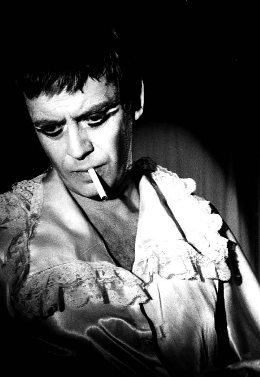
I guess most of everyone who may read this would have no idea of who Carmelo Bene is. And this is fine since he was an Italian avant-garde playwright and actor who died about 10 years ago and was probably the most important figure in Theater that we had.

I mention him here, this blog, because he was inspired by a similar sets of ideas, or beliefs. At some point he worked closely with Gilles Deleuze and was interested in the complete annihilation of the “self”, intended as a conscious entity. From my point of view he essentially represented in “art” Scott Bakker’s Blind Brain Theory. He refused to “exist” and became a rather popular figure in Italy because he was controversial and every time he appeared on TV he aroused all kinds of outrage and scandal. In particular he was accused of speaking in riddles, of nothing and being just a clever trickster who kept fooling the audience with his nonsensical, artificially shocking performances, just to draw the attention. Most of everyone was against him, he was deliberately an antagonist, and had a very troubled and animated relationships with his critics, who were continuously trying to frame him, diminish him or celebrate him, depending on their credo.

But he had a point. This is what happens when you are “misunderstood”. You keep talking of THIS, but people think it’s about THAT. Your stream of (post)consciousness goes in a direction, but everyone else is on another frequency. But when you instead understand the symbols he uses, the hooks, then the ephemeral nonsense of his words transforms into absolute clarity. He then used those ideas to speak about everything: theater, literature, philosophy, politics, his work, his private life.

His purpose, if there was a purpose, was to perform a checkmate on theater and literature. Destroy and deny everything there is, going beyond the post-modern, to some non-entity lying beyond. In order to be “there”, he had to deconstruct, not as conscious analysis, but to remove himself from the scene, to transform the voice and language in a form of non-language. In order to be there he had to “turn off the lights”. To quote Erikson again, two posts down, “look away to see”.

This is not a theory, he only works on the art, and so he only tries to represent it, give it some shape. He described himself as an “actorial machine”, he himself becoming a performance. Only by channeling some demon inside he could say something true. Get closer to the whole, the misshapen lack of identity and voluntary act.

“He considered his work to be about a “constant becoming” in a perpetual state of incompletion. Bene believed that to merely repeat the written lines of famous playwrights was to murder theater. His art, therefore, is an art of repetition through extreme variation. By experimenting with classical dramatic texts, Bene became known as a notorious destroyer of texts.”

I’ll try to translate some of his ideas to better understand what feeds the process. If you’re curious you can also see here one of his performances (it seems the whole thing can be seen here, but obviously in Italian. It’s, huh, quite NSFW). Instead I extracted some of the quotes from a TV show where he spoke directly with the public about himself and his work. The public was, obviously, badly attuned, but it made the show lively.

If someone has defined the “phonè” as a dialectic of thought, then I deny being part of it. I’m looking for the emptiness, which is the end of every art, of every story, of every world. The language of the Great Theater, incomprehensible by definition, becomes completely comprehensible on a different level of understanding, being all about the signifier, and not the signified, or sense.

Language creates failures, it is only made of black holes and failures: (quoting Montale/Nietzsche) “Only this we can now say: what we are not, what we do not want.” Who says “I say I exist, I say this” is two times a stupid. First because he believes in his self, secondly because he’s convinced of saying, and even a third time because he’s convinced of saying what he’s thinking. Because he believes that what he thinks is not signifier, but signified, a sense. That happens under his authority. It’s all noise. I think conscious intelligence is misery. I refuse to consider the ontology.

I do not speak, I am being spoken.

“The gods, plural is the noun, played yourself. The gods returned you to the mythical dawn of times. They carved you empty of simulation. Freed you of codes.”

“We are but ghost lights, representation and model. You and I, in the illusion of being. Sincerity in the lie, truth in contradiction. As truth does not exist, given only in the delirium of language.”

“Voice and language, delirium of omnipotence. Delirium because it’s not there. It does not exist.”

(talking of amplification through a microphone, in theater) The actorial machine is the consequence of the Great Actor, stripped of expressive corporeal human capabilities (vocal, facial expression, gestures, etc..) to wear an amplified attire, both visual and voiced. The voice of the actorial machine is not just a simple amplification, but an extension of the tonal range, becoming a whole. The autorial machine is a fusion between actor and machine; amplification is not a prosthesis, but a further organic extension where the voice is defined by the process. In the same way one doesn’t “have a body” but one “IS a body”, so one is or becomes amplification, equalization, etc…

This amplification is not a mere enlargement of the sound. As an example, it’s as if I’m reading this page at this distance. So I see and understand. But if I bring this page very close, the outlines begin to blur. Closer and closer till they vanish, and I see nothing. At this point, “everyone has his own visions”. What is infinitely large, as discovered in physics, corresponds to what is infinitely small. A step beyond the threshold. That’s why I make myself smaller, “so that he can augment, I have to wane”. It’s the conscious “self” that needs to get smaller. The emptying of the “I”, the abrogation of subject, and so of history. I refuse to be in history. I stepped out of thought.

Art has always been bourgeois, consolatory, idiotic, stupid, it has been especially blathering, whorish and pandering. Art has to be incommunicable. Art has only to overcome itself. That’s why it’s up to us, once we get outside ourselves, to become masterworks. Exit modality to reach the place where modality ceases to be. I can only try to explain my discomfort. I can’t engage with what’s real, what’s obvious, what’s rational. The darkness. Turning off the lights. I even hate symbolism as an artistic language. Poetry is shit. We’re still within words, trying to find a way and unable to come out. I have found in myself a desert, and I speak to the desert who’s the other, and not to someone else’s desert. I possess absence. That’s all. I am being honest because I am not myself.

Universe is one, one only. The pluriverse… is. One can’t say the pluriverse is “what’s left”. The universe is just a tiny, tiny sliver of pluriverse.

(question) What can I do to not exist?

Depose your will. Cut the strings. Will and consciousness are never good. Consciousness does not exist. Look for surrender if you can. But you can’t. You can’t find it. Because when we are not in surrender, we do not realize it. Because once we are in surrender we aren’t “us” anymore. You can’t even exploit it, because you aren’t there anymore when you are there. It doesn’t belong anymore to the dialectic, it comes before and after words.